
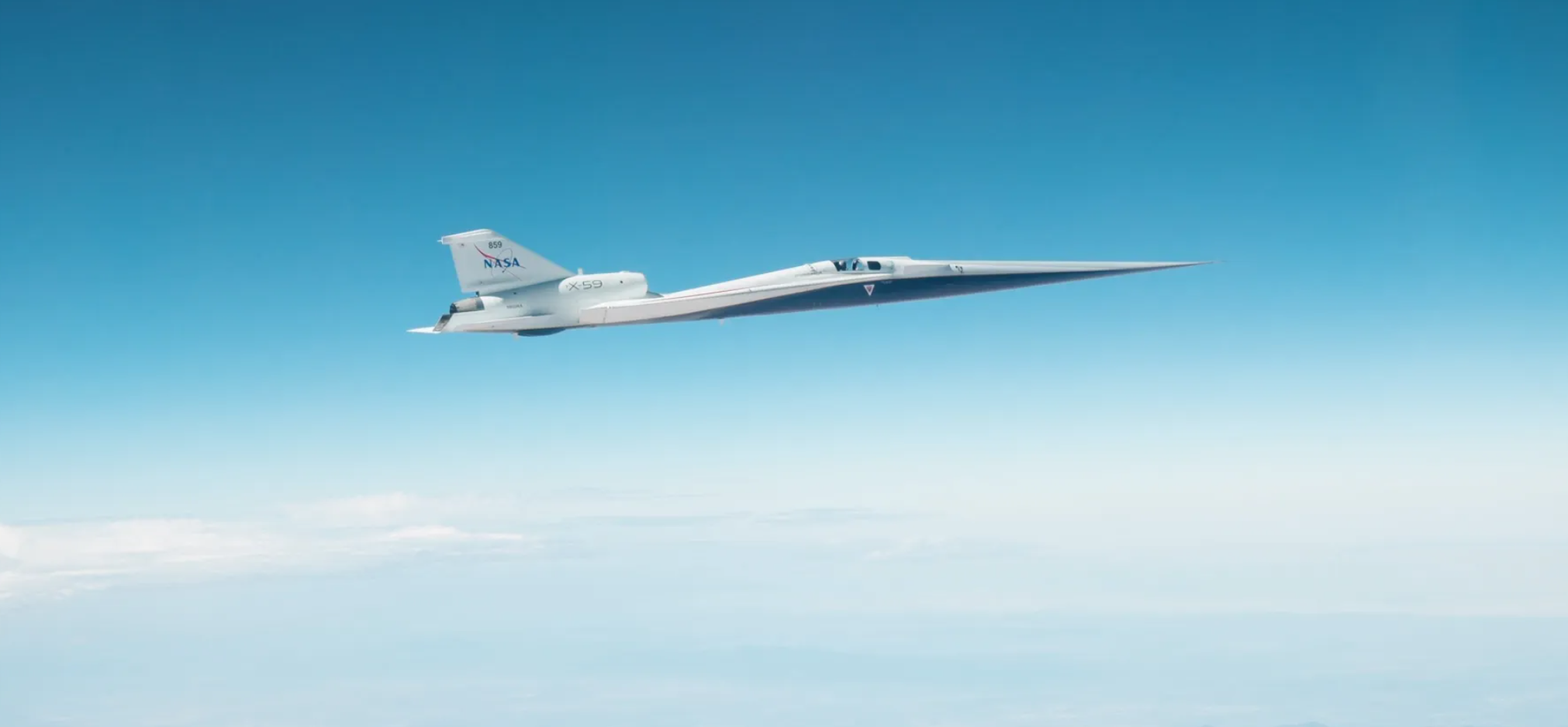
This NASA Jet Just Changed the Future of Travel: X-59 Hits Cruising Milestone
the staff of the Ridgewood blog
Johnson Space Center FL, The era of commercial supersonic travel over land is officially one step closer. On Friday, June 12, 2026, NASA’s X-59 quiet supersonic research aircraft reached its ultimate target speed and altitude for the first time. Flying at Mach 1.4 (approximately 924 mph) and maintaining an altitude of 55,000 feet, the experimental jet successfully achieved the exact “mission conditions” it will use to change commercial aviation forever.
This milestone is a massive win for NASA’s Quesst mission, an initiative aimed at proving aircraft can travel faster than the speed of sound without creating the disruptive, window-rattling sonic booms that led to the 1973 overland supersonic flight ban.
Why the Mach 1.4 Milestone Matters
While the X-59 crossed the supersonic barrier at Mach 1.1 just days ago, this latest flight is the real test. Mach 1.4 at 55,000 feet represents the aircraft’s optimal operational sweet spot.
Instead of a traditional booming explosion, the X-59’s unique architecture is engineered to reduce the sound to a gentle, barely noticeable “sonic thump.” Achieving these exact parameters allows NASA to prepare for the most critical phase of the project: real-world community testing.
What Comes Next for the Quesst Mission?
-
Expanding the Flight Envelope: Pilots will continue a battery of complex maneuvers to evaluate performance at various altitudes and speeds.
-
Shock-Wave Measurements: During early tests, a trailing NASA F-15 research aircraft equipped with a specialized shock-sensing probe will measure the X-59’s precise aerodynamic signature.
-
Acoustic Validation: Researchers will thoroughly map the acoustic footprint of the plane to ensure the “thump” meets quiet targets.
-
Community Overflights: Once validated, NASA will fly the X-59 over several U.S. communities to gather public perception data on the noise.
Silencing the Boom: How NASA Fixed Supersonic Flight
Traditional supersonic jets generate massive, overlapping shock waves that combine into a loud double-boom on the ground. The X-59 handles geometry differently. Its long, slender nose and advanced wing design prevent those shock waves from merging.
Furthermore, because the cockpit has no forward-facing window to preserve its aerodynamic shape, pilots fly using NASA’s eXternal Vision System (XVS)—a high-tech monitor displaying real-time data overlaid onto a forward-facing 4K camera feed. It was this exact XVS cockpit system that proudly displayed Mach 1.4 at 55,030 feet during Friday’s historic run.
The Big Picture: The data collected from these upcoming community flights will be handed over to international regulators. If the public agrees that the sonic thump is quiet enough, it could prompt the FAA and global aviation bodies to lift overland supersonic restrictions—opening the door for a new generation of incredibly fast commercial airlines.
Follow the Ridgewood blog has a brand-new new X account, we tweet good sh$t
https://x.com/TRBNJNews
https://truthsocial.com/@theridgewoodblog
https://mewe.com/jamesfoytlin.74/posts
#news #follow #media #trending #viral #newsupdate #currentaffairs #BergenCountyNews #NJBreakingNews #NJHeadlines #NJTopStories
#NASA #X59 #SupersonicFlight #AviationTech #QuesstMission #AviationHistory #FutureOfTravel #AerospaceEngineering






Really cool technology. Can’t wait for this to be available.