
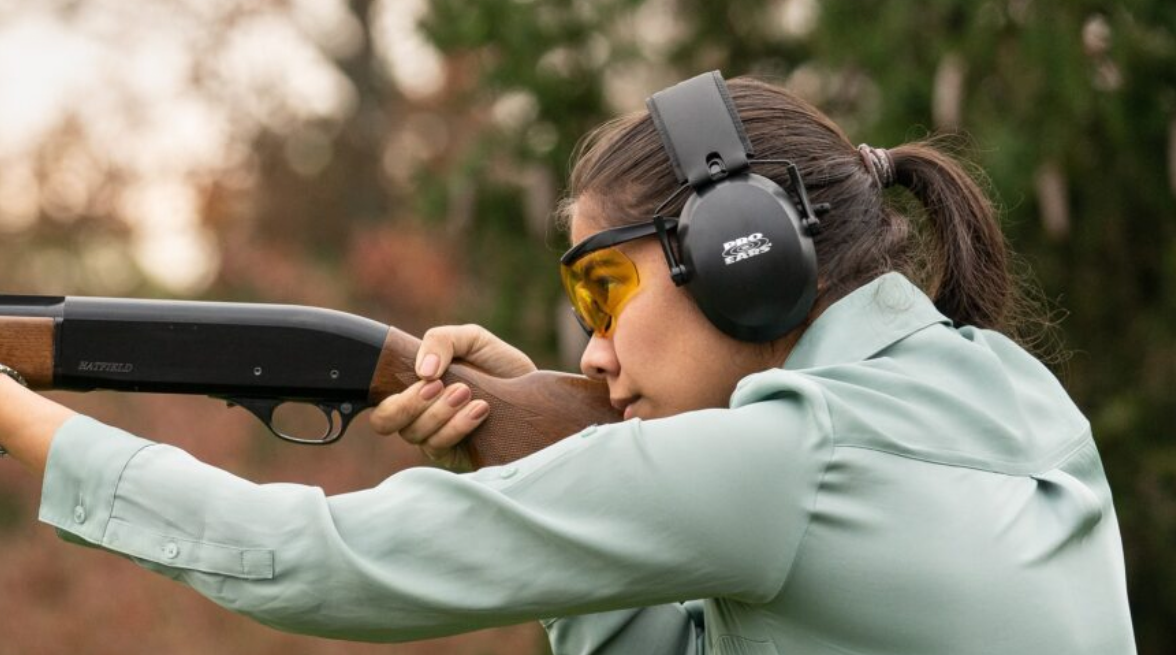
One pull of the trigger can do permanent damage. Not after years of shooting, not after a decade of missed sessions with earmuffs. A single, unprotected gunshot. That’s the uncomfortable reality every shooter should sit with before they ever head to a lane.
Most people think hearing protection is a formality, like the range safety briefing you’ve already memorized. But the science says otherwise, and once you understand what’s actually happening to your ears when a round fires, you’ll never be casual about this gear again.
The Noise Problem Is Bigger Than You Probably Think
Normal conversation registers around 60 decibels. A chainsaw runs at about 110 dB. A single gunshot? Depending on caliber and barrel length, it sits somewhere between 140 and 175 dB. The decibel scale is logarithmic, meaning a 10 dB jump represents a perceived doubling of loudness. So a 9mm at 160 dB isn’t just a little louder than a chainsaw. It’s a fundamentally different category of sound.
According to CDC analysis of NHANES audiometric data, the weighted prevalence of an audiometric notch consistent with noise-induced hearing damage was 24%, extrapolated to represent nearly 40 million U.S. adults (CDC MMWR, 2017). That number includes a lot of people who never worked a jackhammer. Recreational firearm use is a major contributor, and most of those people were confident they were “being careful.”
The damage is also cumulative and silent. You won’t feel your high-frequency threshold creeping downward after each range session. You’ll just slowly find yourself asking people to repeat themselves at dinner, and eventually a specialist will show you the notch on your audiogram.
What “140 dB” Actually Means for Your Gear Choices
The National Hearing Conservation Association’s position statement on recreational firearms confirms that almost all firearms generate impulse levels in excess of 140 dB peak SPL (NHCA, 2017). That matters because 140 dB is the widely cited threshold where a single exposure can cause immediate, irreversible damage, even without any repetition.
So your protection layer needs to get that number down below roughly 85 dB for sustained exposure, or at the very minimum below 140 dB for impulse sounds. That math shapes every purchasing decision you should make.
The key metric is Noise Reduction Rating, or NRR. But the NRR number on the package isn’t a straight subtraction. To estimate real-world protection, subtract 7 from the NRR and divide by two. A set of earmuffs rated NRR 31 gives you roughly 12 dB of effective attenuation in practice. That’s the ANSI-required calculation, and it’s why a lot of shooters who own “31 NRR” gear are still getting far more noise exposure than they realize.
| Firearm | Approx. Peak dB | Min. NRR Needed (to reach ~85 dB)
|
|---|---|---|
| .22 LR rifle | 140 dB | NRR 27+ |
| 9mm handgun | 160 dB | NRR 57+ (double-up) |
| AR-15 / .223 | 155-165 dB | NRR 57+ (double-up) |
| 12-gauge shotgun | 160 dB+ | NRR 57+ (double-up) |
Sources: dB figures from NHCA position statement and ANSI NRR calculation methodology. NRR minimums derived using (NRR-7)/2 formula.
The Three-Layer Defense Framework
Here’s a framework I’d call the Three-Layer Defense, and it’s the mental model I’d use for any serious range day. Think of it as three independent lines standing between your cochlea and permanent damage.
Layer 1: Passive protection. Foam earplugs, rated NRR 30 or above. Insert them correctly, which most people don’t, and they cut roughly 11 dB of effective noise. They’re cheap, they’re always in your bag, and they’re your last line of defense if everything else fails.
Layer 2: Active earmuffs. Electronic earmuffs compress gunshot impulses while keeping ambient sound clear so you can hear range commands and conversation normally. The best units have a response time under 1 millisecond for the limiting circuit. Doubling up, meaning foam plugs under the earmuffs, adds the NRR values together (minus 5 dB), pushing you into genuinely safe territory for centerfire rifles.
Layer 3: Suppression at the source. A silencer reduces the peak sound pressure at the muzzle before it ever reaches your ear. This is different from passive attenuation because you’re cutting the noise at origin. Most suppressors bring a centerfire rifle from roughly 165 dB down to around 130 to 140 dB, which is still loud but meaningfully reduces the load on your other protection layers and, critically, protects bystanders downrange who aren’t wearing anything.
The honest answer is that Layer 3 isn’t a substitute for Layers 1 and 2. It’s a multiplier. A suppressed rifle with quality earmuffs is genuinely in a different category of hearing safety than an unsuppressed one with the same earmuffs. Use all three.
Indoor vs. Outdoor: The Range Environment Matters
Here’s a scenario a lot of new shooters overlook. You might shoot the same .22 LR outdoors and feel fine, then step into an indoor pistol range and walk out with ringing in your ears. The sound isn’t louder from the gun, but the environment is a completely different problem.
An enclosed indoor range lets sound waves bounce off concrete walls, floors, and ceilings. That reflected energy adds to the direct blast, and you’re effectively exposed to each shot multiple times. The practical recommendation for indoor shooting is always double-up protection. Always. No exceptions for “just a few rounds.”
Outdoor ranges, by contrast, let sound dissipate into open air, which meaningfully reduces reflected pressure. That said, outdoor big-bore shooting with a high-caliber rifle can still easily exceed 160 dB at the muzzle, so a single layer of foam plugs doesn’t cut it there either.
Picking Your Gear Without Overthinking It
According to the National Shooting Sports Foundation’s 2024 participation report, more than 52.7 million people enjoy sport and target shooting activities in the United States (NSSF, 2025). That’s a lot of ears at risk, and gear manufacturers have responded with a wide range of options. Here’s how to cut through the noise, so to speak.
For casual range days with pistols and .22s, a pair of electronic earmuffs rated NRR 22 or higher will get you to a workable place. Brands like Walker’s, Howard Leight, and Peltor all sell reliable units for under $60. If you’re shooting centerfire rifles or shotguns, add foam earplugs underneath. That combination gives you the math you actually need.
If you shoot frequently, especially outdoors or while hunting, quality earmuffs are worth the investment in a higher NRR unit with a faster response circuit. The difference between a 1ms and a 0.5ms response time for gunshot limiting is meaningful when you’re firing multiple rounds in quick succession.
“Recreational firearm noise is one of the leading causes of noise-induced hearing loss in the United States.” This consensus, reflected across multiple peer-reviewed studies and the NHCA’s formal position statement, is not a fringe concern from overly cautious audiologists. It’s the documented reality of what happens when millions of people spend years being casual about their ears at the range.
The good news is that this is one of the most preventable forms of hearing loss there is. You don’t have to quit the sport. You just have to gear up correctly every single time, not most times. Hearing damage is cumulative and irreversible, but it’s also, with the right habits, almost entirely avoidable. Set your setup standard once and never negotiate it down again.





