
When Oversight Fails: How a New Jersey Town’s Park Dispute Raised Questions About Environmental Independence, Political Influence, and the Integrity of LSRP Decision-Making
the staff of the Ridgewood blog
Ridgewood NJ, In 2008, the Village of Ridgewood, New Jersey, purchased a seven-acre property along Route 17 North with a straightforward civic goal: convert it into a public park for a neighborhood with almost no access to green space. Early plans included walking paths, a small playground, and a modest athletic field—features aimed at serving children, seniors, and local families who had long requested a safe, accessible recreational area.
For nearly a decade, competing visions stalled consensus. Local sports groups advocated for a large, tournament-scale athletic field, while nearby residents pushed for a mixed-use park that preserved mature trees and prioritized general public access. In 2017, both sides finally reached a compromise: a multipurpose playing field, a playground, walkways, and protection of roughly 1.7 acres of trees on the property.
Two candidates—Paul Vagianos (now Mayor) and Siobhan Winograd (now Councilwoman)—ran their first campaigns pledging to uphold this compromise.
To prepare the land for future use, the Village constructed a 20–25-foot-wide berm along Route 17. Built as a protective barrier, it shielded future park users from highway noise, debris, and pollution, and the Village planted trees on top to reinforce the buffer. It appeared that the project was finally moving forward.
There was just one problem – while protecting the residents from highway traffic & pollution, THE BERM was created for a mid sized field and RBSA still wanted their full size field!
The Reversal
By 2025, the political landscape had shifted. Mayor Vagianos and Councilwoman Winograd, despite their campaign commitments, began promoting a dramatically larger athletic field—one that required removing the berm and altering the 2017 plan. Members of the sports community publicly acknowledged at council meetings that they had supported the officials’ campaigns (through donations) based on expectations of a larger field.
Shortly thereafter, the Village hired a new Village Manager: Keith Kazmark, who had previously served as Mayor Vagianos’s campaign manager for a state legislative race. His compensation exceeded $225,000. At multiple public meetings, Mr. Kazmark stated that he takes direction from the mayor and council, further tightening the political chain of command.
Around this time, Mount Sinai Hospital sent a letter urging the Village to consider health-protective modifications to its plan. According to public records and meeting footage, the Village did not consult its own Health Department and did not act on Mount Sinai’s recommendations.
Consultants With a Mission
In an effort to obtain state approval for the revised project, the Village hired consultant Peter Primavera, despite residents publicly raising concerns about his prior work on other municipal projects. The Village stood by its decision and paid him for his services. Later he was arrested on unrelated charges, proving that resident concerns were correct.
The Village then retained Suburban Consulting Engineers, Inc., whose report concluded that almost every other field or open space in Ridgewood had been “developed to the maximum extent” and offered no viable alternative location for a full-size field. The simplicity and certainty of these conclusions stood in stark contrast to two independent assessments:
- a CMX engineering report, and
- a report by Gianforcaro Architects, commissioned by the Ridgewood Board of Education,
both of which identified multiple Board-of-Education-owned fields that could be expanded. The CMX report contradicts Suburban Engineering report for village owned properties too! The discrepancy raised questions about whether Suburban’s brief, categorical dismissals were tailored to satisfy a key requirement of the State Historic Preservation Office (SHPO): demonstrating that no alternative sites existed before altering a historic property.
State-Level Scrutiny and a Sudden Approval
SHPO issued a temporary denial, requesting additional information. While SHPO continued its review, an unrelated political event occurred: NJDEP Commissioner Shawn LaTourette and Village Manager Kazmark co-hosted a fundraiser for governor candidate Mikie Sherrill. The appearance of a close working relationship raised eyebrows but did not violate any published ethics rules.
The NJDEP, which oversees SHPO, then approved the project—despite SHPO’s pending concerns. Commissioner LaTourette recused himself, but the approval was signed by his deputy, who had been on vacation during the SHPO hearing and issued the approval the day after returning. The timing drew attention among residents tracking the process closely.
The LSRP Question: Independence or Influence?
At the center of the current debate lies a crucial system within New Jersey’s environmental framework: Licensed Site Remediation Professionals (LSRPs). LSRPs are intended to serve as independent, scientifically objective stewards of environmental remediation—professionals who act on behalf of public health rather than the entity that pays their invoices.
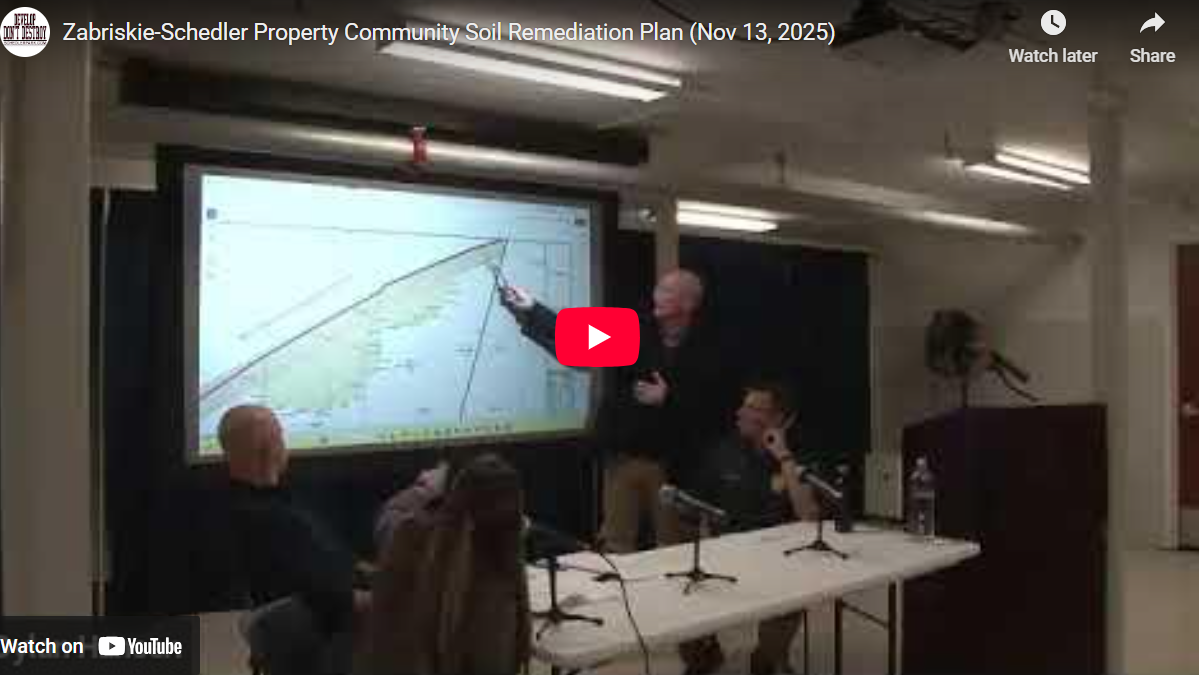
The Village hired Matrix New World Engineering, which employs multiple LSRPs. In a publicly available YouTube video
(https://www.youtube.com/
- Different standards apply to residential vs. recreational contamination.
Recreational standards are significantly more relaxed because exposure times are shorter. The berm—never intended for direct public contact—may not have required soil removal under recreational standards. If that 20-25 foot area is going to get contimated again through highway fumes, was adding a fence between the berm and the field an option? - Soil removal is not the only remediation method.
The LSRP openly acknowledged that options such as biodegradation were available. - Capping the berm was feasible.
Capping is a widely used remediation technique that seals contaminants in place.
The LSRP stated this could be done; however, the Village was pursuing full removal. - The Village directed the LSRP to remove the berm.
In the same video, Village Manager Kazmark confirms that although capping was an option, he chose removal. - The remediation by soil removal is estimated at $1.8 million for LSRP plus a few million that will be charged by the trucking company.
Given the berm’s function as a protective barrier from highway pollution, many residents question why a costlier approach—one that also eliminates a safety feature—was selected.
A System Under Pressure
The convergence of political reversals, consultant selections, contradictory engineering reports, SHPO’s concerns, and a rapid NJDEP approval created an atmosphere of mistrust. Now, attention has turned to whether the LSRP system—designed to ensure independence—can withstand political and financial pressure.
The central question emerging from Ridgewood’s Route 17 project is no longer limited to local park design. It is broader and more consequential:
Are LSRPs in New Jersey able to operate independently when a municipal client expects a specific outcome, or do structural incentives make it difficult for them to deviate from the desires of the party that hires them?
The answer matters not only for Ridgewood’s residents, but for communities across New Jersey that rely on LSRPs to safeguard public health, protect historic properties, and uphold environmental integrity without fear or favor.
Tell your story #TheRidgewoodblog , #Indpendentnews, #information, #advertise, #guestpost, #affiliatemarketing,#NorthJersey, #NJ , #News, #localnews, #bergencounty, #sponsoredpost, #SponsoredContent, #contentplacement , #linkplacement, Email: [email protected]








I am 100% sure that in the written answers to resident questions, the LSRP responded that capping the berm was not an option. His answer in this video is exact opposite to his written answer. It can be found on village’s website under q&a for this project.
Who renews their license?
The two candidates (Vag. & Win) wanted the sports groups support to get elected. So promises were made. You will see when this project is totally done that the estimates for completing this are no where near what you are being told. It will be millions over. The fact that contaminated soil containing lead, mercury, pesticides and others that all exceeding guidelines was “tested” before being brought in is laughable….
Where is News12 New Jersey?
Instead of 45 minutes of weather every hour, how about some coverage?
Vagianos had this whole larger field plan plotted from Day 1. His great pal Gail Price introduced him to the now infamous Primavera who was hired to make sure an athletic complex ended up on the property. Vagianos brought him to village hall to meet with Mailander and Rutishauser to being voted mayor with his new to council joining. Weitz and Whinograd were part of the plan and Whino knew she’d flip and seeing how weak Pam is, they voted Vagianos in as mayor. Primavera, like every other contractor hired by the village, is being paid to say and do whatever this council tells them to. This much is 100% crystal clear. This council might think they are fooling the public but when Kazmark has the political connections and can hang poolside with LaTourette, then you know whatever plan you want is the one that gets approved.
It is good to see the P2P mentality in full bloom within the RW sports community. I guess Kazmark’s whistleblower days are in the rear view mirror. It is all aboard the crazy train to build a field at all costs and pay contractors who will do exactly what you want. Literally.
None of them from the Mayor and entire council, village manager and his team have one inkling of integrity.
#Apple doesnt fall far
Someone should file a complain against this LSRP. A resident alerted me that he has asked this question during written Q&A and this is the answer provided:
“Was the option to cap the berm (rather than remove it) considered, and if so, what were the technical or regulatory reasons for selecting removal over capping? Children will not be in direct contact with the berm and a fence could have been added between the field and the berm to ensure no one walks over it, even after capping it with 18-20 inches of soil? Afterall a berm next to the highway is safer than a chain link fence for vehicular traffic.”
Answer: (Note that it does not say this is what Kazmark wanted which they admitted in the live video):
“The imported material contains a variety of debris that the Bureau of Solid Waste Compliance and
Enforcement (BSWCE) deems solid waste. BSWCE has required that visually confirmed solid waste be
removed from the property. In order to remove this material, excavation of much of the imported fill is
necessary. As excavation is already required at the site, chemically contaminated soil will also be
removed as part of this process to facilitate an unrestricted use property designation. “