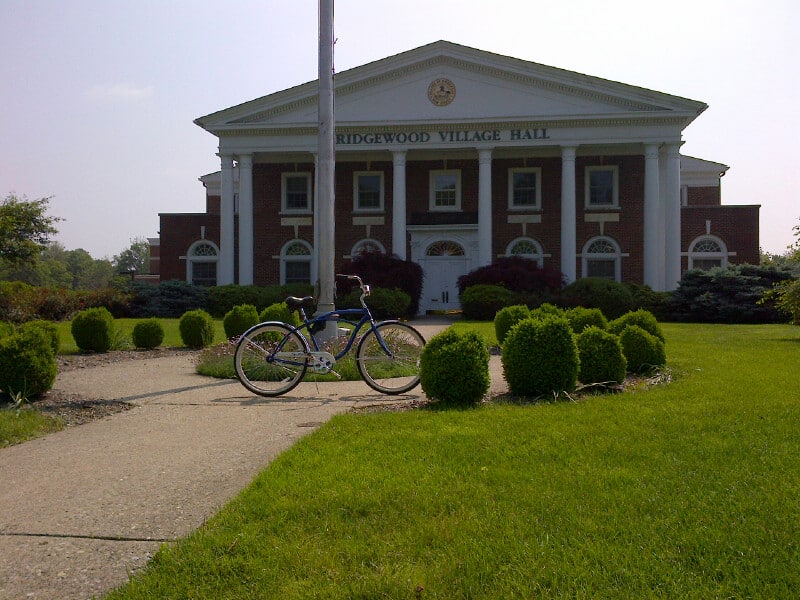
Village Council Schedules Special Public Meeting For Wednesday, September 26 (Yom Kipper) to Appoint New Municipal Court Judge
VILLAGE COUNCIL SPECIAL PUBLIC MEETING SEPTEMBER 26, 2012 7:00 P.M.
1. Call to Order – Mayor
2. Statement of Compliance with the Open Public Meeting Act
MAYOR: “Adequate notice of this meeting has been provided
by a posting on the bulletin board in Village Hall,
by mail to the Ridgewood News, The Record, and by submission to all persons entitled to same as provided by law of a schedule including the date and time of this meeting.”
3. Roll Call
4. Comments from the Public
5. Resolution to go into Closed Session
6. Closed Session
A. Personnel – Municipal Court Judge
7. Resume Open Portion of Special Public Meeting
8. Resolution #12-233 – Appointment of Municipal Court Judge
9, Discussion of Timing for Village Council’s Public Workshop Meeting on October 3, 2012
Mixed message from real estate as uneven recovery continues
New Jersey’s commercial real estate market continues to have a mixed recovery, as major gains in some sectors are being tempered by slow growth in others, a panel of developers said today.
The panelists, speaking at the annual RealShare NJ conference in New Brunswick, told an increasingly familiar story that includes a thriving multifamily market, a healthy industrial sector and an office market stymied by the state’s tepid job growth. (Burd, NJBIZ)
History 101: On September 22, 1862, following the Union “victory” at the Battle of Antietam, the Preliminary Emancipation Proclamation was issued
Today is the 150th Anniversary of the Emancipation Proclamation
Although January 1st, 1863, is the date most Americans identify as the day the Emancipation Proclamation officially took effect, the ideals of the Proclamation had been carefully contemplated by President Lincoln many months before.
Lincoln first proposed the idea of the Emancipation Proclamation to his cabinet in the summer of 1862 as a war measure to cripple the Confederacy. Lincoln surmised that if the slaves in the Southern states were freed, then the Confederacy could no longer use them as laborers to support the army in the field, thus hindering the effectiveness of the Confederate war effort. As an astute politician, however, Lincoln needed to prove that the Union government could enforce the Proclamation and protect the freed slaves. On September 22, 1862, following the Union “victory” at the Battle of Antietam, the Preliminary Emancipation Proclamation was issued, this preliminary proclamation would go into effect three months later on January 1, 1863.
The Emancipation had an immediate and profound effect on the course of the war. In addition to saving the Union, freeing the slaves now became an official war aim, garnering passionate reactions from both the North and the South. The Proclamation also allowed for African-Americans to join the Union’s armed forces, and by the end of the war nearly 200,000 would honorably serve.
Initially the Proclamation applied just to the states in rebellion, but it paved the way for the 13th Amendment, adopted on December 6, 1865, which officially abolished slavery in the United States.
Why The Polls Understate Romney Vote
By Dick Morris on September 21, 2012
Republicans are getting depressed under an avalanche of polling suggesting that an Obama victory is in the offing. They, in fact, suggest no such thing! Here’s why:
1. All of the polling out there uses some variant of the 2008 election turnout as its model for weighting respondents and this overstates the Democratic vote by a huge margin.
In English, this means that when you do a poll you ask people if they are likely to vote. But any telephone survey always has too few blacks, Latinos, and young people and too many elderly in its sample. That’s because some don’t have landlines or are rarely at home or don’t speak English well enough to be interviewed or don’t have time to talk. Elderly are overstated because they tend to be home and to have time. So you need to increase the weight given to interviews with young people, blacks and Latinos and count those with seniors a bit less.
Normally, this task is not difficult. Over the years, the black, Latino, young, and elderly proportion of the electorate has been fairly constant from election to election, except for a gradual increase in the Hispanic vote. You just need to look back at the last election to weight your polling numbers for this one.
But 2008 was no ordinary election. Blacks, for example, usually cast only 11% of the vote, but, in 2008, they made up 14% of the vote. Latinos increased their share of the vote by 1.5% and college kids almost doubled their vote share. Almost all pollsters are using the 2008 turnout models in weighting their samples. Rasmussen, more accurately, uses a mixture of 2008 and 2004 turnouts in determining his sample. That’s why his data usually is better for Romney.
But polling indicates a widespread lack of enthusiasm among Obama’s core demographic support due to high unemployment, disappointment with his policies and performance, and the lack of novelty in voting for a black candidate now that he has already served as president.
Please join ManufactureNJ for this special event. With a leverage of 4-6 jobs in the economy for each manufacturing job, and with the increasing commitment to rebuilding this sector in NJ and nationally, this is an important event to redefine the importance of the sector.
The ManufactureNJ launch will be at NJIT on Monday Oct 22 from 10 am – 12 pm. The event will have two parallel tracks, one for students and career seekers, and the other an event to commemorate the importance of manufacturing in our state.
Additionally you can participate in the regional open houses to be held the 4 days following that launch, Oct 23-26.
Please spread the word.
Visit https://www.manufacturenj.org/events for info and to register for specific events.
Cost of Regulations Under Obama: $488 Billion
10:03 AM, SEP 19, 2012 • BY DANIEL HALPER
The American Action Forum has released new analysis of the burden of new regulations under President Obama. It’s most striking finding? The cost of added regulations under President Obama is now estimated to be $488 billion.
“Based on data from the Government Accountability Office (GAO) and regulations published in the Federal Register, the Administration has published more than $488 billion in regulatory costs since January 20, 2009 – $70 billion in 2012 alone,” reads the analysis from AAF.
“Ignoring all non-“major” rules with costs in 2009, the regulatory tally still surpassed $61 billion. In 2010, counting only “major” rules, the regulatory bill rose to $160 billion in lifetime costs. AAF began tracking every proposed and final rule in 2011. That year alone the Administration published more than $231 billion in regulatory costs. AAF reviewed 6,705 regulations in 2011 and has tracked more than 4,700 regulations to date in 2012.”
The most costly government agencies in 2012 alone are Health and Human Services (which has an estimated regulation burden of $16.7 billion), the Environmental Protection Agency ($12.1 billion), the Department of Energy ($10.6 billion), the Department of Justice ($6.9 billion), and the Securities and Exchange Commission ($6.2 billion).
The other cost associated with these regulations is the man-hours that it would take to implement and enforce these new regulations. Under President Obama, this cost is at least 1.58 billion hours.
The Ridgewood Art Institute Instructor Exhibition 2012
September 24th–October 31st
Join us in viewing the beautiful examples of our Instructor’s work. Landscape, still life, figure, portrait and seascape are on exhibit. In addition,the exhibit is an opportunity to visit the Barn and obtain a schedule of art classes, for adults and young people, ongoing year round. Instruction is available in a variety of mediums including Oil, watercolor, acrylic, drawing and pastel. You can also stop in and watch a class in session.
We are located at 12 East Glen Avenue Ridgewood, NJ 07450
Girls in Grades 1-8 are invited to participate in the Youth Soccer Clinic and Fun Fair run by the RHS Women’s Soccer Team. The event is Monday, October 8 from 10 a.m. – 12 p.m. at RHS Stadium.
The fee is $25 per player. Deadline for sign-up is Monday, September 24. Click here for more information and the sign-up form https://tinyurl.com/9qnom6n
Jeez…I go on a business trip for a few days and when I come back, I find that the VC floated a brilliant idea to give jail time for leaf policy scofflaws? While I believe the council has since backed off ,
Harlan Coben, at Bookends Saturday, September 22nd
Harlan Coben, Saturday, September 22nd @ 1:00pm
International Bestselling author, Harlan Coben, will sign his new book for young readers: Seconds Away Books available Sept. 18th
Appearing authors will only autograph books purchased at Bookends and must have valid Bookends Receipt.Availability & pricing for all autographed books subject to change.Bookends cannot guarantee that the books that are Autographed will always be First Printings.
Autographed books purchased at Bookends are non-returnable.
While we try to insure that all customers coming to Bookends’ signings will meet authors and get their books signed, we cannot guarantee that all attendees will meet the author or that all books will be signed. We cannot control inclement weather, author travel schedules or authors who leave prematurely.
Bookends, 211 E. Ridgewood Avenue, Ridgewood, NJ 07450 201-445-0726
Sunday will mark the start of the 100-day countdown to “Taxmageddon” – the date the largest tax hikes in the history of America will take effect. They will hit families and small businesses in three great waves on January 1, 2013:
First Wave: Expiration of 2001 and 2003 Tax Relief
In 2001 and 2003, the GOP Congress enacted several tax cuts for small business owners, families, and investors (later re-upped by President Obama and Democrat Congress in 2010). The following tax hikes will occur on January 1, 2013:
Personal income tax rates will rise on January 1, 2013. The top income tax rate will rise from 35 to 39.6 percent (this is also the rate at which the majority of small business profits are taxed). The lowest rate will rise from 10 to 15 percent. All the rates in between will also rise. Itemized deductions and personal exemptions will again phase out, which has the same mathematical effect as higher marginal tax rates. The full list of marginal rate hikes is below:
-The 10% bracket rises to a new and expanded 15%
-The 25% bracket rises to 28%
-The 28% bracket rises to 31%
-The 33% bracket rises to 36%
-The 35% bracket rises to 39.6%
Higher taxes on marriage and family coming on January 1, 2013. The “marriage penalty” (narrower tax brackets for married couples) will return from the first dollar of taxable income. The child tax credit will be cut in half from $1000 to $500 per child. The standard deduction will no longer be doubled for married couples relative to the single level.
Middle Class Death Tax returns on January 1, 2013. The death tax is currently 35% with an exemption of $5 million ($10 million for married couples). For those dying on or after January 1 2013, there is a 55 percent top death tax rate on estates over $1 million. A person leaving behind two homes and a retirement account could easily pass along a death tax bill to their loved ones.
Higher tax rates on savers and investors on January 1, 2013. The capital gains tax will rise from 15 percent this year to 23.8 percent in 2013. The top dividends tax will rise from 15 percent this year to 43.4 percent in 2013. This is because of scheduled rate hikes plus Obamacare’s
investment surtax.
Second Wave: Obamacare Tax Hikes
There are twenty new or higher taxes in Obamacare. Some have already gone into effect (the tanning tax, the medicine cabinet tax, the HSA withdrawal tax, W-2 health insurance reporting, and the “economic substance doctrine”). Several more will go into effect on January 1, 2013.
They include:
The Obamacare Medical Device Tax begins to be assessed on January 1, 2013. Medical device manufacturers employ 409,000 people in 12,000 plants across the country. This law imposes a new 2.3% excise tax on gross sales – even if the company does not earn a profit in a given year. Exempts items retailing for <$100.
The Obamacare Medicare Payroll Tax Hike takes effect on January 1, 2013. The Medicare payroll tax is currently 2.9 percent on all wages and self-employment profits. Starting in 2013, wages and profits exceeding $200,000 ($250,000 in the case of married couples) will face a 3.8 percent rate.
The Obamacare “Special Needs Kids Tax” comes online on January 1, 2013. Imposes a cap on FSAs of $2500 (now unlimited). Indexed to inflation after 2013. There is one group of FSA owners for whom this new cap will be particularly cruel and onerous: parents of special needs children. There are thousands of families with special needs children in the United States, and many of them use FSAs to pay for special needs education. Tuition rates at one leading school that teaches special needs children in Washington, D.C. (National Child Research Center) can easily exceed $14,000 per year. Under tax rules, FSA dollars can be used to pay for this type of special needs education. This Obamacare cap harms these families.
The Obamacare “Haircut” for Medical Itemized Deductions goes into force on January 1, 2013. Currently, those facing high medical expenses are allowed a deduction for medical expenses to the extent that those expenses exceed 7.5 percent of adjusted gross income (AGI). The new provision imposes a threshold of 10 percent of AGI. Waived for 65+ taxpayers in 2013-2016 only.
Third Wave: The Alternative Minimum Tax and Employer Tax Hikes
When Americans prepare to file their tax returns in January of 2013, they’ll be in for a nasty surprise—the AMT won’t be held harmless, and many tax relief provisions will have expired. These tax increases will be in force for BOTH 2012 and 2013. The major items include:
The AMT will ensnare over 31 million families, up from 4 million last year. According to the left-leaning Tax Policy Center, Congress’ failure to index the AMT will lead to an explosion of AMT taxpaying families—rising from 4 million last year to 31 million. These families will have to calculate their tax burdens twice, and pay taxes at the higher level. The AMT was created in 1969 to ensnare a handful of taxpayers.
Full business expensing will disappear. In 2011, businesses can expense half of their purchases of equipment. Starting on 2013 tax returns, all of it will have to be “depreciated” (slowly deducted over many years).
Taxes will be raised on all types of businesses. There are literally scores of tax hikes on business that will take place. The biggest is the loss of the “research and experimentation tax credit,” but there are many, many others. Combining high marginal tax rates with the loss of this tax relief will cost jobs.
Tax Benefits for Education and Teaching Reduced. The deduction for tuition and fees will not be available. Tax credits for education will be limited. Teachers will no longer be able to deduct classroom expenses. Coverdell Education Savings Accounts will be cut. Employer-provided educational assistance is curtailed. The student loan interest deduction will be disallowed for hundreds of thousands of families.
Charitable Contributions from IRAs no longer allowed. Under current law, a retired person with an IRA can contribute up to $100,000 per year directly to a charity from their IRA. This contribution also counts toward an annual “required minimum distribution.” This ability will no longer be there.
America’s Vanishing Economic Freedom
September 19,2012
We’re on a slippery slope.
By Michael Tanner
The 2012 Economic Freedom of the World report was released this week by the Cato Institute and Canada’s Fraser Institute, and it showed that the United States has plummeted to 18th place in the ranked list, trailing such countries as Estonia, Taiwan, and Qatar. Even such notorious welfare states as Finland and Denmark, not to mention Canada, have freer economies than we do.
Actually, the decline began under President George W. Bush. For 20 years the U.S. had consistently ranked as one of the world’s three freest economies, along with Hong Kong and Singapore. By the end of the Bush presidency, we were barely in the top ten.
And, as with so many disastrous legacies of the Bush era, Barack Obama took a bad thing and made it worse.
During the past four years, the U.S. saw significant declines in nearly all categories of the economic-liberty index. Most significant — and this should come as no surprise to anyone paying attention — is that the size of government grew substantially, particularly when measured by size of government subsidies and transfers and by government consumption as a share of national consumption.
As recently as 2005, the U.S. ranked 45th in size of government among the 144 nations surveyed. That was bad enough, but it still had us in the top third of the 144 countries surveyed. Today, government has grown dramatically, and our ranking has fallen to 61st place. By the metrics used, the U.S. now has a bigger government than Ukraine or Syria.
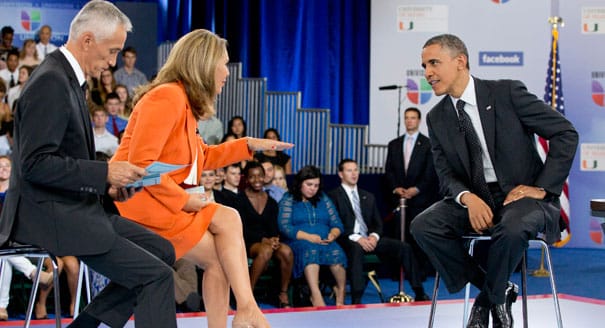
Obama pressed on failures at Univision forum
By REID J. EPSTEIN | 9/20/12 5:07 PM EDT
CORAL GABLES, Fla. – President Barack Obama on Thursday faced some of the toughest questioning of his reelection campaign to date, pressed repeatedly on his failure to achieve comprehensive immigration reform and other unmet promises from his 2008 run.
The Univision presidential forum at the University of Miami here kicked off with grilling on another topic which brought mounting criticism from Republicans Thursday: The government’s decision to label as a terrorist attack the violence at the consulate in Benghazi which killed American Christopher Stevens.
The Fallacy of Redistribution
September 20,2012
Thomas Sowell
The recently discovered tape on which Barack Obama said back in 1998 that he believes in redistribution is not really news. He said the same thing to Joe the Plumber four years ago. But the surfacing of this tape may serve a useful purpose if it gets people to thinking about what the consequences of redistribution are.
Those who talk glibly about redistribution often act as if people are just inert objects that can be placed here and there, like pieces on a chess board, to carry out some grand design. But if human beings have their own responses to government policies, then we cannot blithely assume that government policies will have the effect intended.
The history of the 20th century is full of examples of countries that set out to redistribute wealth and ended up redistributing poverty. The communist nations were a classic example, but by no means the only example.
In theory, confiscating the wealth of the more successful people ought to make the rest of the society more prosperous. But when the Soviet Union confiscated the wealth of successful farmers, food became scarce. As many people died of starvation under Stalin in the 1930s as died in Hitler’s Holocaust in the 1940s.
How can that be? It is not complicated. You can only confiscate the wealth that exists at a given moment. You cannot confiscate future wealth — and that future wealth is less likely to be produced when people see that it is going to be confiscated. Farmers in the Soviet Union cut back on how much time and effort they invested in growing their crops, when they realized that the government was going to take a big part of the harvest. They slaughtered and ate young farm animals that they would normally keep tending and feeding while raising them to maturity.
People in industry are not inert objects either. Moreover, unlike farmers, industrialists are not tied to the land in a particular country.
Russian aviation pioneer Igor Sikorsky could take his expertise to America and produce his planes and helicopters thousands of miles away from his native land. Financiers are even less tied down, especially today, when vast sums of money can be dispatched electronically to any part of the world.
If confiscatory policies can produce counterproductive repercussions in a dictatorship, they are even harder to carry out in a democracy. A dictatorship can suddenly swoop down and grab whatever it wants. But a democracy must first have public discussions and debates. Those who are targeted for confiscation can see the handwriting on the wall, and act accordingly.
N.J.’s middle class shrinking under growing income gap, Census data shows
Published: Friday, September 21, 2012, 6:30 AM Updated: Friday, September 21, 2012, 9:08 AM
By Stacy Jones and Stephen Stirling/The Star-Ledger
New Jersey’s middle class has eroded in the last four years, further polarizing a state where the rich and the poor have long been miles apart on levels of income, if not on the map, new Census data shows.
A Star-Ledger analysis of four years of data from the American Community Survey shows the percentage of households with an annual income between $35,000 and $150,000 has dipped by nearly 3 percent since 2008, while the percentage of those richer and poorer has increased.
That accounts for about 79,000 people in the state leaving the middle class, according to New Jersey Policy Perspective, a left-leaning think tank.
“I’m very concerned that last year was probably one of the worst years in half-a-century for the state,” said Ramon Castro, a senior policy analyst at NJPP. “It may well be that we’ve reached our peak but … my concern is that New Jersey is more vulnerable than other states.”