Democratic commissioner has been no-show from public meetings since early December
BY: Joe Schoffstall
February 19, 2017 12:45 pm
A Democratic Federal Election Commission official who pushed to regulate the internet and has been absent from public meetings for months is resigning, according to an announcement.
Ann Ravel, who wanted to regulate political speech on the internet from websites such as the Drudge Report, announced Sunday that she is stepping down from her post.
“It’s been an honor to serve the FEC. I’m committed to transparency – here’s my resignation letter to Donald Trump,” Ravel tweeted on Sunday morning.
Ravel attached her resignation letter to President Donald Trump, which focused on asking Trump to prioritize campaign finance reform.
“I respectfully urge you to prioritize campaign finance reform to remedy the significant problems identified during the last election cycle,” the letter says. “Disclosure laws need to be strengthened; the mistaken jurisprudence of Citizens United reexamined; public financing of candidates ought to be expanded to reduce reliance on the wealthy; and Commissioners who will carry out the mandates of the law should be appointed to expired terms at the FEC. Thank you very much.”
By Adam Clark | NJ Advance Media for NJ.com
on February 16, 2017 at 5:19 PM, updated February 17, 2017 at 3:02 PM
PISCATAWAY — Rutgers University has issued a formal apology after banning students from a job fair for wearing blue suits, colored shirts, brown shoes or other attire that violated a strict new dress code for the event.
The controversy started Feb. 10 when several students who arrived at a career fair for the Rutgers Business School were turned away, according to The Daily Targum, the university’s student newspaper. Students were told they could return if they changed clothes, but some owned only one suit or lived too far away to drive home and make it back in time, the Targum’s report said.
Rutgers told NJ Advance Media it could not confirm how many students were turned away.
Ridgewood NJ, A lifetime of hard work may have rewarded you with a nice home and hefty bank accounts, but what happens to all those assets once you’re gone?
Maybe you want everything to go to the kids. Perhaps a charity or a cause you champion should get a portion. And what happens if, before you die, your mental capacity diminishes and you can no longer make decisions for yourself?
Just thinking about your final wishes – or mentioning them to a close friend over coffee – isn’t enough.
“I believe too many people don’t do the proper planning to make sure that any wealth they’ve accumulated over the years ends up where they want it to,” says Jaime Cowper, president of Unity Financial Advisors (www.unityfinancialadvisors.net).
“Of course, that’s not going to cause any problems for the deceased because they’ll be gone. Those left behind, though, could end up feuding over property, paying more taxes than necessary, or just becoming stressed as they try to put together the puzzle pieces of your estate.”
But you don’t have to leave your heirs guessing about your intentions. Cowper suggests an estate-management checklist to make sure everything is in order.
And if you’re lacking with any item on the list, she says, a financial professional can help steer you in the right direction.
A will. This is perhaps the best known document for letting your final wishes be known, yet it’s not as widely used as you might assume. Just 36 percent of American adults have a will, according to a Rocket Lawyer estate-planning survey by Harris Poll. If you don’t have one, it’s time to remedy that. “It’s especially important to have a will if you have minor children because you can use the will to name a guardian for them,” Cowper says. • Healthcare documents. Like it or not, as you near the end of your life you could reach a point where you’re no longer capable of making medical decisions for yourself. The right documents can spell out your wishes for health care and you can also name someone to make the decisions for you if it comes to that. Documents you should consider include a living will, a power of attorney agreement and a durable power of attorney agreement for healthcare. • Financial documents. Similar to the health situation, you can also outline your financial wishes and appoint someone to make financial decisions for you if you become unable to make decisions for yourself, Cowper says. Documents to consider include joint ownership, durable power of attorney, and living trusts. • Beneficiary forms. In some cases, when you name a beneficiary for bank accounts and retirement plans, they automatically become “payable on death” to your beneficiaries. In other cases, you must fill out a form to make the accounts payable on death. Why is payable on death such an important distinction? The beneficiaries can get their money without the potential delays caused by probate.
Finally, make sure your heirs know where to find all of your important documents.
“When you’ve done all this planning, you don’t want to leave your heirs searching through closets, attics and dresser drawers in search of your important papers,” Cowper says. “You won’t be there to guide them, so someone should know exactly where to look.”
About Jaime Cowper
Jaime Cowper, president of Unity Financial Advisors (www.unityfinancialadvisors.net), is an Investment Advisor Representative under Alphastar Capital Management, an SEC Registered Investment Advisory Firm. She has a life and health insurance license with the states of Michigan, Florida, Hawaii, North Carolina, New Mexico, Nevada and Minnesota.
HOUSE GOP’S CORPORATE TAX SCHEME HAS ITS REPUBLICAN SKEPTICS
BY STEPHEN OHLEMACHER
ASSOCIATED PRESS
WASHINGTON (AP) — House Republicans face opposition to their plan to overhaul the way corporations pay federal taxes from a powerful group of lawmakers – other Republicans.
“I’m not very enthused about it,” said Republican Sen. Orrin Hatch of Utah, the chairman of the Finance Committee and the Senate’s top tax writer.
Another skeptic is John Cornyn of Texas, the No. 2 Republican in the Senate.
“The question is, who is going to pay the tax?” Cornyn asked. “Is it going to be our citizens?”
Seeking to overhaul the tax code for the first time in 30 years, the House GOP plan would scrap the 35 percent tax on corporate profits, which is riddled with exemptions, deductions and credits. It would be replaced with something called a “border adjustment tax.”
President Trump’s Action to Delay Harmful Fiduciary Rule
February 04,2017
the staff of the Ridgewood blog
WASHINGTON DC, Financial Services Committee Chairman Jeb Hensarling (R-TX) and Oversight and Investigations Subcommittee Chairman Ann Wagner (R-MO), who were with President Trump today at the White House, made the following comments regarding the President’s executive action on the Obama Administration’s harmful fiduciary rule:
Chairman Hensarling: “I was proud to stand next to President Trump in the Oval Office today as he signed two important executive actions that represent the beginning of the end of the Dodd-Frank mistake and the start of a new day that will bring more freedom and economic opportunity to all Americans.
“No unaccountable Washington bureaucrats should get in the way of hardworking Americans and their ability to make financial decisions that work best for their families. Republicans want to empower Americans to make their own financial decisions, but the Obama administration’s so-called fiduciary rule instead empowered unelected, unaccountable bureaucrats. That means costs will go up and choices will go down – just like with Obamacare. Republicans believe if you like your retirement planner, you should be able to keep your retirement planner. If you like your financial adviser, you should be able to keep your financial adviser.
Chairman Wagner: “Today is a great day for low- and middle-income American families. I applaud President Trump’s executive order to delay the Department of Labor Fiduciary Rule, listening to the concerns of everyday Americans and protecting their ability to access retirement investment advice. This delay will allow the Administration to potentially repeal the rule entirely, and within this time, I will continue working toward a permanent solution in Congress through legislation to help preserve investment choice, access and affordability while ensuring all families are receiving investment advice that is truly in their best interest.”
Ridgewood NJ, After President Trump today said Congress should make financial regulatory reform a priority to “help striving Americans get the credit they need to realize their dreams” and Vice President Pence said “dismantling Dodd-Frank” is a top legislative priority for the Trump Administration, House Financial Services Committee Chairman Jeb Hensarling (R-TX) issued the following statement:
“No bureaucrat in Washington should be able to tell hardworking Americans what kind of credit card, bank account, mortgage or retirement advice they can have, but that’s exactly what Dodd-Frank does. As the President and Vice President have said, Dodd-Frank makes it harder for people to get loans to buy a home or start a small business. Consumers are paying more in fees and are losing benefits and access to services they want and need. Instead of ending ‘too big to fail,’ Dodd-Frank institutionalizes bailouts for big banks. Dodd-Frank’s regulations give Wall Street a competitive advantage over community banks and credit unions. In fact, since Dodd-Frank became law the big banks have gotten bigger and the small banks are fewer.
“Fulfilling the Trump Administration’s pledge to dismantle Dodd-Frank this year is essential to leveling the playing field, building a healthy economy and offering every American greater opportunities to achieve financial independence.
“Republicans on the Financial Services Committee are eager to work with the President and his administration to unclog the arteries of our financial system so the lifeblood of capital can flow more freely and create jobs. The Financial CHOICE Act, our bold and forward looking plan, replaces Dodd-Frank with new policies to protect consumers by holding Wall Street and Washington accountable, end bailouts and unleash America’s economic potential.
“Replacing the Dodd-Frank mistake is necessary if we ever hope to enjoy a healthy economy and make America great again.”
In contrast to U.S. stocks, most major stock markets around the globe haven’t enjoyed the same postelection bump, and many remain far below their record levels
By
JULIE WERNAU
Updated Jan. 25, 2017 5:02 p.m. ET
Donald Trump never promised to make the rest of the world great again.
U.S. stock markets have rallied since the president’s victory more than two months ago, rising on improved economic data and hopes Mr. Trump can stimulate the economy with tax cuts and infrastructure spending while rolling back regulations.
But most major stock markets around the globe haven’t enjoyed the same postelection bump, and many remain far below their record levels.
Ridgewood NJ, our friends at Park Wealth Managementreminded us that the Economist invented the Big Mac index in 1986 as an entertaining way to assess whether currencies were at the “correct” levels. The index reflects the idea that countries’ exchange rates should balance so the same product (in this case, a hamburger) costs the same in two different countries when the price is denominated in the same currency. After updating the index on January 11, 2017, The Economist reported the “all-meaty” dollar was stronger than usual:
“The dollar is now trading at a 14-year high in trade-weighted terms. Emerging-world economies may struggle to pay off dollar-denominated debts. American firms may find themselves at a disadvantage against foreign competition. And, American tourists will get more burgers for their buck in Europe.”
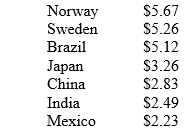
A Big Mac in the United States cost about $5.06 last week. In the Euro area, the price was about $4.06 and in Britain $3.73. A Big Mac is cheapest in Russia ($2.15) and most expensive in Switzerland ($6.35). Here are the prices of a Big Mac (a.k.a. the Maharaja Mac in India) in a few other locales:
It should be noted the Big Mac index is not a perfect measurement tool. The price of a burger should be less in countries with lower labor costs and more in countries with higher labor costs.
When prices are adjusted for labor (using gross domestic product per person), the Brazilian real is the world’s most overvalued currency, followed by Pakistan and Thailand. The most undervalued currencies include Egypt, Malaysia, and Hong Kong.
Park Wealth Management is located at 216 East Ridgewood Ave , 2nd Floor Ridgewood NJ 07450 201 689-2020
Baby Boomers: your millennial children are worse-off than you. Millennials earn 20 percent less than boomers did at the same stage of life, despite being better educated, according to a new analysis by the advocacy group Young Invincibles. (Jan. 13)
WASHINGTON – The House approved bipartisan legislation on Thursday to ensure that the benefits of proposed regulations from the Securities and Exchange Commission (SEC) justify the costs to jobs, economic growth, and capital formation.
The SEC Regulatory Accountability Act, sponsored by Financial Services Committee member Rep. Ann Wagner (R-MO), passed 243-184.
“Ill-advised laws like the Dodd-Frank Act empower unelected, unaccountable bureaucrats to callously hand down crushing regulations without adequately considering what impact those regulations have on jobs,” said Committee Chairman Jeb Hensarling (R-TX). “The true cost of Washington red tape includes the jobs not created, the small businesses not started and the dreams of our children not fulfilled.”
Under the bill, before issuing a regulation the SEC will be required to:
identify the nature and source of the problem its proposed regulation is meant to address;
utilize the SEC’s Chief Economist to assess the costs and benefits of a proposed regulation to ensure the benefits justify the costs;
identify and assess available alternatives; and
ensure that any regulations are consistent and written in plain language.
Further, the legislation requires the SEC to engage in a retrospective review of its regulations every five years and conduct post-adoption impact assessments of major rules.
Ridgewood NJ, Small business Optimism soared in December by the most since 1980 as expectations about the economy’s prospects improved dramatically in the aftermath of the Trump election.
The National Federation of Independent Business gauge jumps to 105.8 in month after presidential election and expectations for business conditions are highest since 2002
The National Federation of Independent Business’s (NFIB) index jumped 7.4 points last month to 105.8, the highest since the end of 2004, from 98.4. While seven of the 10 components increased in December, 73 percent of the monthly advance was due to more upbeat views about the outlook for sales and the economy, the Washington-based group said.
1. In 2014, the top 400 US taxpayers based on Adjusted Gross Income earned $127 billion collectively, and they paid $29.4 billion collectively in federal income taxes at an average tax rate of 23.13% (see chart above). Just those 400 taxpayers paid more than 2% of all the federal income taxes collected in 2014 ($29.4 billion out of $1.377 trillion).
2. In 2014, the bottom 50% of taxpayers, a group totaling nearly 70 million Americans, earned collectively more than $1 trillion and paid $37.7 billion in federal income taxes at average tax rate of about 3.4% (see chart above).
Update:
3. According to the IRS, the top 0.001 percent of US taxpayers (N = 1,396) paid $49.7 billion in federal income tax in 2014, which is $12 billion more than the taxes collected from the entire bottom 50% (see updated chart above). Also, because of the progressive income tax schedule, note that the bottom 50% of US taxpayers reported about 5 times as much income as the top 1/1000 of 1% (more than $1 trillion vs. $207 billion), but paid $12 billion (and 24%) less in income taxes in 2014.
On Wall Street, the rising dollar has been one of the most visible signals of growing optimism in the U.S. economy; for many other countries, it spells trouble.
By
IRA IOSEBASHVILI
Updated Jan. 1, 2017 10:03 a.m. ET
On Wall Street, the rising dollar has been one of the most visible signals of growing optimism in the U.S. economy. For many other countries, it spells trouble.
Most analysts expect the U.S. currency to strengthen in 2017, extending a gain that has boosted the value of the dollar by more than one-third since the U.S. credit downgrade in 2011.
That expectation is mostly because a strengthening economy appears likely to enable the Federal Reserve to enact its plan for multiple rate increases in 2017. Higher rates make it more attractive to hold dollar-denominated assets, attracting money into the U.S.
French woman Lilly is in a relationship with a robot she 3D-printed herself She and the robot have been living together for a year and are now ‘engaged’ Lilly describes herself as a ‘proud robosexual’ and says they will marry
By Khaleda Rahman For Daily Mail Australia
A French woman has revealed she is in love with a robot and determined to marry it.
Lilly’s partner is a robot called InMoovator, who she 3D-printed herself and has been living with for a year.
On her Twitter page, where she goes by ‘Lilly InMoovator,’ she says: ‘I’m a proud robosexual, we don’t hurt anybody, we are just happy.’
Now, Lilly is reportedly engaged to the robot and says they will marry when human-robot marriage is legalised in France.
PUBLISHED: 19:10 EST, 13 December 2016 | UPDATED: 19:10 EST, 13 December 2016
US technology giant IBM said Tuesday it would hire 25,000 people in the country over the next four years, a day before President-elect Donald Trump meets with tech industry leaders.
About 6,000 of those hirings will occur in 2017, IBM chief executive Ginni Rometty said in an opinion article published in the newspaper USA Today.
IBM, which has undertaken in recent years a restructuring of its activities, will invest $1 billion on employee training and development in the next four years, said the IBM president, chairman and CEO.