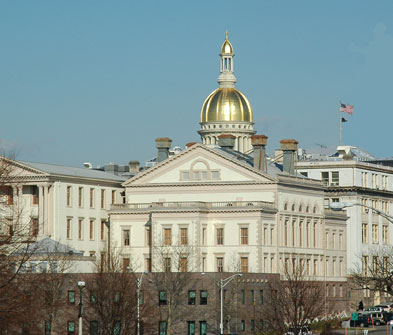
Serious conversations about raising New Jersey’s gas tax to head off a looming transportation-funding crisis were put on hold earlier this year, so lawmakers could focus on the Assembly elections that were just held in all 40 legislative districts earlier this week. But now with those contests in the rearview mirror, the talk in Trenton has shifted back to transportation. John Reitmeyer, NJSpotlight Read more
Posted by Matt Rooney On November 06, 2015 7 Comments
By Matt Rooney | The Save Jersey Blog
If you STILL don’t know or understand why New Jersey is almost irreparably screwed up, and a strengthened Democrat legislative majority is only going to make it worse, all you need to do is check out this quote from a celebratory SpeakerVince Prieto over on NJ.com.
He’s moving full-steam-ahead on the gas tax hike after Tuesday’s big win and isn’t ready to listen to any proposals that don’t raise taxes:
You can’t have something that’s revenue neutral,” Prieto said. “How are you going to fix the roads and then take the money from somewhere else? That is a ridiculous statement.”
There you have it, Save Jerseyans.
Translated: “The problem with Trenton isn’t Trenton, but that the people we “serve” aren’t sending us enough money.”
The man has balls, I’ll grant him that much. He also hates math. Study after study recognizes New Jersey as the worst (orsecond to worst) state for taxes in the entire country, a quantifiable fact further substantiated by a no-less-quantifiable herd of taxpayers fleeing New Jersey for other states. There’s a several mile traffic jam of moving vans heading west on I-80! And South on I-95. And Vince is worried about where we’re going to get the money for roads which no one can afford to drive…
So somehow, magically, we’re going to make New Jersey better for businesses, and families, by making it less affordable to live (and drive) here. #PrietoLogic! Which is apparently logic neutral.
And he can’t find ANYTHING he’d like to cut from the budget. Nothing. Not in a state notorious for no-show jobs, pension abuse, redundant departments, ponderous layers of bureaucracy and a school funding formula – where most of your property tax increase go – that spends $20k+ on urban education, per child, with nothing to show for it.
Look: everyone agrees the roads need to fixed. But we’veproposed alternatives to higher taxes including reducing the cost of maintaining our roads (which is – surprise! – also the highest in the nation) because, unlike the Speaker’s Assembly caucus, our Garden State businesses and families have no choice but to cut their budgets when times are tough. No cable next month! Less eating out. Less shifts at the shop. Etc. and so on.
Prieto doesn’t care. ‘Cause he doesn’t get it. The few Democrats who do get it are too afraid – or bought off – by the Super PAC backers to care. Does anyone honestly believe the Dems who just won upsets riding NJEA Super PAC cash to victoryare now going to be independent of the public sector unions?
All of the changes contained in the 2011 law that haven’t already taken effect will be fully implemented in just over 1 year. This law wasn’t designed to show a substantial immediate savings. It was designed to implement changes over a period of years and once ALL of those gradual changes were completed the impact of those changes going forward would have a positive effect on the states financial condition. Immediate solutions for long term problems, are just not reasonable or possible.
The full story on the Chapter 78, P.L. 2011 pension reforms… the problems are unfortunately still very much with us. Here are the facts: cost-of-living adjustments (COLAs) were suspended for current and future retirees and beneficiaries from July 2011, but there’s been no inflation in NJ since 2008, so this is not an issue. The increases in employee contribution rates towards their own pensions are only gradual: from 5.5% to 6.5% plus an additional 1% phased-in over 7 years through 2019 for TPAF and PERS; from 3% to 12% for JRS phased-in over seven years; from 8.5% to 10% for PFRS members; and, from 7.5% to 9% for SPRS members. Given the “special” retirement option available only to PFRS members, who can retire after 20-25 years and earn more from their defined benefit pensions for life in retirement then they earned in compensation while serving, they should be contributing more than 10%. As for the increased health benefit contributions, employees subject to any collective negotiations agreement in effect on the effective date of the law in July 2011, i.e. CBAs, that had an expiration date on or after the expiration of the health care contribution provisions of the law, haven’t been subject to the new higher contribution rates yet. In Ridgewood, only Fire is now paying a higher contribution amount, while the PBA and the REA haven’t yet agreed to new CBAs that would trigger higher health benefit contribution rates… so Ridgewood taxpayers have yet to see much, if any benefit from the pension reforms of 2011.
what are Sweeney, Sarlo and Prieto trying to do to our gasoline taxes? What’s going to happen to our property taxes? State income tax increases on the top 1%, i.e. anyone who earns over $350,000? Higher sales taxes anyone? How about all of the above. And for what you ask? To feed the vampire squid sucking the lifeblood out of the state of NJ. All of the tax revenues raised will go to pay for past promises on wages & benefits for unionized labor, not to invest in the future of the state. These thugs in Trenton won’t ask any questions, they’ll just throw more hard earned money down the black hole of pension and healthcare corruption.
The Stakes For a Lame Duck Gas Tax Vote Following Assembly Victories
After Tuesday’s wins in the Assembly elections, Democrats will be entering Lame Duck with the weight of the proposed gas tax on their shoulders and a strategic choice to make: to help fund the Transportation Trust Fund, or wait for the newly elected Assembly members to arrive and for Christie to return to Trenton from the campaign trail. JT Aregood, PolitickerNJ Read more
Democrats win their largest N.J. Assembly majority in 36 years
Democrats tightened their control of the state Assembly in Tuesday’s elections, wresting at least three seats away from a Republican party ruled by Gov. Chris Christie, a presidential candidate whose popularity has dropped at home. Brent Johnson, NJ.com Read more
Secret Independent Influence on Elections at ‘Astounding’ Levels
There is no better illustration of the dominant role in elections undertaken by independent groups in New Jersey than this year’s Assembly contest. Jeff Brindle, PolitickerNJ Read more
New Jerseyans already know it to be true, but a Forbes analysis of state-by-state tax burdens places the Garden State near the top of its “Worst States for Taxes” list. Samantha Marcus, NJ.com Read more
Experts say Tuesday’s state Assembly elections may draw one of the lowest voter turnouts New Jersey has ever seen. In fact, a Rutgers-Eagleton poll released this past week showed three-quarters of New Jersey residents had no idea at all there was an election coming up. But there are at least a few races generating drama — with both Democrats and Republicans hoping they can grab a few new seats in the lower house of the state Legislature. Brent Johnson, NJ.com Read more
Tuesday limped lamely into view without suggestion of epic consequences. Clearly by the end of the night, as Rutgers-Eagleton polling showed 76% of New Jerseyans claimed zero knowledge of a coming election, no one would be able to lay claim to a Ben Hur moment. Max Pizarro, PolitickerNJ Read more
Who? What? Huh?? New Jerseyans Unaware of Next Week’s Election, Eagleton Says
Forty-four years after the first press release from the Eagleton Institute of Politics’ inaugural poll reported little awareness of the then upcoming 1971 state legislative elections, New Jerseyans today remain uninformed about the Legislature, according to the latest Rutgers-Eagleton Poll. Three-quarters of Garden State residents are completely unaware that any elections will be held next week, just slightly better than the 85 percent who were ignorant in 1971, in what was then called the New Jersey Poll. Politicker Staff, PolitickerNJ Read more
A new Rutgers poll suggests that New Jersey residents are as uninformed and uninterested as ever when it comes to state-level politics. PolitickerNJ decided to visit the Cherry Hill Mall and see whether people at one of South Jersey’s biggest commercial centers would buck the trend. JT Aregood, PolitickerNJ Read more
While corporate income taxes are often mistaken for the totality of business tax burdens, in reality they are just one of many taxes paid by businesses, and often a relatively small percentage of overall corporate tax burdens. Nationwide, corporate income taxes only account for 3.5 percent of state and local tax revenue. That figure will continue to decline as more businesses organize as pass-throughs (S corps, partnerships, sole proprietorships, etc.), which are liable under the individual income tax code, and as more C corporations receive incentives and abatements which erode the corporate income tax base.
Today’s map shows how much each state collects in corporate income taxes per capita. Unsurprisingly, states like New York ($539 per capita) collect a great deal, due to a heavy concentration of corporate payers. Alaska has the highest collections per capita ($912), the result of a large presence from extractive industries combined with relatively low population. A similar dynamic is at play in fourth-ranked North Dakota, while third-ranked New Hampshire leans more heavily on corporate taxes (and property taxes) due to the lack of an individual income tax (except on interest and dividends) or a sales tax.
At the other end of the spectrum, Nevada, Ohio, South Dakota, Texas, Washington, and Wyoming do not levy corporate income taxes, though four of these states (Nevada, Ohio, Texas, and Washington) instead impose economically distortive gross receipts taxes, and some states that forego a traditional corporate income tax still show a small amount of corporate income tax due to taxes on the corporate net income of special kinds of corporations (e.g., financial institutions). As such, only Nevada, Texas, and Wyoming show no revenue whatsoever from corporate income taxes, though all three of these states levy other business taxes, including, inter alia, Nevada’s Commerce Tax (a gross receipts tax) and Modified Business Tax (a payroll tax) and Texas’s Margin Tax (a gross receipts tax).
There are several reasons why the corporate income tax share is so low on average:
The number of businesses organized as traditional C corporations has decreased over time. Between 1980 and 2010, the number of pass-through businesses nearly tripled, while the number of C corps actually declined.
States hand out generous corporate tax incentive packages to entice businesses to move into (or remain in) their states. Jobs credits, investment credits, and other targeted incentives lower tax liability for certain businesses and industries, but they are distortionary and non-neutral, picking winners and losers while carving away at the tax base.
States further reduce corporate tax bills by adjusting income apportionment formulas, reducing the in-state taxable income of corporations within their borders. Our Location Matters study helps explain the effect of apportionment in each state.
Beyond their limited capacity to raise revenue in most states, corporate income taxes are also highly volatile, as many corporations post losses during economic downturns and thus have no liability under the corporate income tax.
How much does your state collect in corporate income taxes per capita?
OCTOBER 23, 2015, 7:23 PM LAST UPDATED: FRIDAY, OCTOBER 23, 2015, 11:07 PM
BY DUSTIN RACIOPPI
STATE HOUSE BUREAU |
THE RECORD
Now that the Senate has voted to override Christie’s veto of that Madden bill on mental health records, sending it to the Assembly for consideration, the details of both proposals are at the center of a dispute between Democrats and Republicans over what is sound policy and what is political theatrics. The arguments show how powerful Christie’s pen stroke can be in Trenton, turning a bipartisan agreement into a pitched debate over mental illness and guns — plus all the other pressing matters facing the state.
Republicans in the Assembly now face the same choice as their colleagues in the Senate: Either switch their votes or defy Christie and hand him the first complete override of his tenure. Republican leader Jon Bramnick, a prime sponsor of the Assembly version of Madden’s bill, said his party expects Democrats to work toward solving New Jersey’s most vexing challenges first.
“If you’re willing to post and get passed in both houses serious tax reform and serious policy changes, I’m happy to talk about overriding the governor,” Bramnick said. “But my sense is that if you just want to override the governor for political purposes, I’m not with you.”
Sharing information
The bill at the heart of the dispute was sponsored by Bramnick, of Union County, and Madden, D-Gloucester, and was requested by the Administrative Office of the Courts. It would provide for local law enforcement to be notified when someone with a history of mental illness — like being committed to an institution or determined by the state to be a danger — applies to have a mental health record expunged for the purpose of obtaining a firearm.
While nothing stops judges from contacting law enforcement to get more details about an applicant that may weigh on their decision, the bill would automatically notify authorities to give them an opportunity to share information with the courts such as pending charges or “aberrant” behavior of the individuals.
The bill unanimously passed the Legislature in June. But Christie, who is running for the Republican nomination for president, conditionally vetoed the legislation in August because, he said, it didn’t comprehensively address mental health reform. Instead, he urged the Legislature to act on his recommendations found in the bill sponsored by Thompson, R-Middlesex.
Hybrid proposal
Christie’s reforms included a new standard for involuntary commitment for someone with mental illness; new training programs for first responders to identify and deal with people “in crisis”; and a requirement that someone who has been involuntarily committed for mental health treatment demonstrate “adequate medical evidence of suitability” in order to get a firearms purchaser card. None of his recommendations dealt with expunging mental health records.