
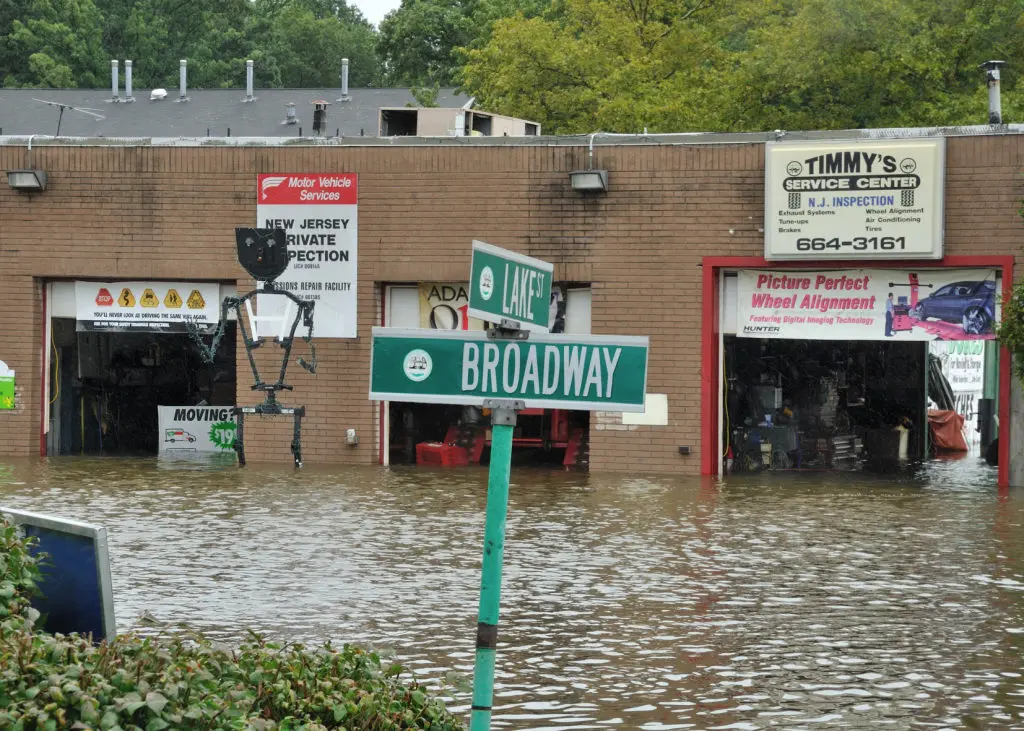
Major Obstacle in Flood Modeling: Stevens Tech Team Stymied by Lack of Data
photo courtesy of Westwood Mayor Ray Arroyo (2012)
the staff of the Ridgewood blog
Westwood, NJ—The ongoing study into flood mitigation in the Pascack Valley is running into a significant roadblock: a lack of crucial operational data regarding the Woodcliff Lake Reservoir.
On October 16, 2025, Mayor Ray Arroyo hosted Professor Marouane Temimi and a colleague from the Stevens Institute of Technology at the Westwood Community Center to update about 40 residents on the Forecast Informed Reservoir Operation (FIRO) study.
While the Stevens team—which has worked with the Department of Defense (DOD) on highly sensitive projects—is making progress, Professor Temimi’s ability to create an accurate forecast model is severely hampered. Mayor Arroyo noted the core concern: the private water company, Veolia, is either not sharing or doesn’t have public documentation on the dam’s operational parameters and associated infrastructure.
“The security concerns seem unwarranted,” stated Mayor Arroyo, emphasizing that the Stevens researchers have a history of accessing sensitive, NDA-protected data.
The researchers are currently forced to “make assumptions by observing the changes in the water levels,” making their work a complicated guessing game. Having the written operational parameters that Veolia’s engineers follow would eliminate much of this uncertainty, allowing the $200,000 state-funded study to achieve its full potential.
Pushing for Cooperation: State Funding vs. State Facilitation
State Senator Holly Schepisi (who secured the $200,000 in taxpayer funding for the FIRO study) and Councilmembers Bicocchi, Dell, and Hodges were in attendance.
Mayor Arroyo pointed out that since the state funded the research, its agencies should be actively facilitating it. He is now working with Professor Temimi and Westwood OEM Coordinator Darren Blankenbush to set up a critical meeting with relevant state agencies and Veolia to secure the necessary information.
Political Support Mounts: Gubernatorial Candidate Weighs In
The systemic flooding problem is increasingly drawing attention from state leaders. Mayor Arroyo revealed that he has spoken three times with Gubernatorial Candidate Jack Ciatterelli about the FIRO study and the multi-town remediation plan recommended by Boswell Engineering.
Ciatterelli, who sent a formal statement to the community, committed to supporting key flood legislation:
“I have heard from many residents along with your local leaders about the serious need for these initiatives […] the status quo is simply not acceptable. As Governor I will support […] bills S 2107 and A 427 and pursue efforts to pursue this problem systemically, rather than a drawn-out piecemeal approach […] the flood alleviating remedies you all are seeking will be a priority for my administration. It really is time.”
The Root of the Problem: Outdated Mandates vs. Climate Reality
Arroyo emphasized that the estimated cost of implementing the multi-town drone-based remediation recommendations is $8.1 million—a figure that represents only $0.014\%$ of NJ’s $58.8 Billion FY26 State Budget, calling it “essentially a rounding error.”
The larger issue is a decades-long systemic failure:
- Rapid Overdevelopment is escalating flooding in the fully developed, northern Bergen County towns.
- Static Management: The DEP warns of “wetter seasons and higher flood plain elevations,” yet Veolia’s water management mandates remain static and unresponsive.
- Obsolete Rules: Veolia’s current mandate of holding water at a prescribed 95 feet is now considered “obsolete” given the changes in climate and development.
Mayor Arroyo concluded with a bipartisan call for action: Flooding is not a partisan issue, and residents are frustrated by Trenton’s inaction. As Jack Ciatterelli stated: “It really is time!”








One inch of rain falling on 1 acre of ground is equal to about 27,154 gallons and weighs about 113 tons.
When you cover up the ground with a house, driveway and patio, that water has to go somewhere else.
That somewhere else is downhill, to the flood plain.