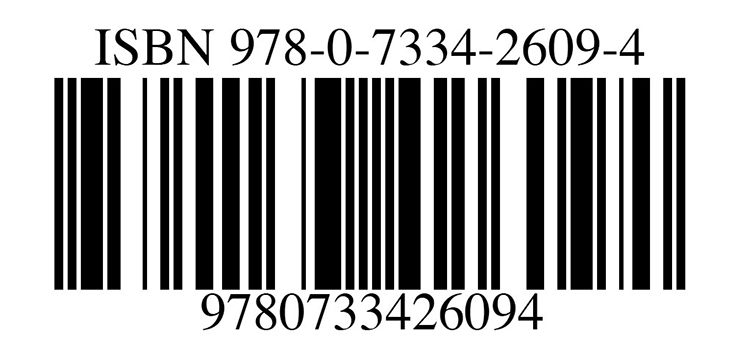
Here’s a question that trips up countless new authors: “I finally finished my book. Do I just need one ISBN for it?” The short answer, in almost all cases, is no. If you plan to publish your book in multiple formats, like a paperback, an eBook, and an audiobook, you will need a separate, unique ISBN for each one.
This article will break down exactly why this is the rule, what the exceptions are, and how to think about ISBNs in the simplest way possible: as product codes.
What Is an ISBN, Really?
Let’s clear this up first. An ISBN (International Standard Book Number) is not a copyright. It doesn’t protect your intellectual property.
Think of an ISBN as your book’s social security number or, even better, the bar code on a can of soup.
Imagine you’re at the grocery store. Campbell’s Chicken Noodle soup and Campbell’s Cream of Mushroom soup are both made by the same company, and they’re both soups. But when the cashier scans them, they have different bar codes. Why? Because they are different products. One is a clear broth with noodles; one is a thick, creamy soup. The store needs to know which one you bought, track how many are left on the shelf, and reorder the correct one.
Your book is the exact same. A paperback is a physical item with a specific size, page count, and print cost. An eBook is a digital file (like an ePub or .mobi). An audiobook is an audio file (like an MP3).
To the global supply chain, distributors, warehouses, online stores, and libraries, these are three completely different products.
- A reader can’t buy your eBook and expect a paperback to show up.
- A library can’t lend an audiobook file using the inventory number for its hardcover.
The ISBN is the unique identifier that tells everyone in the business exactly which version of your book they are dealing with.
Your Quick-Guide to ISBNs by Format
Here is the simple breakdown of what you’ll need.
- Print Editions (Paperback, Hardcover, Large Print)
This is the most straightforward. Every different physical version of your book must have its own ISBN.
- Your 6×9 paperback version needs one ISBN.
- Your 8×10 hardcover version needs a second, different ISBN.
- If you later release a large-print paperback version, it needs a third, different ISBN.
These are all separate physical products with different printing costs and retail prices, so they must be tracked separately.
- eBook Editions (Kindle, Kobo, Apple Books)
Yes, your eBook needs its own ISBN, separate from your print versions. This is where many self-publishers get confused, so let’s be very clear.
- The Big Exception: Amazon KDP. If you only plan to sell your eBook on Amazon, you technically do not need to buy an ISBN. Amazon will automatically assign your book an ASIN (Amazon Standard Identification Number) for free, which is its own internal tracking number.
- The “But”: This ASIN only works on Amazon. If you want to sell your eBook on other platforms (like Apple Books, Kobo, Barnes & Noble Nook) or make it available to libraries (through services like OverDrive), you will need to buy an ISBN for your eBook.
Pro Tip: Most authors just buy one “eBook ISBN” and use it for all non-Amazon platforms (Apple, Kobo, etc.). They then let Amazon use its free ASIN for the Kindle store.
- Audiobook Editions
Just like the others, your audiobook is a unique product and requires its own unique ISBN.
- This ISBN is separate from the paperback, hardcover, and eBook versions.
- The ACX/Amazon Exception: Just like with eBooks, if you produce and distribute your audiobook only through ACX (Audiobook Creation Exchange), which feeds into Amazon, Audible, and iTunes, you are not required to provide your own ISBN. They will assign their own identifier.
- The “But”: If you want to distribute your audiobook to a wider network, including libraries or other platforms, you will need your own ISBN for the audiobook.
What About New Editions?
The rule of thumb is simple: If you make a substantial change to your book, you need a new ISBN.
- You DON’T need a new ISBN for: Fixing a few typos, correcting a grammar mistake, or updating your book’s cover art. These are considered minor reprints.
- You DO need a new ISBN for: Adding new chapters, rewriting significant portions of the text, or releasing a “Second Edition.” This is now a new product.
Final Checklist: How Many ISBNs Do You Need?
Let’s use a common scenario. You’re launching a new book and want it to be available everywhere.
- Paperback: Yes. (ISBN #1)
- Hardcover: Yes. (ISBN #2)
- eBook (for Amazon): No, you can use their free ASIN.
- eBook (for Apple, Kobo, etc.): Yes. (ISBN #3)
- Audiobook (for ACX/Audible): No, you can use their identifier.
- Audiobook (for wider distribution): Yes. (ISBN #4)
In this common publishing plan, you would need to purchase at least four ISBNs to properly register and track all the different products you’re selling.
It may seem like a hassle, but using correct ISBNs is a sign of a professional publisher. It ensures your book gets into the right hands and, just as importantly, that you get credit (and royalties) for every single sale, no matter the format.