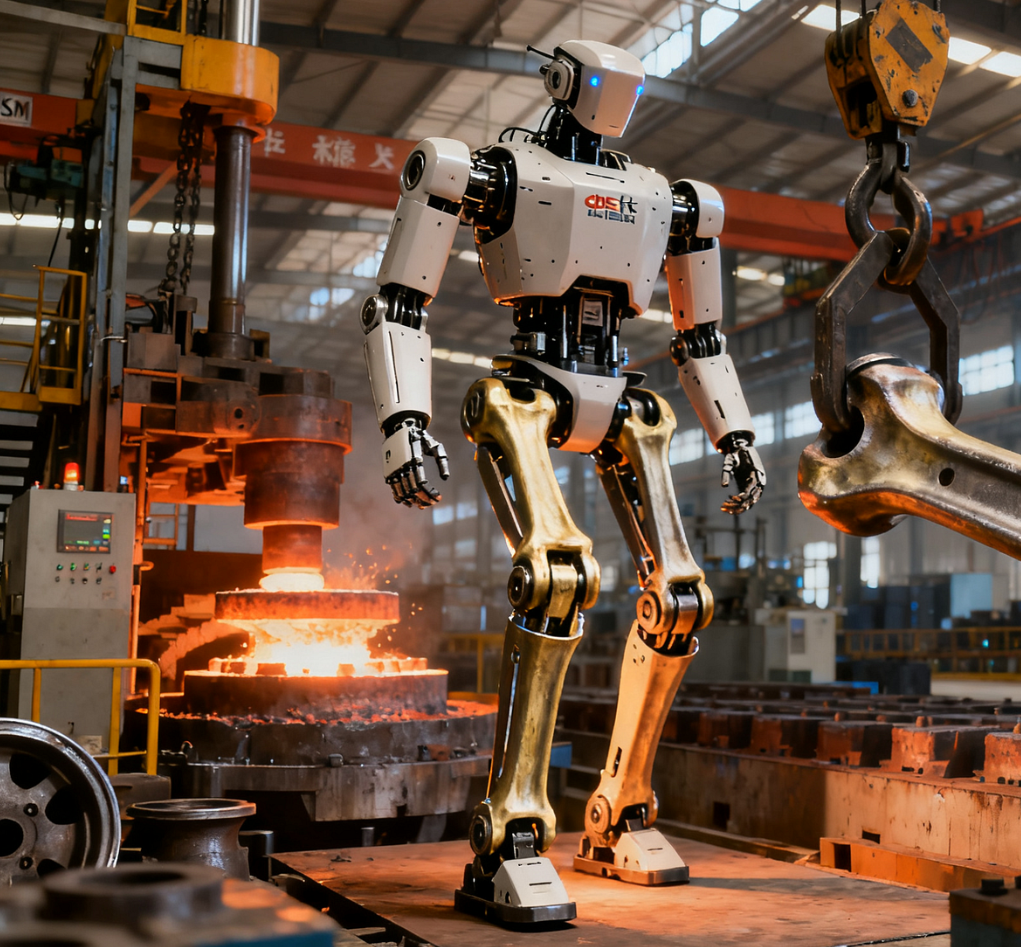
The future of the shop floor isn’t about robots that look like us. It’s about machines that can finally think like us in the context of physical space—adapting, learning
the staff of the Ridgewood blog
Las Vegas NV, CES 2026 made one thing crystal clear: the robots are no longer just coming; they are punching into work. From Tesla’s Optimus beginning its apprenticeship at the Austin Gigafactory to BMW’s Figure 02 fleet handling 90,000 parts on the X3 line, humanoid machines are officially on the payroll.
But here is the catch: if you think the goal is to build a “mechanical person,” you’re missing the point. In the industrial world, looking human is optional—being autonomous is mandatory.
2026: The Year Humanoids Got Down to Business
The start of 2026 has seen a staggering acceleration in real-world deployments. We are moving past the “demo” phase and into the “scale” phase:
-
BMW Group & Figure AI: After successful trials, Figure 02 humanoids are now running 10-hour shifts, seamlessly integrating into sheet-metal production.
-
Boston Dynamics & Hyundai: The new “field-ready” Atlas has moved from backflips to brawn, with Hyundai planning to produce tens of thousands of units annually by 2028.
-
Tesla Optimus: Using “imitation learning,” Optimus is now training on real-world tasks at Tesla’s factories, moving beyond pre-programmed loops to true task execution.
-
NVIDIA & Siemens: By releasing “Physical AI” models and simulation frameworks, these giants have provided the “brain” that allows hardware from any manufacturer to understand a factory floor.
Social vs. Industrial: Why Form Follows Function
There is a massive misconception in public discourse. We often conflate Social Humanoids with Industrial Humanoids, but they serve two completely different masters.
| Feature | Social Humanoids (Healthcare/Retail) | Industrial Humanoids (Manufacturing/Logistics) |
| Primary Goal | Building trust & empathy | Data collection & task execution |
| Appearance | Human-like face, skin, and gestures | Rugged, sensor-heavy, functional |
| Success Metric | User satisfaction/interaction | Uptime, precision, and data accuracy |
| Legs/Arms | Required for social “presence” | Negotiating stairs/clutter in human spaces |
The Reality Check: In a factory, a robot doesn’t need a smile. It needs to not fall over. If a task is better served by three arms or a sensor-array instead of a “head,” the industrial humanoid will evolve in that direction.
The “Physical AI” Revolution
The most important term in 2026 isn’t “robotics”—it’s Physical AI.
Traditional industrial robots are deterministic; they do exactly what they are told, over and over. Physical AI allows a robot to perceive the world, reason about it in real-time, and act autonomously.
“Humanoids are not just tools; they are mobile, sensor-rich AI platforms.”
Think of a humanoid as a 24/7 data-gathering machine. While moving parts, it is also monitoring temperatures, detecting visual anomalies, and mapping environmental changes. This data flows directly into ERP and Maintenance systems, making the robot a living part of the company’s digital nervous system.
The Geopolitical AI Race
This isn’t just about productivity; it’s about power. The race between the U.S. and China is increasingly centered on who owns the most robust Physical AI models.
-
U.S. Lead: Companies like NVIDIA and Qualcomm dominate the compute and simulation space.
-
China’s Scale: Manufacturers like Unitree are driving down costs, making humanoid platforms (G1, H2) affordable for mass research.
Control over these models—trained on trillions of data points from the physical world—is becoming a defining feature of global technological leadership.
Rethinking the Future
We should stop asking, “Can a humanoid replace a robotic arm?” Instead, we should ask:
“What becomes possible when AI gains a body that can move, sense, and act in our world?”
The future of the shop floor isn’t about robots that look like us. It’s about machines that can finally think like us in the context of physical space—adapting, learning, and operating where traditional automation fails.
Gusto is a payroll and HR software that helps you pay your team, file taxes, offer benefits, and more. See how Gusto compares to other providers, get a free trial, and learn how to switch to Gusto in minutes.
https://gusto.com/i/james3539