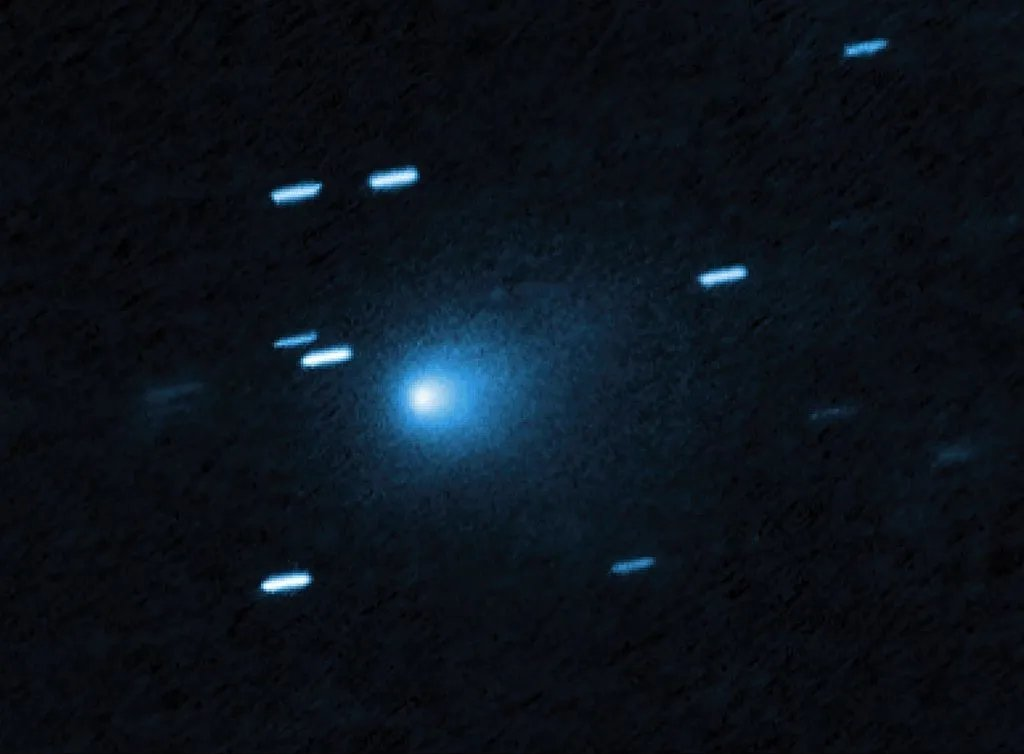
Earth is having a close encounter with a visitor from another star system.
the staff of the Ridgewood blog
Ridgewood NJ, today, December 19, 2025, an extraordinary traveler known as 3I/ATLAS is making its closest approach to our planet. This isn’t just any comet; it is only the third confirmed interstellar object ever detected in our solar system—following the famous ‘Oumuamua (2017) and 2I/Borisov (2019).
Born around a distant, unknown star, 3I/ATLAS has spent millions—perhaps billions—of years drifting through the darkness of deep space. Now, for a fleeting moment, it is passing through our neighborhood, offering scientists a rare “time capsule” from a far-off corner of the galaxy.
5 Fascinating Facts About 3I/ATLAS
1. It’s Breaking the Speed Limit
When 3I/ATLAS was first discovered in July 2025, it was zipping through space at a staggering 137,000 miles per hour. As it swung around the Sun (perihelion) in late October, the Sun’s gravity accelerated it to over 153,000 mph. This extreme velocity is how astronomers knew immediately it wasn’t from our solar system—it’s moving far too fast for our Sun to ever capture it.
2. A Cosmic “Snowball” the Size of a City
Based on high-resolution data from the Hubble Space Telescope, astronomers estimate the nucleus (the solid, icy core) of 3I/ATLAS is between 1,400 feet and 3.5 miles in diameter. While it’s relatively small on a cosmic scale, its impact on science is massive.
3. It “Broke the Rules” of Comets
3I/ATLAS has puzzled experts since day one. Unlike local comets, it began glowing and forming a “coma” (a cloud of gas and dust) while still out past Jupiter. Even more bizarrely, Hubble images captured an “anti-tail” that appeared to point toward the Sun—a phenomenon that defies standard cometary physics and has sparked intense debate among astrophysicists like Harvard’s Avi Loeb.
4. It Is Made of “Alien” Ice
Data from the James Webb Space Telescope (JWST) revealed that 3I/ATLAS contains a carbon dioxide-to-water ice ratio that is “out of this world.” This chemical signature gives us a direct look at the conditions of the distant planetary system where the comet was originally formed.
5. No Danger to Earth
Despite its “close approach” today, there is absolutely no risk of impact. 3I/ATLAS will remain about 170 million miles (270 million km) away from Earth—roughly 1.8 times the distance between us and the Sun.
How to See It
If you have a backyard telescope or a powerful pair of binoculars, look toward the east to northeast in the predawn sky. 3I/ATLAS will appear as a faint, glowing star-like object just below Regulus, the brightest star in the constellation Leo.
Where Is It Going Next?
This is a one-way trip. After passing Earth today, 3I/ATLAS will head toward Jupiter in the spring of 2026. From there, it will use a final gravity assist to slingshot out of our solar system forever, returning to the silent void between the stars.
Follow the Ridgewood blog has a brand-new new X account, we tweet good sh$t
https://twitter.com/TRBNJNews
https://truthsocial.com/@theridgewoodblog
https://mewe.com/jamesfoytlin.74/posts
#news #follow #media #trending #viral #newsupdate #currentaffairs #BergenCountyNews #NJBreakingNews #NJHeadlines #NJTopStories