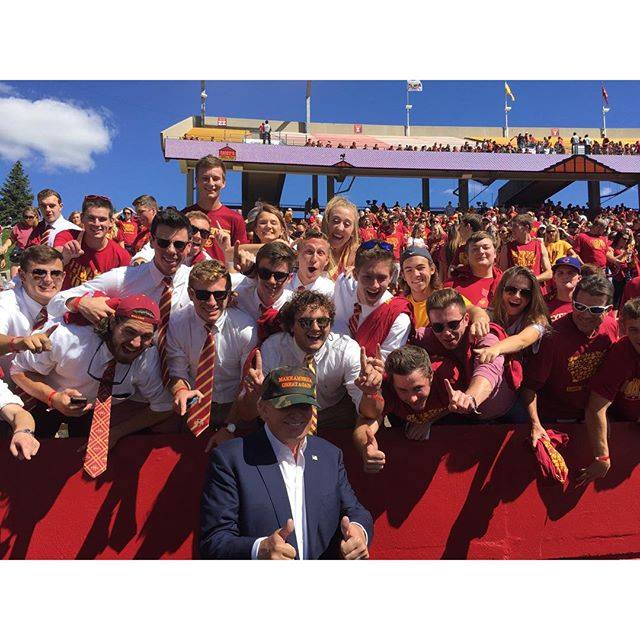
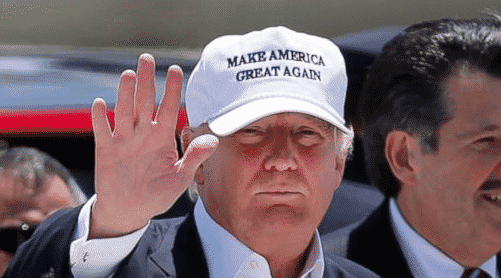
Republican presidential front-runner Donald Trump had a message to his critics at a massive, sold-out rally in Dallas on Monday: “I’m not going anywhere.”
“I’m not going anywhere and we’re not going anywhere,” Trump told a packed American Airlines Center, where an estimated 20,000 rallied.
“We are killing it. They mentioned a little while ago about the silent majority — it’s back. And it’s not silent. Maybe we should call it the noisy, aggressive, wanting to win — wanting-to-win majority.”
Trump said that he is preparing for the second Republican presidential debate on Wednesday, and offered frequent criticism to his rival former Florida Gov. Jeb Bush.
“Who would you rather have negotiating — Jeb or Trump?” Trump asked.
Trump, who continues to lead his Republican rivals by wide margins, said that he will unveil a tax policy plan in about three weeks, reiterating that he wants to lower taxes for middle income Americans, while raising taxes on hedge fund companies. He hasn’t said how he’ll pay for it.
Trump said that he would be able to negotiate a deal with Congress to lower corporate taxes on international companies, who have had to change their corporate headquarters to overseas addresses to take advantage of lower rates.
Democratic presidential candidate Hillary Rodham Clinton speaks at the University of Wisconsin at Milwaukee last week. (Morry Gash/Associated Press)
COLUMBUS, Ohio — Hillary Rodham Clinton is suffering rapid erosion of support among Democratic women — the voters long presumed to be her bedrock in her bid to become the nation’s first female president.
The numbers in a new Washington Post-ABC News poll are an alarm siren: Where 71 percent of Democratic-leaning female voters said in July that they expected to vote for Clinton, only 42 percent do now, a drop of 29 percentage points in eight weeks.
The period since the last survey coincides with the news that the FBI is looking into the security of e-mails sent over a private server Clinton used when she was secretary of state, as well as an intense media focus on her response to the controversy. The episode has raised questions about her judgment and revived memories of the scandals that plagued the presidency of her husband, Bill Clinton, in the 1990s.
If Hillary Rodham Clinton’s new apology for her private email server fails to reassure jittery supporters, it could amplify the chatter among some Democrats who have been casting about for a potential white knight to rescue the party from a beleaguered Clinton candidacy.
Vice President Joseph R. Biden Jr., Secretary of State John Kerry, SenatorElizabeth Warren, former Vice President Al Gore: Each has been discussed among party officials in recent weeks as an alternative to Mrs. Clinton if she does not regain her once-dominant standing in the 2016 presidential field and instead remains mired in the long-running email controversy, with its attendant investigations.
On Monday, Mr. Biden, who has spoken publicly of pondering a run, looked very much like a candidate at a Pittsburgh union gathering and Labor Day parade. And some Democrats were intrigued by word that Mr. Kerry, the 2004 Democratic nominee, had met recently in Nantucket, Mass., with David M. Rubenstein, a billionaire co-founder of the Carlyle Group — and the sort of Washington wise man Mr. Kerry might consult if he were mulling another run. (Friends say he isn’t.)
Who Is Running for President?
It is not just Mrs. Clinton’s weakness in the polls that has generated talk of other alternatives, but also the strength of Senator Bernie Sanders of Vermont, who is routinely drawing huge crowds at campaign events. That has been disconcerting to Democratic officials who believe that Mr. Sanders, a socialist, is so liberal that his presence at the top of the party’s ticket in 2016 would be disastrous.
“If party leaders see a scenario next winter where Bernie Sanders has a real chance at the Democratic nomination, I think there’s no question that leaders will reach out to Vice President Biden or Secretary of State Kerry or even Gore about entering the primaries,” said Garnet F. Coleman, a Texas state lawmaker and Democratic national committeeman.
Donald Trump is putting his mouth where CNN’s money is, demanding that all profits from the broadcast of next week’s GOP debate go to veterans.
Following news that CNN has been capitalizing on Trump-mania by raising ad prices for the Sept. 16 debate to 40 times their normal rate, the GOP front-runner sent a letter to the news network’s president, Jeff Zucker, to insist that he share the wealth.
“While I refuse to brag,” Trump writes, “this tremendous increase in viewer interest and advertising is due 100% to ‘Donald J. Trump.’”
Given the record-setting audience for the first GOP debate on Fox News, Trump says it stands to reason that CNN’s audience “will be even larger.”
Media mogul Rupert Murdoch likes Vice President Joe Biden’s chances if he runs for the Democratic presidential nomination in 2016.
“Looks like Biden already running,” Murdoch tweeted late Monday. “Very likely he wins nomination and be hard to beat.”
Murdoch’s comments come as Biden reportedly nears a decision on a third Oval Office bid.
During a Labor Day speech in Pittsburgh on Monday, Biden heard chants of, “Run, Joe, run.”
“I gotta talk to my wife about that,” the vice president told one supporter.
Beau Biden, Joe Biden’s son, died in May after a prolonged battle with brain cancer and reportedly urged his father to make a final attempt at becoming president.
Joe Biden has since repeatedly argued that he is uncertain if he has the emotional energy for seeking the nation’s highest office.
Republican presidential front-runner Donald Trump leads Democrat Hillary Clinton head-to-head, according to a new poll released Friday.
The poll by SurveyUSA finds that matched up directly, Trump garners 45 percent to Clinton’s 40 percent.
In other head-to-head matchups, Trump beats out Sen. Bernie Sanders (I-Vt.) by 44 percent to 40 percent; Vice President Joe Biden by 44 percent to 42 percent; and former Vice President Al Gore by 44 percent to 41 percent.
Trump’s surge past Clinton marks a dramatic turnaround in the polls.
A CNN/ORC sampling of national voters in late June — just days after Trump entered the race — found that 59 percent supported Clinton to 34 percent picking Trump in a head-to-head race.
The same poll taken in July saw Clinton at 57 percent to Trump at 38 percent. And a version taken in August had Clinton with 52 percent support and Trump with 43 percent.
Trump has seen his campaign’s popularity surge through the summer while Clinton’s has struggled with voter concerns over her transparency and trustworthiness as secretary of State.
The poll also found that 30 percent of respondents believe Trump will eventually be the Republican nominee, leading the field.
By Dan Balz Chief correspondent September 5 at 11:32 AM
At the beginning of this year, the Annenberg Public Policy Center at the University of Pennsylvania sponsored a focus group in the Denver suburbs composed of a dozen adults — Republicans, Democrats and independents. Looking back almost nine months later, the two-hour discussion proved to be a prescient guide to the surprising politics of 2015.
For any conventional politician paying attention, what was said there should have been unnerving. The name Donald Trump was never mentioned, nor was that of Ben Carson or Bernie Sanders. But the sentiments expressed that evening help explain why those three candidates are in the forefront of the political conversation on this Labor Day weekend.
Dan Balz is Chief Correspondent at The Washington Post. He has served as the paper’s National Editor, Political Editor, White House correspondent and Southwest correspondent.View Archive
The participants made it clear that they were fed up with politics as usual. They were harsh in their judgments about most traditional politicians, the political establishment and the way Washington works. They had no particular appetite for a clash-of-dynasties presidential campaign pitting a Bush against a Clinton.
They were especially critical in their assessments of Jeb Bush. They were tepid toward Hillary Rodham Clinton, although judgments fell more predictably along partisan lines. The participants longed for someone who seemed different and who they believed understood their lives. The name Elizabeth Warren, the populist senator from Massachusetts, sparked positive comments, even from some of the Republicans.
The billionaire businessman and reality TV star cemented his standing as the GOP frontrunner in August, kicking off the month with a feisty and unapologetic debate performance and closing it out with direct attacks to Jeb Bush.
He heads into the fall with momentum after having orchestrated what Republicans are describing as a months-long clinic in the race for the presidential nomination.
Trump is leading in the polls; blanketing the airwaves; relishing the role of attack dog against his opponents and the media, and forcing the other candidates to adapt to a race that’s being run on his terms.
He has perfected a style and message that resonates with the conservative base’s long-simmering frustration with party leadership. And he’s owned the hot-button issue of immigration, successfully driving the policy discussion to the right.
While Trump finished the month of July atop the polls nationally, few political watchers took his rise seriously.
Gov. Chris Christie of New Jersey said on Saturday that if he were elected president he would combat illegal immigration by creating a system to track foreign visitors the way FedEx tracks packages.
Mr. Christie, who is far back in the pack of candidates for the Republican presidential nomination, said at a campaign event in New Hampshire that he would ask the chief executive of FedEx, Frederick W. Smith, to devise the tracking system.
Immigration has become a top issue in the Republican campaign, with the front-runner, Donald J. Trump, having vowed to deport the estimated 11 million illegal immigrants in the country and to build a wall along the United States’ southern border.
“At any moment, FedEx can tell you where that package is. It’s on the truck. It’s at the station. It’s on the airplane,” Mr. Christie told the crowd in Laconia, N.H. “Yet we let people come to this country with visas, and the minute they come in, we lose track of them.”
He added: “We need to have a system that tracks you from the moment you come in.”
He said 40 percent of illegal immigrants are allowed into the United States legally with a visa and then stay longer than their visa allows.
If you’re having trouble understanding the phenomenal rise of Donald Trump, buck up — you’re not alone. Even political pros are dumbfounded.
They were shocked when the reality-TV star and businessman first grabbed the lead in national GOP polls. Now they’re double shocked as he soars in primary states, grabbing a 24-point lead in New Hampshire and a 15-point lead in South Carolina.
In one survey, Trump more than doubled his favorability ratings among Republicans in a single month, from 20 percent to 52 percent. The Hill newspaper called the turnaround “political magic” and the poll’s director, Patrick Murray of Monmouth University, called it “astounding.”
“That defies any rule in presidential politics that I’ve ever seen,” Murray told The Hill.
Other pollsters made similar comments, but a closer look shows an explanation. I call it the Pendulum Factor.
It reflects the fact that the legacy of each president includes the political climate he leaves behind. In plain English, Barack Obama’s most important failures as a leader begat Donald Trump’s success.
A favorable legacy among voters generally means the public wants more of the same in the next president. The clearest example is that Vice President George H.W. Bush succeeded Ronald Reagan in 1988, an election widely regarded as Reagan’s third term.
On the other hand, George W. Bush narrowly defeated Vice President Al Gore in 2000, a disputed election that was nonetheless seen as a repudiation of the scandal-scarred Bill Clinton era.
Republican presidential front-runner Donald Trump says he is leading the GOP race because he represents Americans who have had it with their nation coming up short.
“People in this country are smart,” he told listeners at the National Federation of Republican Assemblies’ 2015 conference in Nashville on Saturday.
“We’re tired of being the patsies for everyone,” Trump said.
“There is a big, big, growing-by-leaps-and-bounds silent majority out there. [The 2016 race] is going to be an election based on competence.”
Trump argued he is surging in national polls because he represents the Tea Party supporters ignored by Democrats and betrayed by Republicans.
“I love the Tea Party,” Trump said. “You people have not been treated fairly. These are people who work hard and love their country, and then get beat up by the media. It’s disgusting.”
“At least I have a microphone and can fight back,” the outspoken billionaire added.
They’re the pundits’ front-runners, but they’re at odds with a restless electorate.
BY JOSH KRAUSHAAR
August 27, 2015 By focusing so much on the candidates, consultants, and donors in political coverage, it’s easy to overlook the most important element in the political process—the voters. And at a time when Washington has prospered but much of the country has struggled, it’s easy to forget just how disaffected the American electorate is. For nearly all of the past decade, Americans have consistently believed that the country was headed in the wrong direction and have grown alienated from their elected leaders.
Consider: Since 2006, there have only been seven public polls (out of thousands) showing that more people believe the country is generally headed in the right direction than the wrong direction. In recent years, the “right-track” optimists have rarely hit even the 30 percent mark. In the year before the two most recent open presidential elections (2008/2016), nearly three-quarters of voters surveyed in theNBC/Wall Street Journal poll said they wanted the next president to take a different approach than his or her predecessor.
It has been a dismal decade for most Americans. Whether it’s government incompetence (Hurricane Katrina, the Veterans Affairs’ deadly lapses in medical care), economic recession followed by a slow recovery, deadly struggles in managing post-war Iraq, or the increasing threat of terrorism from a brutally repressive enemy, there’s been good reason for voters to distrust their government and its political representatives. Indeed, since 2006, we’ve seen wave elections occur in four out of the past five cycles. Democrats capitalized on the public’s anger to take back control of Congress in 2006 only to hit historic lows in representation across the country eight years later. If the United States had a parliamentary system, the government would be facing routine votes of no confidence.
So it’s no surprise that this year’s presidential campaign has been as unpredictable as ever. That happens when voters feel that government isn’t working for them, and they’ve been feeling that way for nearly 10 straight years. In past elections during times of voter alienation, the unexpected happens. In 1976, the first campaign after Watergate and amid rising crime and inflation, a little-known Georgia governor (Jimmy Carter) came out of nowhere to win the Democratic nomination and the presidency. That same year, a Republican president (Gerald Ford) was nearly unseated by a conservative insurgent (Ronald Reagan) that few pundits took seriously at first. In 1992, in the middle of a recession, Democrats chose a fresh-faced Arkansas governor (Bill Clinton) while Republicans saw a populist (Pat Buchanan) threaten their president (George H.W. Bush) in early primaries—with a billionaire winning 19 percent of the vote running as a third-party candidate (Ross Perot).
It’s apparent from my vantage point behind the microphone that if you’re even remotely glossy-eyed by presidential coverage in the media, you’d better buy some eye drops. The panorama of candidate content, communications and messaging is barely on the horizon, and soon to be in full view as the Iowa caucus and primaries in New Hampshire, South Carolina, Florida and Nevada come into focus.
Maneuvering through the gauntlet of opinions, I’m finding a consistency remains in deep-rooted support for presidential candidate Donald Trump.
People love Trump. They deem him a saving grace. He’s the proverbial Hercules and America’s problems are the labors to pursue and slay. He is riding a wave of popularity so profound even the sharks are curbing their taste.
In light of the Trump sensation, it may be appropriate, or at least instructive, to delineate what my radio listeners embrace from Trump’s message.
Here are five reasons why Trump appears to be the candidate to beat:
1. He doesn’t need to bluff. Trump has such confidence that he’s the kind of player who doesn’t bluff in a poker game. While this feels counterintuitive to a winning strategy, particularly in an age of baby-kissing politicians who thrive on placation over results, it’s actually refreshing. His candor builds respect. Radio listeners are extolling day after day the fact Trump is transparent to a fault, from his stances on immigration to foreign relations. Even his faults are steadily accepted and adopted. Poll Americans on who they like better: Trump vs. Univision reporter Jorge Ramos, actress Rosie O’Donnell, Sen. Rand Paul (R-Ky.), Sen. Lindsey Graham (R-S.C.), blogger Erick Erickson, pollster Frank Luntz or even columnist George Will, and the New York businessman will be on top every time by double digits.
2. He can’t be intimidated. Forget his multibillion dollar net worth. Push aside his armada of contacts and networking forged over decades. One of the strongest resonating dimensions to Trump is grit and tenacity. Super-PAC coffers of more than $100 million, compliments of the U.S. Supreme Court’s Citizens United case, don’t dissuade or cower Trump. He has access to the same level of resources. Political titles and legislative chevrons glimmering with laws passed in Congress don’t make Trump blink, because he’s been the donor sought after by many of these same politicians now running against him. From connections to chits, deep roots in business to opponents with far less resources, competitors simply can’t match Trump’s popularity. As one caller to the show recently bemused, compare Sen. Marco Rubio’s (R-Fla.) student loans or Gov. Scott Walker’s (R-Wis.) personal debt to Trump’s acumen and portfolio, and it’s almost like petulant children are competing against their successful, prominent father.
3. Out with political correctness. Build a wall to block illegal immigration from Mexico and Central America while deporting what he calls “anchor babies” and their families; impugn Russian, Chinese and South American leaders despite inextricably linked economies with the U.S.; hobble castigators who choose insults and fodder over substance in debates and interviews. It’s almost like describing a Roman general or martyr of a revolution, yet it’s a precise portrayal of Trump. His wherewithal is opening the eyes of Americans to the incompetence of our government. Callers remind me nearly every show that they want solutions, not sensationalism. They seek commonsense policies, not sound bites. My callers think Megyn Kelly was rude in her Fox News debate questions. They resoundingly believe Ramos deserved his fast-and-furious escort out of the recent Iowa press conference. They concur that chest-pounders like Sen. John McCain (R-Ariz.) do, in fact, need to be taken down a notch on the hubris ladder. From race to gender to economic principles, Trump’s stark opinions are catching the attention of the public, and they can’t stop staring — in a good way. This isn’t a painted breast in Manhattan, but the cold, hard truth about America being broken, and a journeyman blessed with the right tools to “get ‘er done” and make repairs.
4. He’s reinvigorating America across the political spectrum. Like a Lee Greenwood or Johnny Cash song, Trump is traveling from the lakes to the fields to the cities of America, and he’s definitely been everywhere — and isn’t stopping. The media follow his path; opponents emulate his narrative; the electorate revels in the freshness of a candidate diagnosing what ails us and offering painful but necessary remedies. As for radio talk show listeners, be it the libertarian free marketer, Tea Party stalwart, open-minded Republican or smidgeon of moderate Democrats, Trump’s ascension in public support isn’t just vertical, but also lateral from right to middle to left in partisan affiliation. As one listener messaged last month, President Obama’s initial campaign maxims of “hope” and “yes we can” were just that: maxims, that never came to fruition. It appears Trump’s legacy may be following through with his promises, and that expectation appears to have awakened the American ethos.
5. Finally, a business-centric leader who is comfortable making decisions. A fan of the show recently commented that Trump can win the race for the presidency by naming his vice president and Cabinet members in the next few months, rather than after a Republican nomination. The logic is that building a team of experts who will manage the operations of the nation, as part of a campaign platform, is superior to generalities and wishful thinking. Trump’s business acumen is proven. Callers are alluding to the fact that he isn’t afraid of the media, nor does he use the crutch of notes and prepared speeches. He’s a negotiator, not a political puppet. He’s a dealmaker who thrives in the hot seat of a boardroom. Logic suggests he’ll be the same in foreign negotiations or hunkered down in a military command center. Trump doesn’t “blink,” in the Malcolm Gladwell context
shington (CNN)Vice President Joe Biden fares better against top GOP candidates in hypothetical general election match-ups than Hillary Clinton, according to a new national survey.
The Quinnipiac University poll, released Thursday, also shows Donald Trump smashing the GOP presidential competition garnering 28% support from registered Republican voters in the 17-member field. The real estate mogul’s closest competitor is retired neurosurgeon Ben Carson, who tallies 12%.
Just 7% said they would vote for former Florida Gov. Jeb Bush, a record low since November 2013.
Those results show just how far both Trump — now the Republican front-runner — and Bush — the old one — have come. Bush led national polls for much of the first half of 2015, but was quickly dislodged by Trump, after he announced his presidential ambitions this June.
Sens. Ted Cruz of Texas and Marco Rubio of Florida both are tied with Bush at 7%, the polls shows, with Wisconsin Gov. Scott Walker at 6% and former tech CEO Carly Fiorina and Ohio Gov. John Kasich tied at 5%.
“Donald Trump soars; Ben Carson rises; Jeb Bush slips and some GOP hopefuls seem to disappear,” said Tim Malloy, assistant director of the survey. “Trump proves you don’t have to be loved by everyone, just by enough Republicans to lead the GOP pack.”
And Trump certainly isn’t loved by everyone, the survey shows. About 1-in-4 GOP voters say they would never vote for Trump, topping the field. Bush comes in second with 18%.
Clinton still leads the Democratic race at 45% support from registered Democrats, followed by Vermont Sen. Bernie Sanders at 22% and Biden — who is currently mulling a 2016 bid — at 18%.
But Biden, currently sporting the highest favorability rating among any 2016 candidates polled of either party, tops Trump 48% to 40%, compared to Clinton, who beats Trump 45% to 41%. Biden also beats Bush, 45% to 39%, compared to Clinton, who beats Bush 42% to 40%.
As the vice president edges toward a presidential run, is he banking on further public disclosures to discredit the frontrunner?
YONI APPELBAUM
AUG 26, 2015
As Joe Biden edges closer to a presidential run, there’s no shortage of theories as to what he’s up to. Former secretary of state Hillary Clinton has built a commanding lead in the national polls, giving Biden little apparent space to gain traction. Perhaps he’s counting on the early-primary state of South Carolina to provide a critical boost. He might be banking on appearing as a stronger general-election candidate than any of his potential rivals in the primary race. Maybe after spending the past 42 years of his life running for elective office, he just can’t stop.
But there’s one intriguing theory that has so far garnered little attention: What if Biden knows something about Democratic frontrunner Hillary Clinton that the rest of us don’t?
After jumping to what seemed a prohibitively large early lead, Clinton has stumbled in recent months. Vermont Senator Bernie Sanders, hardly the most charismatic politician, has emerged as a viable challenger, generating enormous enthusiasm on the campaign trail, and surging ahead in polling averages in New Hampshire.