Posted on 14 Comments

State Appointed Fact finder will join Ridgewood teacher talks

BOE_theridgewoodblog

NOVEMBER 16, 2015    LAST UPDATED: MONDAY, NOVEMBER 16, 2015, 1:20 AM
BY STEVE JANOSKI
STAFF WRITER |
THE RECORD

RIDGEWOOD — A state-appointed fact finder in February will try to settle a 10-month contract dispute between the Board of Education and the Ridgewood Education Association, even as the two sides try to hammer out an agreement on their own.

Although there are several points of contention — including possible salary increases — the fight over how much REA members must contribute to their health insurance premiums has taken center stage since negotiations began last February.

The fact finder has scheduled an informal hearing on Feb. 3, when each side will present what it considers pertinent information, officials said. Two-and-a-half months later, the fact finder will issue a non-binding recommendation on how to settle the dispute.

In Ridgewood, union members pay an average of 26 percent of the cost of their health insurance premiums, a district spokeswoman said Thursday. This, many members say, is simply too much

“I know I have to pay something, but this an unreasonable burden on my family,” Mariann Gelenius said at the Nov. 2 board meeting. Gelenius, a Child Study Team member at Benjamin Franklin Middle School, said she’s paying about 35 percent of the premium cost, and that’s meant less take-home pay — even after previous salary increases.

REA President Michael Yannone, a 19-year veteran of Ridgewood High School, said Friday that the REA would keep meeting with the board’s negotiating team, but an agreement would depend on the board’s willingness to lower insurance contributions.

“That’s the stumbling block,” Yannone said. “We’re willing to negotiate that — we know that’s going to cost us something, and so we’re willing to pay to get that … but right now the board is holding the line on that issue.”


https://www.northjersey.com/news/education/fact-finder-will-join-teacher-talks-1.1456157
Posted on 3 Comments

REA members did not listen to BOE

BOE_theridgewoodblog

BOE Meets on November 16 at 7:30 p.m.
The Ridgewood Board of Education will hold a Regular Public Meeting on Monday, November 16, 2015, at 7:30 p.m.

 The public is invited to attend the meeting at the Ed Center, 49 Cottage Place, Floor 3. The meeting may also be viewed on FiOS channel 33, Optimum channel 77 or from computers via the “Live BOE Meeting” tab on the district website.
Click here to view the agenda for the November 2, 2015 Regular Public Meeting.

Click here to view the minutes of the October 19, 2015 Regular Public Meeting.

11.03.15: Board of Education Issues Statement on Contract Negotiations
Click here to read a November 2, 2015 statement by the Ridgewood Board of Education, “Negotiations Status Report.”

REA members did not listen to BOE

NOVEMBER 13, 2015    LAST UPDATED: FRIDAY, NOVEMBER 13, 2015, 12:31 AM
THE RIDGEWOOD NEWS
Print

REA members did not listen to BOE

To the Editor:

As a regular attendee of the Board of Education meetings of late, I would like to express one fact that was missing from last week’s article that appeared on your front page (“Fact-finder returns in February,” Nov. 6, page A-1).

Your staff writer accurately reported the following: “… opening remarks were made; a couple of presentations took place; and then public comments opened up, with various members of the REA coming to the microphone to have their say.”

He then continued with, “After the public comments, Sheila Brogan, president of the board, read from a prepared statement, explaining that the talks between the REA and BOE had slowed once again…”

What your reporter failed to include in his article is that immediately after the REA chief negotiator made her comments at the microphone, all the REA members present exited the building. Ms. Brogan’s reading of the prepared statement was made to an intimate group of us after the throng of REA members left. The REA members did not even grant to a volunteer elected official, to whom they are asking a lot, the courtesy of listening to her. The board listened to them, but I can only guess that the REA felt not compelled to show the decency of listening in return.

Pick your statement: “Actions speak louder than words” or “Adults are to be role models for the younger people.”

Bob Hutton

Ridgewood

https://www.northjersey.com/opinion/opinion-letters-to-the-editor/ridgewood-news-letter-rea-members-did-not-listen-to-boe-1.1454653

Posted on 4 Comments

Fact-finder for Ridgewood teacher contract talks to return in February

BOE_the ridgwoodblog

NOVEMBER 6, 2015    LAST UPDATED: FRIDAY, NOVEMBER 6, 2015, 12:31 AM
BY MATTHEW SCHNEIDER
STAFF WRITER |
THE RIDGEWOOD NEWS

Despite recent optimism that contract discussions between the Ridgewood Board of Education (BOE) and Ridgewood Education Association (REA) could conclude in the near future, the process seems to have ground to a halt once again.

This past week’s BOE meeting featured a series of events that have become standard: opening remarks were made; a couple of presentations took place; and then public comments opened up, with various members of the REA coming to the microphone to have their say. While not all of the comments were related to the negotiations, the majority were.

After the public comments, Sheila Brogan, president of the board, read from a prepared statement, explaining that the talks between the REA and BOE had slowed once again, and that even with the state-appointed mediator, no agreement could be hammered out.

“As has been the case since the parties’ first meeting back in February 2015, when the association declared an impasse, the main issues have been negotiating the levels of employee share of health care premiums, the cost of premium and type of plan and fair salary increases while staying within what the board feels the taxpayers can support,” Brogan said.

https://www.northjersey.com/news/education/fact-finder-returns-in-february-1.1449843

Posted on 2 Comments

Ridgewood teachers rally as contract talks continue

Ridgewood_BOE_theridgewoodblog

OCTOBER 30, 2015    LAST UPDATED: FRIDAY, OCTOBER 30, 2015, 12:31 AM
BY MATTHEW SCHNEIDER
STAFF WRITER |
THE RIDGEWOOD NEWS

A teachers’ rally took place Monday outside the Education Center.

The event occurred just before Michael Yannone, president of the Ridgewood Education Association (REA), entered the building to commence the second and potentially final negotiating session with a mediator present between the REA and the Ridgewood Board of Education.

“This is a sign of unity for the negotiating team that’s about to walk in there,” Yannone said at the event. “As a member of that team, I greatly appreciate this.”

Ridgewood Board of Education President Sheila Brogan said while a settlement wasn’t reached at the meeting, “The board understands the teachers’ wish for a settlement. We too want to settle the contract.

“We had a positive dialogue, but were unable to settle the contract,” she said. “The fact finder spent the evening talking with both sides and decided to move the process to a formal fact-finding hearing.”

According to Brogan, the fact finder is scheduled to return to Ridgewood on Feb. 3.

“At the hearing, he will listen to both sides and issue a non-binding opinion in an attempt to settle the contract, she said.

“Moving forward, the board’s negotiating team is willing to meet with the REA’s team to resolve issues and settle the contract.”

https://www.northjersey.com/news/education/rea-rallies-as-talks-continue-1.1444781

Posted on Leave a comment

After the NJ Elections: An Agenda for Healthcare Consumers and Caregivers

obamacare_theridgewood blog

The NJ Assembly elections are predicted to be the lowest voter turnout races in years – yet much hangs in the balance of the outcome. After the dust has settled, a number of crucial healthcare issues being addressed in the NJ Legislature remain unresolved, and New Jerseyans will still face a maze of obstacles when they look for accessible, affordable, quality health care. Ann Twomey, PolitickerNJ Read more

Posted on Leave a comment

Ouch …Wave of Health Insurance CO-OPs to Shut Down in Latest ACA Failure

coop_map

OCTOBER 22, 2015 10:08AM
By CHARLES HUGHES

Hundreds of thousands people will lose their insurance plans as a raft of health insurance cooperatives (CO-OPs) created by the Affordable Care Act will cease operations. Just last week, CO-OPs in Oregon, Colorado, Tennessee and Kentucky announced that they would be winding down operations due to lower than expected enrollment and solvency concerns (although the one in Colorado is suing the state over the shutdown order).  They join four other CO-OPs that have announced that they would be closing their doors. In total, only 15 out of the 23 CO-OPs created by the law remain. These closures reveal how ill-advised this aspect of the ACA was both in terms of lost money and the turmoil for the people who enrolled in them. The eight that have failed have received almost $1 billion in loans, and overall CO-OPs received loans totaling $2.4 billion that might never get paid back. In addition, roughly 400,000 people will lose their plans.

Sources:  Sabrina Corlette et al. “The Affordable Care Act CO-OP Program: Facing Both Barriers and Opportunities for More Competitive Health Insurance Markets,” The Commonwealth Fund, March 12, 2015; Erin Marshal, “8 Things to Know About Insurance CO-OP Closures,” Becker’s Hospital Review, October 20, 2015. Created using Tableau.

Notes: Hawaii and Alaska not shown. Neither state had a CO-OP. CoOportunity Health served both Iowa and Nebraska.

Proponents of the CO-OPs believed that they would be able to offer lower premiums than for-profit insurers because they did not have the same profit motive, but even non-profit insurers cannot operate at a financial loss indefinitely. When they were created, these CO-OPs had no customers, no experience in setting premiums, no networks and limited capital. The government tried to subsidize the early period of uncertainty by disbursing loans to help with startup and solvency issues, and money from other provisions like risk corridors would dampen losses in the initial years. Lower than expected payments from the risk corridors have exacerbated the issues facing some of these CO-OPs, who were counting on substantial payments to stay afloat. But this is hardly the only factor contributing to their struggles, some of them the product of other government policies like delaying employer mandate penalties and giving states the option to allow transitional policies through 2017. Some of these later developments could not have been anticipated, but many analysts, including Cato scholars, were skeptical about the prospects of CO-OPs from the beginning.  Even some ACA supporters recognized the flaws inherent in the CO-OP design: Paul Krugman derided them as a “sham”  and in a 2009 interview Professor Timothy Jost said could not see how a CO-OP “does anything to control costs.” There have been multiple warning signs that many CO-OPs were in trouble.  Earlier this year The Centers for Medicare and Medicaid Services sent letters to 11 CO-OPs placing them on “enhanced oversight” due to financial concerns, and a 2014 report from the HHS Office of Inspector General found that “most of the 23 CO-OPs we reviewed had not met their initial program enrollment and profitability projections,” and that the government “had not established guidance or criteria to assess whether a CO-OP was viable or sustainable.”

These CO-OPs were not a good idea at inception and were always going to face many obstacles to success.  Multiple changes to the law since they were established have exacerbated these problems, and already struggling CO-OPs have folded. Competition is indeed vital in health insurance markets, but the CO-OPs were a bad way to try to foster this competition. With these closures, billions of taxpayer dollars could be lost and hundreds of thousands of people will discover that the “if you like your plan, you can keep it” promise does not apply to them.

Posted on 2 Comments

Exchange between Ridgewood school board, REA is troubling

Ridgewood_BOE_theridgewoodblog

Exchange between school board, REA is troubling

To The Editor:

I am troubled by the exchange between Ridgewood teachers and the Board of Education in recent letters to the editor of this newspaper.

As I understand it, Chapter 78, a state law that phased in greater employee contributions to healthcare, is now fully implemented. The law says, “After full implementation, those contribution levels will become part of the parties’ collective negotiations and will then be subject to collective negotiations in a manner similar to other negotiable items between the parties.” I believe this means that, under current law, our board is expected to look at both salaries and healthcare in order to reach a satisfying agreement with the Ridgewood Education Association.

Yet, it seems as if teachers are appealing to the board to negotiate healthcare as well as salaries. In a letter to the editor, Pat Rosenfeld asks the board to “step up and negotiate alternate cost sharing arrangements.” Donna Pedersen echoes this request in her letter and says, “All that I am requesting of our Board of Education is to have respect for us as educators, professionals, and community members and to sit down with the REA to talk about the cost of our healthcare benefits.” In both letters, teachers seem to be pleading for a negotiation process that I believe is currently expected under state law. So I ask, If negotiation is stipulated in Chapter 78, why is this appeal necessary?

My last point is an observation. Based on the board’s information, 413 of the 520 teachers earn less than $100,000 per year. Most teachers do not enter the field of education in order to get rich. From my experience, most Ridgewood teachers work hard and care deeply about their students and education. In return, they expect a reasonable standard of living in an outrageously expensive area. Equally important, they want a Board of Education that negotiates both healthcare arrangements and salaries, which, as I understand it, is stipulated in Chapter 78, a state law.

Sally Lewis

Ridgewood


https://www.northjersey.com/opinion/opinion-letters-to-the-editor/ridgewood-news-letter-union-boe-exchanges-are-troubling-1.1439295

Posted on 2 Comments

Progress reported on Ridgewood teacher contract talks

BOE_theridgewoodblog

OCTOBER 23, 2015    LAST UPDATED: FRIDAY, OCTOBER 23, 2015, 12:31 AM
BY MATTHEW SCHNEIDER
STAFF WRITER |
THE RIDGEWOOD NEWS

As has become a pattern over the past few weeks, Monday’s Board of Education (BOE) meeting featured a bevy of speakers, most of whom were demanding a resolution to the contract negotiations between the BOE and the Ridgewood Education Association (REA).

Although this week’s meeting featured debate from the public, there was some potentially favorable news given by trustee Sheila Brogan.

“Jim (Morgan) and I did sit down on Friday with (REA chief negotiators) Laura (Grasso) and Mike (Yannone) and had a really positive conversation,” Brogran said, adding that they were set to meet again Oct. 21.

“We are working at it,” Brogan told the public at the meeting. “I know it’s not at the pace that you are wishing for.”

Yannone, president of the REA, confirmed the meeting via e-mail, and said he “thought it was productive in that it was the first time the REA felt we were able to talk one-on-one with the board members on their negotiating team. We left that meeting believing we articulated our position regarding our health contributions and we listened to their concerns regarding their budget.”

https://www.northjersey.com/news/education/progress-reportedon-talks-1.1439403

Posted on 4 Comments

Ridgewood BOE addresses Raising Teacher Healthcare Costs

cottage_place BOE_theridgewioodblog

The following letter appeared in The Ridgewood News on October 16, 2015.

To the Editor: At our October 5th Board of Education meeting and in last week’s letters to the editor, several of our teachers voiced opposition to the employee healthcare premium contributions phased in over the last four years under state law, known as Chapter 78. We would like to clarify the information on the healthcare contribution. The rates by which Ridgewood teachers contribute to their individual healthcare premiums is determined by a graduated structure, with employees at higher end of salary grades paying a greater percentage of their individual premiums than those at the lower end.
The highest paid teachers contribute 35 percent of their plans’ premiums while the lowest paid teachers pay 12 percent. The contribution level of 35 percent is applied to salaries of $95,000 and above when the employee has single coverage and $110,000 and above when the employee chooses family coverage. The majority of our teachers are enrolled in the School Employee Health Benefits Plan NJ Direct 10. At present, premiums are $10,610 for single coverage and $29,177 for family coverage.
The teacher who earns $95,000 and has single coverage would contribute $3,713 and a teacher earning $110,000 enrolled in the family plan would contribute $10,212. This year the total health insurance premium cost for the REA members is $10,228,960. Of that amount, they contribute $2,628,843. The net health insurance cost to the district is $7,600,117. With insurance premiums increasing annually, sometimes dramatically, controlling the growth of health care costs is challenging for all employers, in both the public and private sectors.
With the legislated 2 percent cap on property tax increases, keeping the school district’s overall costs within the cap is particularly challenging when cost drivers such as healthcare grow at a rate in excess of 2 percent. This year, the district offered employees 20 different plans through the School Employee Health Benefit Plan. Some of these plans have lower premiums. With lower premiums, the amount spent on insurance and the contribution cost would decrease.
The Board respects our teachers and appreciates the work they do. We share their concerns about rising healthcare costs as well as the increasing demands brought about by state mandates and our collective efforts to improve and update our curricula and programs. We know that through their great work our students thrive and our school district is well respected. Our appreciation is demonstrated in their compensation. Our teachers’ average salary of $82,500 is near the top of all Bergen County districts, while our starting salary of $55,693 for a first-year teacher with a Bachelors of Arts degree is at the very top (based upon collective bargaining agreements on file at the New Jersey School Board Association). Currently, 107 of our 520 teachers earn $100,000 or more. As stated at the Board meeting, our negotiating team is willing to meet with the REA team to settle the contract.
Ridgewood Board of Education
Sheila Brogan, President Vincent Loncto, Vice President Christina Krauss Jim Morgan Jennie Smith Wilson
Posted on Leave a comment

ObamaCare co-ops at risk of failing after billions in loans

1379441947-obamacare3-300x27721

By Peter Sullivan – 10/17/15 12:18 PM EDT

The future of an ObamaCare program that was intended to create non-profit insurers is increasingly in doubt, with several of the ventures forced to close down around the country.

On Friday, co-op insurance plans in Colorado and Oregon became the latest to call it quits, following the closure of similar plans this month in Tennessee, Kentucky and New York.

Just 15 of the original 23 co-ops remain in operation, and the administration acknowledges that more of them could fail, potentially leaving a strike against President Obama’s signature law.

“The co-op program was always kind of swimming upstream,” said Larry Levitt, senior vice president at the Kaiser Family Foundation, which does nonpartisan health analysis. “Starting an insurance company is not easy, and there’s a reason why it’s not done very often.”

Democrats created the non-profit co-ops under ObamaCare as a way to increase competition with established, for-profit insurers. Liberals rallied to the idea after they failed to secure the passage of a government-run insurance option.

But experts say the co-ops are facing a range of problems that could prove hard to overcome.


https://thehill.com/policy/healthcare/257220-obamacare-co-ops-at-risk-of-failing-after-24b-in-federal-loans

Posted on 1 Comment

Democrats Big Donors for Teachers Unions

BOE_theridgewoodblog

Teachers’ union is big donor to N.J. Democrats

The super PAC that has spent nearly $1 million to support Democrats in New Jersey’s Assembly elections next month has received nearly 90 percent of its money from a group affiliated with the state’s largest teachers’ union, records filed with state regulators show. Andrew Seidman, Philadelphia Inquirer Read more

Posted on 4 Comments

School board must talk healthcare : Time for Teachers to Go on Obamacare

obamacare_theridgewood blog

Ridgewood NJ , School board must talk healthcare costs with union no truer statement has ever been said and since the teachers unions were overwhelming supporters of Obamacare for the rest of us ,its high time they participate in the “healthcare” they pushed on the rest of America .

OCTOBER 9, 2015    LAST UPDATED: FRIDAY, OCTOBER 9, 2015, 12:30 AM
THE RIDGEWOOD NEWS

BOE must talk healthcare costs with REA

To the Editor:

I am proud to say that I have been educating 6 and 7 year olds in this community for 32 years. Many of these children have gone on to become doctors, lawyers, actors, and most dear to my heart, teachers, as well as numerous other professions. The one thing they have in common is Ridgewood and the superior education they received here.

As I enter into my 33rd year of teaching, I look into the eyes of my current students, knowing the path in front of them will lead them to a successful future because of the dedicated teachers and administrators who work here.

Each year, teachers are asked to do more and more for less and less. We all understand the economic realities that face us today. Teachers are taxpayers, too, and we all have our own budgets to balance.

As a member of the REA, this is my 11th contract negotiation, and it is sad to observe that every negotiation has become more and more acrimonious; however, never in my 33 years has a Ridgewood Board of Education refused to discuss all of the topics that need to be negotiated, specifically healthcare.

Every day I come to work knowing both parents and administrators expect me to be keeping the best interests of my students in mind. I would like to think that the board is doing the same for my colleagues and me. My personal contribution in 2012 to our health benefit package was over $2,200. In 2015, I am now contributing almost $10,000, which is a 350 percent increase. However, my salary certainly did not increase that much. It actually increased by 4.9 percent over the same time period. Anyone retiring from Ridgewood within the next five years will not be able to make the same amount of money that he/she did in 2012. That is just wrong!

All that I am requesting of our Board of Education is to have respect for us as educators, professionals, and community members and to sit down with the REA to talk about the cost of our healthcare benefits.

Donna Pedersen

Ridgewood

https://www.northjersey.com/opinion/opinion-letters-to-the-editor/ridgewood-news-letter-school-board-must-talk-healthcare-costs-with-union-1.1428787

Posted on 1 Comment

CRITICS TAKE HORIZON TO TASK OVER OMNIA ALLIANCE, CITING LACK OF TRANSPARENCY

Valley_Hospital_theridgewoodblog

I want to thank Senators Vitale and Gill for raising the red flag on the Blue Cross Horizon Omnia Plan. Any time a private company wants to merge and become bigger, we run the risk of having a monopoly that ultimately has the power to charge whatever it wants. “Care-coordination” and “value based approach” are meaningless buzz words.

The sickest and most vulnerable patients are at risk, as these plans have no real way to “keep people well.” Hospitals must be places of mercy and not revenue centers. This should be about care– not big business and mergers. If a hospital is unprofitable, it may just be doing its job, caring for those who are in need. Arbitrary “measurements of quality and cost efficiency” are not what the people need when choosing a hospital.

There is no price transparency in medical care as demonstrated by the recent $42,678 hospital bill for a normal uncomplicated delivery. “Insurance payments and adjustments” were $42,624.60. What exactly did that insurance company pay? What were the real costs and how can such a bill be justified? All of these charges, adjustments and payments behind closed doors suggest skulduggery, plain and simple.

We need to remember what real insurance was meant to be– a buffer to protect one’s assets against the cost of major medical events. Insurance cannot keep people well. We must reduce the power of these plans and have them serve the people, competing with other plans on cost, service and ability to negotiate and pay for major medical expenses. All hospitals should be included.

Let’s work together. Let’s clear the way for direct primary care, where people pay directly or become members of a local physician office for as low as $50/month. Let’s reserve insurance for the catastrophic and reduce the power of these big conglomerates. And let’s figure out how to provide real charity care to the poor without erecting a huge bureaucracy that amounts to a barrier to care. Alieta Eck, MD For Real Health Care Reform


ANDREW KITCHENMAN | OCTOBER 6, 2015

State senators to call on attorney general to block controversial tiered insurance plan before planned November launch

The traditional role of New Jersey’s state government in regulating the hospital and insurance industries has been to balance the needs of residents against the realities of the market, to ensure, among other things, equitable access to healthcare.

Then why are two leading senators on insurance issues — Nia H. Gill (D-Essex and Passaic) and Joseph F. Vitale (D-Middlesex) — arguing that the state has abdicated its responsibility in the case of the new OMNIA Health Alliance from Horizon Blue Cross Blue Shield of New Jersey? And they’re not alone in claiming that Horizon’s secretive selection process has left hospitals that were shut out of the alliance facing a bleak future, one that could include going dark.

This situation helps explain why Gill and Vitale are calling for Acting Attorney General John J. Hoffman to step in and put a stop to the OMNIA rollout, at least until his office and legislators have more time to review the plans.

Both Horizon executives and critics of how OMNIA was put together attempted to build their cases during nearly eight hours of testimony before a joint meeting of Senate Commerce and Health, Human Services, and Senior Citizens Committee.

It’s a process that could play out again in legal proceedings, as those left out of the alliance are raising the possibility of going to court to block it.

That said, not everything about OMNIA is raising a red flag. Senators welcome the possibility of lower costs, as well as the improved care-coordination and value-based approach that the tiered insurance plan is supposed to deliver.

And OMNIA has its defenders. One of them, Dr. Jeffrey Le Benger, CEO of alliance member Summit Medical Group, said that Summit has already reduced the cost of providing care to Horizon members by 13 percent over a two-year period.

Ronald C. Rak, chief executive of New Brunswick-based St. Peter’s Healthcare System, is definitely not among OMNIA’s champions. He found a corollary to the actions of the state’s largest insurer in ancient Rome.

https://www.njspotlight.com/stories/15/10/06/critics-take-horizon-to-task-over-omnia-alliance-transparency/?utm_source=NJ+Spotlight++Master+List&utm_campaign=69e35f56a3-Daily_Digest2_5_2015&utm_medium=email&utm_term=0_1d26f473a7-69e35f56a3-398635969

Posted on Leave a comment

Health Care Crisis is a Matter of Bureaucracy, taking government out of health care is key to lower costs

unnamed

FPANJ Women’s Group: Health Care Crisis is a Matter of Bureaucracy

Dr. Alieta Eck, founder of Zarephath Health Care Free Clinic and 2014 Congressional Candidate, tells FPANJ Women that taking government out of health care is key to lower costs

Upper Montclair, NJ – October 2015 – Financial Planning Association of New Jersey(FPANJ) has launched a Women’s Group and their inaugural event touched on a hot-button topic: health care costs and the Affordable Care Act.

The group invited Dr. Alieta Eck, M.D., to speak on “How Women Can Solve the Health Care Crisis” last week and her message was well-received among the financial professionals.

“Dr. Eck’s message of reducing costs resonated with our group, especially because we are always working with clients to manage their money, and recent changes in the health care system have proved challenging for many,” Trish Scott, Chairman of the Women’s Group said. “She shared a vision of positive change for the health care in the near future that was enthusiastically received.”
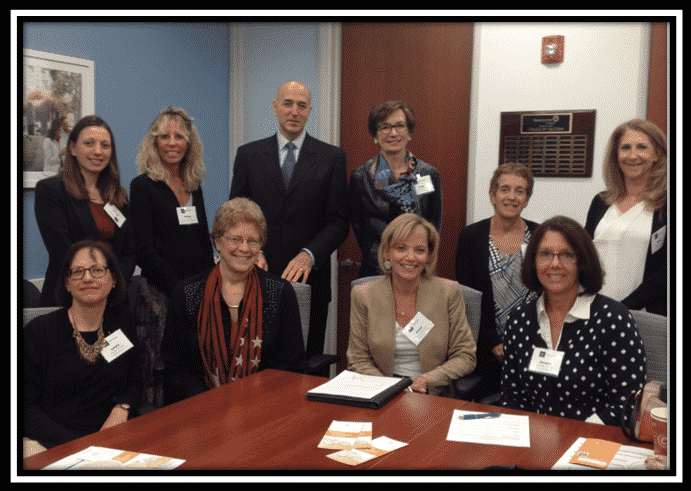
Dr. Alieta Eck pictured front row, second from left, with FPANJ Women’s Group Members and Nick Scheibner, FPANJ PR Chair.

Startling to most in attendance were the statistics comparing the rise in health administrators (more that 3500 percent) to doctors (approximately 100 percent) since 1970. It’s this addition to the health care bureaucracy that Dr. Eck points to for making affordable health care inaffordable for many patients.

“If you have a single mother who has to pay $268 per month for a premium, that’s a lot of money,” Dr. Eck explained. “But if you add a medical problem to that mix, most bronze plans require a $6000 deductible, which skyrockets those costs.”

She also explained that the measures of a good doctor between patients and bureaucracies are vastly different, much to the detriment of the patient-doctor relationship, saying, “Patients measure a doctor on their experience, how well they listen, how much they care. Bureaucracies focus on things like ‘clinical quality metrics,’ and maintenance of certification. In the end they view a good doctor as one who earns and spends less so the bureaucracy can earn more.”

Dr. Eck and husband Dr. John Eck founded the Zarephath Health Center, a free clinic for the poor and uninsured that currently cares for 300-400 patients per month utilizing the services of volunteer physicians and nurses. She explained they spend $13 per patient because of the volunteer staff, and is working with New Jersey lawmakers to pass theVolunteer Medical Professional Health Care Act in the Senate. The bill provides malpractice protection for doctors in their private practice if they volunteer four hours every week at a non-governmental free clinic such as Zarephath.

She contrasted these costs with the $13 billion Medicaid costs for New Jersey, which is approximately one-third of the state’s budget.

Dr. Eck explained the new law could also provide a way to “Help the poor without fleecing the public” with the cost of bureaucracy. The bill is co-sponsored by
Sen. Robert Singer, District 30; and Sen. Brian P. Stack, District 33.

More about Dr. Alieta Eck:

Dr. Eck’s topic “How Women Can Solve the Health Care Crisis,” stems from her interest in health care for the poor and her advocacy against the Affordable Health Care Act, testifying in opposition in 2011 at a U.S. Senate subcommittee hearing. She has campaigned twice for public office: first as a Republican nominee for U.S. Senate  in 2013, and again in 2014 to fill the temporary seat in New Jersey’s 12th District. These bids were unsuccessful, but she continues to be active in advocacy.

Posted on 1 Comment

Obamacare Actually Isn’t All That Affordable — Unless You’re Broke

obamacare_theridgewood blog

By Simon Constable

NEW YORK (TheStreet) — It’s time for the Affordable Care Act to join a long list of oxymorons. Why? Because rather like “military intelligence,” “cat proof,” “government organization,” and “simple calculus,” the law better known as Obamacare turns out to be an inherent contradiction. For a sizeable part of the population, anyway.

The ACA is just not affordable to a big chunk of those it was most meant to serve: The previously uninsured. In fact, many are worse off than before, according to a new study. That fact could also unravel part of the program’s foundation, which could be a problem for healthcare insurers.

“Many of the non-poor formerly uninsured are estimated to be worse off,” than without insurance, according to a September-dated working paper from the National Bureau of Economic Research titled “The Price of Responsibility: The Impact Of Health Reform On Non-Poor Uninsured.”

https://www.thestreet.com/story/13298998/1/obamacare-actually-isn-t-all-that-affordable-unless-you-re-broke.html?utm_content=buffera24cf&utm_medium=social&utm_source=facebook.com&utm_campaign=buffer