
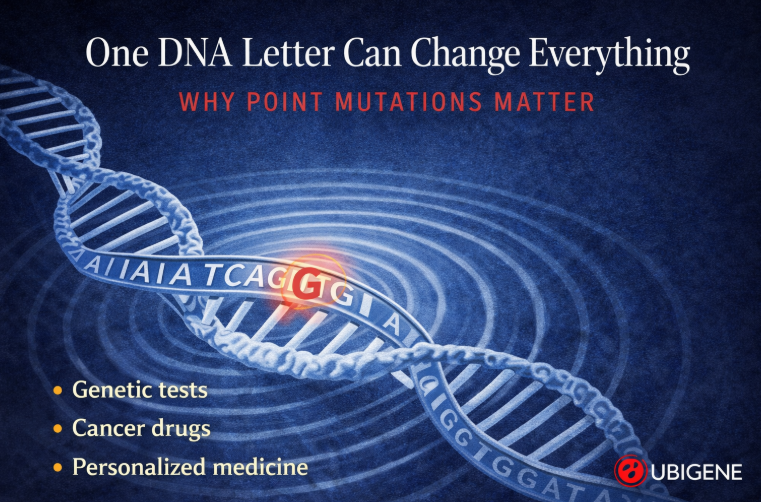
If you’ve ever taken a genetic test—or had a doctor mention “a variant”—you’ve probably had the same reaction most people do: Okay… but what does that actually mean for me?
That question is becoming more common. We can now spot tiny differences in DNA faster than ever, whether it’s from an ancestry-style report, a health screening panel, or a cancer test that looks at a tumor’s genes. But there’s a catch: finding a change is not the same as understanding it. Many results land in the frustrating category of “uncertain.”
A lot of those uncertain changes come down to something surprisingly small: a single “letter” in DNA being different. Scientists call that a point mutation—and even though it sounds like a detail, it can help explain why some diseases run in families, why a medication works for one person but not another, and why a cancer treatment can work beautifully… until it suddenly doesn’t.
This is a plain-language guide to point mutations: what they are, why they matter, and how researchers figure out whether a tiny change is a harmless quirk or something worth paying attention to.
The moment people meet genetics: “variants” in real life
For most of human history, your DNA was invisible. You lived your life without ever knowing what it said.
Now genetics shows up in everyday places:
- a report that says you carry a “variant associated with higher risk”
- a doctor explaining why a certain drug might not work well for you
- a cancer diagnosis that comes with a list of genetic changes inside the tumor
- a news story about a new drug that works only for patients with a specific mutation
All of that can sound intimidating. But at the center of many of these conversations is a simple reality: humans vary. Our DNA isn’t identical, and those differences can sometimes affect health.
The hard part is figuring out which differences matter.
What point mutations are, in plain English
DNA is written in four letters: A, T, C, and G. Those letters form long strings—like an instruction manual. Cells read those instructions to build proteins and regulate how the body works.
A point mutation is just a one-letter change in that string. For example:
- an A becomes a G
- a C becomes a T
That’s it. One letter.
And here’s an important, calming fact: most point mutations are not dangerous. Many do nothing at all. They’re like spelling changes that don’t alter the meaning of a sentence.
But sometimes the letter change hits a sensitive spot—like changing a key word in a recipe—and that’s when you get real effects.
Why tiny changes can have big effects
Point mutations matter when they land in places that control something important. Here are three everyday ways to think about it.
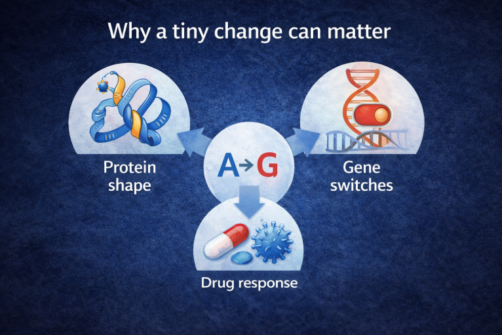
They can change a protein’s “shape”
Proteins are the body’s workers: they build, carry, signal, repair, defend. They’re like machines. If a point mutation changes a protein’s building instructions, the protein may still work… or it may work differently.
Sometimes the change is mild. Sometimes it’s like bending a key so it no longer fits the lock.
They can affect gene “switches”
Not all DNA is about making proteins. Some DNA is more like a control panel—turning genes up, down, on, or off depending on what the cell needs.
A point mutation in one of these regions might not change the protein at all, but it could change how much of it gets made, or when it gets made.
They can influence drugs
Modern medicines often work by binding to a very specific target—like a key fitting into a lock.
If a point mutation changes the shape of the lock, the key may not fit as well. That can mean a drug works less effectively, or stops working altogether. (This is one reason researchers pay close attention to specific mutations in cancer.)
Point mutations in cancer and drug resistance
Cancer is often talked about as a disease, but in many ways it behaves like an ongoing process. Tumor cells divide quickly. Mistakes happen. Mutations appear. And then treatment applies pressure—like a harsh environment.
When a drug kills most cancer cells, it can still leave behind a few that have a change helping them survive. Those survivors grow. Over time, the tumor becomes harder to treat.
That’s drug resistance—and point mutations can play a starring role.
A single-letter change might:
- subtly change the drug’s target so the drug binds less effectively
- switch on a backup pathway that helps the cell survive
- strengthen the cell’s repair systems
- or change how the cell handles stress
For patients, the important point isn’t that “mutations are inevitable.” It’s that researchers study these changes so they can design better treatments, smarter combinations, and better ways to predict who will benefit from what.
How scientists figure out what a point mutation does
Here’s where things get interesting—and more grounded than people expect.
If a mutation shows up in patients, researchers often try to recreate it in a controlled setting, usually in cells. They make two versions that are as similar as possible:
- one with the mutation
- one without it
Then they ask: Do the cells behave differently? Do they grow faster? React differently to stress? Respond to a drug?
And crucially: they double-check the work.
Because in real science, it’s not enough to say, “We edited it.” Researchers need to confirm:
- the exact DNA letter change happened
- it happened in the right place
- they’re not accidentally studying a contaminated or mixed-up cell line
- the results repeat reliably
For readers who want a practical overview of how researchers investigate point mutations—from creating cell models to validating edits—there are step-by-step explainers that show how scientists turn “a variant on paper” into a testable experiment.
Can CRISPR fix a point mutation?
This is the question that naturally follows: If one letter can cause a problem, can we just change it back?
In lab settings, gene-editing tools can be used to recreate or correct specific mutations in cells. That’s a big deal for research. But using gene editing safely in people is much harder, and it depends on things like:
- getting the editor to the right cells in the body
- avoiding unintended edits
- ensuring the change lasts and actually helps
- meeting strict safety requirements
Researchers are also developing tools aimed at making these edits more precise. Two you may hear about:
- Base editing, which can change certain DNA letters without making a full cut in the DNA
- Prime editing, which is often described as a more flexible “search-and-replace” method in certain contexts
For readers curious about how scientists design experiments around a crispr point mutation—including how edits are checked and compared—some background explainers outline the typical research workflow.
A minimal note for context: one example of these explainer-style resources comes from Ubigene, alongside many academic protocols and public research guides.
What this means for the future of “personalized medicine”
The promise of personalized medicine is simple: the right treatment for the right person at the right time.
The reality is that we’re discovering genetic differences faster than we can interpret them. A single tumor can contain many mutations. A single genetic test can flag multiple variants. Some matter a lot. Some don’t. Many aren’t fully understood.
That’s why point mutations matter so much. They’re common. They’re specific. And they’re often the difference between:
- a drug working or not working
- a mutation being harmless or harmful
- a risk being real or just theoretical
Scientists won’t solve this overnight, and cells in a dish aren’t the same as a living human body. But studying point mutations is one of the clearest ways to turn uncertainty into evidence.
Quick FAQ
Are point mutations always harmful?
No. Many are harmless. The effect depends on where the change happens and what it influences.
What’s the difference between a point mutation and a gene mutation?
A point mutation is one letter. “Gene mutation” is broader—it can include larger changes like deletions or insertions.
Why does cancer become resistant to treatment?
Because tumor cells evolve under pressure. Cells with changes that help them survive are more likely to stick around and multiply.
Can CRISPR cure genetic diseases?
Sometimes gene editing may offer long-lasting treatments, but it depends on the disease and the ability to deliver edits safely. Much of today’s work is still research-focused and carefully tested in clinical development.
Bottom line
Point mutations are tiny—sometimes just one DNA letter—but they can have real consequences. They help explain why genetic test results can be confusing, why drug response varies from person to person, and why cancers can adapt to treatment.
As genetics becomes more common in everyday medicine, the big challenge is shifting from “we found a variant” to “we know what it does.” And for many of the most important medical questions, point mutations are where that story begins.








Interesting article, actually. Thanks