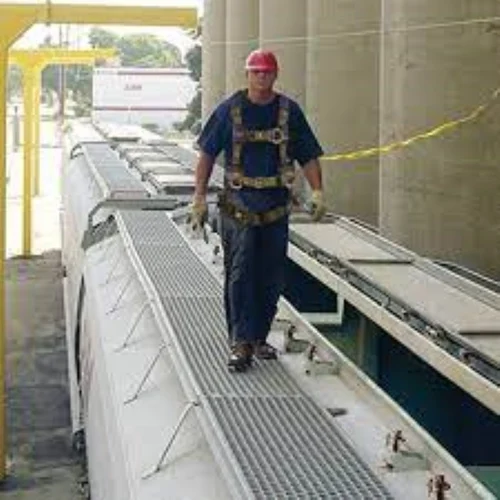
The modern industrial facility is a marvel of efficiency. It’s a landscape of high-bay warehousing, complex robotics, multi-tiered mezzanines, and sophisticated machinery. While these advancements have pushed productivity to new heights, they have also introduced new and complex safety challenges. Among these, the risk of a fall from height remains one of the most persistent and devastating. In this environment, “being careful” isn’t a strategy; it’s a gamble.
This is precisely why a robust, site-specific engineered fall protection program is no longer a “nice-to-have” but an absolute cornerstone of a modern, ethical, and sustainable operation.
It’s time to move past the outdated image of a safety solution being just a harness and a rope. True safety is proactive, not reactive. It’s a system designed by a qualified person, typically a professional engineer, who analyzes the specific hazards of your facility and designs a solution to mitigate them.
The Human Cost: A Moral Imperative
Before we discuss compliance or productivity, let’s start with the most important factor: people. A fall from as little as six feet can result in life-altering injuries or death. The impact of such an event cascades far beyond the individual, affecting families, colleagues, and entire communities. The “it won’t happen to me” mindset is a cognitive bias that has no place in a high-hazard environment.
Implementing an engineered fall protection system is a powerful, tangible statement from a company that it values its workforce. It builds a culture of trust and safety, demonstrating that leadership is invested in sending every worker home in the same condition they arrived. In an era where skilled labor is scarce, a proven commitment to safety is a critical factor in attracting and retaining top talent. Workers who feel safe are more focused, more engaged, and more productive.
The Business Case: An Investment, Not an Expense
Many businesses view comprehensive safety systems through the narrow lens of capital expenditure. This is a critical mistake. The cost of a fall is exponentially higher than the cost of prevention.
Consider the direct and indirect costs of a single fall-related incident:
- Direct Costs: Worker’s compensation, medical bills, and legal fees.
- Indirect Costs: Work stoppage, incident investigation (which can shut down a line or an entire site), decreased worker morale, damage to equipment or product, training and replacement of the injured worker, and potential reputational damage to the company.
- Regulatory Penalties: OSHA fines for fall protection violations are steep and can be applied per instance. These penalties are not just a slap on the wrist; they are significant financial blows.
An engineered fall protection system, when properly designed, is an investment that pays for itself. It prevents costly downtime, protects against litigation and fines, and stabilizes insurance premiums. It transforms safety from a cost center into a business driver that supports operational continuity.
Adapting to Complex Modern Environments
Modern industrial sites are not simple, four-walled boxes. They involve:
- Complex Rooftops: Covered in HVAC units, pipe racks, solar panels, and skylights.
- Mezzanines and Catwalks: Often positioned directly over active production lines or expensive machinery.
- Loading Docks: A constant hub of activity with open edges and variable truck heights.
- Robotic Cells & Automation: Requiring maintenance access in tight, elevated, or unusual spaces.
An off-the-shelf, one-size-fits-all solution cannot possibly address this level of variability. This is where the “engineered” part becomes critical. A qualified engineer will analyze the work being performed, the frequency of access, the number of users, and the structural capacity of the building. They will then design a custom solution, be it a rigid horizontal lifeline over a production line, a series of discrete anchor points for specific maintenance tasks, or a passive guardrail system around a rooftop perimeter. This custom-fit approach is the only way to ensure both 100% compliance and 100% usability.
A system that is difficult to use, or that workers don’t trust, will be bypassed. An engineered system is designed with the worker’s process in mind, making safety the path of least resistance.
Conclusion
In the end, the importance of engineered fall protection is about control. It’s about taking control of your work environment, controlling the inherent risks, and controlling the business outcomes. It’s a proactive declaration that worker safety is not left to chance but is a calculated, designed, and fundamental part of the operation.