
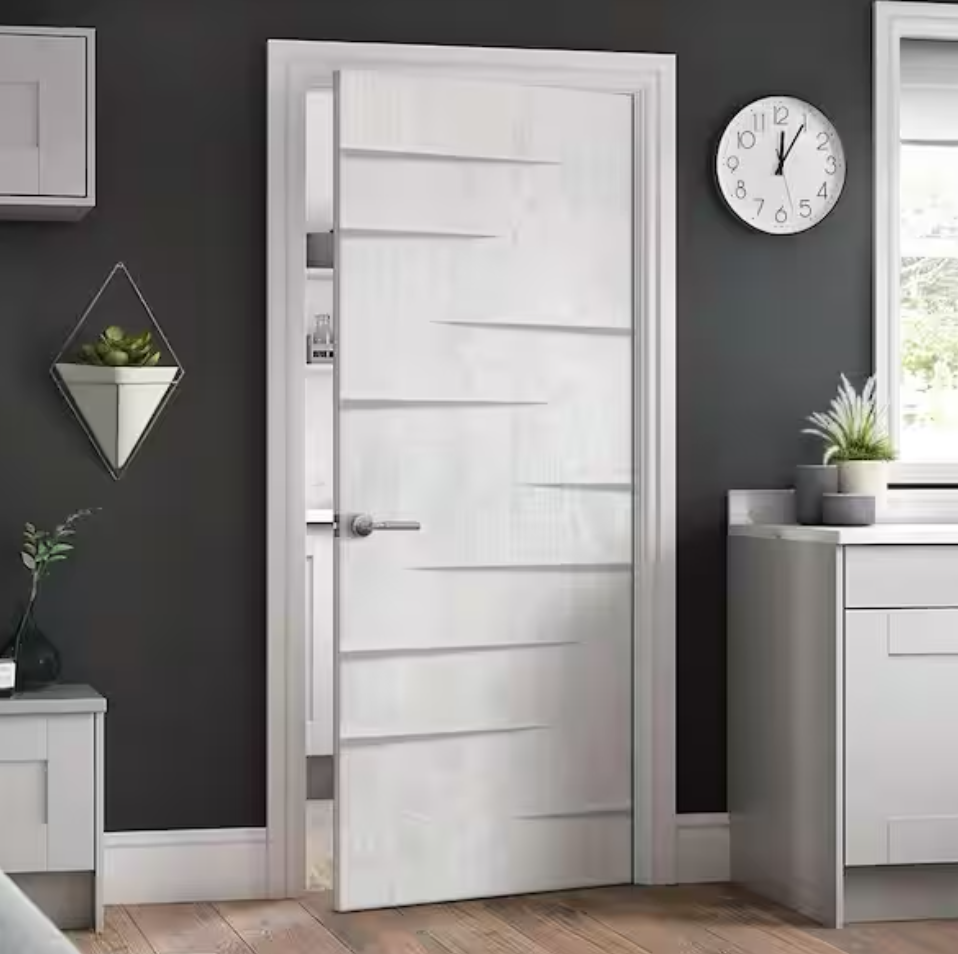
There’s a problem that almost every homeowner eventually runs into — and it’s surprisingly specific. You spend months carefully selecting furniture, lighting, flooring. Then you look at the doors. Standard rectangular slabs in beige or white, with generic hardware that came with the apartment. Suddenly everything you’ve worked to build aesthetically falls flat. Interior doors, it turns out, are one of the most underestimated architectural elements in residential design, and for a long time the industry had almost nothing interesting to offer the average buyer. That’s changing fast.
When a Door Stops Being Just a Door
The concept of a functional door — a flat panel that opens, closes, blocks sound — held unchanged for decades. Then, around 2019–2021, something shifted. According to the Global Door Market Report by Grand View Research, the global interior door market was valued at over $120 billion in 2022 and is projected to grow at a compound annual rate of 4.8% through 2030. That kind of growth doesn’t happen in a static industry. It happens when new ideas start colliding with real demand.
Contemporary door design today sits at a strange and exciting crossroads: the material science of aerospace and automotive industries, the minimalist aesthetic philosophy borrowed from Japanese architecture, and the connectivity logic of smart home ecosystems. These three forces didn’t arrive together by coincidence. They arrived because buyers started asking for more.
The shift, nadо zametit’, began in commercial spaces. Hotels, offices, medical facilities — these environments adopted smart interior doors technology years before it migrated into homes. Touchless access, biometric entry, motorized sliding panels that respond to motion sensors: what once felt like a sci-fi prop is now standard in premium residential builds. And the price gap between commercial-grade and consumer-grade solutions has narrowed significantly — in some categories by as much as 40% over the past five years.
If you’ve ever felt that your home’s entryways are the weakest link in your interior design chain, you’re not alone. The good news is that the solutions now available are more varied, more accessible, and frankly more interesting than anything that existed a decade ago. The question is knowing where to look.
Glass, Air, and the Geometry of Light
Ask any interior architect what material has most transformed modern interior doors trends in the past few years, and the answer almost universally involves glass. Not the frosted-glass-in-a-wooden-frame kind that became a mid-2000s cliché, but structural glass systems — floor-to-ceiling frameless panels, pivoting glass slabs, ribbed or reeded glass that scatters light without blocking it.
The functional problem this solves is real: in urban apartments and modern open-plan homes, natural light is a premium resource. A solid door between a hallway and a living space can rob a room of its only indirect light source. Reeded glass doors — those with vertical fluted texture — transmit roughly 70–80% of ambient light while maintaining visual privacy. That’s a measurable quality-of-life improvement, not just an aesthetic preference.
Sliding interior doors trends have followed a parallel trajectory. The wall-mounted sliding door, once associated with cramped Japanese studio apartments, has been reinterpreted by European and American designers as a statement piece. Pocket doors — which disappear entirely into the wall — are now appearing in custom residential projects at a rate that would have seemed improbable ten years ago. They require more precise carpentry and planning, but the payoff in spatial perception is substantial. A room that “opens up” by absorbing its door into the wall feels measurably larger than one with a door swinging into it.
One detail worth paying attention to: frameless pivot doors. These are doors hung on a central or offset vertical axis rather than traditional side hinges. The pivot mechanism allows for door widths up to 1.5 meters without sagging or warping — something conventional hinges struggle with. The visual effect when a large pivot door swings open is, frankly, theatrical. Several leading European hardware manufacturers, including FritsJurgens and Anyway Doors, have built entire product lines around this single mechanism. It’s not inexpensive, but it’s not inaccessible either.
Materials That Carry a Philosophy
Here’s where things get genuinely interesting — and where the industry’s transformation feels most substantive. Sustainable door materials have moved from a marketing category into a real engineering priority, driven partly by regulation and partly by authentic consumer demand.
Traditional interior doors relied heavily on MDF (medium-density fiberboard) cores wrapped in wood veneer or PVC foil. The formula worked, but it came with environmental costs: formaldehyde-based adhesives, virgin timber consumption, non-recyclable composite structures. The newer generation of sustainable alternatives looks quite different:
- Reclaimed solid wood — sourced from decommissioned structures, each piece unique in grain and patina, with carbon footprint significantly lower than new lumber
- Bamboo composite panels — bamboo reaches harvestable maturity in 3–5 years versus 25–70 for most hardwoods; panels can achieve hardness ratings comparable to oak
- Cork-core doors — cork provides natural acoustic dampening (reducing sound transmission by 15–20 dB in some configurations) and is harvested without cutting the tree
- Recycled aluminum frames — particularly in sliding and pivot systems, recycled aluminum has roughly one-quarter the embodied carbon of primary aluminum
- Bio-based resins — replacing petroleum-derived binding agents in composite door constructions, now offered by several Scandinavian manufacturers
According to a 2023 survey by the National Kitchen and Bath Association, 67% of American homeowners reported that sustainability credentials “significantly influenced” their decision when selecting interior finishes. Doors are increasingly part of that conversation.
Smart Access and the Invisible Interface
This section deserves more attention than it typically gets, because the shift happening here is not incremental — it’s architectural. Smart interior doors technology isn’t about adding a keypad to an existing door. It’s about rethinking what access control means in a domestic space.
The current generation of smart door systems operates on several levels simultaneously. At the most basic: motorized openers triggered by proximity sensors or smartphone apps. More sophisticated: integration with building management systems, so that a door recognizes different household members and adjusts — unlocking silently for adults, chiming or requiring confirmation for children entering restricted spaces. At the leading edge: doors that monitor environmental conditions (CO2 levels, temperature differentials) and adjust their seal or ventilation gap accordingly.
The numbers behind adoption are telling. According to Statista, the global smart door lock market alone was valued at $2.7 billion in 2023 and is expected to reach $7.4 billion by 2030. Interior applications — as opposed to entry locks — represent the fastest-growing segment. Companies like Allegion, dormakaba, and ASSA ABLOY have all launched product lines specifically targeting interior smart door applications in the past two years.
What’s particularly worth noting is the integration angle. A smart interior door in 2024 doesn’t function as an isolated gadget — it connects to platforms like Apple HomeKit, Google Home, and Amazon Alexa. This means that a door can be part of an automated morning routine: it opens on schedule, triggers the hallway light, and signals the thermostat that a room is now occupied. The door becomes a sensor node in a larger domestic intelligence system. That reframing — from hardware to software-enabled infrastructure — is what makes this category genuinely new.
For anyone planning a home renovation or new build, the practical advice is this: rough in the power and data conduit now, even if you don’t install smart systems immediately. Retrofitting is expensive; future-proofing the opening costs almost nothing at framing stage.
The Custom Design Shift and What It Means for American Homeowners
Custom interior doors USA has become a genuinely competitive market segment, not just a luxury niche. The combination of CNC routing technology, digitally controlled finishing systems, and direct-to-consumer manufacturing models has reduced the price premium for custom doors to a range where middle-market homeowners can realistically access it.
What custom design actually means in practice: doors specified to non-standard dimensions (critical in older American homes where openings are rarely standard), doors with integrated lighting or integrated shelving (the door as a functional object rather than a passive divider), doors finished in materials matched precisely to existing cabinetry or millwork. The last point is particularly relevant to anyone who has ever tried to match a factory door finish to custom cabinetry — the color and texture discrepancy is maddening.
Companies working at the intersection of custom design and contemporary construction — including, for example, the kind of integrated approach that firms like A&E Modern Construction Los Angeles bring to high-end residential projects — increasingly treat doors as coordinated architectural elements rather than afterthoughts sourced from a catalog. That shift in how doors are specified and installed produces interiors that feel resolved and intentional rather than assembled.
The practical path for homeowners: start with the opening dimensions and the light conditions of each room before selecting a door type. Then work backwards from function — is privacy the priority, or light transmission, or acoustic performance? Only after those questions are answered does the aesthetic choice become meaningful. A beautiful door that blocks the only light source in a room is a problem dressed as a solution.
The interior door is, in the end, a threshold — literally and architecturally. Every room begins and ends at one. Getting it right isn’t a finishing detail. It’s a structural decision about how a home feels to live in.







