
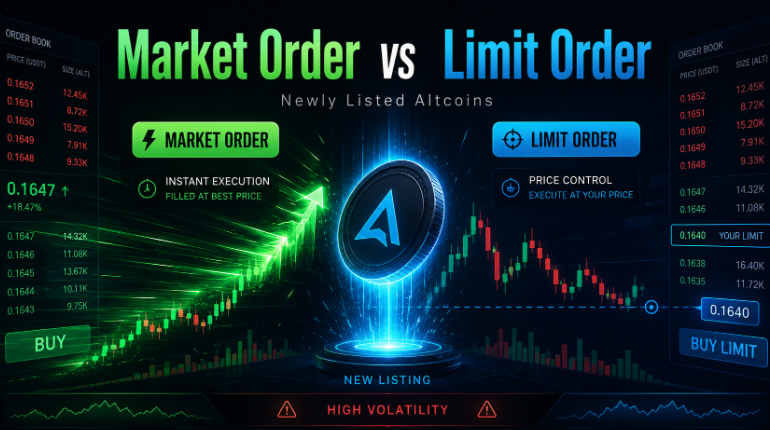
Quick Answer
A limit order is usually safer for newly listed altcoins because it sets the worst price you’re willing to accept. A market order guarantees speed, not price, and on a thin, newly opened order book, that can mean paying far more (or receiving far less) than the last quoted price. When the order book looks disorderly, the safest move is often to wait rather than use either order type.
Key Takeaways
- Limit orders control price, not execution, they protect against a bad fill but may not fill at all.
- Market orders control execution, not price, they almost always fill, but the average price can move sharply against you.
- A marketable limit order, priced just past the current spread, often balances both goals.
- Exchange launch rules matter. Many platforms restrict or disable market orders during the first minutes of trading.
- Liquidity, not order type, is the real risk. If the book can’t support your trade size, switching order types won’t fix that.
This article covers spot trading on centralized exchanges, newly opened pairs, and retail-sized orders, not futures, DEX swaps, or OTC trading.
Why Newly Listed Altcoins Are Riskier to Trade
A newly listed token hasn’t yet built a dependable price, spread, or liquidity base, so the same order type behaves very differently than it would on an established pair.
Several factors compound the risk during the opening minutes of trading:
- Unstable price discovery: early buyers and sellers often disagree sharply on fair value.
- Thin cumulative depth: the best bid or ask may represent only a small amount of capital.
- Wide bid-ask spreads: a trade can start at a loss before fees are counted.
- Fast-changing orders: visible liquidity can vanish before your order reaches the matching engine.
- Fragmented pricing: the same token can trade at different prices across exchanges at launch.
- Concentrated order flow: airdrop recipients and early holders can flood one side of the book at once.
- A misleading last price: the most recent trade reflects one transaction, not what’s available for your whole order.
A small market buy can fill across several rising price levels instead of one, pushing the average cost well above the quoted price.
When a Market Order Helps — and How It Can Go Wrong
A market order is useful when execution can’t wait, but it hands control over your final price to whatever liquidity happens to be sitting in the book.
Legitimate uses
Highest likelihood of immediate execution; reasonable when your order is small relative to visible depth; useful for exiting a position quickly when reducing risk matters more than price; requires no active order management.
Risks on a new listing
The order can sweep through multiple price levels instead of one; the average fill can be materially worse than the top-of-book quote; a large buy can push its own price up (a large sell, down); the exact cost is unknown until after the fill; exchange protection rules can still cancel the unfilled portion, so completion isn’t guaranteed; and market orders typically remove liquidity, usually treated as taker trades, though fees vary by exchange and account tier.
For example, a buy order might fill partly at $1.00, then at $1.06, then $1.14 as it works through thinner levels, a realistic launch-day outcome, not an edge case.
Why a Limit Order Is Usually Safer — but Isn’t Risk-Free
A limit order protects you from paying more (or accepting less) than a price you choose, but it can’t force another trader to meet that price.
Benefits
Sets a clear ceiling on buying price or floor on selling price; prevents the order from consuming liquidity beyond your tolerance; lets you wait for price to move toward your target; can qualify for maker fees when it rests on the book instead of executing immediately.
Trade-offs
The order may receive no fill at all; only part of the requested quantity may execute; an unfilled order can go stale as conditions shift; repeatedly raising your limit to chase a rising price undermines the original point of using one. Also, a limit order isn’t automatically a maker order, one priced to cross the spread executes immediately as a taker order, and fees follow the execution type, not the label.
A marketable limit order is often the practical middle ground. Whether you’re buying a newly listed pair or preparing to trade ATLA/USDT, placing a buy limit slightly above the current ask (or a sell limit slightly below the current bid) can improve execution while still capping the maximum price you’re willing to pay.
How Exchange Launch Rules Change the Decision
Newly listed pairs often don’t open into full, unrestricted trading, check the exchange’s current market status before choosing an order type.
- Coinbase can move a new listing through auction, limit-only, and full-trading phases. Only limit orders are accepted during the auction, while market orders become available once full trading starts.
- OKX has used call auctions with price-limit rules on select listings, its AEON listing in July 2026, for instance, combined a one-hour call auction with a five-minute post-auction window in which market orders were rejected.
- MEXC has applied an opening price-protection band on some new listings, for example, capping executable prices at a multiple of the opening price for the first couple of minutes before lifting the restriction. Separately, since August 2025 it has rejected orders (including limit, OCO, FOK, and IOC types) that deviate too far from the current fair price.
- Binance and Kraken offer trader-level safeguards instead of phased launches. Binance’s slippage-tolerance setting can convert a protected market order into an immediate-or-cancel limit order, though it may be unavailable right after a pair opens, before a last price exists. Kraken Pro shows a confirmation warning when projected slippage reaches roughly 3% or more.
These are backstops, not substitutes for checking depth and spread yourself. Rules and availability change, so confirm current settings before trading.
Decision Framework: Which Order Should You Use?
Work through this in order rather than deciding based on whether you’re bullish or bearish.
Is trading fully open?
If the pair is in auction, post-only, or limit-only mode, use an eligible limit order or wait. If market status is unclear, don’t submit the order yet.
Is the spread stable and acceptable?
Compare the best bid and ask — not the last-traded price. A wide, rapidly changing spread, or repeated gaps between book levels, signals weak depth.
How large is your order relative to available depth?
Add up quantity across price levels up to your acceptable maximum, using quote-currency value rather than token count. Split the order if one submission would consume several levels.
How urgent is execution?
| Situation | Preferred response | Benefit | Trade-off |
| Buying during the opening auction | Limit order, or wait | Keeps price discipline | No guaranteed allocation |
| Buying shortly after full trading opens | Marketable limit order | Fast execution with a ceiling | Possible partial fill |
| Low urgency, uncertain valuation | Passive limit order | Better price control, possible maker rate | Price may move away |
| Urgent risk exit | Small protected market order or aggressive sell limit | Prioritizes reducing exposure | Worse realized price possible |
| Large order, thin liquidity | Split limit orders, or don’t trade | Reduces market impact | Slower execution |
| Extreme volatility, no stable reference price | Wait | Avoids uncontrolled entry | May miss the trade |
If the order book can’t absorb your trade within an acceptable price range, changing the order type won’t fix that, the underlying liquidity problem remains.
Safer Execution Checklist
- Before submitting: confirm the trading pair, check the market’s status, review spread and depth, estimate your likely average fill, and check maker/taker fees rather than assume a limit order earns the maker rate.
- While executing: start smaller than your full intended size, prefer a marketable limit order when speed matters, and avoid repeatedly raising a buy limit just because it hasn’t been filled.
- After execution: check the weighted average fill, confirm whether it filled completely, cancel unwanted remaining quantity, and record fees and realized slippage.
Don’t trade yet if spreads are unusually wide, depth is disappearing, market status is unclear, or your order exceeds available liquidity.
The Bottom Line
A limit order is usually the safer default because it defines the worst price you’ll accept, while a market order trades that certainty away for speed. A marketable limit order often gives the best balance of the two. But no order type makes an illiquid or disorderly market safe, when price discovery hasn’t settled, declining to trade is itself a valid decision.
FAQ
Is a market order or limit order better for buying a new crypto listing?
A limit order generally offers better price protection, since it caps what you’ll pay. A market order prioritizes speed and can produce a worse average price on a thin book.
Do limit orders guarantee a safer entry?
No. A limit order guarantees a price ceiling or floor, not that the trade executes. In a fast-moving or illiquid market it may fill only partially, or not at all.
Why do some exchanges disable market orders right after a listing?
Platforms like Coinbase and OKX use auction or limit-only phases so an opening price can form with less risk of runaway execution, before lifting restrictions once trading stabilizes.
How can I reduce slippage on a newly listed token?
Use a marketable limit order instead of a plain market order, size your trade against visible depth rather than your full intended amount, and split large orders into smaller pieces.
When should I avoid trading altogether?
When the spread is unusually wide, depth is thin or disappearing, market status is unclear, or your order exceeds what the book can absorb within your acceptable price range.





