
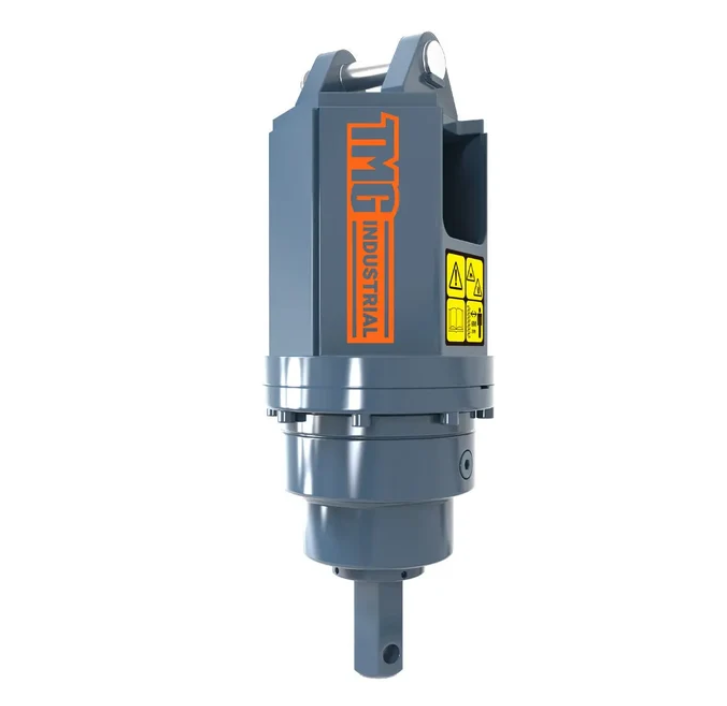
Late summer fence work exposes the component nobody shops for
Across the United States, late summer is when fence lines, deck footings, and sign posts get built before autumn ground conditions arrive. Crews study bits closely and rarely study the auger drive that turns them, even though that unit sets what a day can accomplish.
A bit only cuts what something else turns. The power head supplies rotation, carries the tool, and passes the reaction back into the carrier machine. A mismatch there shows up as a hole that stops halfway rather than as a dull cutting edge.
A power head is a hydraulic motor with gear reduction bolted underneath
Pressurized oil spins a motor at high speed and modest force. A planetary gear set then trades that speed away for turning force, which is exactly the exchange that packed clay demands. What reaches the shaft is slow and strong instead of fast and weak.
This is why an auger drive is rated by turning force rather than by the horsepower of the machine behind it. The carrier supplies oil, the motor converts it into rotation, and the reduction multiplies it. Every published figure follows from that chain.
Flow sets how fast the shaft turns and pressure sets how hard
Hydraulic flow, measured in gallons per minute, governs rotational speed. System pressure governs the force available at that speed. A unit built for seven to twenty gallons per minute covers most compact carriers and must behave sensibly across that band.
Operators often assume that more oil means more power. Extra flow only spins the shaft faster and heats the motor. Thin pressure leaves the tool turning freely in air and stalling the instant soil resists. Neither number substitutes for the other.
Turning force has to be matched to the largest diameter a crew will spin
A wider tool sweeps more soil each revolution, so resisting torque climbs steeply with diameter rather than in even steps. A head sized around narrow work stalls on a larger tool. Operators then lean on the machine, and that is where damage starts.
Sizing an auger drive therefore begins with the biggest hole a crew honestly digs, not the average one. A landscaper in central Ohio who mostly sets four inch posts but occasionally a lamp pillar sizes for the pillar. Spare turning force is cheap insurance.
Whatever the shaft twists into the ground twists back into the machine
Reaction torque is the unavoidable other half of drilling. Soil resists rotation, and that resistance travels up the shaft into the mounting plate and then into the carrier. A skid steer can slew sideways, and a light tractor can lift a wheel.
The answer is a carrier heavy enough to absorb what the head produces, and an operator ready for the moment a tool catches a root or a stone. Nobody should stand alongside a turning shaft. Torque does not vanish because nobody planned for it.
The output shaft is where two separate systems have to agree
A two inch hexagonal output shaft has become the common interface, because flat faces cannot slip under load and the pin drops in by hand. Any tool sharing that pattern fits, which makes the head a platform rather than half of a pair.
The same reasoning applies at the top of the unit. A universal mounting plate lets one auger drive serve a skid steer this week and a track loader the next. Quick couplers on the hydraulic lines reduce a changeover to minutes.
Mounting plates and shafts that decide what an auger drive can serve
- Universal skid steer plate: fits most compact carriers
- Two inch hexagonal shaft: accepts common tool sizes
- Flat faced couplers: connect without trapped pressure
- Case drain line: protects the motor seals
Where a dedicated power head earns its place and where it does not
- Strength: turning force independent of tool choice
- Strength: moves between carriers on one plate
- Limit: demands matching flow and pressure
- Limit: reaction torque needs a stable machine
Weighed against a handheld digger, the unit gives up nothing that matters on open ground and returns holes that stay vertical without a second person hanging on. On tight sites close to buildings, a handheld tool still reaches places a loader simply cannot.
Buyers are starting to specify the drive before they specify the bit
Rental fleets and small contractors increasingly treat cutting tools as consumable stock and the power head as the durable asset, which reverses how the category was sold a decade ago. That shift rewards units built around flow range and interface standards.
It is the thinking behind the earth drilling attachments TMG Industrial builds for compact carriers, where the head is matched to the machine first and to the ground second.





