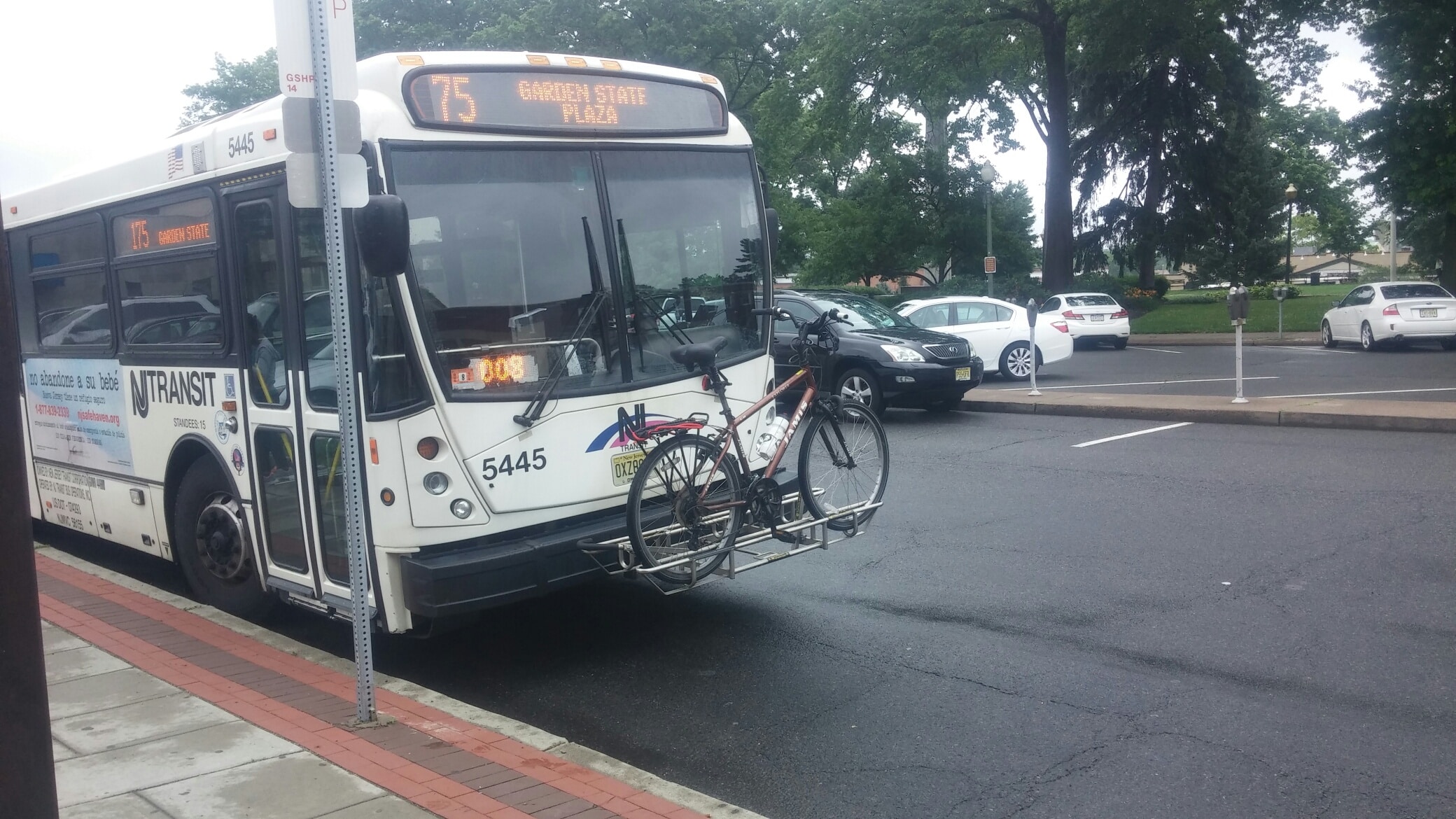
A parking garage that close to the train station and bus stop would be sufficient to serve commuters. The street level spaces near the should all be limited to 3 hors for the benefit of CBD businesses and their customers. Oh, and parking should be free on Sundays. Okay, now someone else can be king for a day…
The chamber wants it for increase parking for the business but you say it for the commuters. Can’t have it both way. And if you think that the commuter are going to get off the train and eat and shop in Ridgewood I don’t think so. Commuter just want to get home after a long day. On a side not if they get off the train after 5:30 they couldn’t shop anyway all the store are closed. Which is it?
If it is meant to be a place for long-term commuter parking, then I can see a better chance of it working. For this to happen, the existing all-day parking bays at/near the train station and the bus station will need to be changed to meters that only allow short-term parking intended for shoppers and diners.
The parking garage under consideration would be constructed across the street from Our Lady if Mount Carmel Church. Has this location been determined to be the best? What happened to the lot across the street from TD Bank on Franklin Avenue? Wasn’t that lot condemned for the purpose of erecting a parking garage? And wasn’t a bond issued at the time that we never used to build the structure?
Readers say at the end of the Taxpayers will be on the hook for the garage while business,developers and NJT will all benefit from it
My questions:
1. What happens if parking revenues fall short of expectations?
2. What is the proposed parking fee structure for the new garage?
These are very important questions and I will explain why. For the first one, the answer is pretty obvious. The Village taxpayers will be on the hook for it as the construction bond cannot be reneged on just because you hoped there would be enough revenue. The second one will absolutely dictate the success or failure of the entire project. Any fee structure that is more than street parking will completely disincentivize most people from using the garage. They will circle the blocks until a street space frees up, or they will go somewhere else to eat/shop. As I’ve stated before, this garage will represent the parking location of absolute last resort, and I predict it will be viewed in years to come as one of those “what were they thinking” buildings.
Its called a shell game. money from the parking revenue is now used to support the town budget. money from the new garage if a surplus will be used to pay the loan off on the new garage. If revenue from the new garage isn’t adequate the town (I mean taxpayers) will have to make up the shortfall.
Or should the Village tax the CBD landlords for the garage or local businesses, their the ones that are going to profit from it.
Ridgewood NJ, Walker Parking study compares a traditional self storage parking complex of 5 stories to using an automated vehicle storage and retrieval system(AVSRS). A 5 level self park structure would increase parking approximately 350 spaces while the AVSRS at a significantly higher cost would add approximately 393 spaces according to Walker.
Walker looked at 2 types of automated parking systems Puzzle and Rack .
Self park would cost roughly $42,200 per car and total cost estimate of $11,500,000.
Puzzle Automated Park $60,900 per car and total cost estimate of $23,900,000.
Rack Automated Park $53,800 per car and total cost estimate of $17,310,000.
Larger capacity self park 394 spaces , $30,800 per car and total cost estimate $12,140,000.
Walker Parking Consultant Study – Ridgewood Hudson Street – July 5th
On June 17th, Treasury Secretary Jack Lew shocked many, including former Chairman of the Federal Reserve Ben Bernanke, when he proclaimed that Alexander Hamilton (1755-1804) – the first and foremost Treasury Secretary – would be demoted and share the ten-dollar bill with a yet unnamed woman. Undaunted by wide-spread criticism, Secretary Lew continued to press his case at an event at the Brookings Institution on July 8th. Asked about the ten-dollar bill’s selection, Secretary Lew insipidly claimed that the ten-dollar bill was the “next up” for redesign to help combat forgery. The diminution of Hamilton, for whatever reason, is simply indefensible.
Just how great was Hamilton? A recent scholarly book by Robert E. Wright and David J. Cowen, Financial Founding Fathers: The Men Who Made America Rich, begins its pantheon of greats with a chapter on Alexander Hamilton. It is aptly titled “The Creator.”
After the Constitution was ratified and George Washington was elected President, the new federal government lacked credibility. Public finances hung like a threatening cloud over the government. Recall that paper money and debt were innovations of the colonial era, and that, once the Revolutionary War began, Americans used these innovations to the maximum. As a result, the United States was born in a sea of debt. A majority of the public favored a debt default. Alexander Hamilton, acting as Washington’s Secretary of the Treasury, was firmly against default. As a matter of principle, he argued that the sanctity of contracts was the foundation of all morality. And as a practical matter, Hamilton argued that good government depended on its ability to fulfill its promises.
Hamilton won the argument and set about digging the country out of its financial debacle. Among other things, Hamilton was – what would today be called – a first-class financial engineer. He established a federal sinking fund to finance the Revolutionary War debt. He also engineered a large debt swap in which the debts of individual states were assumed by the newly created federal government. By August 1791, federal bonds sold above par in Europe, and by 1795, all foreign debts had been paid off. Hamilton’s solution for America’s debt problem provided the country with a credibility and confidence shock.
Doesn’t the 76th Secretary of Treasury have better things to do than to diminish the presence of our 1st and most distinguished Secretary of Treasury
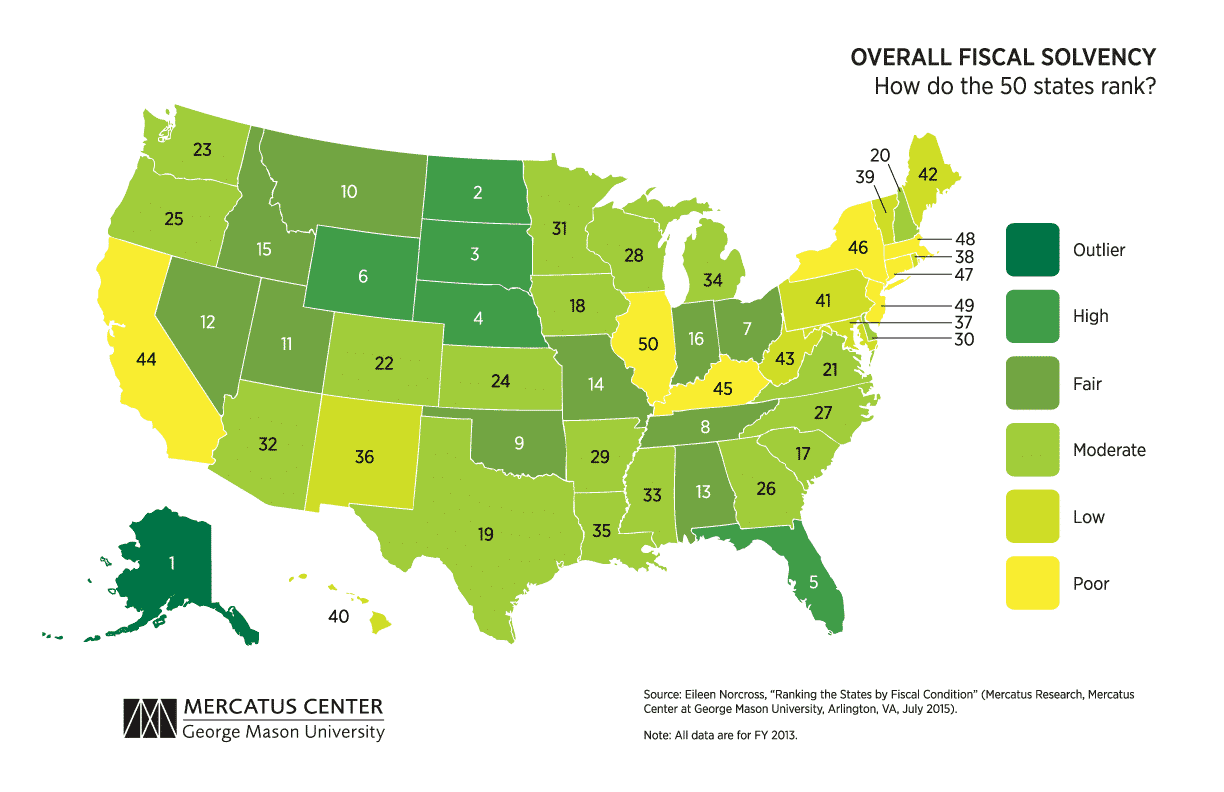
Most U.S. state governments are nearly back to fiscal normalcy following the Great Recession of 2007–09, but there still exist troubling signs that states are ignoring the risks in unfunded programs, according to a new study from the Mercatus Center at George Mason University. States that appear to be fiscally robust must take stock of their long-term fiscal health before making future public policy decisions in order to avoid serious trouble if another financial crisis were to occur, the study warns.
Building on previous research about state fiscal conditions, Mercatus Center Senior Research Fellow Eileen Norcross ranked each state’s financial health based on short- and long-term debt and other key fiscal obligations. The study provides snapshots of each state’s fiscal health in an easily understood format.
Norcross analyzed the states’ own audited financial reports, which include basic financial statistics on revenues, expenditures, cash, assets, liabilities, and debt. The states were ranked based on five categories of fiscal solvency, including cash solvency, budget solvency, long-run solvency, service-level solvency, and trust fund solvency. These factors determine states’ ability to cover short- and long-term bills.
The top five states, which are considered fiscally healthy relative to other states, still face substantial long-term challenges with pension and health care benefits systems. The study attributes the high ranking of these five states — Alaska, North Dakota, South Dakota, Nebraska, and Florida — to their significant amounts of cash on hand and relatively low short-term debt obligations.
The bottom five states — Illinois, New Jersey, Massachusetts, Connecticut, and New York — have low amounts of cash on hand, large debt obligations, and high deficits. Based on their billions of dollars in unfunded liabilities, including unfunded pensions and health care benefits, they are at risk of “fiscal peril.”
UPDATE: Ridgewood Police Department : The person the Ridgewood Police was trying to identify earlier this evening has been positively identified through social media Thank you
Help Needed Identifying a living John Doe , Please Share
ON THE EVENING OF JULY, 8 2015 A MAN WALKED INTO THE EMERGENCY DEPARTMENT AT THE VALLEY HOSPITAL IN RIDGEWOOD, NJ. HE HAS NO RECOLLECTION OF ANY EVENTS PREVIOUS TO WALKING INTO THE HOSPITAL AND DOES NOT KNOW HIS IDENTITY. PHYSICIAN’S REPORT THAT THE PARTY MAY BE SUFFERING FROM “GLOBAL TRANSIENT AMNESIA”.
PHYSICAL DESCRIPTION: WHITE MALE, 40S TO 50S, NO TATTOOS, TWO SURGICAL SCARS ON HIS LOWER BACK, APPROXIMATELY 4CM IN LENGTH FROM A SPINAL FUSION OF L5 AND S1. MUSTACHE AND SCRUFFY BEARD UPON ENTRY TO THE HOSPITAL
CLOTHING DESCRIPTION: WEARING OFF-WHITE HAT, GREY HANES BRAND LONG SLEEVE SHIRT, DARK GREY SWEAT PANTS, SIZE 9 ½ WHITE REEBOK CLASSIC SNEAKERS.
ANY ASSISTANCE IN IDENTIFYING THE PARTY WOULD BE APPRECIATED.
NJ Transit needs to close a $56 million budget gap.
Rockland residents will likely find out this week if they’ll still be able to take a late night Pascack Valley Line train on most days to get home from New York City.
On Wednesday, the New Jersey Transit board is expected to decide whether to eliminate the 12:45 a.m. train out of Hoboken, N.J. (1601), which runs Monday through Friday. That would leave those who work or stay late in the city scrambling to catch the 10:42 p.m. departure from Hoboken.
But people who like to spend Friday or Saturday nights in the city can take some consolation: Train 2101, which departs Hoboken at 12:45 a.m. on Saturdays and Sundays, is not part of the package of potential service cuts, meaning they can return to stations in Pearl River, Nanuet and Spring Valley.
If approved, NJ Transit spokeswoman Nancy Snyder said the service would end in September, while a nine percent fare increase would take effect in October. Most train riders in Rockland, except those who travel from Suffern, wouldn’t be impacted by the proposed increase since they pay their fares to Metro-North Railroad.
NJ Transit needs to close a $56 million budget gap. Eliminating Train 1601 — which serves about 40 daily riders — would save it $420,000 this fiscal year. Roughly half of those riders get off at one of three stations in Rockland, Metropolitan Transportation Authority spokesman Aaron Donovan said.
Parents are often at fault, directly or indirectly, when children and teenagers become hooked on electronic media, playing video games or sending texts many hours a day instead of interacting with the real world and the people in it. And as discussed in last week’s column, digital overload can impair a child’s social, emotional and intellectual growth.
This sad conclusion of many experts in child development has prompted them to suggest ways parents can prevent or rectify the problem before undue damage occurs.
“There’s nothing about this that can’t be fixed,” said Catherine Steiner-Adair, a Harvard-affiliated psychologist. “And the sooner, the better.”
As Susan Stiffelman, a family therapist, put it in The Huffington Post, today’s parents are unprepared “to deal with the intense pull and highly addictive nature of what the online world has to offer. As parents, we have an opportunity to guide our kids so that they can learn habits that help them make use of the digital world, without being swallowed whole by it.”
Trump: The U.S. will invite El Chapo, the Mexican drug lord who just escaped prison, to become a U.S. citizen because our “leaders” can’t say no!
By Greg Richter | Sunday, 12 Jul 2015 07:16 PM
Donald Trump on Sunday blasted “corrupt Mexican officials” for letting a notorious drug kingpin escape from a maximum security prison.
Joaquin “El Chapo” Guzman escaped the prison by riding a motorcycle through a mile-long tunnel that was connected to the shower area of Guzman’s cell. It is his second escape, and prison employees are being questioned.
Editor’s Note: Do You Approve of Obama’s Job Performance? Vote Here Now.
Trump noted that the last time Guzman escaped he was free for 13 years.
“He has been selling drugs in the U.S. big-time – a major kingpin,” he said in a statement sent to the media.
“He is possibly in the U.S. and his drugs and drug dealers freely cross into the United States through our pathetic border,” Trump said. “This is just one example of the many instances of Mexico taking advantage of the United States. They take our country’s money but leave the tremendous crime, much of which is a result of the rampant drug trafficking.”
Greece Disaster Shows Unavoidable Consequences of Socialism
Stephen Moore / @StephenMoore / July 11, 2015
The Greek citizens have rolled the dice and voted overwhelmingly to reject the “austerity” referendum. This was a way for voters to stick a finger in the eye of their creditors. The left around the world has responded to the vote with thunderous applause—and is selling the results as a vote for “the little guy.”
The Greeks believed that voting against the debt restructuring plan would give them more leverage with the banks, the IMF and the EU. But what happens now in Greece? The banks are shutting down this week. Withdrawals from bank accounts are being tightly restricted.
Greece is formally in default on its loans and in the weeks ahead as more IMF and EU loans come due, Greece is about to slide into fiscal oblivion. This is the natural and unavoidable consequence of socialism everywhere it has been tried.
Financial collapse.
Get our emails for free.
Sign Up
There are no “good” options for now to end this Greek tragedy. A lot of people are going to get an involuntary financial haircut—pensioners, bond holders, welfare recipients, government workers, the IMF. By voting “no” on the latest referendum, the Greek voters rejected outside help, and the conditions that come with it. That means the responsibility for resolving the crisis now rests clearly with the Greeks themselves, as it should have all along.
Greece is now sitting on $350 billion of debt. It’s unpayable and the international monetary experts are deluding themselves if they believe that by some magic stroke this nation of 11 million citizens will sometime in the future come up with the funds to repay it.
Greece is already overtaxed, and adding more taxes on the few businesses that are still functioning is only going to ensure their eventual demise too. Meanwhile the Greek citizens have come to the conclusion that fat pensions and cradle to grave welfare benefits are a human right that can never be taken away. That is what they declared in the referendum. But those benefits are going to be lost. Socialism has radically reduced the standard of living of the citizens.
All of the conventional EU and IMF solutions have been designed to give Greeks time to adjust stop their profligate ways. That hasn’t happened. The Greek citizens are simply living way, way beyond their means. This is a nation with an average retirement age of 60. This is a nation that has one in four adults unemployed and half of its young people out of work. With such countrywide levels of idleness, who is there that is working to pay for these super-extravagant benefits? Are the hard-working German citizens going to pay more taxes to pay for lavish benefits to Greek retirees? Almost certainly not. And they would be fools to do so.
Default will force everyone to take a hit. Creditors may get 50 cents on the dollar owed depending on how bleak the finances really are in Athens. Welfare benefits will have to be slashed. Pensions for retirees will be cut based on the new reality of Greece’s finances. This may seem “unfair,” but how is it fair to require young Greek citizens to pay exorbitant taxes to pay for the sins of their fathers and grandfathers. And default, at least, may provide the opportunity for a fresh start.
When Detroit filed for bankruptcy, it allowed the Motor City to in effect start over economically. The city is financially cut off from much borrowing. Government workers have been laid off. Benefits have finally been trimmed. And guess what? Detroit is making a comeback. Real estate values are rising. Construction is beginning again. In a decade, Detroit could be a financially sound and desirable place to live and do business.
One implication of this solution is that investors may start to view sovereign debt as risky, not risk free. They will charge nations—especially those that have massive unfunded liabilities—higher interest rates on their debt. Making it harder for bloated governments to borrow would be a positive development. More money would flow to private sector borrowing, and less to governments.
The bigger chance of fiscal contagion is to accede to the Greek voters’ demands for better terms of its debt repayment. If that happens every nation that owes debts to the IMF or the European Union will demand more generous terms from its creditors. Nations like Argentina and Bolivia will stop making payments on international loans and claim the conditions are too tough to repay.
The big lie is that Greece has already lived through austerity. This is a nation that in 2013 was spending up to 59 percent of its GDP on government benefits and programs. Even today the government accounts for half of all spending. How is that austerity? The problem is as the private economy shrinks, the government’s role keeps expanding. Greece’s debt was 120 percent of GDP a decade ago, and now its 175 percent. This is the opposite of austerity. It is a spendfest.
In sum, Greece needs much less socialism, and much more privatization. Sell off government assets. Cut tax rates. Sell one of the islands to Disney. Oust the communists who ruined this nation. Get government spending down to 25 percent of GDP.
As this is being written, the Greek government, despite the referendum and its inflammatory rhetoric, has resumed negotiations with its creditors. They need to hold firm, insisting that Greece finally undertake the necessary reforms that they have promised over and over to implement. Clearly, the loans so far have not averted financial crises. They have enabled them through their lending policies that trust too much in the promises of an irresponsible government. That’s the equivalent of giving crack cocaine hits to drug addicts. That story never ends well, and, alas, Greece is a tragic example of that lesson.
JULY 12, 2015 LAST UPDATED: MONDAY, JULY 13, 2015, 12:16 AM
BY GREGORY RUMMO
SUBURBAN TRENDS
Two articles caught my attention last week about one of everyone’s favorite topics—bacon.
The first headlined “High on the Hogs as Herds Rebound,” appeared in the July 3 Wall Street Journal and shared the joyful news that farmers are “on track to produce a record amount of pork this year.”
You may recall in the spring of 2013 the US population of hogs was decimated by an infection called PED, short for porcine epidemic diarrhea. Piglets were born in poor health and many of them didn’t survive more than a few days. It was estimated that anywhere from 7-10 million hogs died and the economics of the U.S. livestock industry being simply one of supply and demand pushed the price of pork to all-time records, and, sadly, bacon along with it.
Fast forward two years and in a startling reversal of fortunes for farmers and bacon connoisseurs, this is all about to change.
2015 is forecast to be a record pork production year in the United States, eclipsing the previous record of 23.35 billion pounds set in 2008.
I can almost hear it sizzling on the griddle!
The price of pork—including bacon—will be dropping as fast as you can say “Budea, budea th, tha, that’s all folks!”
But is eating all that bacon really healthy for you?
Ridgewood NJ, For the 15th consecutive year The Valley Hospital has been recognized as one of the nation’s Most Wired Hospitals, according to the 17th annual HealthCare’s Most Wired™ Survey, released by the American Hospital Association’s Health Forum and the College of Healthcare Information Management Executives (CHIME).
The Most Wired distinction recognizes hospitals for successful health IT planning and implementation. The survey examined how organizations are leveraging IT to improve performance for value-based healthcare in the areas of infrastructure, business and administrative management, quality and safety, and clinical integration.
“The Valley Hospital is proud to have once again made the Most Wired list,” said Eric Carey, Vice President of Information Systems and Chief Information Officer for The Valley Hospital. “Valley is committed to providing excellent clinical care and service, and we continue to invest in technology that helps us improve the quality and delivery of patient care,” he said.
HealthCare’s Most Wired™ Survey, conducted between Jan. 15 and March 15, 2015, is published annually by Health & Hospitals Network. Respondents completed 741 surveys, representing more than 39 percent of all U.S. hospitals. Last October, the AHA/Health Forum and CHIME announced the formation of a Most Wired partnership to enhance collaboration between the two organizations in the development and sustainability of the survey, and to collectively help meet the growing demand for useful data on health IT integration.
Detailed results of the survey and study can be found in the July issue of Health & Hospitals Network. For a full list of winners visit www.hhnmag.com.
He drives a Harley-Davidson motorcycle. He brags about wearing a sweater he bought for $1 at Kohl’s department store.
He touts his humble upbringing as a small-town minister’s son, and how he proposed to his wife over ribs at a local barbecue joint. Scott Walker, the governor of Wisconsin, has criss-crossed the country for months regaling crowds with his everyman, “regular Joe” shtick.
On Monday, as he becomes the 15th Republican to enter the race for the party’s 2016 presidential nomination, his backers are hoping he can convince voters not only that he is the most authentic candidate, but one who can rise to meet the most complex economic and foreign policy challenges facing the country.
“He’s a Midwesterner, he is a governor, and he is an average Joe,” said Larry Sabato, a politics expert at the University of Virginia. “People can relate to that. And if you pretend to be something you’re not, you’re going to be unmasked.”
Since surging into the top tier of the crowded field with a barnstorming speech at a GOP event in Iowa in January, Mr Walker’s workmanlike approach has been damaged by a series of public gaffes, and amid whispers from senior Republicans that he is not ready for prime time.
Having first risen to national prominence on the back of a crackdown on public sector unions and a conservative fiscal agenda rooted in boosting jobs and slashing the size of government, Mr Walker is expected to cite his record in Wisconsin as a template for broader reform.
JULY 12, 2015, 10:09 PM LAST UPDATED: SUNDAY, JULY 12, 2015, 10:44 PM
BY STEPHANIE AKIN
STAFF WRITER |
THE RECORD
In what some legal experts are calling a watershed moment in the decades-long battle over affordable housing in New Jersey, courts across the state are bracing for a potential onslaught of lawsuits from builders and property owners seeking to force municipalities to accept housing developments for low- and moderate-income residents.
For the first time in almost 30 years, builders can go directly to the courts, rather than a state agency long criticized as a bureaucratic black hole, to challenge local building restrictions if towns have not shown that they meet state quotas for affordable housing.
“It’s a very big deal,” said Lori Grifa, a Hackensack-based lawyer and former chairwoman of the New Jersey Council on Affordable Housing. “The courts will be very busy this summer.”
The Christie administration in 2011 tried to disband the Council on Affordable Housing, which for decades oversaw how municipalities regulated low-income development, calling it ineffective. But in March, the state Supreme Court ruled that affordable housing must be regulated and put judges in charge of setting rules and giving guidance to towns on how many low-cost housing units they should build.
The ruling was delayed for 90 days to allow towns and housing developers, as well as the courts, time to set up a system to handle the potential litigation. It then provided towns a 30-day grace period — starting June 8 — to initiate claims showing that they already have enough affordable housing and should be considered immune from builders’ lawsuits.
After that, towns that have not filed anything with the courts could be sued.
Ridgewood NJ, Is it just me, or does the draft wording of the proposed non-binding referendum question suggest that property tax revenues will not be required to finance or build a “downtown parking garage?”
The proposed wording of the question voters would see on Election Day, read aloud by Mayor Paul Aronsohn during last Wednesday evening’s Village Council Work Session, is as follows:
“Do you support a proposal to finance and build a downtown parking garage on the Hudson Street lot, located at the corner of Hudson Street and South Broad Street, by bonding up to 15 million dollars of public funds, which would be paid for by using parking revenues.”
Doesn’t the wording of this question imply that parking revenues will be the sole source of funding required garage financing and construction?
So what happens if there’s a recession, like we had in 2008, and people cut way back on shopping and dining out. No shoppers, and no diners means no parking revenue. Then who’s left holding the bag? You guessed it folks!
Remember fellow voters, the Village Hall renovation project was sold to taxpayers with a projected cost of $4.5 million. At $11 million, they stopped counting. To this day, we still don’t know how much was spent renovating Village Hall.
I’m skeptical that parking revenues alone can pay for a $15 million garage. I’m also skeptical that the brain trust at Village Hall would be actually able to bring in a project on time and on budget.
Before you enter the voting booth this coming November, know exactly what you’re voting for and how it might impact your pocketbook/wallet (i.e., property tax increases).
NONBINDING REFERENDA – ALL MUNICIPALITIES AND COUNTIES
The governing body of any municipality or county may “ascertain the sentiment of the legal voters of the municipality or county upon any question or policy pertaining to the government or internal affairs thereof” by adopting an ordinance or resolution at a regular meeting requesting that the proposition appear on the ballot at the next general election. The request must be filed with the county clerk no later than 74 days before the election. (N.J.S.A. 19:37-1 et seq.)
Once a municipal governing body has adopted a resolution or ordinance placing a nonbinding proposition before the voters and transmitted the request to the county clerk, the voters of the municipality have the power to place a reasonably related nonbinding question or policy before the voters by presenting to the governing body a petition signed by 10% or more of the registered and qualified voters of the municipality. The governing body must adopt a resolution at its next regular meeting requesting the county clerk to print the proposition as formulated and expressed in the petition on the ballot and must file the request with the clerk no later than 60 days prior to the election. (N.J.S.A. 19:37-1.1)