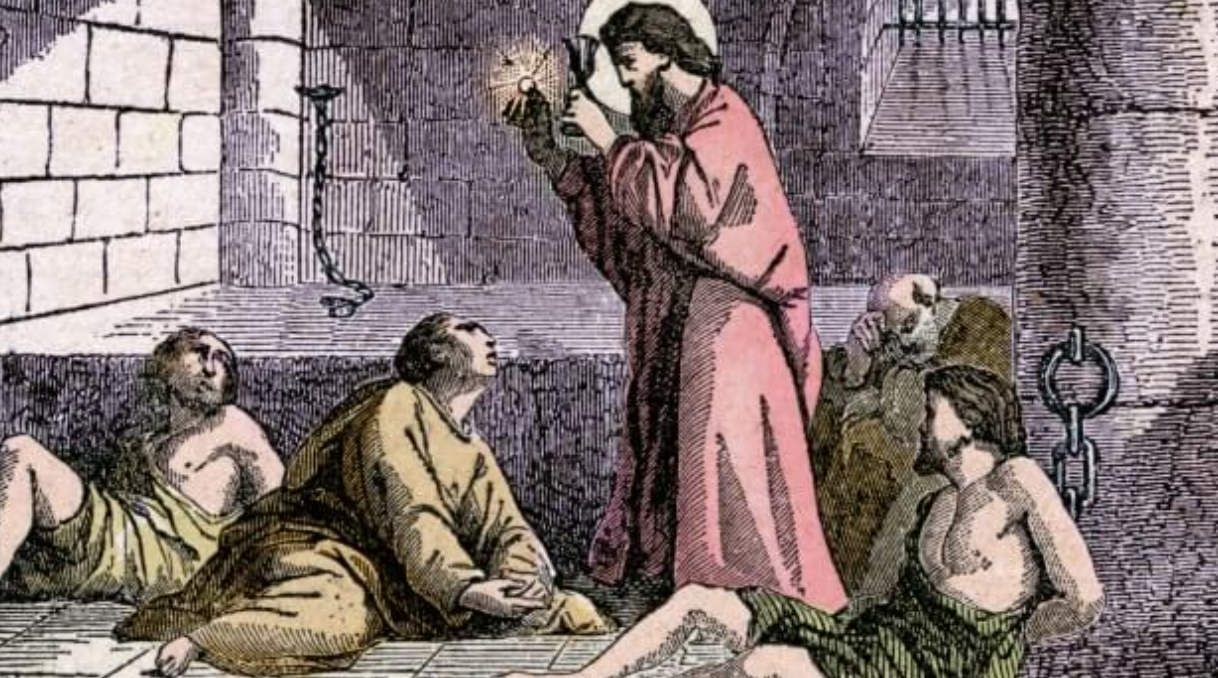
Valentine took pity on the ostracized soldiers who were not permitted to marry or see their sweethearts
the staff of the Ridgewood blog
Ridgewood NJ, Some say the day is named after a bishop named Valentine, who was stationed in the Roman Empire. Claudius II or Claudius Gothicus was the Emperor at that time.Claudius II’s short reign was vulnerable to internal as well as external attack. There may have been a revolt in 269-270 led by a Censorinus. Claudius received the title Gothicus in recognition of his major triumph over the Goths. He thought that unmarried men made better soldiers, so he decided to make it a law that young men could not marry. Around 270 A.D., Valentine took pity on the ostracized soldiers who were not permitted to marry or see their sweethearts.
Valentine’s Day it originated in 5th Century Rome as a tribute to St. Valentine, a Catholic bishop
the staff of the Ridgewood blog
Ridgewood NJ, February 14 is Valentine’s Day. Although it is celebrated as a lovers’ holiday today, with the giving of candy, Valentine flowers, or other gifts between couples in love, it originated in 5th Century Rome as a tribute to St. Valentine, a Catholic bishop.
WASHINGTON, D.C. — Long before today’s debates over the national debt and fiscal policy, America’s first Treasury Secretary, Alexander Hamilton, laid the foundation for a strong financial future by harnessing the power of tariffs to pay down debt and unify a young nation.
Ridgewood NJ, “Liberty, Equality, Fraternity.” These three words fueled one of history’s most iconic revolutions—but behind the rallying cry of the French Revolution (1789–1799) lies a darker truth. What began as a revolt against tyranny spiraled into a ruthless regime that silenced dissent, guillotined its critics, and replaced monarchy with militant absolutism. Sound familiar?
Ridgewood NJ, Easter is a Christian holiday that celebrates the resurrection of Jesus Christ from the dead. It is one of the most important religious holidays in the Christian calendar and is celebrated by Christians all over the world.
Ridgewood NJ, the tradition of the Easter bunny has its roots in pre-Christian fertility myths and festivals. In many ancient cultures, rabbits and hares were associated with spring and fertility because of their rapid reproduction cycles. As Christianity spread, the Easter bunny became intertwined with the Christian celebration of Easter.
Ridgewood NJ, Saint Valentine was a Catholic priest who had also worked as a doctor. He lived in Italy during the third century AD and served as a priest in Rome. His birth year unknown, died 270 AD in Italy,
Ridgewood NJ, what do Neil Armstrong, tortoises, and jelly beans have in common? Why, they’ve all been to space, of course. President Ronald Reagan was known for being a connoisseur of the chewy candy, so much so that he provided the astronauts aboard the Challenger shuttle with a bag full of them in 1983 — a gift that resulted in charming footage of them tossing the jelly beans in zero gravity before happily eating them. Reagan was also known to break the ice at high-level meetings by passing around jelly beans, even commenting that “you can tell a lot about a fella’s character by whether he picks out all of one color or just grabs a handful.”
Ridgewood NJ, the tradition of the Easter bunny has its roots in pre-Christian fertility myths and festivals. In many ancient cultures, rabbits and hares were associated with spring and fertility because of their rapid reproduction cycles. As Christianity spread, the Easter bunny became intertwined with the Christian celebration of Easter.
Ridgewood NJ, Easter is a Christian holiday that celebrates the resurrection of Jesus Christ from the dead. It is one of the most important religious holidays in the Christian calendar and is celebrated by Christians all over the world.
Ridgewood NJ, Some say the day is named after a bishop named Valentine, who was stationed in the Roman Empire. Claudius II or Claudius Gothicus was the Emperor at that time.Claudius II’s short reign was vulnerable to internal as well as external attack. There may have been a revolt in 269-270 led by a Censorinus. Claudius received the title Gothicus in recognition of his major triumph over the Goths. He thought that unmarried men made better soldiers, so he decided to make it a law that young men could not marry. Around 270 A.D., Valentine took pity on the ostracized soldiers who were not permitted to marry or see their sweethearts.
Ridgewood NJ, February 14 is Valentine’s Day. Although it is celebrated as a lovers’ holiday today, with the giving of candy, Valentine flowers, or other gifts between couples in love, it originated in 5th Century Rome as a tribute to St. Valentine, a Catholic bishop.
Valentine’s Day is a time to celebrate romance and love and kissy-face fealty. But the origins of this festival of candy and cupids are actually dark, bloody — and a bit muddled.
A drawing depicts the death of St. Valentine — one of them, anyway. The Romans executed two men by that name on Feb. 14 of different years in the 3rd century A.D.
Though no one has pinpointed the exact origin of the holiday, one good place to start is ancient Rome, where men hit on women by, well, hitting them.
Those Wild And Crazy Romans
From Feb. 13 to 15, the Romans celebrated the feast of Lupercalia. The men sacrificed a goat and a dog, then whipped women with the hides of the animals they had just slain.
The Roman romantics “were drunk. They were naked,” says Noel Lenski, a historian at the University of Colorado at Boulder. Young women would actually line up for the men to hit them, Lenski says. They believed this would make them fertile.
The brutal fete included a matchmaking lottery, in which young men drew the names of women from a jar. The couple would then be, um, coupled up for the duration of the festival — or longer, if the match was right.
et out your green! It’s St. Patrick’s Day. USA TODAY Network explains the origins of some of the Irish holiday’s traditions.
1. Who was St. Patrick?
St. Patrick — brace yourself — was not actually Irish. Patrick was a nobleman born in about 400 A.D. in Britain and kidnapped by Irish pirates at the age of 16, said Philip Freeman, author of St. Patrick of Ireland: A Biography.
Patrick was born into a religious family, but was an atheist early in his life. However, he rediscovered his faith while enslaved in Ireland, Freeman told USA TODAY Network.
After 17 years as a slave, St. Patrick escaped Ireland and found his way home, but returned to Ireland as a missionary.
“He said he was ready to die in Ireland in order to make his mission successful,” Freeman said.
It’s unclear if St. Patrick did in fact die in Ireland, but March 17 is widely believed to be the day of his death, according to Freeman.
2. Green River in Chicago is a family affair:
Another unique tradition that has grown in popularity every year is the annual dyeing of the Chicago River for St. Patrick’s Day.
April Fools’ Day: Origin and History
The uncertain origins of a foolish day
by David Johnson and Shmuel Ross
April Fools’ Day, sometimes called All Fools’ Day, is one of the most light-hearted days of the year. Its origins are uncertain. Some see it as a celebration related to the turn of the seasons, while others believe it stems from the adoption of a new calendar.
New Year’s Day Moves
Ancient cultures, including those of the Romans and Hindus, celebrated New Year’s Day on or around April 1. It closely follows the vernal equinox (March 20th or March 21st.) In medieval times, much of Europe celebrated March 25, the Feast of Annunciation, as the beginning of the new year.
In 1582, Pope Gregory XIII ordered a new calendar (the Gregorian Calendar) to replace the old Julian Calendar. The new calendar called for New Year’s Day to be celebrated Jan. 1. That year, France adopted the reformed calendar and shifted New Year’s day to Jan. 1. According to a popular explanation, many people either refused to accept the new date, or did not learn about it, and continued to celebrate New Year’s Day on April 1. Other people began to make fun of these traditionalists, sending them on “fool’s errands” or trying to trick them into believing something false. Eventually, the practice spread throughout Europe.
Problems With This Explanation
There are at least two difficulties with this explanation. The first is that it doesn’t fully account for the spread of April Fools’ Day to other European countries. The Gregorian calendar was not adopted by England until 1752, for example, but April Fools’ Day was already well established there by that point. The second is that we have no direct historical evidence for this explanation, only conjecture, and that conjecture appears to have been made more recently.
Another explanation of the origins of April Fools’ Day was provided by Joseph Boskin, a professor of history at Boston University. He explained that the practice began during the reign of Constantine, when a group of court jesters and fools told the Roman emperor that they could do a better job of running the empire. Constantine, amused, allowed a jester named Kugel to be king for one day. Kugel passed an edict calling for absurdity on that day, and the custom became an annual event.
“In a way,” explained Prof. Boskin, “it was a very serious day. In those times fools were really wise men. It was the role of jesters to put things in perspective with humor.”
This explanation was brought to the public’s attention in an Associated Press article printed by many newspapers in 1983. There was only one catch: Boskin made the whole thing up. It took a couple of weeks for the AP to realize that they’d been victims of an April Fools’ joke themselves.
Spring Fever
It is worth noting that many different cultures have had days of foolishness around the start of April, give or take a couple of weeks. The Romans had a festival named Hilaria on March 25, rejoicing in the resurrection of Attis. The Hindu calendar has Holi, and the Jewish calendar has Purim. Perhaps there’s something about the time of year, with its turn from winter to spring, that lends itself to lighthearted celebration