Posted on 2 Comments

Changes in NJ car-seat law take effect Tuesday

car seat

AUGUST 31, 2015    LAST UPDATED: MONDAY, AUGUST 31, 2015, 8:52 AM
BY KARA YORIO
STAFF WRITER | THE RECORD

North Jersey parents have always looked forward to a child’s first birthday. Not only is it a great milestone and cause for celebration, it was the point where the law allowed car seats to be flipped from rear-facing to forward-facing. As of Tuesday, that changes.

New Jersey law is falling in line with the American Academy of Pediatrics (AAP) recommendations, which have said that children should remain rear-facing until at least 2 years old or weighing more than 30 pounds.

“The science and studies are quite clear,” said Howard Mazin, an Englewood Hospital and Medical Center attending pediatrician, who has always urged his patients to keep their children rear-facing until age 2. “I know all parents want what’s safest for their kids.”

11958002 876766915711185 4874231426430673956 o

The other big change in the law is that kids should be in a booster seat until age 8 or 57 inches. Previously it was until 8 or 80 pounds. Children younger than 4 years old or under 40 pounds must be in a seat with a five-point harness (ideally rear-facing until hitting the limits set by the seat manufacturer) not a booster seat using the regular seat belt. The fines have also been raised from a minimum of $10 and maximum of $25 to a minimum of $50 and maximum of $75.

https://www.northjersey.com/community-news/family/changes-in-nj-car-seat-law-take-effect-tuesday-1.1401351

Posted on 6 Comments

New Jersey Most Hated State in the Nation …ouch !

map3

One State Has Officially Been Named the Most HATED State in the US

There’s 50 states. Not every one can get as much love as the others.

YouGov made a ‘State of the States,’ in which they asked Americans how they feel about each and every state.

This research shows that New Jersey is the only state in the U.S. which people tend to have a negative opinion of. 40% of Americans have an unfavorable opinion of the Garden State while 30% have a favorable opinion of the state, which gives the state a net favorability of -10%.

For comparison, Alabama, the second least popular state, has a net favorability rating of +8%,as 39% of Americans have a favorable view of Alabama and 31% have an unfavorable opinion.

After Alabama the least popular states are Illinois (+9%), Mississippi (+9%) and Indiana (+12%).

Read more: https://capitalismisfreedom.com/most-hated-state-in-the-us/#ixzz3kEtFqu6n

Posted on Leave a comment

Superior Court Approves ExxonMobil Settlement

Chris_christie_theridgewoodblog

A Superior Court Judge today approved a $225 million settlement between the State and ExxonMobil to resolve liability for damage to the environment and injury to natural resources caused by contamination from the corporation’s refinery operations in Bayonne and Linden, as well as other facilities and service stations in New Jersey, Acting Attorney General John J. Hoffman and Department of Environmental Protection (DEP) Commissioner Bob Martin announced.
Politicker Staff, Politickernj Read more

Posted on Leave a comment

Senator: Tax breaks for performers would boost Atlantic City

Tom Kean - High Quality


Large crowds at a weekend beach concern have a state lawmaker more convinced than ever that his bill to give tax breaks to A-list performers that commit to multi-night stands in Atlantic City would give the struggling city a financial boost. (Wayne Parry, Associated Press) https://www.philly.com/philly/news/politics/20150817_ap_5b8ab34c3a8f414889158e24aef122c4.html#tjimZpzBaPGSiQTu.99

Posted on Leave a comment

New Jersey use of body cameras to expand

Honda-Civics-collide-Ridgewood-Police-Ridgewood-Fire-Deparrtment3-300x225

file photo by Boyd Loving

“Public confidence in our police officers is absolutely positively vital,” said Acting Attorney General John Hoffman.

In a year of police shootings, community uproar and disturbing videos, Hoffman announced the expansion of body cameras in New Jersey.

(Michael Aron, NJTVNews)

https://www.njtvonline.org/news/video/new-jersey-use-of-body-cameras-to-expand/

Posted on Leave a comment

Corrupting Political Life in New Jersey: The Public Costs of a Power Broker

George_E

By Linda Stamato | NJ Voices
on July 19, 2015 at 5:54 PM, updated July 29, 2015 at 9:57 AM

The slogan reads “Your Interests, not Special Interests.”It’s available on a bumper sticker courtesy of theDemocratic Senatorial Campaign Committee. Seriously. I’d like to believe it. But I’d like to believe in tooth fairies too.

Here in New Jersey, as elsewhere, the slogan is more wishful thinking than reality. It’s not just the Democrats or even mostly them, but Republicans too. And when both political parties want to do favors for a special interest and join sides to do it, watch out! It’s then that even the “good guys” look the other way and others hold their noses and go along.

This is not what we mean by bipartisanship.

Case in point: George E. Norcross III, citizen of South Jersey, or as Tom Moran dubbed him, the Dark Lord, the second most powerful political force in New Jersey. What Mr. Norcross wants, evidently, Mr. Norcross gets. Both parties go along, and, at a fast clip. Recently, Norcross decided he wanted–for Cooper University Hospital–the paramedic service that Virtua Health has been providing in the city of Camden since 1977, even though Virtua has provided advanced life support and paramedic services, by all accounts, exceptionally well. So, why take it away? Because, we learn, Norcross said so. (And, he has “a history” with Virtua.)

A bill, S2980 /A-4526) was rushed through both houses to accomplish this act, pausing by a few committees that passed on it in less than a week, and it wound up on Christie’s desk where it was promptly signed. Ordinarily, for such a change to take place, a certification of need would be required. Not for Cooper. Not for Norcross. Why? Think about it. The certification process is transparent. It takes time. And, Cooper might not have prevailed. So, what to do? Bypass the process. That way the outcome is assured. And, by the way, not only did the governor not hesitate to sign off, he put $2.5 million into the budget to help buy the ambulances and the equipment Cooper “needs” to carry out its new responsibilities. What are friends for?

https://blog.nj.com/njv_linda_stamato/2015/07/corrupting_political_life_in_n.html#incart_river_mobile

Posted on 1 Comment

Analysis: Weaker oversight gives N.J. public colleges greater power to chart their agendas

rutgers

JULY 19, 2015    LAST UPDATED: SUNDAY, JULY 19, 2015, 12:35 AM
BY PATRICIA ALEX
STAFF WRITER |
THE RECORD

Kean University is launching an expensive architecture program, largely tailored to foreign students, at its Union campus despite another public one just 6 miles away at the New Jersey Institute of Technology.

The technology institute, virtually across the street from Rutgers Medical School in Newark, is considering partnering with Rowan University, just south of Philadelphia, to train doctors.

A new public business school is opening in Jersey City even as others in nearby Newark and Montclair are spending millions to beef up their programs.

If it seems like there’s no statewide plan for higher education in New Jersey, it’s because there isn’t, and recent decisions by the schools have raised questions about whether weak state oversight has allowed for expensive and duplicative projects that have helped make the state home to some of the highest public tuitions in the nation.

The politically appointed boards that run the state-subsidized colleges and universities have a degree of autonomy unheard of in most other states. And with no resistance from state officials, the boards have approved costly and controversial projects.

Stockton University bought an $18 million former casino it is now unable to use; Montclair State University agreed to spend $250,000 on a statue of its mascot and Kean purchased a multimedia conference table from China for $219,000, prompting a state investigation.

https://www.northjersey.com/news/analysis-weaker-oversight-gives-n-j-public-colleges-greater-power-to-chart-their-agendas-1.1376906

Posted on Leave a comment

Is the Two Party System Doomed ?

VOTE_theridgewoodblog

N.J. campaign committees continue to see fundraising decline
By Matt Friedman | NJ Advance Media for NJ.com

TRENTON —With campaign spending increasingly shifting to “independent expenditure” organizations, New Jersey’s legislative fundraising committees continue to see their contributions decline.According to numbers released Friday by the state Election Law Enforcement Commission (ELEC), the state’s “Big Six” fundraising committees – the finance arms of the Senate and Assembly Republicans and Democrats, and both parties’ state committees – have raised a combined $2.5 million for this election cycle and have $2.2 million on hand.

That’s the least amount raised for any legislative election year since at least 2007, though that’s in part because only the Assembly is on the ballot — the first time that’s happened since 1999. But Jeff Brindle, ELEC’s executive director, said much of that money has been or will be put into other channels.

https://www.nj.com/politics/index.ssf/2015/07/nj_campaign_committees_continue_to_see_fundraising.html#incart_river

Posted on 1 Comment

When is $100 worth $87.34 , only in New Jersey

$100 Map

July 16, 2015
By
Alan Cole,
Scott Drenkard

This week’s map shows the real value of $100 in each state. Prices for the same goods are often much cheaper in states like Missouri or Ohio than they are in states like New York or California. As a result, the same amount of cash can buy you comparatively more in a low-price state than in a high-price state.

The Bureau of Economic Analysis has been measuring this phenomenon for two years now; it recently published its data for prices in 2013. Using this data, we have adjusted the value of $100 to show how much it buys you in each state.

For example, Ohio is a low-price state. $100 there will buy you stuff that would cost $111.61 in a state closer to the national average. You could think of this as meaning that Ohioans are, for the purposes of day-to-day living, eleven percent richer than their incomes suggest.

The states where $100 is worth the most are Mississippi ($115.21) Arkansas ($114.29) South Dakota ($114.16) Alabama ($114.03) and West Virginia ($113.12). In contrast, $100 is effectively worth the least in the District of Columbia ($84.96) Hawaii ($86.06) New York ($86.73) New Jersey ($87.34) and California ($89.05.)

Regional price differences are strikingly large; real purchasing power is 36 percent greater in Mississippi than it is in the District of Columbia. In other words: by this measure, if you have $50,000 in after tax income in Mississippi, you would have to have after-tax earnings of $68,000 in the District of Columbia just to afford the same overall standard of living.

It’s generally the case that states with higher nominal incomes also have higher price levels. This is because there is a relationship between the two: in places with higher incomes, the prices of finite resources like land get bid up. But the causation also runs in the opposite direction. Places with high costs of living pay higher salaries for the same jobs. This is what labor economists call a compensating differential; the higher pay is offered in order to make up for the low purchasing power.

This relationship is important, though it is not the only thing that matters. Some states, like North Dakota, have high incomes without high prices. Adjusting incomes for price level can substantially change our perceptions of which states are truly poor or rich.

For example, Nebraskans and Californians earn approximately the same amount in dollars per capita, but after adjusting for regional price parity, Nebraskan incomes can buy more.

This has substantial implications for public policy, which is often progressive with respect to income.

Many policies – like minimum wage, public benefits, and tax brackets – are denominated in dollars. But with different price levels in each state, the amounts aren’t equivalent in purchasing power. This has some unexpected consequences; people in high-price-level states like New Jersey will often pay more in federal taxes without feeling particularly rich.

Posted on Leave a comment

Is Your City a Sanctuary City? This Map Has the Answer

killer


Fort Lee, NJ. was improperly included due to an error on the Sanctuary City map by Apsan Law Offices,  our sincerest apologies 


PJ Blogger and the Staff of the Ridgewood blog


New Jersey Sanctuary cities

Camden, NJ (Added in 2007; latest source: Camden, Immigrant Haven?, By Lauren Feeney, City Paper, 7-16-08)
Hightstown, NJ (Added 5-30-07)
Jersey City, NJ.
Newark, NJ (Added 6-3-07)
North Bergen, NJ.
Trenton, NJ.
Union City, NJ.

More items…

List of Sanctuary cities – Apsan Law Offices

www.apsanlaw.com/law-246.List-of-Sanctuary-cities.html

Kate Scanlon / @scanlon_kate / July 10, 2015

Is your city a sanctuary city?

The Center for Immigration Studies has released an interactive map depicting cities, counties and states that are “sanctuaries” for immigrants who are in the country illegally.

>>View interactive map here

The map shows over 200 sanctuary cities, counties and states nationwide.

Sanctuary cities are cities or jurisdictions where local authorities have chosen not to act in accordance with federal immigration laws.

According to the Center for Immigration Studies, “these state and local jurisdictions have policies, laws, executive orders, or regulations allowing them to avoid cooperating with federal immigration law enforcement authorities”:

[The cities] ignore federal law authorizing U.S. Immigration and Customs Enforcement (ICE) to administratively deport illegal aliens without seeking criminal warrants or convictions from federal, state, or local courts. Although federal law requires the cooperation, the Department of Justice has never sued or taken any measure, including denying federal funds, against a jurisdiction.

According to the map, North Dakota and Rhode Island are sanctuary states.

David Inserra, a research assistant at The Heritage Foundation, said that it is a “no brainer” for local and state officials to aid federal agencies in enforcing federal laws.

“Not enforcing the law results in lawlessness,” Inserra said.

https://dailysignal.com/2015/07/10/is-your-city-a-sanctuary-city-this-map-has-the-answer/

Posted on 4 Comments

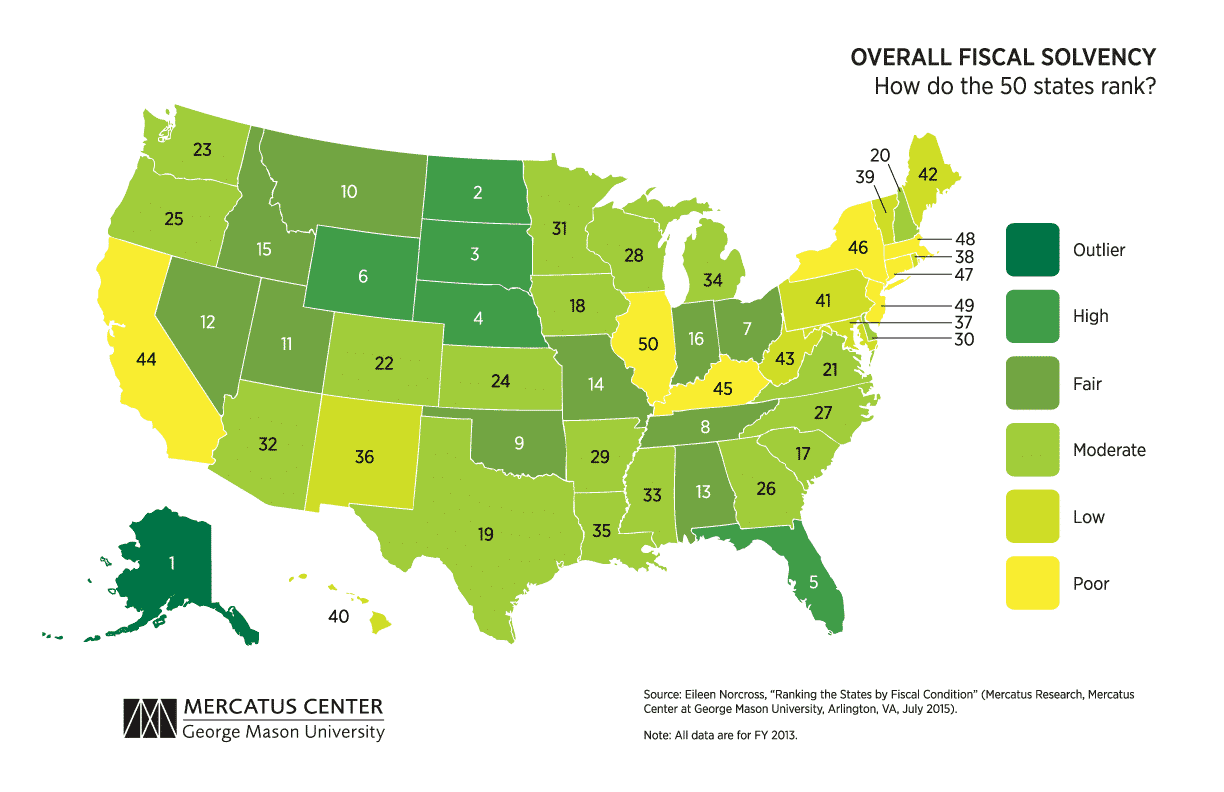
NEW JERSEY RANKS 49th OF U.S. STATES BY FISCAL CONDITION

FR-OVERALL-Map-1

July 11, 2015

Most U.S. state governments are nearly back to fiscal normalcy following the Great Recession of 2007–09, but there still exist troubling signs that states are ignoring the risks in unfunded programs, according to a new study from the Mercatus Center at George Mason University. States that appear to be fiscally robust must take stock of their long-term fiscal health before making future public policy decisions in order to avoid serious trouble if another financial crisis were to occur, the study warns.

Building on previous research about state fiscal conditions, Mercatus Center Senior Research Fellow Eileen Norcross ranked each state’s financial health based on short- and long-term debt and other key fiscal obligations. The study provides snapshots of each state’s fiscal health in an easily understood format.

Norcross analyzed the states’ own audited financial reports, which include basic financial statistics on revenues, expenditures, cash, assets, liabilities, and debt. The states were ranked based on five categories of fiscal solvency, including cash solvency, budget solvency, long-run solvency, service-level solvency, and trust fund solvency. These factors determine states’ ability to cover short- and long-term bills.

The top five states, which are considered fiscally healthy relative to other states, still face substantial long-term challenges with pension and health care benefits systems. The study attributes the high ranking of these five states — Alaska, North Dakota, South Dakota, Nebraska, and Florida — to their sig­nifi­cant amounts of cash on hand and relatively low short-term debt obligations.

The bottom five states — Illinois, New Jersey, Massachusetts, Connecticut, and New York — have low amounts of cash on hand, large debt obligations, and high deficits. Based on their billions of dollars in unfunded liabilities, including unfunded pensions and health care benefits, they are at risk of “fiscal peril.”

Read the full Mercatus Center study, “Ranking the States by Fiscal Condition.”

Posted on 5 Comments

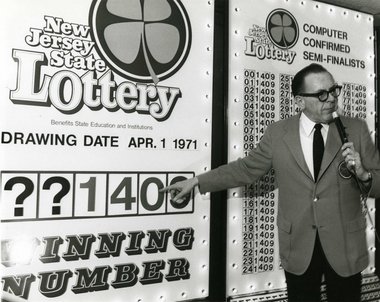
Powerball odds growing against players, but changes may boost N.J. revenue

Lottery_theridgewoodblog

JULY 9, 2015, 7:36 PM    LAST UPDATED: FRIDAY, JULY 10, 2015, 12:55 PM
BY DUSTIN RACIOPPI
STATE HOUSE BUREAU |
THE RECORD

The Powerball lottery jackpots are about to get bigger – but so too will the odds against winning, a change that will likely mean fewer winners but more money for the states that run the game.

The changes come as multistate lottery sales have dropped by a third in New Jersey, cutting into one of the state’s biggest revenue sources. Slower sales could mean less for education programs and housing for veterans and the disabled.

And it comes as lottery officials here and in other states are blaming “jackpot fatigue,” the claim that sales drop because customers aren’t excited by smaller jackpots. Experts and lottery critics, however, said any change that makes bigger jackpots might either backfire — since there would be far fewer winners of big payouts, causing players to keep away — or have just a short-term effect on sales.

The change is set to take effect Oct. 4 and was made by the consortium that oversees the multistate lottery; states that offer the game must agree to the new rule.

Once the change is in place, the odds against winning the Powerball will grow by two-thirds – from a one-in-175,223,510 chance of winning to one in 292,201,338, according to the New Jersey Lottery.

Put another way, it’s 400 times more likely an individual will get struck by lightning than win the Powerball jackpot under the new rules. As it stands now, winning this lottery is only 250 times more likely than facing a lightning strike.

Players currently win by matching five numbers from a set of 59 white balls and a sixth – the Powerball — from a set of 35 red balls. Numbers are drawn twice a week. If no one matches all six numbers in a drawing, the jackpot increases by at least $10 million. In October, the number of white balls available will increase to 69, while the pool of red balls will decrease to 26.


https://www.northjersey.com/news/powerball-rule-change-likely-means-less-winners-bigger-lottery-jackpots-1.1371741

Posted on 7 Comments

N.J. Dem lawmakers try to force Christie’s resignation, but we have a better idea everyone in Trenton should forced to resign

legislature
Lets face it the State is run like crap, roads arnt paved , bridges are falling down, pension go unfunded and yet we suffer the highest taxes in the land 
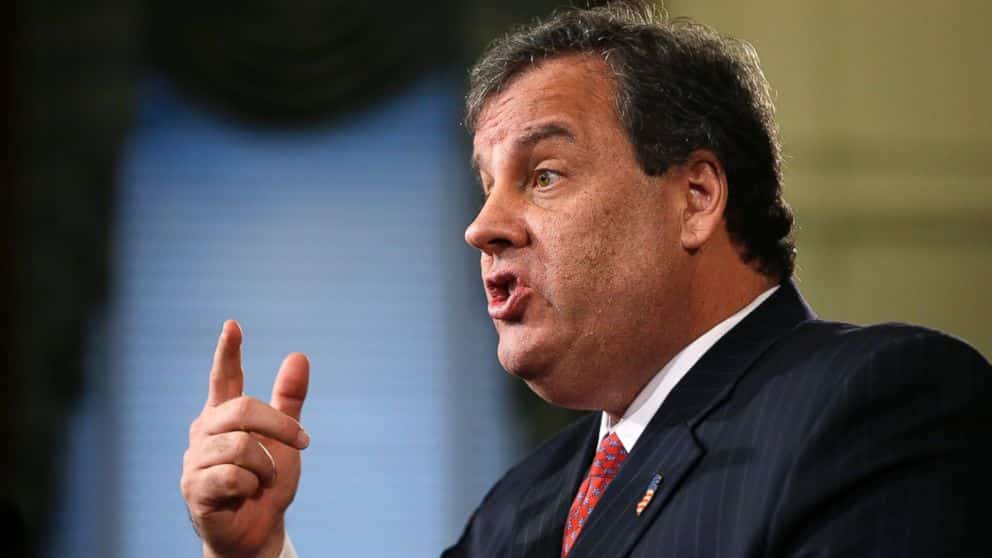
Its time for everyone involved in state government to just step down TRENTON — Democratic state lawmakers will soon introduce legislation that would force Gov. Chris Christie to resign from office because he is running for president, NJ Advance Media has learned.State Sens. Raymond Lesniak (D-Union) and Loretta Weinberg (D-Bergen), who are expected to co-sponsor the bill, said they are fed up with Christie’s frequent absences from New Jersey this year in the run-up to last week’s announcement that he’s running for the White House. The bill would require Christie and any future governor to resign in order to run for president.

“He’s not doing the state any good by spending the bulk of his time out of state,” Lesniak said. “And even when he’s in-state, he’s focusing on what he has to do to get elected president — which often runs contrary to what he ought to do for the state.”

https://www.nj.com/politics/index.ssf/2015/07/fed_up_with_christies_2016_absences_dem_lawmakers.html

Posted on 3 Comments

Ouch New Jersey: The least liked state in America

Route_17_Glen062_theridgewoodblog
file photo Boyd Loving
Wow we really suck 

New Jersey is the only state which Americans tend to have an unfavorable opinion of

As America prepares to celebrate its 239th birthday this Saturday, YouGov compiled a ‘State of the States’, asking Americans how they feel about each and every state that forms our country.

This research shows that New Jersey is the only state in the country which people tend to have a negative opinion of. 40% of Americans have an unfavorable opinion of New Jersey while 30% have a favorable opinion of the state, giving the state a net favorability rating of -10%. In contrast, Alabama, the second least popular state in the country, has a net favorability rating of +8%, as 39% of Americans have a favorable view of Alabama and 31% have an unfavorable opinion. After Alabama the least popular states are Illinois (+9%), Mississippi (+9%) and Indiana (+12%).

Hawaii is the most popular state in the union with a net favorability rating of +56%, with 67% of Americans having a favorable view of the state and only 11% having an unfavorable opinion. Hawaii is followed by Montana (+43%), Wyoming (+42%), Alaska (+42%) and Maine (+42%).

https://today.yougov.com/news/2015/07/01/new-jersey-least-liked-state-america/

Posted on 1 Comment

Testicle-munching fish species found in Swedes Lake in South Jersey

11659495_890635744335755_7415501044559381364_n

A man and his son caught a strange species in Swedes Lake in South Jersey that turned out to be a rare Amazonian fish known in South America as the “Nutcracker,” according to reports.

The pacu is native to the Amazon
By David Lawler, Washington

9:08PM BST 24 Jun 2015

A species of fish best-known for attacking human testicles has apparently invaded America.

A father and son were fishing in New Jersey when they got a bite from an unfamiliar fish with a startling array of near-human teeth. It was a pacu, a relative of the piranha that is native to the Amazon.

The pacu has accumulated some colourful nicknames – nutcracker, ball cutter – and a sighting in Sweden in 2013 led to a warning for male swimmers to keep their trunks on.

This time the catch came not in Sweden but in Swede’s Lake, a man-made body of water near Philadelphia. Fortunately for Ron Rossi, this particular fish went for the bait.

Mr Rossi knew as soon as he “scooped” the fish that he had “never seen anything like” it. He originally thought he had caught a piranha.

Henrik Carl, a Danish fish expert, said that was a common mistake.

“They are almost identical to the piranha, you couldn’t even tell from the outside,” he explained after the Scandinavian pacu sighting. “It’s just that they have different teeth. Flatter and stronger, perfect for crushing.”

“The pacu is not normally dangerous to people but it has quite a serious bite, there have been incidents in other countries, such as Papua New Guinea where some men have had their testicles bitten off,” Mr Carl said.

The freshwater fish can grow up to 90 centimetres and weigh up to 25 kilograms.

https://www.telegraph.co.uk/news/worldnews/northamerica/usa/11697491/Testicle-munching-fish-species-found-in-US-lake.html