
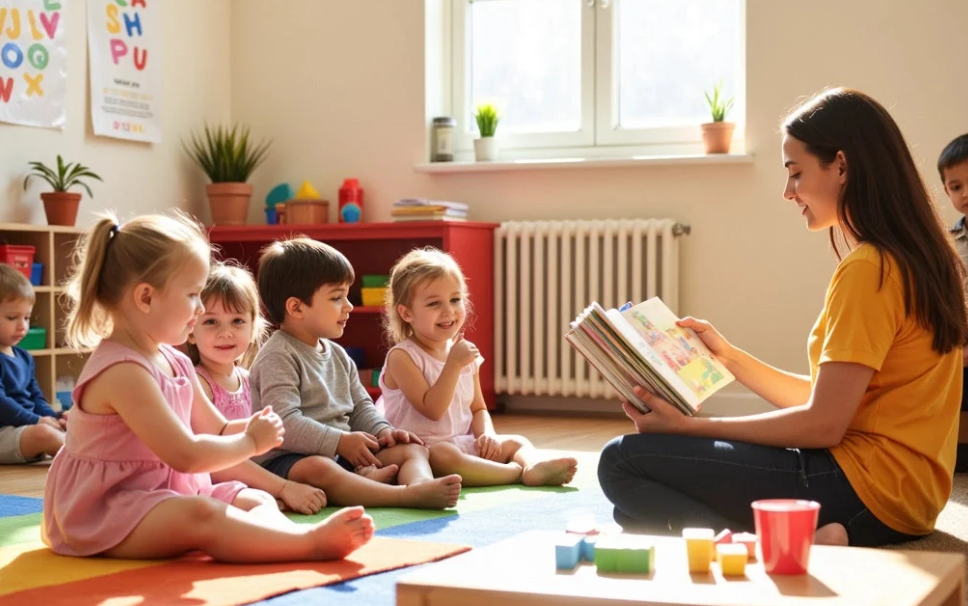
When people picture an inclusive preschool classroom, they often imagine a big concept, fairness, access, belonging. Those ideas matter, but families usually experience inclusion in much smaller moments. It shows up when a teacher knows a child needs a quieter arrival routine. It shows up when circle time includes movement, visuals and songs, so one activity works for many kinds of learners. It shows up when classmates learn that helping, waiting, listening and playing together are all part of how a classroom community works.
That everyday view is what makes inclusive preschool classrooms so powerful. They are not simply places where children with different abilities share a room. They are environments designed around the reality that young children learn in different ways, at different speeds and with different support needs. That is one reason educator preparation matters so much. Training through an early childhood special education degree can help future teachers understand child development, individualized instruction and the kind of responsive planning that makes inclusion work in real classrooms.
For parents, inclusive preschool can feel both hopeful and intimidating at first. They may wonder whether their child will get enough attention, whether routines will be too challenging or whether differences will stand out. In strong inclusive settings, the opposite often happens. Differences become a normal part of the classroom, and support becomes something built into the day rather than saved only for moments of crisis.
Inclusion Begins With Predictable Routines
Young children do well when they know what comes next. In inclusive preschool classrooms, routines are not just about keeping order. They are one of the first tools teachers use to support learning for everyone.
A predictable morning routine can help a child who struggles with transitions settle in without feeling overwhelmed. Visual schedules can support children who are not yet reading, children learning English and children who process spoken language more slowly. Repeated patterns, like greeting time, snack time, play time and story time, create a sense of safety that frees children to focus on learning.
This matters because preschoolers are still building the basic skills that older students often take for granted. They are learning how to join a group, follow directions, ask for help and manage emotions. In an inclusive classroom, routines break these big demands into manageable pieces. Instead of expecting every child to adapt to one narrow format, the classroom is arranged so many children can participate successfully from the start.
Communication Is More Than Talking
One of the most helpful shifts in inclusive preschool education is the understanding that communication takes many forms. Some children talk a lot. Some use fewer words. Some communicate best through gestures, pictures, modeled language or assistive tools. In a thoughtful preschool classroom, communication is not measured by who talks fastest or most often.
Teachers support different ways of communicating by pairing spoken directions with images, modeling simple phrases during play and creating regular opportunities for turn taking. This approach can benefit children with identified disabilities, but it also helps classmates who are shy, impulsive or still learning how to express themselves clearly.
Families often notice this support first during pickup conversations. A teacher might explain that a child pointed to a visual choice board to select an activity, used a gesture to ask for a turn or joined a song by doing hand motions before singing the words. These details matter. They show that participation is broader than verbal performance.
Professional organizations in early learning have long emphasized that inclusion means access, participation and support, not just placement in the same room. The NAEYC guidance on inclusion reflects this idea by focusing on environments where young children with and without disabilities can meaningfully engage together.
Play Is Where Different Learning Styles Meet
If you want to see inclusive education working at its best, look at the block area, the dramatic play corner or the sensory table. Play gives children multiple entry points into learning. One child may narrate an entire pretend restaurant scene. Another may sort plates by color. Another may watch for a while before joining. All three are learning.
This is part of what makes preschool inclusion such a strong model. Play does not require every child to prove understanding in the same way. A child can show early math skills by stacking and comparing. A child can build language through imitation. A child can practice motor planning by carrying materials across the room. The same play setting can support social, emotional, cognitive and physical growth all at once.
Teachers in inclusive classrooms do a lot behind the scenes to make this happen. They choose materials with different textures, sizes and uses. They arrange centers so children can move easily and share space. They step in with prompts when needed, but they also know when to pause and let peer interaction unfold naturally. To an outside observer, it may look simple. In reality, it is careful teaching embedded in ordinary preschool experiences.
Individualized Support Should Feel Natural
Some of the best inclusion work is almost invisible. A teacher may offer one child a shorter direction, another child a wiggle cushion and another a few extra seconds to respond. None of these supports need to interrupt the flow of the classroom. In fact, when done well, they blend into the daily rhythm.
This natural feel is important because preschoolers are highly sensitive to tone. They notice when something feels tense or forced. Inclusive classrooms work best when support is treated as a normal part of learning. Just as one child may need help zipping a coat and another may need help starting a conversation, individualized support is simply part of what adults provide.
Families can sometimes worry that individualized support will separate their child from peers. But quality preschool inclusion usually aims for the opposite. The goal is to give support in ways that keep children connected to classmates, routines and shared activities whenever possible. Under the Individuals with Disabilities Education Act, early childhood services are built around the principle that children with disabilities should have access to appropriate educational opportunities and supports.
The Classroom Community Teaches Everyone
One of the most overlooked benefits of inclusive preschool is what peers learn. Children in these classrooms begin to understand early that people solve problems differently, communicate differently and need different kinds of help. That understanding is not delivered as a lecture. It grows through shared routines, joint play and repeated experience.
A child learns patience when a classmate needs extra time to answer. A child learns flexibility when a game changes to include everyone. A child learns empathy when a friend uses a support tool and still wants the same things every preschooler wants, to belong, to be understood and to have fun.
These are not side lessons. They are central to what early education can do at its best. Academic readiness matters, of course, but preschool is also where children begin to form expectations about community. Inclusive classrooms can teach that community is not based on everyone being the same. It is based on everyone being part of the group.
Why Educator Preparation Matters So Much
Inclusive preschool classrooms do not happen by accident. They depend on teachers who understand child development, family communication, assessment, behavior support and differentiated instruction. They also depend on educators who can notice small signs of growth and adjust the environment before frustration builds.
That is why specialized preparation matters. Teachers need more than goodwill. They need practical knowledge about how to plan activities with multiple points of access, how to collaborate with families and specialists and how to support each child without losing sight of the whole group.
For parents, this preparation often becomes visible in the confidence of the classroom. The teacher seems ready for variation, not surprised by it. The room feels structured without being rigid. Children are supported without being singled out. Those qualities do not come from guesswork. They come from training, reflection and experience.
What Families Can Look For
When families visit a preschool, they can learn a lot by watching the little things. Do classroom materials invite different kinds of participation? Does the teacher speak to children with warmth and clarity? Are routines supported with visuals, songs, gestures or modeling? Do children seem engaged in more than one way, talking, moving, building, observing, pretending?
A strong inclusive classroom rarely looks like every child doing the exact same thing in the exact same way. It looks like shared purpose with flexible paths. It feels calm, active, responsive and human.
That is the real promise of inclusive preschool. It supports different ways of learning not by lowering expectations, but by widening the ways children can meet them. In those early years, that kind of classroom can shape how children see school, how families experience support and how communities define belonging.





