
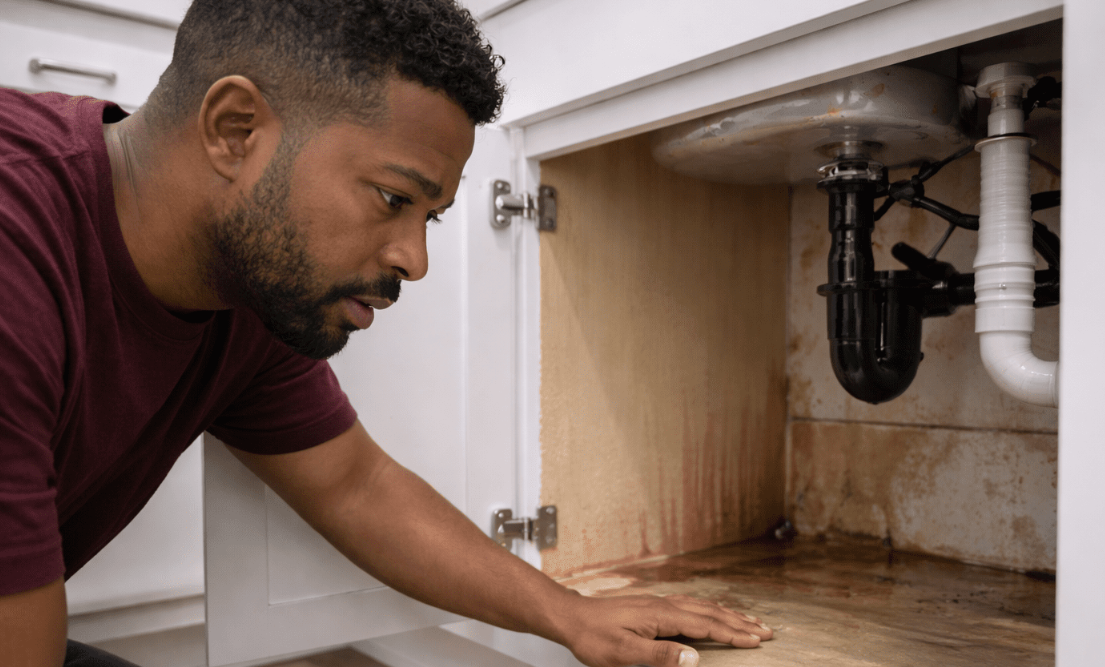
Your water bill just jumped 30 bucks. No new appliances, no house guests, no change in your routine. That spike is your plumbing trying to tell you something, and you should listen.
Hidden leaks are one of the most financially punishing problems a homeowner can ignore. The tricky part? Most of them make no noise, leave no puddle, and hide for months inside walls, under slabs, and below ground. By the time you see physical damage, the water has usually been running far longer than you’d want to know.
This guide walks you through the real signals, a tested method for confirming a leak without any tools, and the point at which DIY stops and a pro needs to take over.
The Scale of the Problem Is Bigger Than Most People Realize
Here’s a number that genuinely surprises people: the average household’s leaks account for more than 9,300 gallons of water wasted every year, and nine percent of homes have leaks that waste 50 gallons or more per day, according to the U.S. Environmental Protection Agency’s WaterSense program in 2025. That’s not a catastrophic burst pipe. That’s a slow, invisible bleed.
What makes hidden leaks so destructive isn’t just the water cost. It’s the secondary damage: softened drywall, warped flooring, compromised insulation, and mold that starts growing in as little as 48 hours. A small drip inside a wall cavity is not a small problem. It’s a slow-motion flood.
The financial reality is just as blunt. Fixing easily corrected household water leaks can save homeowners about 10 percent on their water bills, the EPA notes. That’s money leaving your account every month while the leak sits behind your sheetrock, waiting.
Signal vs. Silence: The Two Categories of Hidden Leaks
This is the framework I’d put on the wall of every home inspection class: hidden leaks split cleanly into two categories, and knowing which type you’re hunting changes everything about how you find it.
Signal leaks give you something, even if subtle. A faint musty smell in a cabinet under the sink. A warm section of tile floor when your slab sits over a hot water line. A water stain on the ceiling that appears, dries, and reappears. Peeling paint behind the toilet. These leaks are still hidden, but they’re communicating. Pay attention and you can triangulate them.
Silent leaks are the dangerous ones. A pinhole in a copper pipe behind the bathroom wall. A slow seep at an underground joint. These produce no sensory clues inside the house. The only way to catch them early is to watch your water meter or your bill, because the meter never lies.
Most homeowners spend their energy looking for signal leaks and miss silent ones entirely. Flip that priority. Check the meter first, then look for sensory signals once you know a leak exists.
The 15-Minute Meter Test Every Homeowner Should Know
You do not need a plumber to confirm whether a hidden leak exists. Your water meter will tell you, and the test takes under 15 minutes.
- Turn off every water source in and around your home. No dishwasher running, no irrigation timer, no ice maker. Every fixture completely off.
- Find your water meter, usually in a small utility box near the street or curb.
- Note the current reading and look for a small triangular flow indicator dial. Check your water meter’s leak indicator to see if it’s moving. This is often a small triangle or dial that spins when water is flowing.
- If the indicator is spinning with everything off, you already have your answer. A leak exists on the home side of the meter.
- If it is not moving, record the meter reading and leave everything off for 30 minutes. Come back and read it again. Any change in the number confirms a leak.
That’s it. No tools, no skills, five steps. If your meter shows movement, the next question is where. That’s where the work gets harder.
Why Your Pipes May Be More Vulnerable Than You Think
Copper pipe has a reputation for durability, and it deserves it. But it is not invincible, and the water chemistry in your area plays a bigger role than most homeowners realize.
There are many factors that can contribute to a pinhole leak occurring, including water alkalinity, water pH, stray electrical current, aging hot water heating systems, dissimilar metals in plumbing materials, and inferior or thin-walled copper pipe, according to the Long Island Water Conference, a regional water utility body that has studied pinhole failures across residential systems.
pH and mineral content are the big ones. The primary cause of pinhole leaks is the composition of the water flowing through your plumbing system. Hard water with high amounts of dissolved calcium and magnesium, or water that is too acidic or too alkaline, can all contribute to copper pipe corrosion.
In volcanic island regions like Hawaii, groundwater picks up elevated mineral loads as it moves through porous basalt. That chemistry is harder on copper than the treated municipal supply most mainland homes receive. It’s part of why professional leak detection on the big island so often turns up pinhole failures that have been quietly dripping behind walls for months before a homeowner noticed anything.
Beyond water chemistry, research published in the National Institutes of Health journal in 2017 identified another factor most homeowners never hear about: after ruling out manufacturing flaws, installation flaws, soil interactions, stray electrical currents, and water chemistry, researchers found microbe-laced biofilms in the pitted areas of corroded copper pipes. After a new chlorination booster station was placed in service, the pinhole leaks decreased along with a decrease in microbial counts in the water. Microbial activity inside pipes can accelerate corrosion from the inside out, completely invisibly.
The Signs That Point to a Specific Location
Once you know a leak exists, use these signals to narrow the search before you call a plumber. The more context you give them, the faster and cheaper the diagnosis.
| Observation | Likely Leak Location | Urgency
|
|---|---|---|
| Water bill spike, no visible source | Underground supply line or slab | High |
| Warm or soft section of floor | Hot water line under slab | High |
| Musty smell in a cabinet or closet | Supply line or drain inside wall | Medium-High |
| Wet patch in yard without rain | Buried irrigation or supply line | Medium |
| Ceiling stain that dries and returns | Pipe or fixture in floor above | Medium-High |
| Low water pressure throughout home | Main supply line or multiple pinhole leaks | High |
When DIY Ends and a Professional Starts
The meter test and the visual scan are yours to run. Everything after that belongs to a licensed plumber with the right equipment.
Slab leaks, underground supply line failures, and pipe-in-wall pinhole leaks all require acoustic listening devices, infrared imaging, or pressure testing to pinpoint without tearing open half your house. Guessing at location and then cutting into drywall or concrete to find nothing is expensive and demoralizing. The pro with the acoustic gear opens only where the leak actually is.
The other signal to call immediately: if your meter test shows significant movement and you can not find any evidence of a dripping faucet or running toilet, assume the leak is behind a surface you cannot see. A slow slab leak or underground line failure will not announce itself, and every day it runs adds structural damage to the water bill problem.
“Pinhole leaks can form singly, in patterns, or at random along a pipe. They can form in some sections, but not others, of the same pipe in the same house.” — Butler County Water and Sewer, Pinhole Leaks Resource Page
That randomness is exactly why acoustic equipment exists. There is no reliable visual pattern to follow on your own.
Four Things to Do Right Now
- Pull up your last three water bills and compare usage month over month. A consistent upward trend with no lifestyle change is a leak until proven otherwise.
- Run the 15-minute meter test described above. Do it this week, not when you get around to it.
- Check the area under every sink cabinet for moisture, soft flooring material, or a faint mildew smell.
- If you find evidence of a leak and cannot locate the source visually, call a plumber before the problem compounds.
Water damage does not pause while you think it over. The meter test costs you nothing. The call costs you nothing. The leak, left alone, costs you both money and structural integrity. Run the test today and know where you stand.





