Ridgewood NJ, The massive new 66 unit, multi-retail store complex coming to Franklin and Broad sets off a chain reaction of traffic problems in Ridgewood. As always, taxpayers will be left holding the bag for nearly a million dollars worth of needed traffic signal upgrades alone.
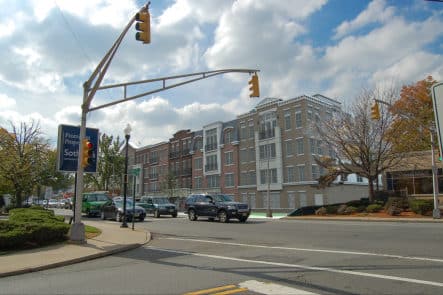
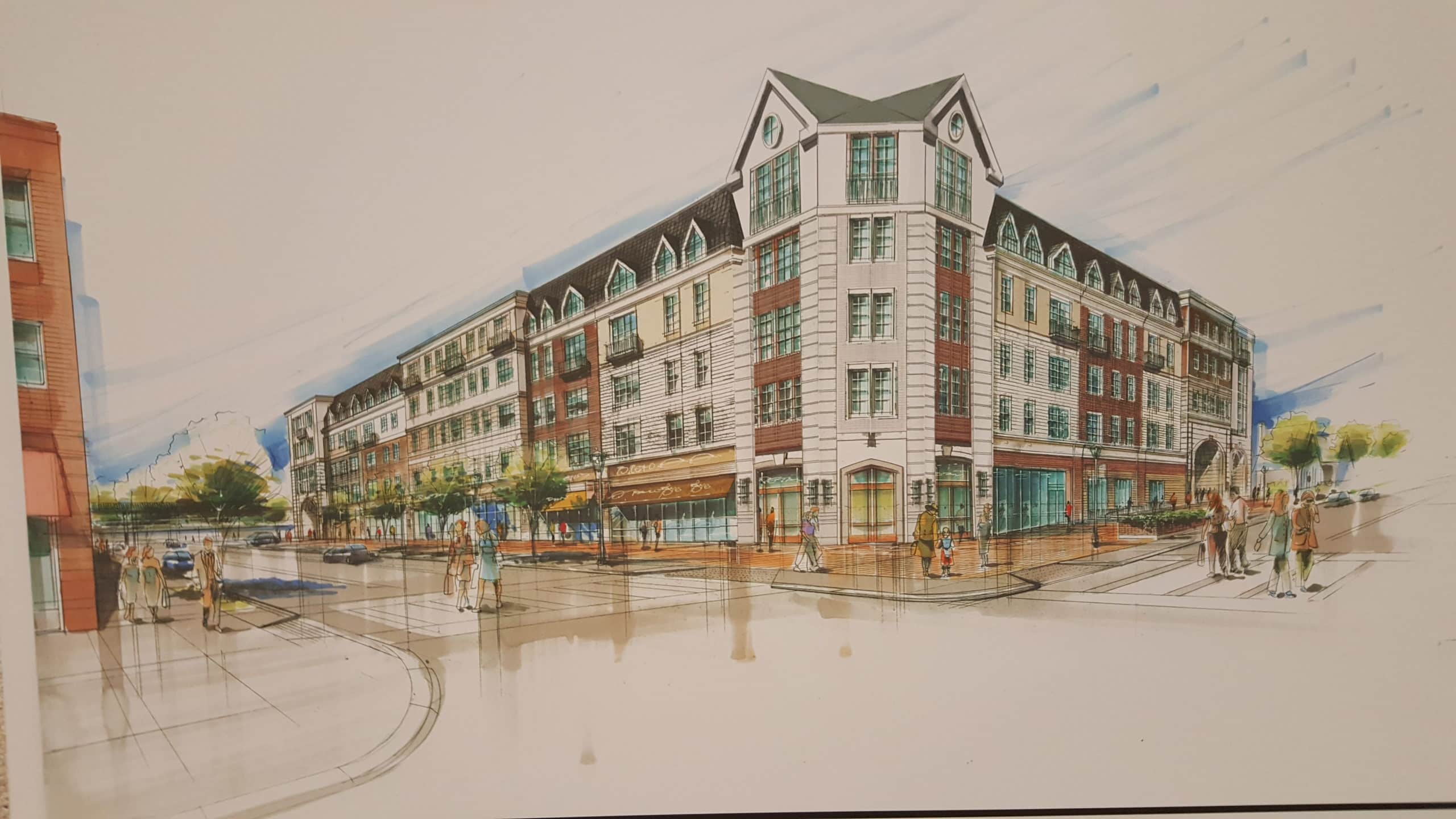
In the zoomed in version of developer John Saraceno’s “rendering” above we see the Franklin & Broad intersection which will be drastically impacted by the new 5 story building and the nearby 4 story Chestnut apartments. The archway on the right is one of two entry/exit for the 150 new parking spots on Franklin. The current lot is private and not open to the public. There will be a great deal of new traffic at one of the most important, dangerous, and crowded intersections in the village.
The new light at this intersection will cost $300k, Saraceno has offered to pay 25% [which is more than the law requires]. The bigger problem is how other, non-upgraded intersections will handle the traffic flow. By law, developers of Ridgewood’s 4 new high-density buildings only have to pay a small fraction of any needed new lights.
The board also spent considerable time with its own traffic professional, Andrew Feranda, further discussing the Franklin Avenue thoroughfare. They looked specifically at the coordination of traffic lights in the area. Feranda recommended coordinating the timing of the lights on Franklin Avenue at Broad Street and Oak Street to ensure more efficient traffic flow.
Voigt said any traffic improvements made to those intersections, the two closest traffic lights to the development, could necessitate changes at all lights from Wilsey Square to Maple Avenue. Feranda agreed the corridor would be more efficient with all the lights working in tandem.
“It certainly doesn’t move traffic efficiently if they’re not coordinated,” said Feranda.
Feranda said his layout would look “similar” to the plans put forth by the applicant. He cited the use of the signalized intersection at Broad Street and Franklin Avenue, and the fact that the driveway, on Chestnut Street, was about as far away from Franklin Avenue as possible.
All 4 of the high-density developments downtown are allowed thanks to controversial laws championed by Ridgewood resident Saraceno and then-mayor Paul Aronsohn.
New Jersey has the highest property taxes, foreclosure rate and is the most expensive state in the nation to own a home. Common sense and basic economics tell us that there is too much supply and too little demand, with high taxes and a dense population distorting total housing costs upward.
Now we are facing the equivalent of housing Armageddon. A non-profit entity with ties to developers is attempting to force towns across the state to build 280,000 affordable housing units in the next nine years.
Ridgewood NJ, The “rendering” of new apartments at Broad and Franklin by John Saraceno’s architect leaves a lot to be desired, like a connection to reality for starters. So let’s break down the reality of what Saraceno is planning. Built on the former home of the Ken Smith car dealership, the 66 unit apartment with thousands of square feet of retail space is allowed under new village laws championed by Ridgewood resident Saraceno and then-mayor Paul Aronsohn.
Frontage:
Franklin St- 198 feet
Chestnut St- 119 feet
Height: 5 stories, putting it above all neighboring buildings and higher than the train station. Saraceno says his 5 story building is 50 feet high. The “tower” is 57 feet. The new Chestnut apartments several hundred feet away are four stories and 53 feet high.
Parking:
155 parking spots, the arches at the ends of the building on Franklin and Chestnut are the lot entry/exits. The Chestnut entry is near the new 43 unit high-density apartments being built on the old vehicle inspection station lot.
Reminder:
Saraceno and Aronsohn, who partnered to raise the density in this area to 35 units, said these two and three bedroom apartments won’t have a lot of school age families. The Ridgewood school budget has grown ~25% in less than 10 years on just about flat enrollment.
The Saraceno, Aronsohn, Hauck, and Pucciarelli dream of turning Ridgewood into high-density heaven is just a few months away. The most densely populated county in the most densely populated state in the union is about to get more crowded. Ridgewood used to be a place to get away from that, no more.
The carpetbaggers came to town, they hedged their bets, bought some real estate,.they had confidence their puppet council would accommodate their demands so they can build build build , pocket the profits, and leave while sticking the taxpayers with the tab for a garage to enhance their bets, You made a bet. You wanted to make the village into your vision of a “Montclair light “. You lost. Now do us all a favor and go home, back to your real home which isn’t 07450
Remember that the former Mayor and Mr. Saraceno conducted studies that showed that there would be LESS traffic and only 4 additional children in the schools as a result of this project. No really, they did – and expected us to believe it. The studies assumed that only empty nesters with no cars would be moving in to these apartments. They further assumed that apartment dwellers would simply walk to get everything they needed in Ridgewood and take the train everywhere else. What could possibly go wrong by trusting a real estate developer and a disgraced politician?
Members of the public suggesting that the proposed development project, when built, will produce unavoidable, intractable problems with vehicular and pedestrian traffic at the intersection of Broad Street and Franklin Avenue, reflect common sense and need not be deemed “out of order” by Saraceno’s henchmen. The idea that we need a developer’s attorney to tell us what is and is not a fact, and what to think of a given fact in terms of what it portends for our lives as Village residents, and that we can’t legitimately rely on our own minds and common sense, is insulting, preposterous and condescending. This is too reminiscent of the Valley travails before the planning board and we shouldn’t be so willing to put up with it now that we are familiar with the tactic.
Smoke rises from an Edgewater, NJ apartment complex Jan. 22 as firefighters battle a fast-spreading blaze. (AP Photo/Julio Cortez)
Legislation to improve fire protection and safety in multi-family dwellings has been rolled out by Assembly Speaker Vincent Prieto.
It was prompted by a massive blaze at a multi-family luxury apartment complex in Edgewater in 2015 that displaced over 500 residents. The fast-moving blaze spread through sealed spaces in the building that didn’t have sprinklers.
Prieto wants to require fire suppression in those spaces.
“I think it will add minimal cost and that way it will still be able to be built.”
There are three main provisions in his two-bill package of legislation, which is co-sponsored by Assemblywoman Angelica Jimenez, Assemblyman Tim Eustace and Assemblyman Joe Lagana.
New Jersey towns are on the hook for 280,000 affordable housing units through 2025, according to a new study by the Fair Share Housing Center.
To put the number in context, it averages out to 496 new units for each of the state’s 565 municipalities, although not all towns face the same requirements.
The affordable housing debate is as wonky as it is politically fraught in New Jersey, pitting Democrats against Republicans and local officials against judges. A small army of lawyers always seems to be in court somewhere fighting over how many units to build.
Why would a private developer build 100% low and moderate income income housing if their cost to build exceeds their projected revenue from the project.? The NJ State Supreme court has ruled on the issue of affordable housing and EVERY municipality must comply, so the choice for the Village is to either build it themselves in which case the existing taxpayers end up footing the entire bill or they can offer an incentive to private developers via a reasonable “set-aside” for an affordable housing component in their proposed development. So the choice is simple, the residents can either pay for the whole thing themselves or they can partially subsidize someone who will. DUH !!
Seven low income housing units are planned for the Chestnut Avenue development that was just approved. How the heck does Ridgewood make any sort of real dent in its preposterous court-imposed low income housing deficit, seven units at a time?
Judicial fiat in any area of life over a time span measured in decades is utter lunacy. In this case it constitutes a naked denial to New Jersey citizens of their right under the U.S. Constitution to a republican (small ‘r’) form of government. The Municipal Law course at Rutgers Newark offered at the turn of the millenium featured a hands-upturned, shoulders-shrugged admission of all of the above by the part-time prof and active municipal law practitioner (who, of course, supported the system despite its unconstitutionality, but why? Because the prof was a reliablly progressive statist drone who agreed with the POLICY!).
The issue of affordable housing is based on a NJ Supreme Court decision over 10 years ago that requires EVERY municipality in the state to provide affordable housing in their community. The towns then essentially passed that burden along to developers who wished to build new housing units in their community by requiring that a percentage of the new units be dedicated to affordable housing. Nonetheless the legal obligation to provide affordable housing ultimately rests with the municipality and not developers..
It doesn’t. The way the ‘settlement’ has been structured, it never will.The settlement isn’t designed to address low income housing availability. It is designed as a club developers can hold over the heads of affluent communities. No prizes for guessing who the driving force behind the settlement was.
If they REALLY cared about affordable housing, they would insist that developers build 100% affordable housing, instead of giving ‘credit’ for a few units in a giant multifamily building. But there the $$$$$ are just not there for developing pure affordable housing, you see!
The part I can’t understand is that to get the seven we have to get a lot more of the “non-low-income” kind, thereby increasing the proportion of those. At that rate, the more affordable units we build, the farther behind we’ll get. By the way, Aronsohn promised the disabled community that he would make sure appropriate housing became available. Why isn’t his name invoked when complaints are made that Ridgewood needs this? No–instead, he’s thanked.
That was the fallacy and lunacy of the Mayor Arohnson approach – – the last council approved close to 400 new family units downtown with only a small percentage addressing our coah requirements. But, the new council does not seem any more intent on doing what we need to do in a rationale manner. Now we have these new units going forward, our schools and other village services will be innundated with new people and we still have the problem we had before — where do we put hundreds of new coah units??
Things are getting personal in the seemingly endless legal fight over how much affordable housing to build in New Jersey.
After South Brunswick lost a court case seeking to tamp down its affordable housing obligations, the township’s attorney, Jeffrey Surenian, filed court papers last week attacking the judge who issued the ruling.
The allegation is that former Superior Court Judge Douglas Wolfson had a conflict of interest because earlier in his career Wolfson represented and befriended a developer, Jack Morris of Edgewood Properties, who allegedly stood to benefit financially from Wolfson’s rulings last year calling for more affordable housing units to be built than some towns wanted.
Seven low income housing units are planned for the Chestnut Avenue development that was just approved. How the heck does Ridgewood make any sort of real dent in its preposterous court-imposed low income housing deficit, seven units at a time?
Mark Krulish , Staff Writer, @Mark_KrulishPublished 7:46 p.m. ET April 5, 2017 | Updated 19 hours ago
RIDGEWOOD — Barring any unforeseen developments, the village will soon be home to a new residential complex on Chestnut Street.
Chestnut Village, a 43-unit apartment complex, will include seven units set aside for affordable housing. It will be built at the site of the old state inspection station, near the village’s central garage.
The crowd who loves high-density CBD housing, massive hospital expansions, and giant money losing garages hate adding more parking to the train station and CBD in a simple and low-cost manner. Why? Because supporting simple, low-cost, low-impact, high-ROI programs undermines their entire narrative of over-developing. Is Sears failing from a lack of parking? Is Englewood, NJ struggling with store-front retail due to a lack of parking? We have the parking, the very well done Walker and Maser reports show we don’t use what we have. Why don’t we try maximizing all the space we have already dedicated to parking first, then think about building. The garages all lose money even while requiring huge fee increases and are really subsidies for the local developer and a couple land owners in the CBD.
Halaby et al do not favor any parking solutions except the garage, promised by former Deputy Mayor Albert Pucciarelli and former Mayor Paul Aronsohn to the developers so that they could legally provide less parking on their own apartment properties. Resolve the parking situation in other ways and the (unwanted, unneeded, solution-less) garage goes away. We can’t have that!!!!!!!