Posted on 2 Comments

Many taxpayers have encountered individuals impersonating IRS officials

IRS_logo

July 7,2018

the staff of the Ridgewood blog

Washington DC, Many taxpayers have encountered individuals impersonating IRS officials – in person, over the telephone and via email. Don’t get scammed. We want you to understand how and when the IRS contacts taxpayers and help you determine whether a contact you may have received is truly from an IRS employee.
The IRS initiates most contacts through regular mail delivered by the United States Postal Service.

However, there are special circumstances in which the IRS will call or come to a home or business, such as when a taxpayer has an overdue tax bill, to secure a delinquent tax return or a delinquent employment tax payment, or to tour a business as part of an audit or during criminal investigations.

Even then, taxpayers will generally first receive several letters (called “notices”) from the IRS in the mail.
Note that the IRS does not:
Call to demand immediate payment using a specific payment method such as a prepaid debit card, gift card or wire transfer. Generally, the IRS will first mail a bill to any taxpayer who owes taxes.
Demand that you pay taxes without the opportunity to question or appeal the amount they say you owe. You should also be advised of your rights as a taxpayer.
Threaten to bring in local police, immigration officers or other law-enforcement to have you arrested for not paying. The IRS also cannot revoke your driver’s license, business licenses, or immigration status. Threats like these are common tactics scam artists use to trick victims into buying into their schemes.

If you owe taxes:
The IRS instructs taxpayers to make payments to the “United States Treasury.” The IRS provides specific guidelines on how you can make a tax payment at irs.gov/payments.
Here is what the IRS will do:
If an IRS representative visits you, he or she will always provide two forms of official credentials called a pocket commission and a HSPD-12 card. HSPD-12 is a government-wide standard for secure and reliable forms of identification for federal employees and contractors. You have the right to see these credentials. And if you would like to verify information on the representative’s HSPD-12 card, the representative will provide you with a dedicated IRS telephone number for verifying the information and confirming their identity.

Collection
IRS collection employees may call or come to a home or business unannounced to collect a tax debt. They will not demand that you make an immediate payment to a source other than the U.S. Treasury.
Learn more about the IRS revenue officers’ collection work.
The IRS can assign certain cases to private debt collectors but only after giving the taxpayer and his or her representative, if one is appointed, written notice. Private collection agencies will not ask for payment on a prepaid debit card or gift card. Taxpayers can learn about the IRS payment options on IRS.gov/payments. Payment by check should be payable to the U.S. Treasury and sent directly to the IRS, not the private collection agency.
Learn more about how to know if it’s really an IRS Private Debt Collector.

Audits
IRS employees conducting audits may call taxpayers to set up appointments or to discuss items with the taxpayers, but not without having first attempted to notify them by mail. After mailing an official notification of an audit, an auditor/tax examiner may call to discuss items pertaining to the audit.
Learn more about the IRS audit process.

Criminal Investigations
IRS criminal investigators may visit a taxpayer’s home or business unannounced while conducting an investigation. However, these are federal law enforcement agents and they will not demand any sort of payment.
Learn more about the What Criminal Investigation Does and How Criminal Investigations are Initiated.

Beware of Impersonations
Scams take many shapes and forms, such as phone calls, letters and emails. Many IRS impersonators use threats to intimidate and bully people into paying a fabricated tax bill. They may even threaten to arrest or deport their would-be victim if the victim doesn’t comply.

For a comprehensive listing of recent tax scams and consumer alerts, visit Tax Scams/Consumer Alerts.

Know Who to Contact
Contact the Treasury Inspector General for Tax Administration to report a phone scam. Use their “IRS Impersonation Scam Reporting” web page. You can also call 800-366-4484.
Report phone scams to the Federal Trade Commission. Use the “FTC Complaint Assistant” on FTC.gov. Please add “IRS Telephone Scam” in the notes.
Report an unsolicited email claiming to be from the IRS, or an IRS-related component like the Electronic Federal Tax Payment System, to the IRS at [email protected].

Posted on Leave a comment

Bergen County, New Jersey, Man Admits Conspiring To Defraud The IRS By Filing False Corporate Tax Returns

IRS_logo

July 7,2018

the staff of the Ridgewood blog

Elmwood Park NJ, A Bergen County, New Jersey, man today admitted conspiring with his father to file false federal tax returns for shell companies, resulting in $191,953 in fraudulent refunds, U.S. Attorney Craig Carpenito announced.
Jason Crespo, 35, of Elmwood Park, New Jersey, pleaded guilty before U.S. District Judge Jose L. Linares in Newark federal court to an information charging him with one count of conspiring with Jose Crespo, his father, to defraud the IRS by filing false corporate tax returns and cashing the resulting fraudulent refund checks.

According to the documents filed in this case and statements made in court:
Between 2010 and 2012, Jason and Jose Crespo filed numerous false federal corporate tax returns – IRS Forms 1120 – for fake businesses, knowing that the businesses were not real and that the credits claimed on the tax returns were false. The Crespos took advantage of fuel excise tax credits offered under federal tax law. The federal government taxes gasoline, diesel fuel, and certain other types of fuel, but certain commercial uses of these fuels are nontaxable. Businesses that purchase fuel for a nontaxable use can claim a tax credit by filing a “Credit for Federal Tax Paid on Fuels” – IRS Form 4136.
In one instance Jason and Jose Crespo filed a federal corporate tax return for 2008 for Jason Cleaning Service Corp. that falsely claimed a fuel excise tax credit of $14,556 and a resulting refund of $10,592. In fact, Jason Cleaning Service Corporation was a shell company and the fuel excise tax credit and other tax return numbers were false. Jason Crespo received and cashed the $10,592 refund check at a check-cashing facility in Guttenberg, New Jersey. He cashed many other refund checks for similar false tax returns at this same facility.

Jose Crespo pleaded guilty on Sept. 11, 2017, before Judge Linares to engaging in the fuel excise tax credit scheme and another tax fraud scheme, both of which claimed fraudulent refunds from the IRS of approximately $1.5 million. Jose Crespo was sentenced on Dec. 20, 2017, to three years in prison.

Marilyn Crespo, Jose Crespo’s wife, pleaded guilty on March 1, 2018, before Judge Linares to engaging in the same fuel excise tax credit scheme and causing a loss to the IRS of $286,742. She was sentenced June 27, 2018, to one year and one day in prison.

The filing a false tax return count carries a maximum potential penalty of three years in prison, and a potential $250,000 fine, or twice the gross gain or loss from the offense. Jason Crespo’s sentencing is set for Oct. 4, 2018.

U.S. Attorney Carpenito credited special agents of IRS-Criminal Investigation, under the direction of Acting Special Agent in Charge Bryant Jackson, with the investigation leading to today’s guilty plea.

Posted on Leave a comment

The Trump administration releases proposed draft of its new shorter 1040 form

Internal_Revenue_Service_logo_CNA_US_Catholic_News_5_16_13

June 29,2018

the staff of the Ridgewood blog

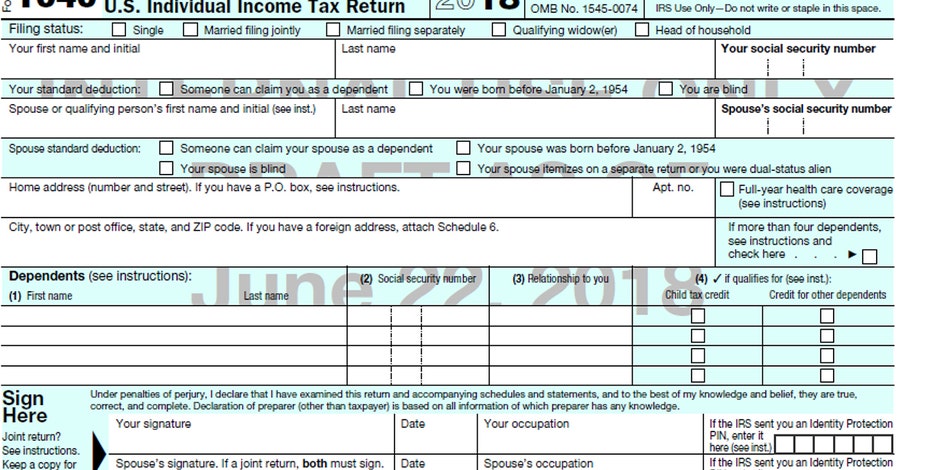
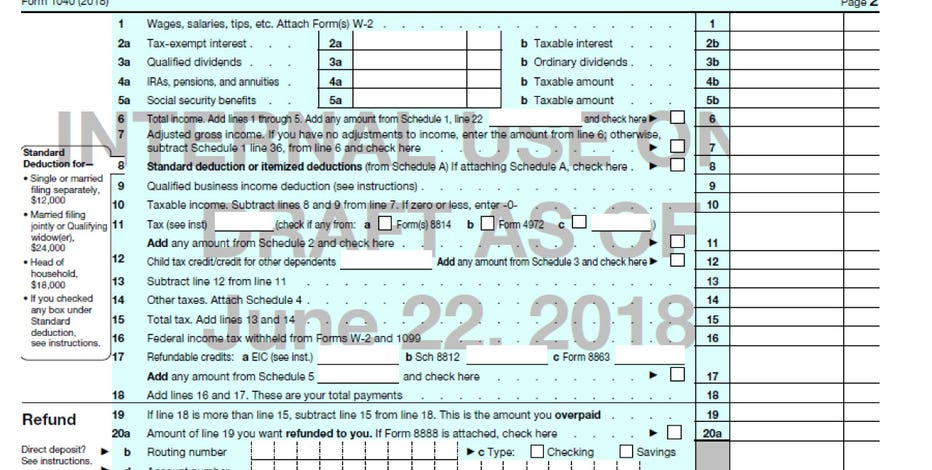
Washington DC, The Trump administration on Thursday released a proposed draft of its new 1040 tax form, which is shorter than the current form but could require additional documentation depending on the financial circumstances of the taxpayer.

Draft 1040

1040

The Tax Cuts and Jobs Act, which eliminated certain deductions, helped the administration shrink the size of the main individual tax form. Items that used to be included on the main form, however, are now moved to subsequent schedules.It should be noted that these documents are just drafts and may not reflect the finished product.

Posted on 1 Comment

IRS Documents Reveal Senator John McCain’s Subcommittee Staff Director Urged IRS to Engage in “Financially Ruinous” Targeting of Tea Party Groups

John-McCain


June 25,2018

the staff of the Ridgewood bog

Washington DC,  Judicial Watch today released newly obtained internal IRS documents, including material revealing that Sen. John McCain’s former staff director and chief counsel on the Senate Homeland Security Permanent Subcommittee, Henry Kerner, urged top IRS officials, including then-director of exempt organizations Lois Lerner, to “audit so many that it becomes financially ruinous.” Kerner was appointed by President Trump as Special Counsel for the United States Office of Special Counsel.

The explosive exchange was contained in notes taken by IRS employees at an April 30, 2013, meeting between Kerner, Lerner, and other high-ranking IRS officials. Just ten days following the meeting, former IRS director of exempt organizations Lois Lerner admitted that the IRS had a policy of improperly and deliberately delaying applications for tax-exempt status from conservative non-profit groups.
Lerner and other IRS officials met with select top staffers from the Senate Governmental Affairs Committee in a “marathon” meeting to discuss concerns raised by both Sen. Carl Levin (D-MI) and Sen. John McCain (R-AZ) that the IRS was not reining in political advocacy groups in response to the Supreme Court’s Citizens United decision. Senator McCain had been the chief sponsor of the McCain-Feingold Act and called the Citizens United decision, which overturned portions of the Act, one of the “worst decisions I have ever seen.”

In the full notes of an April 30 meeting, McCain’s high-ranking staffer Kerner recommends harassing non-profit groups until they are unable to continue operating. Kerner tells Lerner, Steve Miller, then chief of staff to IRS commissioner, Nikole Flax, and other IRS officials, “Maybe the solution is to audit so many that it is financially ruinous.” In response, Lerner responded that “it is her job to oversee it all:”
Henry Kerner asked how to get to the abuse of organizations claiming section 501 (c)(4) but designed to be primarily political. Lois Lerner said the system works, but not in real time. Henry Kerner noted that these organizations don’t disclose donors. Lois Lerner said that if they don’t meet the requirements, we can come in and revoke, but it doesn’t happen timely. Nan Marks said if the concern is that organizations engaging in this activity don’t disclose donors, then the system doesn’t work. Henry Kerner said that maybe the solution is to audit so many that it is financially ruinous. Nikole noted that we have budget constraints. Elise Bean suggested using the list of organizations that made independent expenditures. Lois Lerner said that it is her job to oversee it all, not just political campaign activity.

Judicial Watch previously reported on the 2013 meeting. Senator McCain then issued a statement decrying “false reports claiming that his office was somehow involved in IRS targeting of conservative groups.” The IRS previously blacked out the notes of the meeting but Judicial Watch found the notes among subsequent documents released by the agency.

Judicial Watch separately uncovered that Lerner was under significant pressure from both Democrats in Congress and the Obama DOJ and FBI to prosecute and jail the groups the IRS was already improperly targeting. In discussing pressure from Senator Sheldon Whitehouse (Democrat-Rhode Island) to prosecute these “political groups,” Lerner admitted, “it is ALL about 501(c)(4) orgs and political activity.”
The April 30, 2013 meeting came just under two weeks prior to Lerner’s admission during an ABA meeting that the IRS had “inappropriately” targeted conservative groups. In her May 2013 answer to a planted question, in which she admitted to the “absolutely incorrect, insensitive, and inappropriate” targeting of Tea Party and conservative groups, Lerner suggested the IRS targeting occurred due to an “uptick” in 501 (c)(4) applications to the IRS but in actuality, there had been a decrease in such applications in 2010.

On May 14, 2013, a report by Treasury Inspector General for Tax Administration revealed: “Early in Calendar Year 2010, the IRS began using inappropriate criteria to identify organizations applying for tax-exempt status” (e.g., lists of past and future donors). The illegal IRS reviews continued “for more than 18 months” and “delayed processing of targeted groups’ applications” in advance of the 2012 presidential election.
All these documents were forced out of the IRS as a result of an October 2013 Judicial Watch Freedom of Information (FOIA) lawsuit filed against the IRS after it failed to respond adequately to four FOIA requests sent in May 2013 (Judicial Watch, Inc. v. Internal Revenue Service (No. 1:13-cv-01559)). Judicial Watch is seeking:

All records related to the number of applications received or related to communications between the IRS and members of the U.S. House of Representatives or the U.S. Senate regarding the review process for organizations applying for tax exempt status under 501(c)(4);

All records concerning communications between the IRS and the Executive Branch or any other government agency regarding the review process for organizations applying for tax exempt status under 501(c)(4);
Copies of any questionnaires and all records related to the preparation of questionnaires sent to organizations applying for 501(c)(4) tax exempt status.
All records related to Lois Lerner’s communication with other IRS employees, as well as government or private entity outside the IRS regarding the review and approval process for 501 (c)(4) applicant organizations.
“The Obama IRS scandal is bipartisan – McCain and Democrats who wanted to regulate political speech lost at the Supreme Court, so they sought to use the IRS to harass innocent Americans,” said Judicial Watch President Tom Fitton. “The Obama IRS scandal is not over – as Judicial Watch continues to uncover smoking gun documents that raise questions about how the Obama administration weaponized the IRS, the FEC, FBI, and DOJ to target the First Amendment rights of Americans.”

Posted on 2 Comments

NJ Attorney General Asks IRS to Withdraw Proposal that Would Upend New Jersey’s Charitable Deduction Tax Credit Law

Roadsaltimage

AG Grewal to IRS: Stop “Playing Politics” with SALT Tax Guidance—or Face a Legal Challenge

May 27,2018

the staff of the Ridgewood blog

Trenton NJ,  Attorney General Gurbir S. Grewal today urged the U.S. Internal Revenue Service (IRS) to drop its “misguided” plan to enact a new rule designed to undermine a recent New Jersey law. That law – signed by Governor Phil Murphy earlier this month – allows residents to receive property tax credits when they make charitable contributions to their local governments.

The Trump Administration enacted a tax overhaul in December 2017 that placed, for the first time, a $10,000 cap on the federal deduction for state and local taxes (SALT). In response, New Jersey, New York and other states passed laws allowing residents to instead make deductible charitable contributions to their local governments, and to receive partial tax credits when they do so. “But in an unprecedented move,” Attorney General Grewal explained, the IRS just yesterday “announced plans to end the deductibility of such contributions.”

In a letter to IRS Commissioner David J. Kautter, Attorney General Grewal points out that the New Jersey tax credit law is similar to 100 laws enacted in more than 30 other states, and is consistent with longstanding IRS guidance and numerous court decisions that such contributions remain deductible. So “the IRS’s plan will upend over 100 state programs in a single rule—a nightmare for both states and the IRS.” Yet the IRS has given “no reason for [its] sudden about-face.”

“The IRS should not play politics. Instead, it must confirm its longstanding interpretation of federal law,” Grewal explains in his letter. “Should the IRS and Treasury Department continue down this path, New Jersey will have no choice but to challenge the new rule in court.”

Attorney General Grewal’s letter notes that the New Jersey law authorizes municipal and county governments and local school districts to establish “charitable funds for specific purposes” and to permit residents to gain partial property tax credits for donating to those funds. Across the states with similar programs, charitable funds “run the gamut” from those designed to aid natural resource preservation efforts to funds that help provide financial aid for college-bound children, support shelters for the victims of domestic violence and many other programs.

The Attorney General contends that the IRS’s decision runs counter to the federal Tax Code, which makes plain that deductions are permissible for “any charitable contribution … payment of which is made within the taxable year.”
“The statute is explicit that such contributions include gifts given to state governments and their political subdivisions,” Grewal notes. “The only remaining issue is whether such gifts are deductible if the contributor gets a tax credit in return.” While the IRS has previously “answered that question resoundingly in favor of laws” like New Jersey’s, the latest guidance “suggests that the IRS plans to tell states and taxpayers alike the answer is no.”
“I ask you to think twice before going down that misguided road,” Grewal warns the IRS Commissioner. “The IRS’s longstanding approach, supported by precedent and policy, supports what New Jersey has done.”

Posted on 3 Comments

Tax Freedom Day 2018 Will Not Fall In New Jersey until May 3rd

26992040 1573347669452308 3407901945734657736 n1

Tax Freedom Day falls on April 19th

April 15,2018
the staff of the Ridgewood blog

Ridgewood NJ, according to the Tax Foundation ,Tax Freedom Day is the day when the nation as a whole has earned enough money to pay its total tax bill for the year. In 2018, Tax Freedom Day falls on April 19th, 109 days into the year, three days earlier than last year. Tax Freedom Day is significant because Americans will collectively spend more on taxes in 2018 than they will on food, clothing, and housing combined. If you include annual federal borrowing, which represents future taxes owed, Tax Freedom Day would occur 17 days later, on May 6th.

This year Tax Freedom Day will be three days earlier than it was in 2017, in large part due to the recent federal tax law, the Tax Cuts and Jobs Act, which significantly lowered federal individual and corporate income taxes.

The Tax Foundation defines Tax Freedom Day® as the day when the nation as a whole has earned enough money to pay its total tax bill for the year. Tax Freedom Day takes all federal, state, and local taxes and divides them by the nation’s income. In 2018, Americans will pay $3.39 trillion in federal taxes and $1.80 trillion in state and local taxes, for a total tax bill of $5.19 trillion, or 30 percent of national income. This year, Tax Freedom Day falls on April 19th, 109 days into 2018.

This year, Americans again will work the longest to pay federal, state, and local individual income taxes (44 days). Payroll taxes will take 26 days to pay, followed by sales and excise taxes (15 days), corporate income taxes (seven days), and property taxes (11 days). The remaining six days are spent paying estate and inheritance taxes, customs duties, and other taxes.

The total tax burden borne by residents of different states varies considerably due to differing state tax policies and the progressivity of the federal tax system. This means that states with higher incomes and higher taxes celebrate Tax Freedom Day later: New York (May 14), New Jersey (May 3), and Connecticut (May 3). Residents of Louisiana and Alaska bear the lowest average tax burden in 2018, with Tax Freedom Day having arrived on April 4. Also early were Tennessee, Oklahoma, and Alabama, all on April 5.

Posted on 2 Comments

Reader says The founding fathers designed the Constitution to deal with the eternal truth that national government USUALLY accumulate and abuse power

Ridgewood_-4th_of-_July_theridgewoodblog

The founding fathers designed the Constitution to deal with the eternal truth that national government USUALLY accumulate and abuse power and wanted the citizenry to have the ability to resist threats to their liberties. There is no mention nor even spirit in the language of the Constitution or Federalist Papers that law-abiding citizens be limited to weapons inferior to that of the military. There is AMPLE evidence that the founders wanted the citizenry to be able to DEFEAT a regular army (not to mention the paramilitaries of the blue windbreaker agencies FBI, DEA, ATF, IRS, etc. whose very existence would have chapped their @ss) if used to infringe on civil liberties. If you find such language, please feel free to share it.

Posted on 6 Comments

Reader suggests IRS Could Target Tax Exempt Status for Overly Political Local Church

Emmanual Baptist Church

“The ban on political campaign activity by charities and churches was created by Congress more than a half century ago. The Internal Revenue Service administers the tax laws written by Congress and has enforcement authority over tax-exempt organizations. Here is some background information on the political campaign activity ban and the latest IRS enforcement statistics regarding its administration of this congressional ban.”

UNITED STATES DISTRICT COURT FOR THE DISTRICT OF COLUMBIA
.
Civil Action No. 95-0724 (PLF)
.
BRANCH MINISTRIES, INC., et al., Plaintiffs,
v.
CHARLES O. ROSSOTTI,
Commissioner, Internal Revenue Service, Defendant.
.
Opinion
.
This case is about the decision of the Internal Revenue Service to revoke the status of plaintiff Branch Ministries as an organization exempt from taxation pursuant to 26 U.S.C. § 501(c)(3). Before any discovery was conducted, the government filed a motion to dismiss or for
summary judgment. Plaintiffs sought discovery on their claim that they were victims of selective prosecution, and the Court granted plaintiffs’ motion to compel. The case now is before the Court on the renewed motion of the government for summary judgment and on plaintiffs’ cross-motion for summary judgment. Upon consideration of the cross-motions, the Court concludes that the government has established that there are no material facts in dispute and that it is entitled to judgment as a matter of law.
.

.
3. Political Expression Claims
.
Plaintiffs argue that the IRS engaged in content-based viewpoint discrimination in
violation of their Fifth Amendment right to equal protection and in violation of their First Amendment right to free speech. The Fifth Amendment equal protection claim mirrors plaintiffs’ Fifth Amendment selective prosecution claim.
.
Plaintiffs contend that the IRS targeted the Church for revocation because the Church had expressed its political views. Because plaintiffs have failed
to provide any evidence of similarly situated churches that have not had their Section 501(c)(3) status revoked, see supra at 11-14, plaintiffs’ Fifth Amendment claim fails.
.
“Congress is not required by the First Amendment to subsidize lobbying.” Regan
v. Taxpayers With Representation, 461 U.S. 540, 546 (1983). Plaintiffs contend, however, that churches are different. Plaintiffs maintain (1) that churches are open fora, (2) that the IRS decision to revoke the Section 501(c)(3) status of the Church constitutes viewpoint
discrimination, and (3) that the IRS therefore must demonstrate a compelling interest in order to
justify the revocation. See Perry Educ. Assn. v. Perry Local Educators’ Assn., 460 U.S. 37, 45-46 (1983). There are a number of problems with plaintiffs’ argument. First, it is not at all clear that private churches in fact can be deemed open public fora. See id. (citing, as examples of open fora, numerous public or government spaces).
.
Second, even if a church is an open forum, that would be irrelevant to the revocation at issue in this case. The Section 501(c)(3) status of the Church was not revoked on the basis of any expressive activity that occurred on the property of the Church, the purportedly
“open” forum. Instead, the Section 501(c)(3) status was revoked because the Church took out a full-page advertisement advocating against a partisan political candidate. In this case, the relevant forum is the channel of communication, the newspaper advertisement itself, rather than the
property of the Church, the messenger. See Cornelius v. NAACP Legal Defense and Ed. Fund, 473 U.S. 788, 800-02 (1985) (“in defining the forum we have focused on the access sought by the
speaker. . . . [where plaintiffs] seek access to a particular means of communication,” the channel of communication rather than the physical site is the relevant forum). Even if the property of the Church itself is considered an open forum and the IRS could not constitutionally revoke the
Section 501(c)(3) status of a church on the basis of statements made in the church, the IRS clearly may revoke the tax-exempt status of any organization that publishes an advertisement in
opposition to a candidate for public office. See Regan v. Taxpayers With Representation, 461U.S. at 546.
.
Finally, plaintiffs contend that the IRS viewed the Church as “militant right” and
that revocation of its Section 501(c)(3) status therefore constituted viewpoint discrimination. See Pls’ Motion for Summ. J. at 30. As discussed supra at 14-16, however, plaintiffs have
provided absolutely no evidence that the IRS revoked the Section 501(c)(3) status of the Church on the basis of its political views. Plaintiffs therefore have failed to establish a First Amendment violation. An Order consistent with this Opinion shall be issued this same day.
.
SO ORDERED.
.
PAUL L. FRIEDMAN
United States District Judge

https://theridgewoodblog.net/emmanual-baptist-church-holds-a-community-peace-and-justice-forum-to-host-ridgewood-high-school-walkout-leaders/


Posted on 1 Comment

IRS : Phone Scams Continue to be a Serious Threat

irs

February 17,2018

the staff of the Ridgewood blog

WASHINGTON DC,  Aggressive and threatening phone calls by criminals impersonating IRS agents remain a major threat to taxpayers, headlining the annual “Dirty Dozen” list of tax scams for the 2016 filing season, the Internal Revenue Service announced today.

The IRS has seen a surge of these phone scams as scam artists threaten police arrest, deportation, license revocation and other things. The IRS reminds taxpayers to guard against all sorts of con games that arise during any filing season.

“Taxpayers across the nation face a deluge of these aggressive phone scams. Don’t be fooled by callers pretending to be from the IRS in an attempt to steal your money,” said IRS Commissioner John Koskinen. “We continue to say if you are surprised to be hearing from us, then you’re not hearing from us.”

“There are many variations. The caller may threaten you with arrest or court action to trick you into making a payment,” Koskinen added. “Some schemes may say you’re entitled to a huge refund. These all add up to trouble. Some simple tips can help protect you.”

The Dirty Dozen is compiled annually by the IRS and lists a variety of common scams taxpayers may encounter any time during the year. Many of these con games peak during filing season as people prepare their tax returns or hire someone to do so.

This January, the Treasury Inspector General for Tax Administration (TIGTA) announced they have received reports of roughly 896,000 contacts since October 2013 and have become aware of over 5,000 victims who have collectively paid over $26.5 million as a result of the scam.

“The IRS continues working to warn taxpayers about phone scams and other schemes,” Koskinen said. “We especially want to thank the law-enforcement community, tax professionals, consumer advocates, the states, other government agencies and particularly the Treasury Inspector General for Tax Administration for helping us in this battle against these persistent phone scams.”

Protect Yourself
Scammers make unsolicited calls claiming to be IRS officials. They demand that the victim pay a bogus tax bill. They con the victim into sending cash, usually through a prepaid debit card or wire transfer. They may also leave “urgent” callback requests through phone “robo-calls,” or via a phishing email.
Many phone scams use threats to intimidate and bully a victim into paying. They may even threaten to arrest, deport or revoke the license of their victim if they don’t get the money.

Scammers often alter caller ID numbers to make it look like the IRS or another agency is calling. The callers use IRS titles and fake badge numbers to appear legitimate. They may use the victim’s name, address and other personal information to make the call sound official.

Here are five things the scammers often do but the IRS will not do. Any one of these five things is a tell-tale sign of a scam.

The IRS will never:

Call to demand immediate payment, nor will the agency call about taxes owed without first having mailed you a bill.

Demand that you pay taxes without giving you the opportunity to question or appeal the amount they say you owe.

Require you to use a specific payment method for your taxes, such as a prepaid debit card.

Ask for credit or debit card numbers over the phone.

Threaten to bring in local police or other law-enforcement groups to have you arrested for not paying.

If you get a phone call from someone claiming to be from the IRS and asking for money, here’s what you should do:
If you don’t owe taxes, or have no reason to think that you do:
Do not give out any information. Hang up immediately.

Contact TIGTA to report the call. Use their “IRS Impersonation Scam Reporting” webpage. You can also call 800-366-4484.

Report it to the Federal Trade Commission. Use the “FTC Complaint Assistant” on FTC.gov. Please add “IRS Telephone Scam” in the notes.
If you know you owe, or think you may owe tax:
Call the IRS at 800-829-1040. IRS workers can help you.
Stay alert to scams that use the IRS as a lure. Tax scams can happen any time of year, not just at tax time. For more, visit “Tax Scams and Consumer Alerts” on IRS.gov.
Each and every taxpayer has a set of fundamental rights they should be aware of when dealing with the IRS. These are your Taxpayer Bill of Rights. Explore your rights and our obligations to protect them on IRS.gov.

Posted on 10 Comments

Treasury Secretary Calls individuals looking to skirt new limits on deducting state and local taxes “ridiculous,”

Treasury Secretary Steven Mnuchin

February 13,2018

the staff of the Ridgewood blog

Washington DC, The idea that individuals will skirt new limits on deducting state and local taxes is “ridiculous,” Treasury Secretary Steven Mnuchin said in January, highlighting concerns that people might be able to pay property taxes and claim them as a charitable deduction.

The Secretary continued ,“Let me just say again from a Treasury standpoint and IRS, I don’t want to speculate on what people will do, but I think it’s one of the more ridiculous comments to think you can take a real estate tax that you are required to make and dress that up as a charitable contribution,”

Mnuchin told reporters at the daily White House press briefing. “I hope that the states are more focused on cutting their budgets and giving tax cuts to their people in their states than they are in trying to evade the law.”

Posted on Leave a comment

TAX IDENTITY THEFT AWARENESS WEEK: January 29-February

NJ Attorney General

February 1,2018

the staff of the Ridgewood blog

Trenton NJ,New Jersey Attorney General’s Office  TAX IDENTITY THEFT AWARENESS WEEK: January 29-February 3 is New Jersey Cybersecurity and Communications Integration Cell “Tax Identity Theft Awareness Week” to spread awareness of tax-related identity theft and IRS imposter scams. Stay tuned throughout the week for the best ways to avoid tax identity theft.

New Jersey Attorney General’s Office Today’s tip: NEVER provide personal information to anyone purporting to be an IRS representative who contacts you via an unsolicited telephone call. Instead record the caller’s name, badge number and a call back number. Hang up and then contact the IRS at 1-800-366-4484 to determine if the caller is an IRS employee with a legitimate need to contact you. Also, remember that the IRS will never call demanding immediate payment of taxes owed or a specific method of payment, such as a prepaid debit card, gift card, or wire transfer.

Posted on Leave a comment

Judicial Watch Files Amicus Curiae Brief Urging Federal Court to Unseal Depositions of IRS Officials Lerner, Paz in Tea Party Targeting Case

lerner

January 31,2018

the staff of the Ridgewood blog

Washington DC,  Judicial Watch last week asked a federal court to unseal the depositions of Lois Lerner, the former director of the Exempt Organizations Unit of the Internal Revenue Service (IRS), and Holly Paz, her top aide and former IRS director of Office of Rulings and Agreements. Both played key roles in the targeting of conservative nonprofit groups opposed to Obama policies in the run up to the 2012 presidential election.

The request came in an amicus curiae brief filed with the U.S. District Court for the Southern District of Ohio, Western Division supporting NorCal Tea Party Patriots’ class action lawsuit seeking the unsealing of the depositions (NorCal Tea Party Patriots, et al. v. The Internal Revenue Service, et al. (No. 1:13-cv-00341)). The depositions were sealed by a federal judge after Lerner’s and Paz’s lawyers claimed the two were receiving threats. Judicial Watch’s brief argues that the documents sought may shed light on government misconduct, and the shielding of internal government deliberations does not serve the public’s interest.

Judicial Watch details how the Lerner and Paz depositions may significantly impact ongoing Judicial Watch lawsuits seeking information about misconduct of government officials in the IRS targeting scandal:

In addition to the revelation of IRS employees’ conduct in the emails uncovered, the records obtained by Judicial Watch [in the course of its FOIA investigation] also sparked investigations into Lois Lerner’s emails and IRS’ failure to preserve thousands of emails that were potentially relevant to the various investigations about the IRS’ treatment of conservative groups. While the federal government has now admitted that the targeting “was wrong” and “for such treatment, the IRS expresses its sincere apology” the IRS continues to this day to withhold from the public in Judicial Watch’s main IRS case … email communications with Lois Lerner and/or Holly Paz …
Lerner was actively engaged in the attempted cover-up of IRS misconduct. In July 2016, Judicial Watch revealed that both Lerner and Paz, knew the agency was specifically targeting “Tea Party” and other conservative organizations two full years before disclosing it to Congress and the public. They also knew donor lists of tax-exempt organizations were being used to target those donors for audits.

After refusing to acknowledge the targeting, Judicial Watch forced the IRS to finally admit in that the agency had used “inappropriate political labels” to screen the tax-exempt applications of conservative organizations. IRS agents were targeting organizations requesting tax-exempt status based on “guilt by association” and “party affiliation.” Judicial Watch brought to light that the IRS was going to require 501(c)(4) nonprofit organizations to restrict their alleged political activities in exchange for “expedited consideration” of their tax-exempt applications.

In April 2015, Judicial Watch released court ordered IRS documents that included an email from Lerner asking that a program be set up to “put together some training points to help them [IRS staffers] understand the potential pitfalls” of revealing too much information to Congress. The documents also contain a Lerner email from 2013 in which she says she is willing to take the blame on some aspects of the scandal. She also indicates that she “understands why the IRS criteria” leading to the targeting of Tea Party and other opponents of the President Obama “might raise questions.”

In July 2015, Judicial Watch revealed the IRS scandal also included the Justice Department and FBI as well. According to documents obtained by Judicial Watch under court order, in an October 2010 meeting, Lerner, Justice Department officials and the FBI planned for the possible criminal prosecution of targeted nonprofit organizations for alleged illegal political activity. As part of that effort, the Obama IRS gave the FBI 21 computer disks, containing 1.25 million pages of confidential IRS returns from 113,000 non-profit, 501(c)(4) social welfare groups as part of its prosecution effort. According to a letter from then-House Oversight Committee Chairman Darrell Issa (R-CA) to IRS Commissioner John Koskinen, “This revelation likely means that the IRS – including possibly Lois Lerner – violated federal tax law by transmitting this information to the Justice Department.”

“In a republic, citizens have a right to know what their government is up to, especially when officials abuse the powers entrusted to them,” said Judicial Watch President Tom Fitton. “This effort to seal Lois Lerner and Holly Paz depositions for all time is affront to the rule of law and government accountability.”

In response to Judicial Watch’s litigation, the IRS initially claimed that emails belonging to Lerner were supposedly missing. Later, IRS officials conceded that the “missing” emails were on IRS back-up systems. Throughout its litigation, Judicial Watch repeatedly exposed a variety of IRS record keeping inconsistencies, erroneous claims, and failures to produce court-ordered records:

In June 2014, the IRS claimed to have “lost” responsive emails belonging to Lerner and other IRS officials.
In July 2014 Judge Emmett Sullivan ordered the IRS to submit to the court a written declaration under oath about what happened to Lerner’s “lost” emails. The sworn declarations proved to be less than forthcoming.

In August 2014, Department of Justice attorneys for the IRS finally admitted Judicial Watch that Lerner’s emails, indeed all government computer records, are backed up by the federal government in case of a government-wide catastrophe. The IRS’ attorneys also disclosed that Treasury Inspector General for Tax Administration (TIGTA) was looking at several of these backup tapes.

In November 2014, the IRS told the court it had failed to search any of the IRS standard computer systems for the “missing” emails of Lerner and other IRS officials.
On February 26, 2015, TIGTA officials testified to the House Oversight and Government Reform Committee that it had received 744 backup tapes containing emails sent and received by Lerner. This testimony showed that the IRS had misled Congress, Judge Sullivan, and Judicial Watch that Lerner’s emails were irretrievably lost. The testimony also revealed that IRS officials responsible for responding to the document requests never asked for the backup tapes and that 424 backup tapes containing Lerner’s emails had been destroyed during the pendency of Judicial Watch’s lawsuit and Congressional investigations.

In June 2015, Judicial Watch forced the IRS to admit in a court filing that it was in possession of 6,400 “newly discovered” Lerner emails. Judge Emmet Sullivan’s ordered the IRS to provide answers on the status of the Lerner emails the IRS had previously declared lost. Judicial Watch raised questions about the IRS’ handling of the missing emails issue in a court filing, demanding answers about Lerner’s emails that had been recovered from the backup tapes.

In July 2015, U.S District Court Judge Emmet Sullivan threatened to hold John Koskinen, the commissioner of the Internal Revenue Service, and Justice Department attorneys in contempt of court after the IRS failed to produce status reports and recovered Lerner emails, as he had ordered on July 1, 2015.

Posted on 1 Comment

President Trump Proposed a Massive Tax Cut. Here’s What You Need to Know

1040taxirs_010415getty

APRIL 26, 2017

BY GARY COHN

Washington DC, We have a once-in-a-generation opportunity to do something big. President Trump has made tax reform a priority, and we have a Republican Congress that wants to get it done. This is something that Democrats should support too because it’s good for the American people.

The President is going to seize this opportunity by leading the most significant tax reform legislation since 1986 – and one of the biggest tax cuts in American history.

The President has focused on three things since his campaign: job creation, economic growth, and helping low and middle-income families who have been left behind by this economy. He understands that there are a lot of people in this country that feel like they work hard and still can’t get ahead. They are sick of turning their paychecks over to Washington and having no idea how their tax dollars are spent. They are frustrated by a tax code that is so complicated that they can’t even do their own taxes.

That’s why tax reform is such a big priority for this President.  He cares about making the economy work better for the American people.

We are going to cut taxes for businesses to make them competitive, and we are going to cut taxes for the American people – especially low and middle-income families.

In 1935, we had a one-page tax form consisting of 34 lines and two pages of instructions.  Today, the basic 1040 form has 79 lines and 211 pages of instructions. Instead of a single tax form, the IRS now has 199 tax forms on the individual side of the tax code alone. Taxpayers spend nearly 7 billion hours complying with the tax code each year, and nearly 90% of taxpayers need help filing their taxes.

We are going to cut taxes and simplify the tax code by taking the current 7 tax brackets we have today and reducing them to only three brackets: 10 percent, 25 percent, and 35 percent.

We are going to double the standard deduction so that a married couple won’t pay any taxes on the first $24,000 of income they earn.  So in essence, we are creating a 0 percent tax rate for the first $24,000 that a couple earns.

The larger standard deduction also leads to simplification because far fewer taxpayers will need to itemize, which means their tax form can go back to that one simple page.

Families in this country will also benefit from tax relief to help them with child and dependent care expenses.

We are going to repeal the Alternative Minimum Tax (AMT). The AMT creates significant complications and burdens by requiring taxpayers to do their taxes twice to see which is higher. That makes no sense; we should have one simple tax code.

Job creation and economic growth is the top priority for this Administration, and nothing drives economic growth like capital investment. Therefore, we are going to return the top tax rate on capital gains and dividends to 20 percent by repealing the harmful 3.8 percent Obamacare tax. That tax has been a direct hit on investment income and small business owners.

We are going to repeal the death tax. The threat of being hit by the death tax leads small business owners and farmers in this country to waste countless hours and resources on complicated estate planning to make sure their children aren’t hit with a huge tax when they die. No one wants their children to have to sell the family business to pay an unfair tax.

We are going to eliminate most of the tax breaks that mainly benefit high-income individuals.  Home ownership, charitable giving, and retirement savings will be protected – but other tax benefits will be eliminated.

This is not going to be easy. Doing big things never is. But one thing is for certain: I would not bet against this President.  He will get this done for the American people.

Gary Cohn is the chief economic advisor to President Donald J. Trump and Director of the National Economic Council.

Posted on Leave a comment

5 last-minute tax tips you need to know now

irs

by Dan Caplinger for The Motley Fool   @CNNMoneyApril 13, 2017: 2:10 PM ET
Your video will play in 00:07

The tax filing deadline is just days away, and if you haven’t yet filed your 2016 tax return, the finish line is looming just ahead.

As you crank through the things you need to do to get your returns prepared and filed, it’s essential not to lose sight of some key ideas that smart taxpayers always keep in mind.

By being aware of these simple rules, you can do your best to pay as little tax as necessary and avoid unnecessary audit or other risks.

https://money.cnn.com/2017/04/13/pf/taxes/tax-tips/

Posted on 2 Comments

Documents Confirm that Obama IRS Improperly Targeted Conservatives

irs

April 8,2017

from Judicial Watch

Judicial Watch continues to undercover the details of the Obama IRS’ arbitrary and capricious behavior toward those presumed to be “enemies” of President Obama.

This week we released 695 pages of new documents containing admissions by IRS officials that the agency used “inappropriate political labels” to screen the tax-exempt applications of conservative organizations. Other records reveal that the IRS was going to require 501(c)(4) nonprofit organizations to restrict their alleged political activities if they opted for “expedited consideration” of their tax-exempt applications.

The documents were produced after a revelation by the IRS that it had located “an additional 6,924 documents of potentially responsive records” relating to a 2015 Judicial Watch Freedom of Information Act (FOIA) lawsuit about the Obama IRS targeting scandal. These new records are the first batch of nearly 7,000 documents that had been hidden from JW, Congress, and the American people. (Our FOIA lawsuit seeks records about the IRS’ selection of individuals and organizations for audits based upon applications requesting nonprofit tax status filed by Tea Party and other 501(c)(4) tax-exempt organizations (Judicial Watch v. Internal Revenue Service (No. 1:15-cv-00220)).

Of the 695 pages of documents released by the IRS, 422 (61%) were completely blacked out. Again, this new material was not in the “Congressional Database,” which the IRS created in 2013 to house records responsive to congressional inquiries into the IRS scandal.

Nevertheless, we extracted some key info – such as a June 20, 2013, memo from Karen Schiller, then-acting director, EO (Exempt Organizations) Rulings and Agreements, suspending use of the controversial Be on the Lookout (BOLO) and Touch and Go (TAG) lists:

EO Rulings and Agreements is undertaking a comprehensive review of screening and identification of critical issues. We intend to develop proper procedures and uses for these types of documents. Until a more formal process for identification, approval and distribution of this type of data is established, Rulings and Agreements will not use this technique to elevate issues.

In an August 9, 2013, memo, Schiller admitted the IRS used political labels in targeting the groups for special scrutiny and possible audit and that, going forward, the agency would screen organizations based only on their activities, “not words” or “labels of any kind:”

As Acting Commissioner Danny Werfel has said, the IRS has taken decisive action to eliminate the use of inappropriate political labels in the screening of 501(c)(4) applications. IRS policy is now clear that screening is based on activity, not words in a name. The new steps and current policies were outlined in the June 24 report, which noted: “In the absence of BOLO lists, the Determinations Unit will continue to screen for information affecting the determination of applications for tax exempt status, including activity tied to political campaign intervention, but it [will] be done without regard to specific labels of any kind.” The 30-day report also reflects the June 20, 2013 memorandum, which was issued to officially suspend the use of the BOLO list in the screening process.

The documents also include a “Dear [Applicant]” letter that offers an “expedited process” for 501(c)(4) groups in exchange for restriction on their activities:

This optional expedited process is currently available only to applicants for 501(c)(4) status with applications pending for more than 120 days as of May 28, 2013, that indicate the organization may be involved in political campaign intervention.

In this optional process, an organization will represent that it satisfies, and will continue to satisfy, set percentages with respect to the level of its social welfare activities and political campaign intervention activities (as defined in the specific instructions on pages 5-7). These percentage representations are not an interpretation of law but are a safe harbor for those organizations that choose to participate in the optional process.

In short, the Obama IRS, after lawlessly delaying the approval of Tea Party group applications, tried to extort restrictions – which had no basis in law – on these very same groups.

On September 30, 2013, Acting Director, Exempt Organizations, Kenneth C. Corbin, sent a memo to IRS staff providing detailed guidance on classifying applications when “‘merit approval’ is not an option,” emphasizing that the determination is to be based on “facts and circumstances,” not “words and labels:”

Classifier reviews the application and determines if it should be routed to a specialty group. This determination is based upon facts and circumstances of the stated activities within Part II of the application rather than names or labels. This is consistent with Karen Schiller’s August 9, 2013 memorandum …

The Schiller and Corbin memos came on the heels of the May 14, 2013, Inspector General report revealing that the IRS had singled out groups using conservative-sounding terms such as “patriot” and “Tea Party” when applying for tax-exempt status. The IG probe determined that “Early in Calendar Year 2010, the IRS began using inappropriate criteria to identify organizations applying for tax-exempt status (e.g., lists of past and future donors)” and “delayed processing of targeted groups’ applications” in advance of the 2012 presidential election.

No wonder the Obama IRS hid these records. These new smoking-gun documents contain admissions by the Obama IRS that it inappropriately targeted conservative groups. But the records also show that the abuse continued – as the Obama IRS tried to force conservative applicants to give up their First Amendment rights in order to finally get their applications granted.