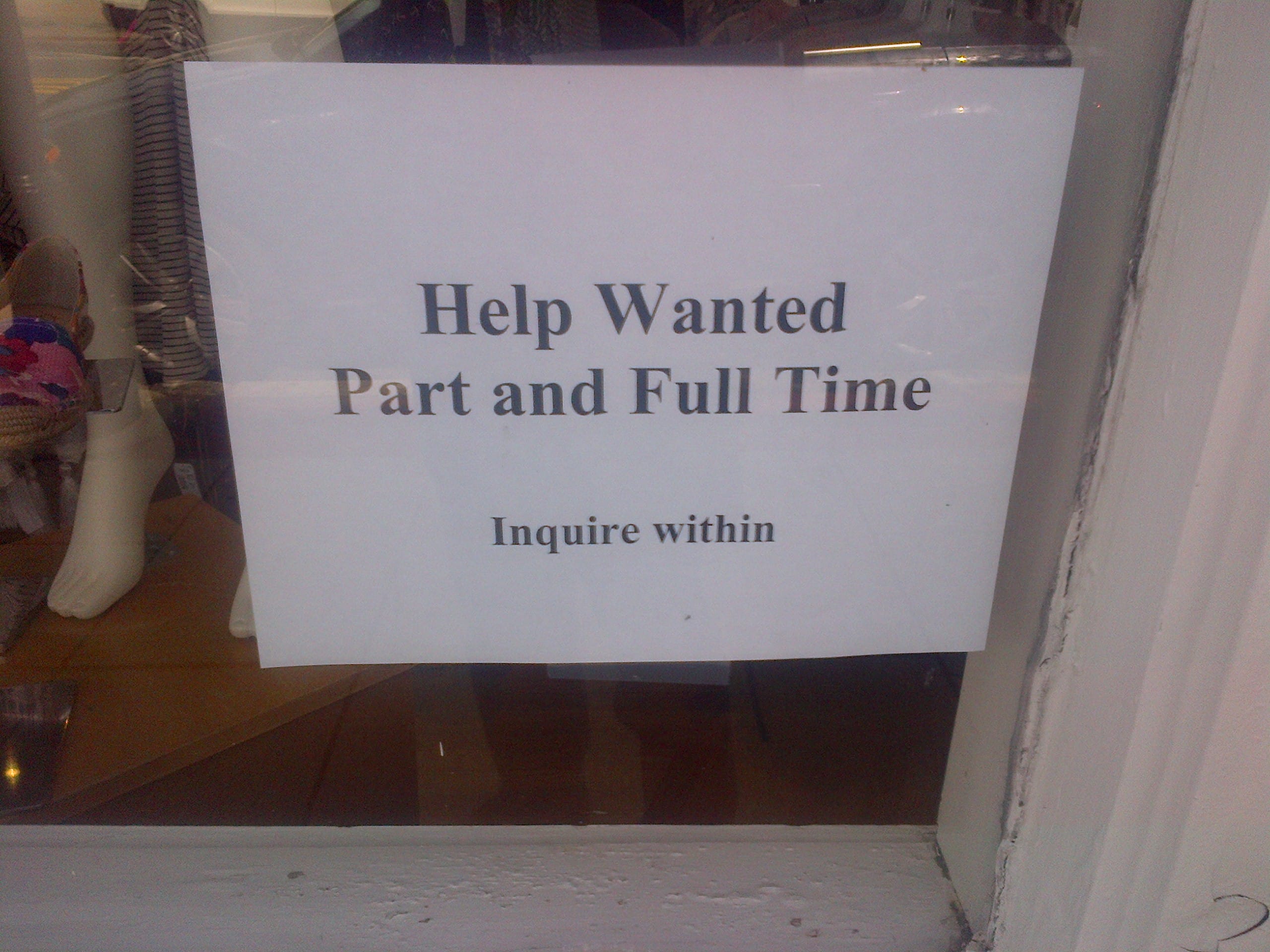
Tech startups love millennials. Tasty, tasty millennials who get underpaid, overworked, churned up and turned into nourishment for venture capitalists. Millennials are the Soylent Green of the tech world.
As each batch gets mashed up, there’s a long line of new hires eager to be made into the next meal for the execs and their billionaire backers, as tech survivor Dan Lyons shows in a scathingly funny new book, “Disrupted: My Misadventure in the Start-Up Bubble” (Hachette Books).
Lyons became a strange kind of celebrity a decade ago when he began posting nutty but funny insights as “Fake Steve Jobs.” Today he’s a writer for HBO’s brilliant tech comedy “Silicon Valley,” but in between he blogged for a Boston tech company called HubSpot and wrote this book about it.
Bloomberg More Americans are finding jobs at retail stores, but they aren’t getting the kind of pay and hours they’d like.
The number of able-bodied Americans entering the labor force has surged since last fall. But in a marked change from earlier in the recovery, more of them are finding jobs right away instead of just looking for work.
What’s going on? It’s hard to say for sure, but circumstantial evidence in the latest U.S. jobs report suggests many of these newly employed workers have found part-time work with mediocre pay.
The participation rate hit a two-year high of 63% in March, climbing from a 38-year low of 62.4% in September, the government said Friday. A person is considered part of the labor force if he finds or job or is actively searching for one.
New Jersey’s unemployment rate fell two percentage points in February, even as the state recorded a loss of more than 10,000 private-sector jobs. Samantha Marcus, NJ.com Read more
POSTED 4:57 PM, MARCH 17, 2016, BY KFOR-TV & K. QUERRY
NEW YORK – A CEO of a fast-food company is causing a stir on social media after claiming that he wants to create a fully automated restaurant.
“We could have a restaurant that’s focused on all-natural products and is much like an Eatsa, where you order on a kiosk, you pay with a credit or debit card, your order pops up, and you never see a person,” Carl’s Jr. CEO Andy Puzder told Business Insider.
Puzder says the automated restaurant would be cheaper since he wouldn’t have to worry about rising minimum wage.
Western democracy faces no mortal threat but it is going through an acute stress test
When people strike comparisons with Hitler — or Munich — I usually reach for my earplugs. The same applies to the Great Depression. There is nothing on today’s horizon that compares with the Nazis or the mass privation that followed the 1929 stock market crash.
Yet there are echoes we would be foolish to ignore. Western democracy faces no mortal threat. But it is going through an acute stress test. On both sides of the Atlantic, people have lost faith in their public institutions. They are also losing trust in their neighbours. Co-operation is fraying and open borders are in question. We can no longer be sure the centre will hold — or even that it deserves to.
The most insidious trend is vanishing optimism about the future. Contrary to what is widely believed, the majority’s pessimism pre-dates the 2008 financial collapse. At the height of the last property bubble in 2005, Alan Greenspan, then chairman of the Federal Reserve, said society could not long tolerate a situation where most people were suffering from declining standards of living.
“This is not the sort of thing that a democratic society — a capitalist democratic society — can readily accept without addressing,” he said. This came after several years of falling median income.
For most Americans and Europeans the situation is worse today than it was then. Many have since had their homes repossessed. Median incomes were lower in 2015 than when Mr Greenspan issued his warning. A majority on both sides of the Atlantic believe their children will be worse off than they are.
A poll released Monday shows New Jersey following national trends in residents’ gloomy assessment of their income and the larger economy. The study from Stockton University’s polling institute found that a majority of New Jersey residents feel their income has failed to keep up with increases in the cost of living. 55 percent of respondents described their income as “falling behind the cost of living,” while 37 percent said it was “just keeping pace.” JT Aregood, PolitickerNJ Read more
According to today’s employment report, 59.8 percent of Americans ages 16 and older had jobs in February. That’s the highest employment-to-population ratio in years, and the rate of increase is clearly on the rise.
Look back some more years, though, and the story is different. The recent gains are real, but by the standards of the past few decades, a 59.8 percent employment-to-population ratio isn’t impressive.
Let this be another lesson in how the presentation of information shapes our understanding of it. The second chart paints a gloomy picture — the picture that Donald Trump may be referring to when he says the true unemployment rate is 40 percent or higher. A 59.8 percent employment-to-population ratio means that 40.2 percent of American civilians 16 and over don’t have jobs. That percentage includes high-school students, 100-year-olds and lots of other people who don’t want or need jobs, so the true unemployment rate clearlyisn’t 40 percent. Still, in April 2000 the employment-to-population ratio peaked at 64.7 percent. Now it’s significantly lower. What’s going on?
The answer that I keep gravitating to is that despite the 4.9 percent unemployment rate, the job market is still pretty weak, and probably malfunctioning in some way. This isn’t the only possible answer. In 2014, for example, two economists at the Federal Reserve Bank of New York divided people responding to the Census Bureau’s Current Population Survey (from which the unemployment rate and the charts in this article are derived) into 280 cohorts defined by “birth, sex, race/ethnicity, and educational attainment.” They determined that most of the decline in the employment-to-population ratio since 2000 could be explained by the changing makeup of the population.
But demographics aren’t destiny. The employment-to-population ratios by age group, for example, have changed a lot since 1990. First, the women:
Happy 75th anniversary to M&M’s! I’m proud to represent such an iconic American candy that is made right in Hackettstown! Such a source of New Jersey pride.
Financial Services Committee Passes Two Garrett-Sponsored Bills
Bills would enforce Constitutional rights and give Main Street businesses new tools to succeed
Mar 2, 2016
the staff of the Ridgewood blog
Ridgewood NJ, Today the Financial Services Committee passed two bills introduced by Congressman Scott Garrett (NJ-05), Chairman of the Financial Services Subcommittee on Capital Markets and Government-Sponsored Enterprises. The bills were H.R. 4638, The Main Street Growth Act, and H.R. 3798, The Due Process Restoration Act.
“One of the biggest concerns I hear from my constituents that the executive branch has run wild and Congress needs to regain control to protect the Constitutional rights of all Americans. For that reason, I’m pleased that today the Financial Services Committee passed my bill to restore the due process rights of all Americans by allowing them to have their case before the SEC heard by a federal court. I’m also happy to announce that my bill to allow Main Street businesses to raise capital by accessing public markets passed the committee. Because if we want to revive America’s economy, we need to give Main Street businesses the tools they needs to innovate and succeed.”
H.R. 3798, The Due Process Restoration Act Would:
Provide a mandatory right of removal allowing the defendant to request that the case be moved to a district court
Grant a right of removal to defendants who are subject to a cease and desist order and monetary penalty that the commission is seeking
Raise the burden of proof for cases that remain in the ALJ to a higher “clear and convincing evidence” standard
The Main Street Growth Act Would:
Authorize the creation of “venture exchanges” which would be registered as a national securities exchange with the SEC and be specifically tailored to list the shares of emerging growth companies and companies that issue shares under the newly finalized “Reg A+”
Exempt venture exchanges from Regulation NMS, Regulation ATS, and would be exempt from extending unlisted trading privileges to companies that list on them;
Subject venture exchanges to all of the existing anti-fraud and investor protection statutes administered by the SEC
Permit all investors— not just Silicon Valley billionaires or the well-connected—to invest in companies that list on venture exchanges.
Posted by Laurie Ehlbeck On March 01, 2016 2 Comments
By Laurie Ehlbeck
We haven’t even made it out of the first quarter of 2016 but there is already plenty for small businesses in New Jersey to be concerned about on the upcoming legislative calendar. Senator Sweeney and Speaker Prieto seem determined to continue to challenge the economic stability of our state by introducing bills to nearly double minimum wage, mandate all employers provide sick leave and attempt to convince the voters that a pension payment must be constitutionally required. Sweeney and Prieto are creating what may ultimately amount to the most hostile session in state history in terms of damage caused to the small business community.
When it comes to minimum wage it is imperative that as a society we are honest about what it truly is. Minimum wage is not now, nor has it ever been, a vehicle in which to feed a family 4. It is an entry level wage that is earned almost exclusively by teens and young adults seeking work experience and a smooth transition into a career. Raising the minimum wage again, especially to the rate of $15 will have one direct effect. It will result in a loss of job opportunities for those seeking to expand their skill sets. It will not alleviate poverty. It will not empower the middle class. It will leave teenagers wondering what to do after school.
According to a recent study, 63 percent of workers who earn less than $9.50 per hour are the second or third earner in their family and 43 percent of these workers live in households that earn over $50,000 per year. In spite of what the proponents would have you believe, minimum wage earners are not an impoverished, disenfranchised group of struggling single mothers just trying to make ends meet. Most are teenagers from middle class families and many more are sharing the responsibility of providing for their families, not breaking under the burden of putting food on the table.
Congressman Scott Garrett, the U.S. Representative for New Jersey’s 5th congressional district, met with employees of Crestron on Monday to tour it’s the company’s Experience Center located at its headquarters in Rockleigh, New Jersey.
Crestron, a global organization with more than 90 offices around the world, employs 1,500 employees from Bergen County and the surrounding area at its worldwide headquarters and campus in Rockleigh, New Jersey.
The campus includes the Experience Center, Research Center, manufacturing plant, pre-production facility, and distribution center.
The tour provided Garrett with an in-depth look into the world of Crestron and its award-winning, advanced control and automation technology. Crestron’s solutions have led the way for over four decades, supporting Fortune 500 companies, government organizations, leading hospitals, universities and prestigious homes.
The Crestron Experience Center combines the finest design with cutting-edge technology, for the ultimate immersive demonstration of its innovative solutions. Congressman Garrett saw firsthand how the company has evolved from a pioneer in A/V and control systems, to the world-class enterprise management company it is today.
It’s a job market revolution: an estimated 10.3 million Americans earned income through Web-based platforms like Uber and Airbnb between 2012 and 2015. That’s more people than reside in the entire state of Georgia and amounts to 6.5 percent of the total U.S. workforce.
So-called gig jobs, in which a person performs a task for another individual often through Web-based platforms, are often easier to land, and help generate additional income when regular earnings aren’t sufficient, according to a new study by the JPMorgan Chase Institute.
Participants in this economy are typically younger, with the 25 to 34 age group accounting for the largest part of the gig workforce. They are more likely to be male, live in the West and have an average median income of about $2,800 per month, according to the study.
The number of people earning income in the online economy over the three-year period of JPMorgan’s study increased 47-fold. Labor platforms, including ride-hailing service Uber, that connect customers with freelancers have grown more rapidly than capital platforms like Airbnb, which rent homes and assets or sell goods. Demand is also driving the growth as online service use becomes more common.
Now, “most people would know they can get their groceries picked up, they can get a ride from three or four different companies — things that only a year ago, only earlier adopters learned,” Diana Farrell, the institute’s founding president and chief executive officer, said in an interview. “It’s becoming more mainstream.”
Business-lobbying organization says brain drain makes it hard for state to attract cutting-edge companies that need younger, skilled employees
New Jersey loses a portion of its senior population every year to less-expensive — and less snowy — states like Florida and North Carolina. But a new study of outmigration trends issued by the New Jersey Business & Industry Association raises new alarms about the number of so-called millennials who have also been leaving the state.
Of all the age groups in New Jersey that experienced a net loss in population from 2007 to 2014, the highest rate was among people between the ages of 18 and 34, according to the business-lobbying organization.
That brain drain hurts the overall New Jersey economy and makes it harder for the state to attract the type of companies that rely on young, skilled workers, the association said.
The new data on millennials leaving New Jersey was included in NJBIA’s broader outmigration study, which concluded that the state had a net loss of 682,062 residents between 2005 and 2014. And from 2004 to 2013, New Jersey lost $18 billion in net adjusted gross income, the NJBIA said.
The organization blamed New Jersey’s high taxes and overregulation for that loss of wealth and residents, and it offered a list of recommendations that ranged from tax reform to better workforce development and making higher education more affordable as remedies.
The average 65-year-old borrower has 47% more mortgage debt than those in 2003
By
JOSH ZUMBRUN
Updated Feb. 12, 2016 4:17 p.m. ET
Older Americans are burdened with unprecedented debt loads as more and more baby boomers enter what are meant to be their retirement years owing far more on their houses, cars and even college loans than previous generations.
The average 65-year-old borrower has 47% more mortgage debt and 29% more auto debt than 65-year-olds had in 2003, after adjusting for inflation, according to data from the Federal Reserve Bank of New York released Friday.
Just over a decade ago, student debt was unheard-of among 65-year-olds. Today it is a growing debt category, though it remains smaller for them than autos, credit cards and mortgages. On top of that, there are far more people in this age group than a decade ago.
The result: The composition of U.S. household debt is vastly different than it was before the financial crisis, when many younger households took on large debts they could no longer afford when the bottom fell out of the economy.
The shift represents a “reallocation of debt from young [people], with historically weak repayment, to retirement-aged consumers, with historically strong repayment,” according to New York Fed economist Meta Brown in a presentation of the findings.
For the last two years, America’s job-creation machine has been like “The Little Engine That Could,” chugging ahead with “I think I can, I think I can” regardless of headwinds at home or abroad.
The nation added 3 million jobs in 2014, making up all the ground lost in the Great Recession, and then piled on another 2.7 million jobs last year. All while the broader economy, as measured by the gross domestic product, grew at a relatively lackluster pace.
But the January jobs report, released Friday, suggests that the ever-dependable locomotive for the U.S. economy has encountered a hill that slowed it sharply.
The question now is whether it is just moving through an unusually steep patch or has finally met a hill it cannot conquer. The answer probably won’t be known for a couple of months, but Friday’s report has further clouded the outlook for investors and the Federal Reserve’s interest rate policy.
The Labor Department said that employers added just 151,000 jobs last month, down from an average monthly gain of 283,000 in the fourth quarter of last year.
Economists caution that one can’t make too much of a single month’s data, especially in the winter when weather can skew payroll statistics. Unseasonably warm temperatures in December probably inflated hiring that month in construction, for example.
What’s the definition of power? It’s the question we get most often at NJBIZ, when it comes time for the Power 100. Unfortunately, there’s not an easy explanation. The one we often give is this: “If you called the governor, how quickly would he call you back? If at all.” NJBIZ Staff, Read more