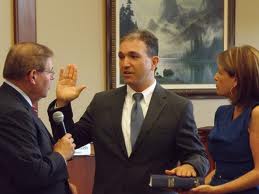
file photo by Boyd Loving , Ridgewood REORG with Senator Menendez
Roque indicted on fraud and bribery charges
Having won reelection last month, West New York Mayor Felix Roque now faces another challenge: indictment by the state.
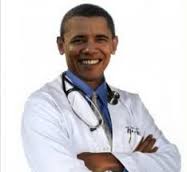
According to prosecutors, Roque, a medical doctor, is accused of referring patients to the medical imaging company Diagnostic Imaging Affiliates in exchange for cash bribes and election campaign contributions. (Pizarro/PolitickerNJ)
Under the draft provisions of the latest trade deal to be leaked by Wikileaks, countries could be barred from trying to control where their citizens’ personal data is held or whether it’s accessible from outside the country.
Wikileaks has released 17 documents relating to the Trade in Services Agreement (TISA), currently under negotiation between the US, the European Union and 23 other nations. These negotiating texts are supposed to remain secret for five years after TISA is finalized and brought into force.
The deal, which has been under discussion behind closed doors since early 2013, is intended to remove barriers to trade in services. It’s a sort of companion piece to the Transatlantic Trade and Investment Partnership (TTIP) and the Trans-Pacific Partnership (TPP), which cover trade in goods – but potentially far bigger, with Wikileaks claiming that ‘services’ now account for nearly 80 per cent of the US and EU economies.
Like TTIP and TPP, TISA could be sped through Congress using Trade Promotion Authority (TPA), also known as fast-track authority, which has been passed by the US Senate and may be taken up in the House this month. Under TPA, Congress is barred from making amendments to the trade deals, and most simply give yes-or-no approval.
Speaking from his ‘prison’ in the Ecuadorian embassy in London, Wikileaks founder Julian Assange explains the Trans-Pacific Partnership treaty, which would link his home country of Australia with the U.S. economically. “It is mostly not about trade,” Assange says. “Only 5 of the 29 Chapters are about traditional trade.”
JULIAN ASSANGE, WIKILEAKS: First of all, it is the largest ever international economic treaty that has ever been negotiated, very considerably larger than NAFTA. It is mostly not about trade, only 5 of the 29 Chapters are about traditional trade.
The others are about regulating the internet, and what information internet service providers have to collect, they have to hand it over to companies under certain circumstances, the regulation of labor conditions, regulating the way you can favor local industry, regulating the hospital, health care system, privatization of hospitals, so essentially every aspect of a modern economy, even banking services are in the TPP.
So that is erecting and embedding new ultramodern neoliberal structure over U.S. law and the laws of other countries. And putting it in treaty form.
By putting it in a treaty form, there are 14 countries involved, that means it is very hard to overturn, so if there is a desire, a democratic desire to do it on a different path. For example, to introduce more public transport. Then you can’t easily change the TPP treaty, because you have to go back to the other nations involved.
Now looking at that example, what if the government or a state government decides it wants to build a hospital somewhere, and there is a private hospital has been erected nearby.
Well the TPP gives the constructor of the private hospital the right to sue the government over the expect loss, the loss in expected future profits. This is an expected future loss, this is not an actual loss that has been sustained, this is a claim about the future.
We know from similar instruments where governments can be sued over free trade treaties, that that is used to construct a chilling effect on environmental and health regulation laws. For example, Togo, Australia, Uruguay are all being sued by tobacco company Phillip Morris to prevent them from introducing health warnings on cigarette packaging…
It is not even an even playing field, lets say you were going to let companies, make it easier for companies to sue governments, maybe that is right, maybe the government is too powerful and companies should have the right to sue them in certain circumstances.
But it is only multinationals that get this right. U.S. companies that operate in the U.S. in relation to investments that happen in the U.S. will not have this right.
The economy got off to an even weaker start this year than first thought, the government reported Friday, as economic activity contracted amid a disappointing trade picture and continued caution on spending by businesses and consumers alike.
The 0.7 percent decline in economic output in the first quarter of 2015 was a reversal of the initial 0.2 percent advance for the periodreported last month by the Commerce Department.
While statistical quirks and one-time factors like wintry weather in some parts of the country played a role, as did a work slowdown at West Coast ports, the lackluster report for January, February and March underscores the American economy’s seeming inability to generate much momentum.
Much of the revision was spurred by fresh data showing businesses added to inventories at a slower pace than first estimated, while net exports fell slightly more than first thought. A sharp pullback in energy exploration in the wake of falling oil prices is also putting pressure on business investment.
Most experts had expected Friday’s data to show a contraction in the first quarter, and virtually no mainstream economists believe the country is on the verge of a recession. Still, the weakness is a reason the Federal Reserve is not expected to raise short-term interest rates until the second half of 2015, after speculation that a June increase was possible.
Camden, N.J., has long been known for its poverty and violence. But President Obama gave it a new label this week, calling the city, “a symbol of promise for the nation.”
He praised the Camden County Police Department’s effort to improve community relations. The city still has a high crime rate, but the president says progress so far makes it a model for others.
But , three South Jersey Cities Named Among the Most Dangerous In America
By Chris Coleman February 9, 2015 1:28 PM
Three towns in South Jersey have made the list of being one of the 100 most dangerous cities in America. In fact, two of the three towns are in the top ten.
If you guessed Camden was #1 on the list, you are correct. In fact, in Camden you have a 1-in-39 chance of becoming a victim of a violent crime. But the other two cities and where they rank might surprise you. The survey ranked Atlantic City as the eighth most dangerous city in the nation and Bridgeton is #25 on the list. As per their rankings, you are safer in Atlanta, Newark, NJ,Philadelphia than you are in Atlantic City or Bridgeton.
Here are the top five and where other cities in our region ranked:
1. Camden
2. Chester, PA
3. Detroit
4. Saginaw, MI
5. Oakland, CA
8. Atlantic City
9. Wilmington
25. Bridgeton
27. Trenton
31. Newark, NJ
55. Philadelphia
Major insurers in some states are proposing up to 51 percentpremium increases for health plans sold under the Affordable Healthcare and Patient Protection Act, commonly referred to as Obamacare. Despite single digit increases for 2015, insurance companies are seeing their costs jump and are demanding to be compensated with dramatically higher rates.
When Insurance plans proposed 2015 rates last summer, they had only a little information about the health of the new customers they expected to sign up during the fall Obamacare expansion. Big insurers tended to ask for increases of less than 10%, while some smaller insurers tried to under-cut pricing by the major’s to take market share, according to theWall Street Journal.
Under Obamacare, insurers must file proposed premium rates with their local state regulator and the federal government by June. But some states have already started publicly disclosing the premium requests. Due to the high utilization costs from people newly enrolled under Obamacare, the 2016 insurance premiums are about to skyrocket.
According to states that have released rate requests, New Mexico’s market leader Health Care Service Corp. is asking for an average premium spike of 51.6 percent; Tennessee’s top insurer BlueCross BlueShield of Tennessee wants an average spike of 36.3%; Maryland’s market leader CareFirst BlueCross BlueShield is requesting an average spike of 30.4%; and Oregon’s top insurer, Moda Health, is seeking a 25% spike.
AMONG liberals, it’s almost universally assumed that of the two major parties, it’s the Republicans who have become more extreme over the years. That’s a self-flattering but false narrative.
This is not to say the Republican Party hasn’t become a more conservative party. It has. But in the last two decades the Democratic Party has moved substantially further to the left than the Republican Party has shifted to the right. On most major issues the Republican Party hasn’t moved very much from where it was during the Gingrich era in the mid-1990s.
To see just how far the Democratic Party has moved to the left, compare Barack Obama with Bill Clinton. In 1992, Mr. Clinton ran as a centrist New Democrat. In several respects he governed as one as well. He endorsed a sentencing policy of “three strikes and you’re out,” and he proposed adding 100,000 police officers to the streets.
In contrast, President Obama’s former attorney general, Eric H. Holder Jr., criticized what he called “widespread incarceration” and championed the first decrease in the federal prison population in more than three decades. Mr. Obama, meanwhile, has chosen to focus on police abuses.
One of the crowning legislative achievements under Mr. Clinton was welfare reform. Mr. Obama, on the other hand, loosened welfare-to-work requirements. Mr. Obama is more liberal than Mr. Clinton was on gay rights, religious liberties, abortion rights, drug legalization and climate change. He has focused far more attention on income inequality than did Mr. Clinton, who stressed opportunity and mobility. While Mr. Clinton ended one entitlement program (Aid to Families With Dependent Children), Mr. Obama is responsible for creating the Affordable Care Act, the largest new entitlement since the Great Society. He is the first president to essentially nationalize health care.
Mr. Clinton lowered the capital-gains tax rate; Mr. Obama has proposed raising it. Mr. Clinton cut spending and produced a surplus. Under Mr. Obama, spending and the deficit reached record levels. In foreign policy, Mr. Obama has shown himself to be far more critical of traditional allies and more supine toward our adversaries than Mr. Clinton was. Mr. Obama has often acted as if American strength is a problem to which the solution is retrenchment, or even retreat.
Another bellwether: Hillary Rodham Clinton, in positioning herself for the 2016 election, is decidedly more liberal than she and her husband once were on illegal immigration, gay marriage and incarceration. She has called to “end the era of mass incarceration” and spoken about the importance of “toppling” the wealthiest 1 percent. She has remained noncommittal on the Trans-Pacific Partnership, the free-trade agreement that has drawn ire from the left.
The Democratic Party, then, has moved steadily to the left since the Clinton presidency. In fact, since his re-election, Mr. Obama’s inner progressive has been liberated. (An exception is the administration’s conditional approval of oil drilling off the Alaskan coast, starting this summer.) Other examples are his executive action granting temporary legal status to millions of illegal immigrants, his claim that gay marriage is a constitutional right, and his veto of legislation authorizing construction of the Keystone XL pipeline.
Rep. Garrett urges Congress to let the Ex-Im Bank expire at a press conference on Tuesday morning
Garrett Pushes to End Crony Capitalism and Shut Down Export-Import Bank
Garrett: Congress Should Put the Export-Import Bank Out of Business
May 27, 2015
WASHINGTON, D.C. – Rep. Scott Garrett (NJ-05) issued the following statement after joining fellow members of the House Freedom Caucus and other concerned lawmakers at a press conference this morning to urge Congress to let the Export-Import Bank expire on June 30:
“It’s hard to imagine anything more unfair and un-American than having the government financially support mega-corporations at the expense of small businesses and American workers. But that is exactly what has been happening, and it will continue to happen if we don’t let the Export-Import Bank expire next month. It rewards those with close relationships with Washington bureaucrats and makes victims of startups that dare to compete against them—literally picking winners and losers in our economy.
“Ex-Im has transformed the role of government from a disinterested referee that guarantees a free and open marketplace into a biased actor that tilts the scales in favor of its friends in businesses. We have the opportunity to save capitalism from cronyism and to fulfill a promise to the American people to work for them instead of a select few with special connections in Washington. For the sake of the American taxpayer and the preservation of the free enterprise system, Congress should put the Export-Import Bank out of business.”
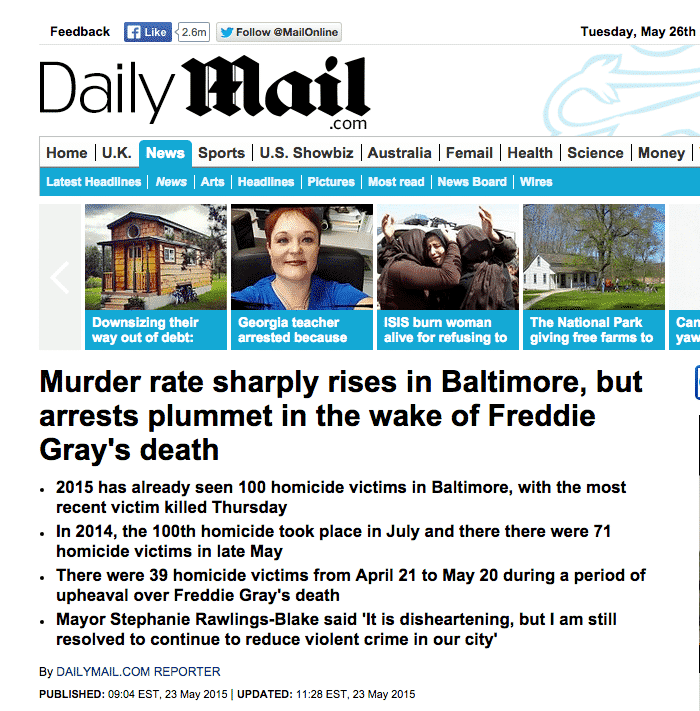
Michael HarrisAccording to Michael Harris , Arrest are down 50% in Baltimore….33 people killed this month alone!
How about you all stop trashing the police!
The police will get payed regardless. Y’all happy yet?
Liberals are using Black people as tokens in their anarchist agenda of undermining
the police force nationwide.
Deep into the seventh year of his tenure, Barack Obama is thinking about his post-presidential legacy. We know this because he’s telling us so.
In an interview this week with The Atlantic about the potential deal with Iran regarding its nuclear program, the president sought to use the fact of his relative youth and his consciousness about how history might judge him to his advantage: “Look, 20 years from now, I’m still going to be around, God willing. If Iran has a nuclear weapon, it’s my name on this. I think it’s fair to say that in addition to our profound national-security interests, I have a personal interest in locking this down.”
In one sense, this is what we want presidents to worry about. We want them to be restrained by the cautionary examples provided by history and by the fact that history will judge them.
But what if the desire to tip the scales of history’s judgment in his favor leads a president to take dangerous risks?
There’s a REASON they’re hiding it from PUBLIC view — Obama’s Fast-track Trade Promotion Authority – a terrible law at the worst possible time – allows the president to GO AROUND Congress, undermine U.S. interests, and subject America to INTERNATIONAL laws antithetical to the United States Constitution!!
REUTERS/Jonathan Bachman
by CAROLINE MAY20 May 2015463
With the Senate poised to vote to end debate on Obama’s fast-track trade legislation,
Wednesday, Sessions took on arguments for the trade deal with a series of what he office says are “myths” versus “truths” about the trade deal under consideration in Congress.
In the myth buster account, Sessions’ office says not only will fast-track erode congressional power over the trade process but the trade agreements implemented under that authority will trump U.S. law.
Myth: Trade agreements implemented under fast-track will not supersede existing U.S. law.
Truth: Every trade agreement negotiated by the President and foreign governments is accompanied by implementing legislation which necessarily supersedes existing law. Proponents of fast-track are relying on semantics: the trade agreement itself will not supersede existing law, but the “fast-tracked” legislation implementing the trade agreement will. What’s more, the Trans-Pacific Partnership—which would be fast-tracked by TPA—will give jurisdiction to international tribunals to settle disputes between parties to the agreement.
Myth: Congress will have more control over the trade process under fast-track.
Truth: If Congress gives the Executive six-year fast-track authority, the Senate will cede its ability to amend any future legislation implementing any yet-unseen global trade and regulatory pact; cede its ability to control debate over that pact; and cede its ability to subject that pact to the 67-vote threshold required for treaties, as well as the 60-vote threshold required for important legislation. Proponents of fast-track suggest the negotiating objectives somehow bind the Administration; this is false. The negotiations on the Trans-Pacific Partnership are nearly complete and have been ongoing for years, long before any negotiating objectives will have been suggested. Moreover, the negotiating objectives are vague and lack any meaningful enforcement mechanisms—particularly enforcement from Senators and Representatives not on the revenue committees. Congress will be giving up the only leverage it has: the ability to amend legislation or to refuse to cut-off debate. No fast-tracked deal has ever been defeated, regardless of whether fast-track “objectives” have been ignored, overlooked, or violated by the Executive.
Myth: Congress is ceding no institutional powers under fast-track.
Truth: By eliminating its own powers of review and amendment, Congress would dramatically shift the carefully calibrated balance of power between Congress and the President. Fast-track would ensure that the President has complete discretion over the drafting of international agreements Congress has never even seen.
The myth busters continue to attack the idea that Congress can simply block a deal the president negotiates but that it does not like. In fact, the office argues, history belies that assertion.
Myth: If the President ignores the negotiating objectives, Congress can simply block the deal.
Truth: A fast-tracked trade deal has never been blocked. By denying members any opportunity to slow debate, mobilize the public by seeking extra time, amend the deal, or seek a better deal, fast-tracked legislation is always ratified no matter how flawed. The train will have left the station once fast-track is adopted. Without any possibility of a 60-vote, let alone 67-vote, threshold in the Senate, this final check will have been removed. Additionally, the revenues and rules committees have exclusive control over enforcement, eliminating the ability of rank-and-file members to hold the Administration accountable for violations. Those saying Congress can just vote down a bad trade deal ignore the unbroken cycle of history.
They further contend that even if Congress were to preempt history and block an agreement, there would still be an agreement in the balance.
Myth: If, for the first time ever, Congress somehow did manage to block a fast-tracked deal, there is no further threat to U.S sovereignty.
Truth: Even if Congress declines to implement a trade agreement, the President’s signature will already be on it, opening the U.S. up to judgments before an international arbitration body known as the International Center for Settlement of Investment Disputes (ICSID), or perhaps even before the WTO. An offshoot of the World Bank, ICSID exists to hear disputes between international companies and foreign governments, at all levels. Congress ratified a 1965 treaty which stipulated that any ICSID awards will be binding as if awarded by a U.S. court, and the Vienna Convention—which the State Department generally considers “customary international law”—states that the President’s signature on the agreement obligates the U.S. not to “frustrate the purpose” of a trade agreement. As such, the President’s signature alone could put many U.S. industries and localities at risk, not to mention binding Congress’ ability to pass future laws without significant international consequences.
The office continues to warn about the effects not only on U.S. sovereignty, but also on U.S. immigration laws.
Myth: Fast-track has protections for U.S. sovereignty.
Truth: Fast-track offers no protection against delegations of power or authority to international tribunals should Congress adopt the implementing legislation of any future fast-tracked deal. This is particularly relevant when considering the TPP, which has promised to set up an international commission to make changes to the TPP in the future. The “Living Agreement” section of TPP calls for the creation of this new body, known as the “Trans-Pacific Partnership Commission,” and TPP’s implementing legislation could well cede important congressional power to this new international body as it did with the WTO. The overview of the TPP provided to members of Congress when they view the TPP’s text states that the amendment and accession processes will be similar to those of the WTO, suggesting that Congress will indeed be removed from the process after the agreement’s initial implementation. The Ministerial Conference of the WTO, for instance, has the power to amend the agreement or to add new countries to the agreement simply with a two-thirds vote (not a unanimous one), and the WTO’s implementing legislation makes these changes binding on the U.S. without any additional congressional approval. At the very least, Congress will not know the truth until it has seen the TPP’s implementing legislation—which will not happen until Congress has already promised to fast-track TPP.
Myth: Trade agreements negotiated under TPA cannot be used to bypass U.S. immigration laws.
Truth: Fast-track includes negotiating objectives to remove barriers to services that could easily be used by the Administration to justify the expansion of foreign worker programs. There is also an entire chapter on “Temporary Entry” in TPP, which could be used to facilitate the admission of more temporary foreign workers into the United States. Even if immigration or temporary entry prohibitions were included in fast-track, the negotiating objectives laid out by fast-track are not binding on the Administration. If any future trade deal, TPP or otherwise, contains language that paves the way for more foreign workers, members will be powerless to strike the offending provision. Additionally, the “living agreement” provision allows for subsequent amendments to the trade agreement after its initial implementation, creating an altogether new avenue for changes to foreign worker programs. Finally, the President has refused to foreclose the possibility of using executive actions or side agreements to facilitate foreign worker expansions, as he did with South Korea as part of the recent South Korean trade deal. In short, fast-track creates broad new avenues for the White House to bring in more foreign workers—whether in the light of day, or behind closed doors no one can open—while giving up for six years the meaningful ability of Congress to do anything about it.
At a time when 8.5 million Americans still don’t have jobs, some 40 percent have given up even looking.
The revelation, contained in a new survey Wednesday showing how much work needs to be done yet in the U.S. labor market, comes as the labor force participation rate remains mired near 37-year lows.
A tight jobs market, the skills gap between what employers want and what prospective employees have to offer, and a benefits program that, while curtailed from its recession level, still remains obliging have combined to keep workers on the sidelines, according to a Harris poll of 1,553 working-age Americans conducted for Express Employment Professionals.
On the bright side, the number is actually better than 2014, the survey’s inaugural year, when 47 percent of the jobless said they had given up.
“This survey shows that some of the troubling trends we observed last year are continuing,” Bob Funk, CEO of Express Employment Professionals and a former chairman of the Federal Reserve Bank of Kansas City, said in a statement. “While the economy is indeed getting better for some, for others who have been unemployed long term, they are increasingly being left behind.”
A number of states are quietly considering merging their healthcare exchanges under ObamaCare amid big questions about their cost and viability.
Many of the 13 state-run ObamaCare exchanges are worried about how they’ll survive once federal dollars supporting them run dry next year.
Others are contemplating creating multi-state exchanges as a contingency plan for a looming Supreme Court ruling expected next month that could prevent people from getting subsidies to buy ObamaCare on the federal exchange.
The idea is still only in the infancy stage. It’s unclear whether a California-Oregon or New York-Connecticut health exchange is on the horizon.
But a shared marketplace — an option buried in a little-known clause of the Affordable Care Act — has become an increasingly attractive option for states desperate to slash costs. If state exchanges are not financially self-sufficient by 2016, they will be forced to join the federal system, HealthCare.gov.
Proposals set the stage for debate over federal health law’s impact
By
LOUISE RADNOFSKY
May 21, 2015 5:34 p.m. ET
Major insurers in some states are proposing hefty rate boosts for plans sold under the federal health law, setting the stage for an intense debate this summer over the law’s impact.
In New Mexico, market leader Health Care Service Corp. is asking for an average jump of 51.6% in premiums for 2016. The biggest insurer in Tennessee, BlueCross BlueShield of Tennessee, has requested an average 36.3% increase. In Maryland, market leader CareFirst BlueCross BlueShield wants to raise rates 30.4% across its products. Moda Health, the largest insurer on the Oregon health exchange, seeks an average boost of around 25%.
All of them cite high medical costs incurred by people newly enrolled under the Affordable Care Act.
Under that law, insurers file proposed rates to their local regulator and, in most cases, to the federal government. Some states have begun making the filings public, as they prepare to review the requests in coming weeks. The federal government is due to release its rate filings in early June.
Insurance regulators in many states can force carriers to scale back requests they can’t justify. The Obama administration can ask insurers seeking increases of 10% or more to explain themselves, but cannot force them to cut rates. Rates will become final by the fall.
“After state and consumer rate review, final rates often decrease significantly,” said Aaron Albright, a spokesman for the Centers for Medicare and Medicaid Services, the federal agency overseeing the health law.
One-quarter of people with healthcare coverage are paying so much for deductibles and out-of-pocket expenses that they are considered underinsured, according to a new study.
An estimated 31 million insured people are not adequately protected against high medical costs, a figure that has doubled since 2003, according to the 2014 national health insurance survey by the Commonwealth Fund.
ADVERTISEMENT
Rising deductibles — even under ObamaCare — are the biggest problem for most people who are considered underinsured, according to the 22-page report.
“The steady growth in the proliferation and size of deductibles threatens to increase underinsurance in the years ahead,” the report warns.
The data is an early warning sign for the Obama administration, which has promised that the millions of people who gained insurance under the president’s law would have affordable access to healthcare.
The survey found that millions of people are paying into the insurance system but are largely unable to reap the benefits.
People who purchase the lowest-quality health insurance are also less likely to see a doctor when they are ill or injured because they fear their high out-of-pocket costs.
“People who have high deductibles do tend to skimp on healthcare,” the study’s lead author, Sara Collins, told reporters.
When people do see a doctor, the costs accumulate quickly.
Half of underinsured adults and 41 percent of privately insured adults with deductibles of $1,000 or higher were paying off accumulated medical bills of $4,000 or more, the report found.