Dems want to empower Boehner
By Mike Lillis – 03/22/15 06:00 AM EDT
House Democrats fighting for leverage in the GOP Congress are hoping they can empower an unlikely ally: Speaker John Boehner (R-Ohio).
Democrats are outnumbered by more than 50 members – and have almost no power to bring bills to the floor.
But they see Boehner as a willing compromiser on must-pass legislation like funding the government and raising the debt ceiling – once the Speaker can convince his troops that the partisan route endorsed by his conservative wing has been denied.
By banding together in veto-sustaining majorities against conservative proposals demanded by Boehner’s right flank, Democrats hope to both sink those GOP measures and grease the skids for more moderate compromises.
“[The Republicans] have a majority party that’s deeply divided,” Rep. Steny Hoyer (D-Md.), the Democratic whip, said Thursday from his office in the Capitol.
“And … what we’ve learned is if we stick together – and we have been sticking together, we’ve been very unified – that it can empower Speaker Boehner at some point in time to say, ‘Look, I tried every which way I can think of to accomplish the objectives that our caucus wants to do. But if I can’t accomplish those, I will not allow the government to shut down, the debt limit to be not extended, or other things that are harmful to the country,’” Hoyer said.
Those dynamics were on full display in the recent fight over funding for the Department of Homeland Security (DHS).
Elizabeth Slattery / @EHSlattery / Hans von Spakovsky / @HvonSpakovsky / March 20, 2015
The IRS, however, extended the tax credits to the federal exchange by interpreting “State” to mean “federal government,” a reading that defies common sense and the normal rules of statutory interpretation.
Putting an imaginative spin on an unfavorable outcome for the administration, Professor Baude claims that the Constitution would allow the administration to apply the judgment only to the four plaintiffs and otherwise ignore the ruling for the rest of the nation. His rationale: “The King litigation is different, because almost everybody who is eligible for the tax credits is more than happy to get them.” Yet whether or not folks are “happy” about a particular regulation has no bearing on whether that rule is authorized by law.
Baude claims that the administration is “free to follow its own honest judgment about what the law requires.” But if the Supreme Court holds that the IRS rule violates federal law, it wipes out the IRS rule in its entirety. Baude raises the fact that President Lincoln ignored the Supreme Court’s ruling in the infamous decision Dred Scott v. Sandford. Yet this is a red herring. The King case is not about the separation of powers or the relationship between co-equal branches of government—it is simply a matter of statutory interpretation.
Such action by the administration would also potentially violate the equal protection principles embodied in the Fifth Amendment’s Due Process Clause—recognized by the Supreme Court in Bolling v. Sharpe—because the administration would not be equally applying the rule of law to everyone in the nation.
Baude also makes the odd claim that such behavior by the administration “would not defy a Supreme Court order, since the court has the formal power to order a remedy only for the four people actually before it.” Again, that is simply not the case. If the Supreme Court holds that a particular statute is unconstitutional on its face or that a particular regulation was improperly issued by a federal agency, that ruling applies in all circumstances in which that statute or regulation was or could be applied—not just to the particular plaintiff in front of the Court unless the Court specifically limits its ruling to the plaintiffs before the Court.
In fact, the Court rejected Baude’s legal theory in Cooper v. Aaron, when it determined that officials in Arkansas were bound by the holding of Brown v. Board of Education even though only Delaware, Kansas, South Carolina and Virginia were the named parties in Brown. Obviously many students and school administrators were, at the time, unfortunately “happy” with segregation; that doesn’t mean the states that weren’t parties to the case could ignore the Court’s ruling in Brown.
This issue already came up in another Obamacare subsidies case, Halbig v. Burwell, before the U.S. Court of Appeals for the D.C. Circuit. As the Halbig plaintiffs pointed out, “[T]his Court has made clear that when it invalidates a regulation under the [Administrative Procedures Act], such a ruling has ‘nationwide’ effect, for ‘plaintiffs and non-parties alike.’”
Baude’s legal theory also ignores the Anti-Deficiency Act, which makes it a crime for a federal employee to spend funds without congressional authorization. Thus, if the Supreme Court rules that Congress did not authorize subsidies for the federal exchanges, and if the Obama administration continues to pay out these subsidies, every federal official involved in making such payments could be fined or even imprisoned.
Baude seems to be urging Obama to copy President Andrew Jackson’s shameful response to Worcester v. Georgia, in which the Supreme Court ruled that Georgia violated a federal treaty when it sought to regulate the Cherokees. Jackson allegedly responded, “[Chief Justice] John Marshall has made his decision, now let him enforce it,” leading to the infamous Trail of Tears when the Cherokees were forced out of their ancestral homelands.
Let’s hope Obama doesn’t take this legal advice to channel Old Hickory and taunt Chief Justice John Roberts in such a way. Though the administration has shown contempt for the rule of law, it has not yet stooped to the level of ignoring a decision by the Supreme Court.
CBO: Obamacare to Hit Only 65 Percent of 2015 Coverage Target
7:23 AM, Mar 20, 2015 • By JEFFREY H. ANDERSON
Given that Obamacare’s supporters like to take the Congressional Budget Office’s overly optimistic scoring of the president’s signature legislation as gospel, it’s fun to look at how poorly Obamacare is actually doing in relation to earlier CBO projections. When the Democrats rammed Obamacare through Congress in 2010 without a single Republican vote, the CBO said that the unpopular overhaul would lead to a net increase of 26 million people with health insurance by 2015 (15 million through Medicaid plus 13 million through the Obamacare exchanges minus 2 million who would otherwise have had private insurance but wouldn’t because of Obamacare).
Fast-forwarding five years, the CBO now says that Obamacare’s tally for 2015 will actually be a net increase of just 17 million people (10 million through Medicaid plus 11 million through the Obamacare exchanges minus 4 million who would otherwise have had private insurance but won’t, or don’t, because of Obamacare).
In other words, Obamacare is now slated to hit only 65 percent of the CBO’s original coverage projection for 2015.
Obamacare’s under-publicized failure on this key point is attributable to a variety of factors, including but not limited to the following: People aren’t thrilled with Obamacare-compliant insurance’s high cost and limited doctor networks, and some would even rather pay a fine for refusing to buy such insurance than pay its premiums; the Supreme Court ruled that part of Obamacare was unconstitutional, thereby giving states more freedom not to help expand it; and HealthCare.gov has been more reminiscent of DMV.org than of Expedia.com.
The Obama administration sets new record for denying, censoring government files
MARCH 18, 2015, 1:41 PM LAST UPDATED: WEDNESDAY, MARCH 18, 2015, 1:41 PM
BY TED BRIDIS
ASSOCIATED PRESS
WASHINGTON — The Obama administration set a new record again for more often than ever censoring government files or outright denying access to them last year under the U.S. Freedom of Information Act, according to a new analysis of federal data by The Associated Press.
The government took longer to turn over files when it provided any, said more regularly that it couldn’t find documents, and refused a record number of times to turn over files quickly that might be especially newsworthy.
It also acknowledged in nearly 1 in 3 cases that its initial decisions to withhold or censor records were improper under the law — but only when it was challenged.
Its backlog of unanswered requests at year’s end grew remarkably by 55 percent to more than 200,000. It also cut by 375, or about 9 percent, the number of full-time employees across government paid to look for records. That was the fewest number of employees working on the issue in five years.
The legal case against Internet rules
By Mario Trujillo – 03/15/15 06:00 AM EDT
Asked what the Internet ‘general conduct rule’ means, FCC Chairman Tom Wheeler said, ‘We don’t really know.’
As legal challenges loom for new net neutrality regulations, GOP members of the Federal Communications Commission are offering some of the first lines of attack.
The dissenting opinions of the two Republicans ran 80 pages, and they telegraph some of the arguments on which critics could rely as they prepare legal filings to scrap the new rules.
FCC Chairman Tom Wheeler has repeatedly said the commission wrote the rules to withstand challenges from the “big dogs.” And while it is still unclear which organization or company will lead the charge, there is little doubt that a legal battle is brewing.
On Thursday, the public got its first look at the actual text of the net neutrality order, two weeks after it was approved. The rules would reclassify broadband Internet access as a telecommunications service under Title II of the Communication Act. The new designation will give the commission increased authority to enforce rules barring Internet service providers like Verizon or Comcast from prioritizing any piece of Internet traffic above another.
Ridgewood NJ, According to the AP , Israeli Prime Minister Benjamin Netanyahu has declared victory after a tight national election appeared to give him the upper hand in forming the country’s next coalition government.
In a Twitter statement , Netanyahu says that “against all odds” his Likud party and the nationalist camp secured a “great victory.”
Despite rumors to the contrary final results indicated that Netanyahu will have an easier time cobbling together a majority coalition with hard-line and religious allies.
A hedge fund manager who warned about the last financial crisis is seeing parallels of that run-up in the market today.
“I think it is a truly scary time,” Andy Redleaf, CEO of $4.2 billion hedge and mutual fund manager Whitebox Advisors, said in an internal memo Sunday night obtained by CNBC.com. (Tweet This)
Redleaf wrote that the stimulus used to put fresh money in markets could end poorly, just like loose credit standards in housing before 2007 crushed that market.
“We do not know exactly where all the credit creation of this cycle has gone. Certainly money sits idly as excess reserves, but just as certainly money that would not exist but for unconventional monetary policy has distorted prices and resource allocation,” Redleaf wrote.
He noted that the oil market—which recently crashed from around $100 a barrel to $43 today—may have been overly inflated by China “buying on easy credit” and other excess money going to oil producers who in turn increased supply.
Redleaf also said that stock markets may similarly be propped up by sovereign wealth funds and the Swiss central bank owning large amounts of equities.
Bolton calls Iran deal ‘unprecedented’ surrender
March 14, 2015, 11:18 am
By Mark Hensch
Former United Nations Ambassador John Bolton said Saturday that President Obama is negotiating “an unprecedented act of surrender” with Iran in discussions over its nuclear weapons program.
“This deal is fundamentally flawed,” Bolton said at the South Carolina National Security Action Summit in West Columbia, S.C. “There really is no deal I’d trust Iran with. It is a regime determined to have nuclear weapons and this deal will give it to them.”
The Obama administration is hoping Iran will slow or stop its nuclear armaments research in exchange for removing economic sanctions. Britain, China, France, Germany and Russia are aiding U.S. efforts to bargain with Iran. The two sides will resume talks in Lausanne, Switzerland, next week.
Controversy erupted over an open letterRepublicans sent Iran’s leadership Monday. It vowed Congress can void any deal it finds unsatisfying and was signed by 47 GOP senators.
The surging dollar is a signal that a colossal financial event is just around the corner
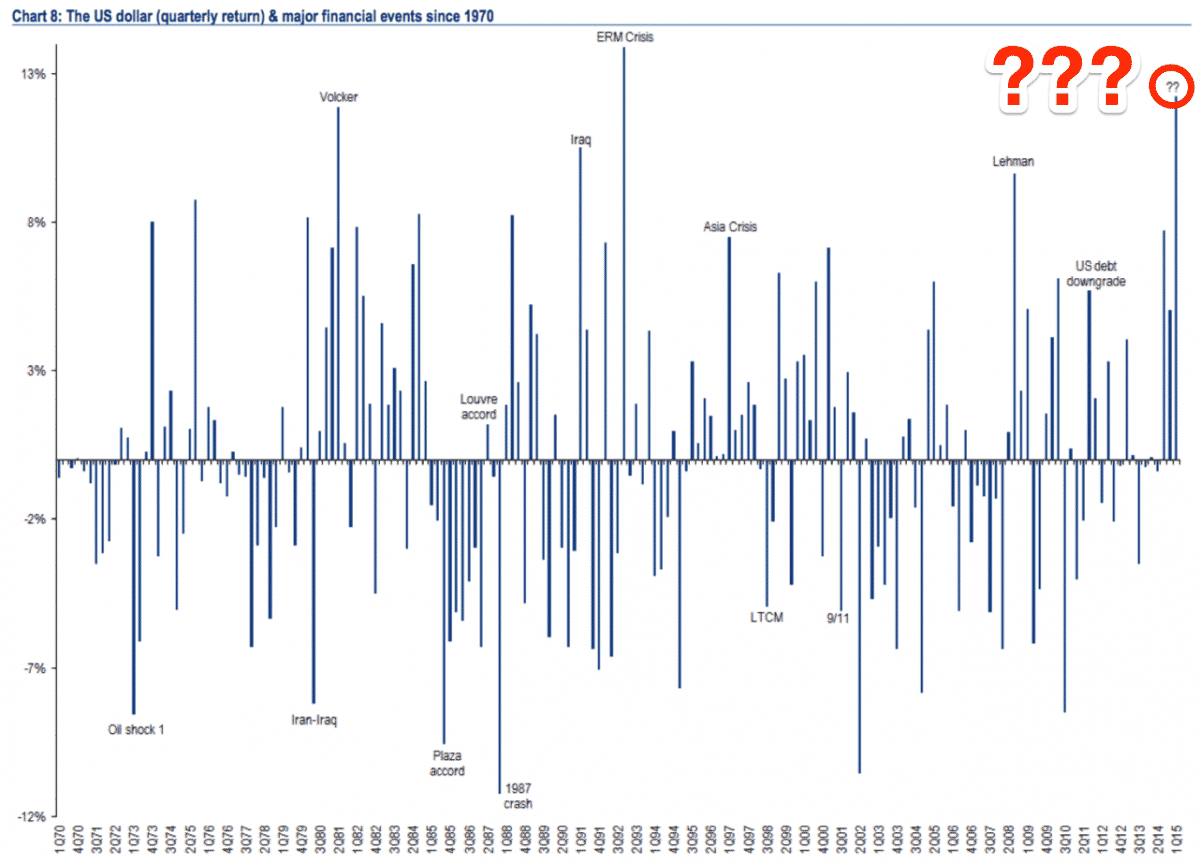
The dollar is set for its strongest quarterly strengthening since 1992, according to Bank of America, a good sign that a rate hike is around the corner.
When markets expect that US interest rates will be hiked, it typically strengthens the dollar. That’s because people rush to change other currencies into dollars — they can make more money in dollar-denominated investments. The higher demand for the US currency drives its value up.
In the past, significant dollar gains against other currencies have pretty much happened only during periods of extreme financial or geopolitical distress.
The last four large dollar shocks in the past 45 years have been symptoms of huge financial events: the collapse of Lehman, Britain’s panicky ejection from the European Exchange Rate Mechanism (ERM) in 1992, the first Gulf War, and Paul Volcker’s shock rate hikes in the early 1980s.
Today’s surge is already considerably larger than the one that surrounded Lehman’s collapse, although the economic conditions are very different.
Surprise: U.S. Economic Data Have Been the World’s Most Disappointing
Is this a sign of unanticipated weakness in the economy?
It’s not only the just-released University of Michigan consumer confidence report and February retail sales on Thursday that surprised economists and investors with another dose of underwhelming news. Overall, U.S. economic data have been falling short of prognosticators’ expectations by the most in six years.
The Bloomberg ECO U.S. Surprise Index, which measures whether data beat or miss forecasts, fell to the lowest since 2009, when the nation was in the deepest recession since the Great Depression.
There’s been one notable exception to the gloom, and it’s a big one: payrolls. The economy added 295,000 jobs in February and 1.3 million over four months, a reflection of a healthier labor market in which the unemployment rate has fallen to the lowest in almost seven years.
Most everything else? Blah.
This month alone, personal income and spending, manufacturing as measured by the Institute for Supply Management, auto sales, factory orders, and retail sales have all come in a bit weak.
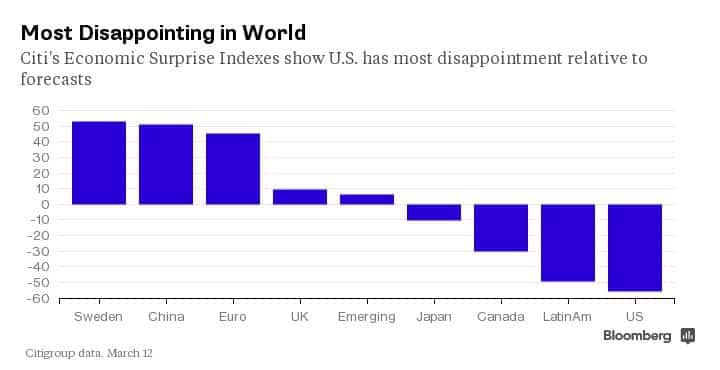
Citigroup keeps economic surprise indexes for the world, and its scoreboard shows the U.S. is most disappointing relative to consensus forecasts, with Latin America and Canada next, as of March 12. Emerging markets were supposed to be hurt by falling oil prices but are now delivering positive surprises. U.S. policymakers frequently talk about weakness in Europe and China, though both are exceeding expectations.
And there’s one rub. The surprise shortfall in the U.S. doesn’t necessarily mean the world’s largest economy is in dire straights. It’s just falling short of some perhaps overly elevated expectations.
Major survey finds record low confidence in government
By EMILY SWANSON
Associated Press
WASHINGTON (AP) — Americans’ confidence in all three branches of government is at or near record lows, according to a major survey that has measured attitudes on the subject for 40 years.
The 2014 General Social Survey finds only 23 percent of Americans have a great deal of confidence in the Supreme Court, 11 percent in the executive branch and 5 percent in Congress. By contrast, half have a great deal of confidence in the military.
The survey is conducted by the independent research organization NORC at the University of Chicago. Because of its long-running and comprehensive set of questions about the public, it is a highly regarded source of data about social trends. Data from the 2014 survey was released last week, and an analysis of its findings on confidence in institutions was conducted by The Associated Press-NORC Center for Public Affairs Research and the General Social Survey.
Governor Scott Walker (R., Wis.) wasted no time in mocking President Obama’s performance with respect to the economy after the president picked a fight with him for signing a right-to-work bill into law.
“On the heels of vetoing Keystone Pipeline legislation, which would have paved the way to create thousands of quality, middle-class jobs, the President should be looking to states, like Wisconsin, as an example for how to grow our economy,” Walker said in a statement to National Review Online. “Despite a stagnant national economy and a lack of leadership in Washington, since we took office, Wisconsin’s unemployment rate is down to 5.0 percent, and more than 100,000 jobs and 30,000 businesses have been created.”
Sen. Robert Menendez, comes out swinging against Obama Administration Foreign Policy
Amid Looming Federal Corruption Charges, N.J. Democrat Pushes Back Against Obama Administration Policy to Counter Russia
Melissa Quinn / @MelissaQuinn97 / March 09, 2015
Amid whisperings that the Justice Department will file criminal corruption charges against Sen. Robert Menendez, D-N.J., the long-time senator today spoke about the importance of the U.S. standing strong against Russia and warned that inaction could embolden countries with nuclear capabilities.
“The simple fact is we all want a diplomatic solution to this problem. But I believe this can only come about when Putin believes that the cost of continuing to ravage Ukraine is simply too high,” he said. “We have a responsibility to increase that cost.”
Menendez, speaking alongside former National Security Adviser Zbigniew Brzezinski, addressed a full house at the Center for Strategic and International Studies in Washington, D.C., on how the U.S. should respond to Russia’s aggression against Ukraine.
“It has never been in our nature to simply observe,” he said of the United States. “In my view, it is in our strategic interest to be an active participant in leading any effort to counter Russia.”
Don’t have time to read the Washington Post or New York Times?Then get The Morning Bell, an early morning edition of the day’s most important political news, conservative commentary and original reporting from a team committed to following the truth no matter where it leads.
Menendez, the ranking member of the Senate Foreign Relations Committee, has been a leading voice in calling for additional sanctions against Russia and advocated for the U.S. to arm Ukrainians as the neighboring country continues to make territorial gains.
The U.S. has sent nonlethal military aid to Ukraine, including blankets and night vision goggles, but Menendez joined a chorus of Republican and Democratic lawmakers pushing for lethal aid.
“That’s all well and good if I can see the enemy, but I have no wherewithal to stop them. It really is not responding to the fundamental challenge,” he said.
Specifically, the New Jersey senator called on the president to provide the country with equipment like counter-artillery radar, surveillance drones, anti-tank and anti-armor weapons, and ammunition.
Military leaders including Chairman of the Joint Chiefs of Staff Martin Dempsey and Secretary of Defense Ashton Carter back calls to arm Ukrainians. The president hasn’t yet said whether he will approve lethal aid to the country, but hasn’t ruled it out either.
“We need to send a very clear global message: If you violate and upend the international order, there will be consequences,” the New Jersey Democrat said. “And we have to mean it when we say it, and we have to back up our words with a menu of agreed upon actions that will follow. There should be no ambiguity about either our resolve or what actions we would consider.”
Menendez warned that the country’s response to Russia is being looked at by other global actors—particularly those with nuclear capabilities.
“Whether it’s China in the South China Sea that has territorial disputes with our allies, South Korea and Japan, or the challenge we face with a nuclear-armed North Korea, or the challenge of [President Nicolás] Maduro in Venezuela oppressing his people—I could go through a long list of global actors who, in the absence of assured consequence for violating the international order, will be emboldened,” he said. “That is an incredibly risky world to live in.”
The senator’s speech on Russia came just days after CNN reported that the Justice Department will file criminal corruption charges against the long-time senator. The charges center around his relationship with friend and political donor Salomon Melgen and are the culmination of a two-year investigation into the duo’s ties.
Menendez hasn’t been indicted yet, and the looming threat of the charges hasn’t stopped him from speaking out against the president’s policies.
“The United States must lead,” he said in closing today. “American leadership counts.”
Menendez, majority of US Senate on same page over Iran: Analyst
Most members of the US Senate share Democratic Senator Robert Menendez’s opinion on Iran’s nuclear energy program and sanctions, an American foreign policy analyst says.
“Senator Menendez is a very powerful member of the Senate, especially in the area of foreign affairs, and his opinion on Iran carries great weight inside the US Senate,” said James George Jatras, a former US diplomat and adviser to the Senate Republican leadership.
The Department of Justice has reportedly decided to bring criminal corruption charges against Menendez, who is involved in congressional efforts to pass anti-Iran legislation.
“As far as the pending charges against him from the Justice Department, I think… you have to presume that he is innocent until the government shows that they have proof of criminal wrongdoing,” Jatras told Press TV on Saturday.
“But I do not think that charges will really do much to change the direction of the Senate on the question of Iran, and the nuclear program and sanctions because Senator Menendez’s opinions are widely shared by other senators of both parties,” he noted.
Menendez, former chairman of the Senate Foreign Relations Committee, has been one of the detractors of President Barack Obama’s administration.
Analysis: More Mideast allies fear U.S. soft on Iran
Jim Michaels, USA TODAY
WASHINGTON — Israel is not the only vital American ally in the Middle East increasingly alarmed that the U.S. is working too closely with Iran. So are America’s most important Arab partners.
Israeli Prime Minister Benjamin Netanyahu has trumpeted his worries about a U.S.-Iranian nuclear deal, most recently to the U.S. Congress last week. Equally concerned but less vocal are Saudi Arabia and other moderate Arab states who play vital roles as bulwarks against radical Islamists in the region.
Shared interests Washington and Tehran have in driving the Islamic State out of Iraq and Syria are another source of worry for the allies, who do not want to see Iran’s radical leadership emerge as a more powerful and potentially nuclear-armed state in the region.
“Distrust in Saudi Arabia toward the United States hasn’t been this high since 1973,” during the oil embargo, said Michael Rubin, an analyst at the American Enterprise Institute.
Reports last week that Iran’s military was playing a prominent role in an Iraqi offensive to drive Islamic State militants from Tikrit, north of Baghdad, raised a fresh a wave of fear that the United States isn’t doing enough to blunt Iran’s expansionist designs.