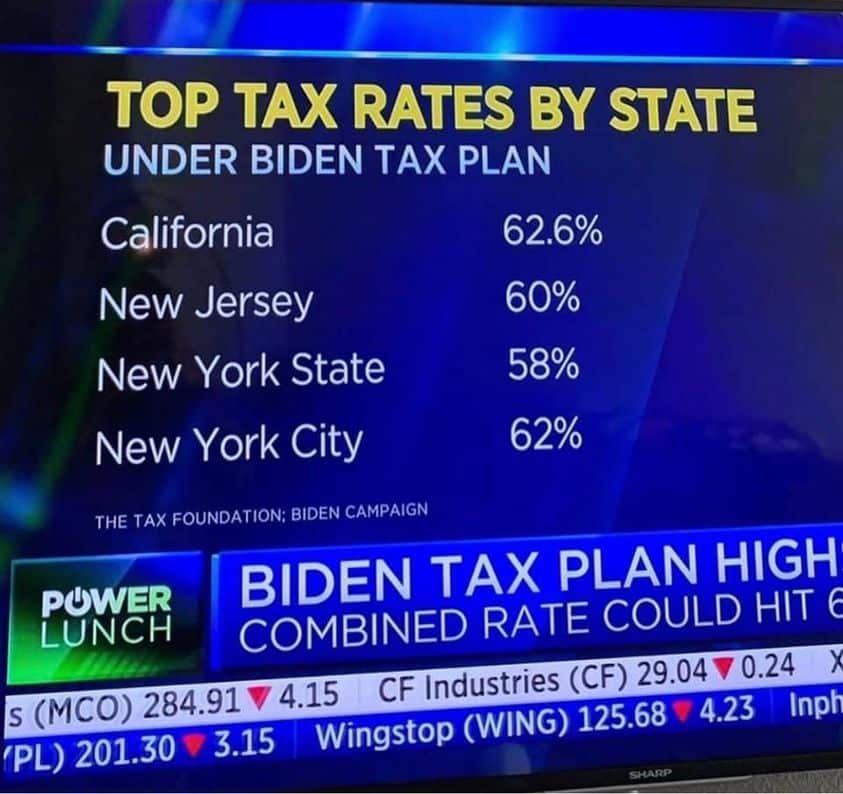
Ridgewood NJ, former vice president and Democratic presidential nominee Joe Biden’s tax plan takes another shot at the tri-state area . CNBC has already reported the massive tax increases to New Jersey, and New york residents . According to CNBC some New Jersey residents will be paying as much as 60% in taxes, New York State 58% , and New York City 62% .
ROSELAND NJ, Statement by Ralph Albert Thomas, CPA (DC), CGMA, CEO and Executive Director of the New Jersey Society of Certified Public Accountants
This morning, Governor Phil Murphy delivered his budget proposal for New Jersey’s new, nine-month fiscal year that begins Oct. 1. The New Jersey Society of Certified Public Accountants (NJCPA) is deeply concerned that the proposal looks very much like the unworkable budget introduced six months ago — plus $4 billion in new borrowing — before the coronavirus pandemic decimated New Jersey’s economy.
Morristown NJ, Garden State Initiative’s (GSI) president, Regina M. Egea, issued the following statement on the decision of the New Jersey Supreme Court in the case of New Jersey Republican State Committee v. Philip D. Murphy:
Trenton NJ, Evidence that Governor Murphy’s policies are choking the life out of New Jersey continues to mount. Just a few days ago, a United Van Lines study found that, for the second consecutive year, more residents moved out of New Jersey than any other state in America. And just today, an analysis of Internal Revenue Service data by the NJBIA confirmed that outmigration cost New Jersey billions of tax dollars in 2017-2018.
The only way to stem our tide of outmigration is to bring our economic policies in line with our direct regional competitors — Pennsylvania and New York
NJBIA president and CEO Michele Siekerka
New Jersey has many positive attributes. We added almost 60,000 jobs in 2016, the state’s largest gain since 2000, according to the New Jersey Department of Labor and Workforce Development. We have among the best K-12 public education systems in the nation and a highly skilled workforce including the highest concentration of scientists and engineers in the world — more than 225,000 statewide.
New Jersey also has a strong transportation network. We are home to the Port of New York and New Jersey, the third largest seaport in North America and the largest and busiest maritime cargo center on the East Coast. And we are among the national leaders in logistics and distribution. New Jersey is also a great recreation state with more than 130 miles of shoreline, beautiful parks, and mountains.
Despite these great assets, New Jersey remains a significant outlier, both nationally and regionally when comparing competitiveness and affordability including our state’s high cost of living and its heavy tax burden. New Jersey’s border states, Pennsylvania and New York, continue to be the No. 1 and No. 2 outmigration states for New Jersey residents and are challenging our competitiveness.
To reverse this trend we must examine our policies on taxation, revenue generation, and spending, and we must do so through the filter of competitiveness and affordability.
The New Jersey Business & Industry Association released a report Thursday indicating that the outmigration of some 2 million New Jersey residents cost the state approximately $18 billion in net adjusted gross income in the years between 2004 and 2013.
“The $18 billion we lost during the years we studied had a significant economic impact on the state,” NJBIA CEO and President Michele Siekerka said. “During that period, we lost $8.4 billion in household spending, $11.4 billion in economic output, 75,000 jobs and $4 billion in total lost labor income.”
The study found that the majority of New Jersey residents leaving the state are migrating to Pennsylvania. New York was the second-most-popular destination for those relocating from the Garden State, showcasing that, while people are leaving in search of lower taxes, they also want to maintain a relatively close proximity to family and friends.
“This pattern underscores New Jersey’s need to stay competitive with its neighbors and those other states vying for our residents and businesses,” Siekerka said.
And it’s not just retirees, either. According to the report, millennials, which it defined as those between the ages of 18 and 34, are leaving New Jersey in the highest numbers.