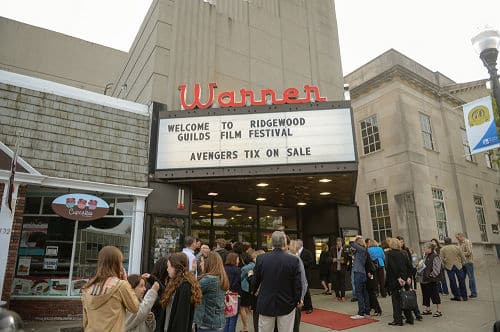
3rd annual film festival in Ridgewood welcomes student work
Tuesday, April 16, 2013
BY ELYSE TORIBIO
STAFF WRITER
The Record
WHAT: 3rd Annual Spring Film Festival.
WHEN: 6 p.m. Wednesday and Thursday.
WHERE: Clearview Cinema, 190 E. Ridgewood Ave., Ridgewood, 201-444-1235.
HOW MUCH: $15 per night, $25 for both nights, $12 for Ridgewood High School students and senior citizens. Tickets available at the door, Brownpapertickets.com and Mango Jam, House of DeCicco and Araya-Rebirth in Ridgewood.
“A Colorful Romance,” one of the feature-length entries in Ridgewood’s Spring Film Festival this year, opens with a short black-and-white sequence highlighting the village’s streets and landmarks like Ridgewood Avenue and Van Neste Square. The rest of the film follows awkward teenager Ted as he falls for Katie, the head cheerleader who literally brings color into his life via a secret Technicolor portal in the woods. The 64-minute film was made entirely by two teenagers.
“Being a former educator, I’m always in awe of the student filmmakers,” said Ridgewood Guild president Tony Damiano. “They’re all so enthusiastic, and the quality of the work we get from them is unbelievable.”
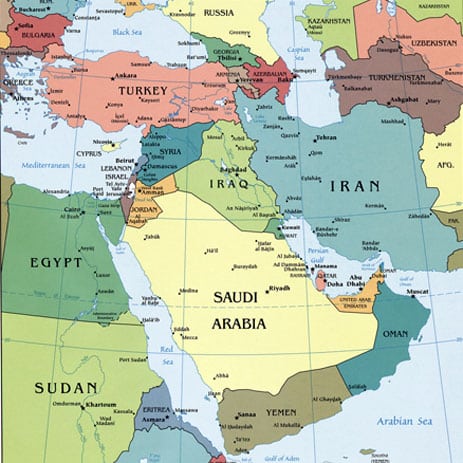
The U.S.A. and the Middle East in a New Era of the Clash of Civilizations
by Vassilios Damiras, Ph.D. (ABD)
CEO
Geostrategic Forecasting Cooperation – (GSFC)
Chryssoula Katsikoudi
Director of International Relations and Middle Eastern Affairs
Geostrategic Forecasting Cooperation – (GSFC)
Events since the terrorists’ attacks of September 11, 2001, have dramatically and drastically changed the political environment in the Arab and Muslims worlds, a vast diverse region incorporating the band of nation-states with significant religious Muslim population that extends from western Africa to the southern Philippines, as well as Arab and Muslim communities and diasporas stretching throughout the globe.
The United States are concerned with three types of serious threats to U.S. national interests.
Direct physical threats against American citizens and military/diplomatic installations
Serious political destabilization of friendly nation-states in the Arab and Muslim worlds
Significant growth of anti-American, anti-Western, and antidemocratic ideologies in the
Middle East and in the wider Arab and Muslim Worlds.
Preventing direct threats against the various American interests is the aim of the global war on terrorism with the defeat of Al Qaeda and related terror networks the paramount U.S. national security priority. The Bush administration in 2002 in the “National Security Strategy of the United States of America” declared that the United States of America is combating a war against brutal terrorists of global reach. The enemy is not a single political regime, or government, or person or religion or political ideology. The main enemy is terrorism premeditated political motivated violence perpetrated against innocents.
Cooperation in fighting terrorism and its networks is therefore a very critical component of the U.S. diplomatic relations with the various Arab and Muslim countries, but it is not the only element. Beyond the problem of terrorism lies the crucial issue of the future socio-political shape
and form of the Arab and Muslim worlds and whether these religious and political worlds will be amicable to U.S. interests, values, and democratic ideas.
Political destabilization of friendly but authoritarian nation-states poses a very serious and complex set of dilemmas and challenges. Statesmen, diplomats, and scholars of the realist school of thought, who direct and influence the U.S. policies and decision-making toward the Arab and Muslim worlds, valued regime stability nearly above democratic values and ideas. At the end of the 1991 Gulf War, serious fear and concern of the strategic consequences of the political destabilization of Iraq informed the George Bush administration’s decision to stop short of toppling Saddam Hussein and to permit him to crush the Kurdish and Shiite revolts. For the following decade both the Bush and Clinton administrations had to live with the serious
consequences of that military decision. Because of that dramatic geostrategic experience, some policymakers now support and vigorously promote that American national interest are sometimes better safeguarded or even protected by regime change in antithetical brutal authoritarian regimes. President George W. Bush faced that dilemma of regime change in Iraq and President Barrack Obama encounters that dilemma in Tunisia, Egypt, Libya, and Syria with the emergence of the Arabic Spring.
Obviously in some cases, promote for regime change is clearly a suitable sociopolitical option. There is little question, for example, that most alternatives to the current suppressive Iranian theocratic government would create a government more respectful of the Iranian people’s political and human rights, less likely to pursue and finish with the development of nuclear weapons or to support or finance vicious terrorist groups or causes, and more favorable positioned toward cooperation with the American administration and other democratic countries.
This specific policy questions relate to the cost-benefit calculus implicit in any set of United States military or diplomatic actions adopted to bolster and promote viable democratic change.
It is evident differentiating between political transitions from authoritarianism to democracy that can be expected to lead to more pluralistic and republic political regimes and those that probably that lead to more repressive and regressive political systems is more difficult in the case of friendly authoritarian nation-states. This demands a more fine-grained analysis of the relative strengths and long-term aims of the sociopolitical forces at play in the region.
The best-case political scenario in the process of democratization of friendly authoritarian countries assumes that a sociopolitical transition from authoritarianism, although in the beginning disruptive and difficult, will create a more democratic and benign political environment over the long term. Thus, a democratic or democratizing Arab and Muslim worlds would significantly reduce or even remove of the structural social and political causes of Islamic extremism and anti-Americanism.
Nonetheless, pushing political change in friendly authoritarian or dictatorial regimes could be significantly destabilizing in short term, specifically in the absence of democratic political
alternatives and strong civil society institutions and values. The removal of the Shah of Iran is a very cautionary study case. Furthermore, Algeria is a story of democratic transition that in the end generated an Islamist electoral majority, but instead of directing the Algerian sociopolitical system toward more inclusive politics, it produced a military crackdown and a radical Islamist insurgency of significance and unprecedented violence. In Egypt the Mubarak administration’s tactics drove the political opposition into underground. In 2011, under the banner of the Arabic
Spring the Mubarak regime collapsed. It is ambiguous if Egypt will become more democratic. In the Saudi Arabia, the most serious sociopolitical menace to the regime’s stability and survival comes from religious Islamic radicals supporting a more extreme version of the official religious/political ideology. Last but not least in Pakistan, an ambiguous ally in the U.S. counterterrorism and counterinsurgency strategies, extreme religious Islamic groups threaten the fragile democracy.
A major concern is the disruption of Jihadist terrorist networks, which potential can carry a biological or nuclear terrorist attacks across the globe, thus undermining democratic developments and endanger the American national interests across the world. An important question is how the American intelligence community can identify hostile use of these lethal networks. It is imperative to analyze the profiles of certain Muslim communities that harbor or maintain violent Islamic networks and the nodal and communicable aspects of these convoluted groups. Methods and process of indoctrination, influence, communications characteristics, and religious rituals necessitate to be better comprehended. Once the U.S. intelligence are identified
the aforementioned methodology of specific jihadist groups, then their recruitment procedure and weaknesses need to be examined and analyzed. Then the American government can design a specific strategy of how to penetrate, disrupt, and destroy menacing jihadist groups.
Interrupting these brutal terrorist groups does not mean closing down various Muslim institutions such as, health and welfare organizations, cultural centers, mosques, youth organizations, and student unions. Rather, it needs dismantling the trust nexus upon which Jihadists depend and promoting Muslim moderates to obtain control of these institutions. The Obama administration needs to continue to promote educational reform, reforms in various Madrassas combine with reforms in several Mosques. It is vital also the American government to promote economic development in the Arab and Muslim worlds. The U.S. intelligence assets need very carefully
to execute psychological operations targeting the various jihadist cells. Inside the U.S. borders, decision-makers need to be pay attention to radical recruitment in various prisons and within the American armed forces to monitor the role of Muslim prison clergy and military chaplains in disseminating radical ideas of Islam.
Evidently, it is extremely difficult in forecasting the consequences of regime change may generated from a failure to comprehend the growth of political ideologies drastically opposed to American national interests, values, democratic ideas, and policies. The American government has a difficult road ahead to promote democratic ideas in the Middle East and in the wider Arab and Muslim worlds and to persuade other American allies mainly in Europe to support that sensitive and important task ahead. One way is United States to sustain a significantly military force in the region that reflects the American commitments to her allies and her military interests. America will be the sole catalyst for democratization in these sensitive aforementioned
areas.
The outcome of the “war of ideas” in progress throughout the Muslim and Arab worlds
is possibly to have significant consequences for the U.S. national interests in the region; nonetheless it is also extremely difficult for the American government to influence or alter Muslim ideas regarding the relations between the West and various countries in the Islamic World. Even pro-American governments wishing to work together with the U.S.A. on various important regional issues may be limited by domestic pressers and public perceptions. It is fundamentally and extremely difficult for a nonwestern power to influence or alter ideas and perceptions of Muslims about their religion or political affiliations. The historical evidence vividly illustrates that only Muslims themselves have the sole credibility to challenge or change the misuse of the Islamic religion by radicals or Jihadst fighters. Thus, the American administration current and future have a serious and difficult task to tackle. The future will
indicate the relations between U.S.A. and the Muslim and Arab worlds.
The Middle East has been the most conflict-prone regions. The lack of economic development and growth is one of the major factors why conflict in the Middle East continues in all likelihood to increase. The significance of ethnic dominance in Islamic countries equal well to the long-lasting and ongoing Arab-Israeli conflict, already hosting two international wars with the participation of Iraq in 1991 and 2003 as well as the Iran-Iraq war in 1980-1988.
Ever since the 1950’s, civil war in the Middle East has been the dominant type of conflict. As a conflict ridden region, one cannot deny that Afrcia and Asia has not been on the same path, but by closely analyzing and comparing the three regions, the Middle East is clearly characterized by current authoritarian regimes, oil-dependent economies, and above all Islam.
Civil war in the Middle East is mostly associated with either religious or ethnic conflict or/and economical, political, and social discrimination. The region’s resistance to democracy and the lack of economic and social development is due to bring a movement of exceptionelism to the surface by reflecting the regions beliefs through their ideology and historical circumstances. Has conflict in the Middle East been shaped by exceptional factors vulnerable to the region, or is the Middle East just an “unfortunate” region; wrong place, wrong time?
After World War I, the boarders were drawn in the form of the 1916 Sykes-Picot agreement. The core regions of the Ottoman Empire became Turkey, some were given to Russia, parts of Syria and Lebanon to France, and Iraq and the rest of Syria to Great Britain. Morocco, Algeria, and Tunisia were controlled by France, and Egypt, Palestine, and Jordan by Great Britain. By the end of 1960, most of those regions have gained their independence, except with the establishment of Istael in 1948, regional conflict in the Middle East started to spread like wild fire. Ethnic and religious conflict between Muslims and Jews became known as the another “holy war.”
However, throughout all the conflict and civil war, the Middle East still today is one of the most influential strategic importance in world politics. The unique and close relationship with Israel and the United States has influenced external intervention such as the U.S./U.K invasion of Iraq in 2003.
According to the “war of ideas” in concept with Huntington’s “Clash of Civilizations,” Islam an the West are engaged in a clash of civilizations as two competing ideologies. As Islam is conflicting with secular democracy and basic civil liberties, the spread and the replacement of the current world with the caliphate are proceeding through two forms of how terrorism is defined nowadays. One, is the extremist Islamist group known as al-Qaeda, and second, the Party of Liberation which is more oriented towards ideological struggle. Known as a radical Sunni Islamist organizatio, PL has not been classified as a terrorist organization, therefore, its ideologies are more accessable to the masses. Other Islamist groups focus more on single, religious issues, such as the Arab-Israeli conflict, but PL reaches out to unite all Muslims under one Islamic banner such as – in Huntington’s case – the clash of civilizations suffered by Muslims all around the world.
After the creation of the Muslim Brotherhood in 1928, modern Islamist movement emerged through some ideologues believing that the decline of the Islamic world can only be reversed if “real” Muslims unite and spread the teachings of the Prophet Muhammad, doing so, replacing the existing governments ruling the Muslim world with Islamic ones. When the Party of Liberation was formed in the early 1950s, its followers, without a doubt, rejected capitalism and preached democracy as “godless.”1 The only way to liberate Muslims from the beliefs of nonbelievers was to replace the Christian dominated nation-states. Furthermore, followers of the PL also believe that Western civilization was seeking an ideological dominance within
the Musim societies, and that capitalims and socialism were anathema because they failed to recognize the superiority of Islam.
Today, the PL is active in more than forty countries with a hierarchical approach aiming to resurrect the caliphate by overthrowing the government, and to prevent Muslims in the West to assimilate into Western culture. One of the party’s main focuses is Turkey – conflicted within a war of ideologies. Although Turkey is currently reforming its legal and constitutional systems in order to join the European Union, in the recent years it has become very vulnerable to domestic Isamist extremists. The PL is trying to convince Turkey not to enter the EU because otherwise they would lose their Islamic identity and instead raise their Islamic flag.
Zeyno Baran, “Fighting the War of Ideas,” Foreign Affairs , Vol. 84, No. 6 (Nov. – Dec., 2005), 70.
Huntington’s clash of civilizations thesis predicts that the increasing conflict between Islam and the West has to do with Muslims being involved in violent conflicts between religious and ethnic groups; with the Middle East being a region where Islam dominates. Ethnic dominance between Shia and Sunni proves his argument that any dominant ethnic group increases the risk of conflict incorporating Islamic dominance. In core content, Huntington’s Clash of Civilization thesis
states that states belonging to different civilizations are more likely to fight each other, while states belonging to the same civilization are less likely to fight each other.
According to Huntington, the Clash of Civilization emerged in the post Cold-War era as a result of different factors such as increased economic regionalization, the interaction amongst people of different civilizations, and most of all a global resourgence of religious identity. Huntington identifies a civilization as “the highest cultural grouping of people and the broadest level of cultural identity people have short of that which distinguishes humans from other species.” 2 Religion is evidently the single most important factor in a civilization. It is the central defining characteristic of a civilization; whether it is Hindu, Islamic, Orthodox, or a Western religious faith, civilizations are most likely to clash with each with different religions.
Huntington places a major emphasis on Islamic belief as a source of cultural strain in the modern world. His thesis predicted that the fundamental source of conflict in this world would be ideological or economical; and he was right. With a sligh emphasis on Weberian theory, combined with his theory of the clash of civilizations, it is evident that there is a troublesome attraction and comparability between Islam and the rest of the cultural world today, which translates into a fatalistic self-empowerment and individualism. Islam’s fatalism is the concept of traditional value system that are unreceptive to the idea of the process of modernization. For that, Huntington’s Clash of Civilization thesis is a perfect comprehensive analysis of the fatalistic
qualities inherited in Islam.
Errol A. Henderson and Richard Tucker, “Clear and Present Strangers: The Clash of Civilizations and International Conflict,” International Studies Quarterly , Vol. 45, No. 2 (Jun., 2001), 319.
A Challenge To Those Who Support “Gay Marriage”
Vostra Guida
Apr 11 ,2013
(Washington State Attorney General has filed a consumer protection lawsuit against a florist who refused to supply flowers for a same-sex wedding. The florist told the couple “I am sorry. I can’t do your wedding because of my relationship with Jesus Chris.” The lawsuit seeks to force the florist to supply flowers for gay weddings and seeks a $2,000 fine for every violation.)
A Challenge To Those Who Support “Gay Marriage”
By Vostra Guida
The concept of so-called “gay marriage” is surrounded with high levels of emotions on all sides of the debate, and has come into even sharper focus this year due in large part to two cases recently argued before the Supreme Court, and the fact that the President of the United States and a slew of “Johnny-Come-Lately” politicians have endorsed the idea of government sanctioned gay marriage.
Yet for centuries, it was presumed that marriage is the union of a man and a woman, and today there are many federal laws that rely on the definition of “marriage” and/or “spouse” (including laws relating to social security, taxes, immigration, employee benefits, etc.). At present, federal law (the Defense of Marriage Act) defines “marriage” as “only a legal union between one man and one woman as husband and wife.” That same law also defines the word “spouse” as referencing only “a person of the opposite sex who is a husband or a wife.” It should come as no surprise that I continue to support those definitions.
The main arguments in favor of gay marriage tend to focus on the “right” of homosexuals to be happy and to marry the person they love, and to be treated equally under the law. But what we have not heard from supporters of gay marriage is what they propose for the new definitions of “marriage” and “spouse” to be used in connection with federal laws like the ones mentioned above.
So for those who have declared your support for gay marriage, I have a challenge for you:
1) Please propose new definitions of “marriage” and “spouse” that include homosexual relationships and that can be used in connection with federal laws.
2) If those definitions are not also inclusive of all varieties of relationships (for example, incestuous relationships, zoophilic relationships, or polygamous relationships — whether heterosexual, homosexual or bisexual) please provide the justification(s) for treating those relationships differently from typical heterosexual and homosexual relationships such that denying people who wish to enter into such marriages may be denied the same “right to be happy, marry who they love, and be treated equally under the law.”
In responding, please keep in mind that people involved in all of the aforementioned types of relationships are capable of conceiving children artificially (some requiring sperm or egg donations or a rented uterus) and/or are capable of adopting children, just like people in heterosexual and homosexual relationships. Some may be too old to have children or have no interest in having children, just like people in heterosexual and homosexual relationships.
The above challenge is a serious exercise. In order to understand whether redefining “marriage” and “spouse” is justified, workable, and generally a good idea, we need to know what the proposed new definitions will be and how those definitions are justified.
Citizens are ready to rally in counties throughout New Jersey to show their disdain for the attack on our Constitution, the Bill of Rights and our freedoms on April 14.
We the People” Bergen County Rally Sunday, April 14, 2pm, Teaneck NJ
The Rally for Bergen County which is just one of eight for this weekend is set for:
April 14th – 2:00 pm – Bergen County – Teaneck Green: Cedar Lane/Teaneck Road, Teaneck 07666
This rally is for ALL who value their freedom and liberty:
If you are a conservative, Second Amendment activist, libertarian, reform, gun activist, gun/rifle club member you need to show up and be counted with others who have simply had enough of the assault on your rights and the liberty we all hold near and dear to our hearts. This is not supporting any one party, so republicans, democrats and unaffiliated – please come out.
Speakers who will give you hope and a pathway to become involved before it is too late. This brief time will bring you where you need to be to be involved and hear how you can be with a small amount of time and effort.
In Bergen on the Teaneck Green we will be hearing some of the best speakers including
Joe Connor – author, appears on Fox ** Rev. Steve Craft -author, How To Raise An American Patriot ** Mike Henry – Heritage Action ** Carolee Adams – Common Core/Education ** Tom Stowe – Fair Tax ** Mark Peters – Constitutional Activist ** Scott Bach, Esq.to name a few.
If you don’t stand up NOW for your children and grandchildren, who will? Will you let them take the minds and well-being of the children without protest?
*Can you afford to miss this opportunity to network with others who feel the way you do?
*How can you sit home when you see all your rights being hijacked each day piece by piece?
*Can you really let others do this by themselves without your support?
Well the answer is YOU CAN’T! – BE THERE! Bring a friend and a lawn chair
This rally is supported by NJ2AS, the NJ Constitution Party, NJ Libertarian Party, NJ Fair Tax activists, NJ Tea Party Caucus as well as conservatives throughout the state.
61st Sponsor Show Painting Images at Ridgewood Art Institute
Sun, April 14, 2013 – Thu, May 02, 2013
Time: 10:00 AM – 8:00 PM
Ridgewood Art Institute, 12 East Glen Ave., Ridgewood, NJ 07450
All are welcome to the opening reception of the 61st Annual Sponsor Show on April 14th from 2 – 4 pm at the Ridgewood Art Institute located at 12 East Glen Avenue in Ridgewood, NJ.
The Sponsor Show, our biggest fundraiser of the year, guarantees each sponsor a painting from the exhibition for a contribution of $275. This year’s show, entitled “Visions of Light” features artwork with beautiful light effects.
***Sponsors claim a painting of their choice at a lottery style drawing on the evening of May 3rd at
8:00 PM. Attend the opening reception to enter a ticket giveaway to the Bergen PAC. The exhibition is free and open to the public from April 14 through May 2, 2012. Gallery hours are Mon. – Fri. (10:00 AM – 8:00 PM), Sat. (10:00 AM – 3:00 PM), and Sun. (12:00 PM – 2:00 PM) Sponsorships can be purchased in person at the Institute or online at www.ridgewoodartinstitute.org.
Please visit the website or call (201)
652-9615 for additional information.
The state Attorney general today released the report of the safety task force created by the governor in the wake of the Newtown, CT, school shootings.
The 83 page report from the NJ Safe Task Force offers a series of 50 recommendations for curbing gun violence in the state. The recommendations focus on several key areas including gun control, urban violence, mental illness, substance abuse, gun violence, violence in the media and school security.
6TH GRADE SPRING MIXER At Ridgewood Community Center
RIDGEWOOD MIDDLE SCHOOL MIXERS Sponsored by Ridgewood Recreation and the NJ Governor’s Council on Alcoholism and Drug Abuse Village teens have the opportunity to come together as both George Washington and Ben Franklin Middle Schools join to form a “mixer”. Each evening offers students a chance to get acquainted with future classmates while enjoying music and dancing with DJ Sound Illusion, refreshments, fun and games. 6th Grade – Friday, April 12th, 7:30 to 9:30 pm 7th/8th Grades – Friday, April 19th, 7:30 to 9:30 pm (Ridgewood teens only)
The Anne Zusy Youth Center, 131 N. Maple Avenue (NOTE: all parents must drop off and pick up youth in the rear lot of Village Hall at the Community Center entrance.) A donation of $8 will be requested at the door. All donations will benefit the Community Center. Adult chaperones are always needed. Please contact the Recreation Office at 201-670-5560 if you are able to volunteer.
4 gay NFL players could come out on the same day, Brendon Ayanbadejo says
By Andrew Sharp on Apr 5 2013, 10:25am
Ravens linebacker Brendon Ayanbadejo was released by Baltimore this offseason, and on the heels of comments earlier this week where he suggested that he was cut in part because of his outspoken stance on gay rights and equality issues, Ayanbadejo clarified himself to the Baltimore Sun on Friday. During an hour-long interview he made it clear that he harbors no resentment toward the Ravens, and respects them for the support they offered him throughout his career both on and off the field. But that’s not all.
Opportunities remain scarce for young people after years of debt-fueled government spending
Washington, DC – (4/5/13) – Generation Opportunity, a national, non-partisan organization advocating for Millennials ages 18-29, is announcing its Millennial Jobs Report for March 2013. The data is non-seasonally adjusted (NSA) and is specific to 18-29 year olds:
The youth unemployment rate for 18-29 year olds specifically for March 2013 is 11.7 percent (NSA).
The youth unemployment rate for 18-29 year old African-Americans for March 2013 is 20.1 percent (NSA); the youth unemployment rate for 18-29 year old Hispanics for March 2013 is 12.6 percent (NSA); and the youth unemployment rate for 18–29 year old women for March 2013 is 10 percent (NSA).
The declining labor force participation rate has created an additional 1.7 million young adults that are not counted as “unemployed” by the U.S. Department of Labor because they are not in the labor force, meaning that those young people have given up looking for work due to the lack of jobs.
If the labor force participation rate were factored into the 18-29 youth unemployment calculation, the actual 18-29-unemployment rate would rise to 16.2 percent (NSA).
Evan Feinberg, President of Generation Opportunity and one of the first Millennials to run for Congress, issued the following statement:
“March was another lost month for my generation. Young people are finding fewer opportunities and are being saddled with the costs of our country’s unsustainable deficits.
“Some people will try to blame the laughably small cuts to government spending known as the sequester – but aside from the Post Office, government actually added 9,000 jobs last month.
“After years of deficit spending and government meddling in the economy, 1 in 6 of us don’t have a job. Half of us are doing no better than a part-time job. All the while, we are all stuck with a bill that keeps getting bigger. It’s like we’re the last one to leave the bar and everybody else ran out without paying their tab.”
Accusations fly in brawl at ‘Real Housewives of New Jersey’ event
Thursday, April 4, 2013 Last updated: Thursday April 4, 2013, 10:57 PM
BY CHRIS HARRIS AND VIRGINIA ROHAN
STAFF WRITERS
The Record
RIDGEWOOD — The Posche II boutique’s grand opening was anything but posh when fists started flying at a “Real Housewives of New Jersey” event last weekend.
And now, village police have been fielding cross-complaints of assault and threats.
The bloody brawl erupted inside an East Ridgewood Avenue hair salon, which was not yet open, as television cameras rolled on Jacqueline and Christopher Laurita and Giuseppe “Joe” Gorga, who allegedly took on a Paramus man.
The fights have come to be expected at “Housewives” events — and Posche events in particular.
Reader says , The truth behind Valley’s fantasy is the massive structure is simply already too big to expand any further
I am glad the Bergen article used the correct measure — the Hospital is going to severely expand, not reduce. Valley tried to get through the night talking about “reductions” in its expansion plans. The truth behind Valley’s fantasy is the massive structure is simply already too big to expand any further, and certainly not on the obese scale presented at last night’s meeting.
From what Valley said last night: The buildings and parking garage will be expanded with a 90% increase in density to what is there now, nearly double the current size. Maximum height will go up to almost 100 feet, further dwarfing surrounding properties. The plan still calls for the same number of parking spaces (2000) so it seems school children and other pedestrians will still face the same amount of increased traffic, despite the claim that certain operations will be conducted elsewhere. There will still be massive excavations impacting our underground water streams, requiring the destruction of bedrock and requiring hundreds of thousands of trips through town by dump trucks carrying off debris. Linwood avenue will be expanded in order to allow for the increased traffic and construction vehicles. (Does this mean the taking of private property from Linwood homeowners?) Today’s technology, we are told, requires larger, single occupancy rooms, yet we are not assured tomorrow’s technology and profit seeking won’t mean large singles are turned into double or triples (and maybe that’s the real reason for the increased number of parking spots.) The loading zone for trucks, with their noise, exhaust, etc., are all being moved down next to BF middle school and the playing fields.
All in all, Valley made it clear that to remain on par with other regional hospitals serving the NorthEast, it needed to expand even if the expansion did not otherwise fit within its space or the neighborhood. Once again, we are being asked to sacrifice our the Village so Valley can remain economically profitable with other major hospitals.
The Mayor asked a very interesting question: last time a prime justification for doubling the Hospital’s size was that overnight hospital beds were needed because of the shrinking number of hospitals. Why then, the Mayor asked, does Valley need the same number of beds as identified in the last expansion plans when Pascack Valley has re-opened down the road. Valley’s answer this time was that it wanted what it wanted. A particularly galling response when one considers Valley uses its financial might (relying on Ridgewood resident donations and funding of Valley’s tax-free status) to fund litigation opposing entities like Pascack Valley from administering to the sick.
I thought one of the most interesting points was not articulated well enough and Valley skirted away from it. Their opening presentation noted that other options, such as moving the entire baby birthing and care operations to another location, was not “feasible.” Valley later explained it was too costly, but it absolutely refused to provide any support for this saying the issue was “private.” In other words, Valley is asking the Village to change its way of public life, while saying the reasons are “private.” Hopefully the Planning Board will see through Valley’s thinly veiled reasons for wanting to expand. I would like to see the Board return to that at the next meeting, and if Valley won’t justify or explain this as one of the reasons for expanding, then the Board should refuse to consider the unavailability of other locations as a reason for expansion.
All in all, a good night for Ridgewood residents who respectfully presented question after question to Valley’s hired guns who sounded absolutely charming, but by the end of the night revealed that, as with the past plan, “these are the things that Valley wants” and that, in and of itself, is the reason the Village should cave and give it to them.
An Easter Message from Bergen County Executive Kathleen A. Donovan
I want to wish all our Christian families in Bergen County a very Happy and glorious Easter Sunday. I hope you get to spend this very special day with your friends and family reliving your long held traditions. On another note, I want to thank the many people who have offered me their good wishes for a speedy recovery from the back problems that required me to seek medical attention. Your cards, flowers and messages of support mean a lot to me and are giving me added motivation to get through the rehabilitation process.
I look forward to returning to my full time duties as County Executive as quickly as possible. In the meantime, my staff continues to keep me updated daily on county business and to forward me all pertinent information about the operations of county government.
Editors note : the Record always omits the fact that the only one making out from an increased gas tax are unions . An increase in gas taxes is a direct payoff to unions looking to get reelected .Years of mismanagement of the High Way trust fund is not even acknowledged . The fact is the state does a terrible jobs allocating resources and spending money . residents have already payed for good roads and bridges , yet politicians since Jim Mac greevey have failed to deliver .In our town look at all the waste , a $9 million Village Hall renovation that was nothing less than a total fiasco as well as many $400,000 golden toilet projects ,it is a wonder anything get done …
Analysis: N.J. gas tax still taboo
Friday March 29, 2013, 11:14 PM
BY JOHN REITMEYER AND KAREN RO– USE
STAFF WRITERS
The Record
New Jersey commuters should get used to idling in traffic, making sudden detours when a bridge fails an inspection and standing on overcrowded railcars.
That’s because the $1 billion state fund that pays for transportation upgrades is tapped out, able to pay only the debt it has accrued over the past decade and leaving a transportation system ranked among the worst in the country with little money for repairs and improvement. And there is no political will in Trenton, by Republicans or Democrats, to increase New Jersey’s 10.5-cent-per-gallon gasoline tax, which provides the main cash for the state Transportation Trust Fund.
With Governor Christie seeking a second term this year, and gearing up for a possible presidential run in 2016, he is unlikely to push to raise the gas tax. In fact, he’s repeatedly dismissed talk of increasing the tax, even when asked in the wake of superstorm Sandy if it could be a tool to help fund the state’s recovery.
And Democrats, who control the Legislature and have been critical of how Christie has handled transportation spending, have not put forward a plan to fix the state’s transportation problems. They too lack the political courage to push a tax hike, especially with all 120 seats in the Legislature on the November ballot this year.