Over 60,000 New Jersey Students Take Part in Field Test of Online PARCC Exams
More than 62,000 New Jersey elementary and high school students were part of the nation’s first large-scale test of the online PARCC exams, an early trial that officials are calling a success — despite some glitches.
New Jersey’s participation over the past month was among the largest in the country, topped only by Illinois and Ohio.
And depending on who is talking, the trial went fairly well, with comments still coming in. NJ Spotlight is conducting its own survey, too, for our readers to share their experiences.
The chief spokesman for PARCC — the acronym for the Partnership for the Assessment of Readiness for College and Careers — said yesterday that the field tests, which involved more than 200,000 students in more than a dozen states, went about as expected, with no major problems but plenty of smaller issues to be addressed.
Taking place in more than 1,000 New Jersey schools, the trial was in the performance-based piece of the PARCC exams for language arts and math, in which students are asked to complete writing assignments or more complex math computations.
PARCC released new versions of the practice exam last week, allowing the public to take the language arts and math tests themselves. (Mooney/NJSpotlight)
The Summer Music Academy provides lessons and performing opportunities for beginning, intermediate and advanced level musicians. Students from all districts are welcome! Program highlights include string orchestras, jazz bands, woodwind, brass and percussion ensembles, drum set classes and the 2014 Guitar Camp. All students are encouraged to join this dynamic program.
Click here for the brochure and registration form.
Sign Up for Space Camp at Hawes School
Two sessions: June 27 – July 11 or July 14 – July 25
Is your son or daughter interested in Space? Have they completed grades 2-4? Sign them up for summer space camp where they learn astronomy by going into a planetarium, build and launch model rockets, learn about the history of flight, solve problems in groups, play space games, enjoy physical fitness (rope climbing, zip lining, and more), perform experiments and make art projects. It’s going to be a blast!
Benjamin Franklin Middle School students show school spirit
Students from B.F. Middle School competed for the best Super Hero Costume as part of School Spirit week during an assembly at the school this morning. The principals of Travell, Somerville and Hawes schools came by to judge the costumes. Ridgewood Officers Michael Karcher and Lt.Glenn Ender were on hand as part of the youth outreach program.
School budget elections disappearing in New Jersey
April 12, 2014, 11:28 AM Last updated: Saturday, April 12, 2014, 11:28 AM
By GEOFF MULVIHILL
Associated Press
TRENTON, N.J. (AP) — Just a few years ago, April school elections were a key date on New Jersey’s political calendar, the time most of the state’s voters had — but ignored — the chance to say yes or no to property tax increases.
Now, the only-in-New Jersey votes hardly exist.
Just 26 of the state’s 585 school districts will hold elections April 23. That’s 15 fewer than last year.
The change is a result of a law that, starting in 2012, allowed schools to save money and duck public outrage by moving school board elections to November and scrap votes on the tax levy. School budgets are the biggest component of New Jersey property tax bills, which average more than $8,000, the highest in the nation.
The conversion has been faster than expected, and it has come without much complaint.
Frank Belluscio, a spokesman for the New Jersey School Boards Association, said his group doesn’t believe the school budgeting process has changed much because the direct vote on tax levies associated with school budgets is a thing of the past in most communities.
The budgets, he says, are still subject to a cap on how much administrative expenses can grow, still get reviewed by state education officials and are still subject to public hearing. And those that call for property tax increases of about 2 percent still must be voted on — unless the bigger increases are because of certain exceptions.
– See more at: https://www.northjersey.com/news/school-budget-elections-disappearing-in-new-jersey-1.938920#sthash.zbWpmLqc.dpuf
Charter School Applications Remain Strong, Despite Few Approvals by State
Administration’s reluctance to sign off on new charters doesn’t do much to discourage nearly 40 new applicants
Even as the Christie administration approves fewer new charter schools, interest in opening these facilities remains high, with nearly 40 applications coming in last week for the latest round of review.
Thirty-eight applications were received in all, although that number may be culled after preliminary reviews are conducted by the state Department of Education to determine if the proposals are complete.
The high number of applications reflects the enduring interest in operating these schools, even as the state throttles back on approvals. In the round of applications this past March, 38 proposals yielded just three approvals.
Overall, 14 of this year’s applications are repeat submissions; nearly a dozen come from the larger education management organizations that are coming to dominate New Jersey’s charter landscape. (Mooney/NJSpotlight)
UConn’s success envied around nation, especially in N.J.
APRIL 8, 2014, 10:55 PM LAST UPDATED: WEDNESDAY, APRIL 9, 2014, 12:48 AM
BY TARA SULLIVAN
RECORD COLUMNIST
THE RECORD
This was before the opening tipoff, before her Connecticut women’s basketball team routed Notre Dame for a second consecutive national championship, before Stefanie Dolson helped turn Storrs, Conn., into the college basketball’s epicenter. Dolson, a senior center who would go out and dismantle the Fighting Irish with 17 points and 16 rebounds, was asked if she’d heard any words of advice from the previous night’s national champions, otherwise known as her male counterparts back at UConn.
Dolson said she and her teammates had received texts from the men’s players that said, “One more game to go – you got this.”
That they did.
For the second night in a row, a Connecticut team outran, out-jumped and out-hustled the opposition; and for the second night in a row, Connecticut was the last college basketball team standing, finishing off a male-female double-double championship for the second time in school history.
The school that was supposed to be left behind is on top of the world.
With a wire-to-wire 79-58 win over previously undefeated Notre Dame in Nashville, Tenn., on Tuesday night, the Connecticut women didn’t simply finish off a perfect 40-0 season, but improved to 9-0 in national title games under head coach Geno Auriemma. One night earlier, the UConn men’s team defeated Kentucky, winning its second national title in four years, and fourth overall.
Between second-year coach Kevin Ollie and predecessor Jim Calhoun, the men’s team is also perfect in four championship games.
Connecticut’s position among the country’s elite athletic programs is indisputable, a testament to a long, sustained and successful building project that is the envy of schools across the land.
Nowhere is that shade of green deeper than amid the sea of Rutgers red, where a floundering department feels so far away from the superior level Connecticut projected to the world across a dominant month of March.
The RHS Winter Guard invites you to join them for a special performance of their 2014 production, HARD LINES | soft curves on Thursday, April 10 from 8-8:30 p.m. in RHS Gym 1. This sophisticated, exciting piece highlights the talent and hard work that earned the team a promotion to the prestigious Scholastic A Class in their regional circuit. These amazing performers have intrigued audiences and impressed judges since their debut performance in January and on April 12 they will conclude their season at circuit championships. Don’t miss this opportunity to see the 2014 RHS Winter Guard in a one-time only home performance!
The Ridgewood High School Winterguard is an integral part of the RHS Band Program. While this group practices and performs independently from the band, the skills learned are easily transferred to the field for the fall marching band season.
The Winterguard is a competitive team activity that performs a 4 – 5 minute routine that is choreographed and performed to recorded music. The Winterguard emphasizes dance and compliments choreography with flags, sabres, rifles, and other props. Competitions take place throughout the tri-state area, including the WGI (Winter Guard International) Regional Championships. The Winterguard season begins with two long weekends rehearsals in December before settling into a practice schedule of once or twice during the school week, depending upon gym availability. Weeknight practices are held on Monday and Wednesday evenings at the start of the season, and often taper off to once a week by mid February. The guard also rehearses on Saturdays beginning in January. The competition season ends in mid March.
A date for the information and organizational meeting will be announced in the coming months. At that time, audition and membership expectations will be discussed, and audition scoring rubrics and season calendars will be distributed. Students are encouraged to bring a parent to this meeting.
Although no experience is necessary to audition for the Winterguard, many find some dance experience to be helpful. Students must be able to demonstrate good coordination, body control and rhythm, and an ability to learn flag techniques and dance routines. A good work ethic is absolutely essential, and students must be able to commit to the schedule of rehearsals and competitions which will be posted on this website. Due to the regulations of our competition circuits (Mid Atlantic Indoor Network and Winter Guard International), there are a limited number of spaces available.
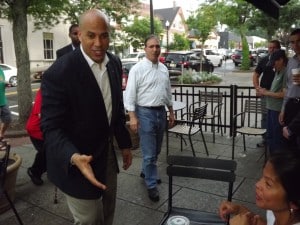
file photo Cory Booker in Ridgewood by Boyd Loving
New Jersey – It Just Ain’t Working
Editor’s Note – There are a number of national news stories today that highlight how fiscal and social policies are destroying the state. The state’s credit rating was down-graded by Moody’s, it’s largest city is posed for state takeover, public pensions are in critical condition and political correctness has run amok in our schools.
How do you plan to change this?
NEWARK FACING ‘EXTRAORDINARY LEVEL OF FISCAL DISTRESS’
UNION CITY, New Jersey–New Jersey’s biggest city has yet to file a budget and hasn’t told the state whether it will need federal aid this year. Left in an “extraordinary level of fiscal distress” by former Mayor Cory Booker, Newark is on the brink of a state takeover.
The Associated Press reports that officials responsible for keeping Newark afloat are increasingly hitting roadblocks in their attempts to streamline the government. In one letter to the City Council, one city official, Thomas Neff, described the situation as “an extraordinary level of fiscal distress” and urged the ailing city to invite state oversight.
While the city is currently being run by an interim government since Cory Booker’s ascendance to the Senate, both candidates currently running for mayor oppose state intervention. New Jersey generally is struggling through a stagnating economy and serious revenue shortfalls, but Newark has become especially aggrieved.
Neff’s argument is centered around the fact that Newark has yet to produce a budget for 2014 and has not reached out to state officials for financial aid during this difficult time.
The federal government is also threatening to intervene to save Newark’s police department. The Justice Department announced in February that it would send observers to the city to monitor police. This resulted from a 96-page appeal that the American Civil Liberties Union sent to the federal government arguing that federal oversight in Newark would prevent police abuse.
The AP notes that Booker, who ran his Senate campaign on a commitment to reform Newark, continues to be proud of his work in the city. He argues that he “turned the city around” after being told “Newark’s problems were literally impossible to solve.” After several years of stagnant crime development, however, 2013 heralded a sea change in Newark’s status quo, with a significant increase in violent crimes–carjackings, in particular. The crime wave peaked during Booker’s Senate campaign but failed to deter his victory. Booker’s mark on the city led The New York Times to attack him as an “absentee landlord” who boasted of doing his job well because he “brought ice pops” around during the summer, though he never actually fixed problems.
Even Newark’s mayoral race is plagued with crime. The inside of the campaign bus of candidate Ras Baraka was “torn apart” and burned, and sugar was poured into the gas tank. A suspect has been arrested, but Baraka accuses opponent Shavar Jeffries of orchestrating the vandalism, as official campaign finance records show that the suspect was paid by the Jeffries campaign.
Reader says Calling Villagers crackpot laypeople is yond belief. Who was the alleged comment really directed to?
He must have meant the “laypeople” on the planning board — perhaps, those asking questions about the faulty premises in the reports of the developers so-called experts, or maybe those who dare to ask what the effect of 400 new families will be on schools, traffic and other aspects of village life. Shame on those planning board members who dare to ask questions of those who testify before the board!!
Could this really have been the developers’ response to the public or did the paper get the quote wrong. Is Saracino that much of a sniveling buffoon who thinks he can get away with destroying the town by insulting Villagers? I suspect there must have been a mistake. Surely, Mr. Saracino is not an ignorant bully who thinks he can insult and buy his way into re-making Ridgewood a city made in his image.
Reader says The schools are going to have to become more efficient, and offer less.
Talk to the Prinipals at the various schools. They will tell you that the cap on the budget is starting to have real effects on what they can do. The BOE “budget” is already “subsidized” by hundreds of thousands of dollars a year (if not more) from individual, activity and sports related fund raising that goes on from the elementary, middle school, and high school levels. Fees for supplies, field trips, classroom upgrades, etc….all of which used to be “in the budget” are now additional costs. With a 2% maximum increase in the budget and something like annual 1.5% salary raises and continued rising costs in health care, the end effect is going to be “cuts.” And those cuts are going to have to come from a lot of different places. Cuts to administrators, cuts to teachers, cuts to programs, cuts to class offerings, cuts to drives ed, cuts to athletics, etc…. The schools are going to have to become more efficient, and offer less.
Reader says I don’t understand the poisonous anti-development sentiment
Is anyone thinking that, as detailed in this post, the inventory of apartments in Ridgewood is old with limited ability to modernize because of the types of buildings that were the style in 1915 and again in the 1950′s are not want people want today? Is anyone thinking that newer and more modern style apartment will attract young professionals who want to start a life in Ridgewood and empty nesters who want to stay in Ridgewood? That combination will bring a vibrancy to Ridgewood so this will not just be a village with parents of school age children who leave when the kids graduate.
As a parent, I find the box of kleenex on the back to school supply list offensive beyond words but I do it and for our children, we write cheeks all year long for teams, field trips, concerts, book fairs, etc., etc. It is called the cost of living in a Village with high expectations for the schools. It is the cost of living so close to NYC.
I don’t understand the poisonous anti-development sentiment and the yard signs that imply the end of the world as we know it if things change.
APRIL 4, 2014 LAST UPDATED: FRIDAY, APRIL 4, 2014, 12:31 AM
PAGES: 1 2 > DISPLAY ON ONE PAGE
Keep an open mind on new housing
Ed Sullivan
to the editor:
The year 1915 saw great change in Ridgewood when the first multifamily building went up at 263 Franklin Ave., where it still stands today. As demand grew, six more apartment complexes were added through the 1920s.
“Will these new apartments destroy our village?” residents must have asked.
Sound familiar? With a Master Plan amendment currently before the Ridgewood Planning Board, this question has emerged again.
The apartment building history of Ridgewood shows a pattern: The first apartments went up 90-100 years ago. Responding to post-war demand, a second wave of 15 complexes followed during the 1950s-60s.
With each wave, Ridgewood embraced the new while preserving the “old.” History tells us that Ridgewood has a wonderful capacity to adapt to the times while maintaining its excellent schools, charming character and vibrant downtown.
Fifty years after the last significant apartment build-out, new demographic forces are driving a third round, driven by baby boomers and young people.
Empty nesters and baby boomers like me are downsizing at an accelerating pace, but we do not wish to live in a senior community.
Today’s active boomers and retirees desire a modern, high-end option, with amenities and conveniences that come with a walkable downtown setting.
– See more at: https://www.northjersey.com/opinion/opinion-letters-to-the-editor/letter-keep-an-open-mind-on-new-housing-1.841702#sthash.gup9CJqI.dpuf
Put education back into state, local hands
By Scott Garrett
Many pundits claim America’s K-12 education system is stagnant and doesn’t equip our nation’s youths with the skills necessary to remain globally competitive in the 21st century. In response, President Obama has recommended the adoption of Common Core standards, a uniform set of benchmarks that must be met by students at the end of each grade. The president has sold Common Core as an innovative set of national standards that will achieve academic excellence.
Unfortunately, we have heard all of this before.
More than a decade ago, President George W. Bush’s No Child Left Behind was signed into law. At the time, NCLB was advertised as dynamic, flexible and federally driven — education reform that would advance academic achievement through accountability. Today, NCLB is considered a failure. After spending billions and enacting rigid punishments for failing schools, no discernible academic improvement was achieved.
The centralization of education did not begin with NCLB. For half a century, Washington has pursued control of the classroom by attaching strings to federal education dollars sent to the states. Yet despite spending roughly $2 trillion and decades of increased federal regulation, reading scores remain flat, education costs have more than doubled, student-teacher ratios continue to decline, high school graduation rates remain unchanged since the 1970s and achievement gaps persist.
The tradition of federalized education has failed our students. And on this tradition the president proposes to double down.
Common Core is the predictable result of the Obama administration’s coercion of cash-strapped states. In return for a state’s adoption of Common Core, the administration promised the states a share of a $4.35 billion bounty.
Some officeholders don’t trust people outside Washington to come up with solutions. I disagree.
Some officeholders don’t trust people outside Washington to come up with solutions. I disagree. Rather than centralizing education, I believe that states and localities — those closest to the students — should set academic standards. The state and local governments are our laboratories of democracy. By promoting innovation at the state and local level, where parents and teachers have a louder voice, we provide ourselves with the opportunity to replicate our successes and learn from our mistakes.
But arrogant, top-down dictates, such as Common Core, rob us of this opportunity. We should allow federalism to work and defer to local experience.
That is why I’ve introduced the Local Education Authority Returns Now Act. The LEARN Act would allow states to opt out of federal education regulations and retain the dollars that would have been sent to Washington by reimbursing the taxpayers through a tax credit. The process is simple, straightforward, and empowers parents, teachers, school boards and local officials.
The LEARN Act works in three steps. First, a state decides that strings attached to federal money are hampering the ability of parents and teachers to educate their children as they see fit and enacts a law opting out of the federal program. Second, the Treasury Department determines how much money an opt-out state is entitled to. Finally, the taxpayers of the opt-out state receive a tax credit to reimburse them for the funds diverted to Washington. This method immediately cuts the authoritative and financial strings of the federal government, allowing states to set appropriate education standards.
The future of our nation depends on our ability to educate and train the generations that will carry on the legacy of freedom and prosperity. Today, states must focus on complying with federal mandates rather than cultivating an atmosphere that allows our educators to effectively educate our students.
We’ve experimented with centralized education before, and it failed. We cannot merely replace one set of federal dictates with another. The time has come to put our children first by returning control to those who know them best.
Rep. Scott Garrett is a Republican representing New Jersey’s 5th Congressional District
N.J. study warns of continuing struggle for black, Latino children
APRIL 1, 2014
BY MONSY ALVARADO
STAFF WRITER
THE RECORD
White, Asian, African-American and Latino children in New Jersey scored higher than the national average across racial and ethnic backgrounds in several key indicators that measure a child’s chance at success in school and in life.
But the data in a report, for release today by a national advocacy organization, reveal deep disparities within the state’s racial and ethnic groups in areas including fourth-grade reading proficiency, eighth-grade math skills, high school and college graduation rates, and poverty levels. White and Asian children in the Garden State continue to score better than their Latino and black counterparts in several of these areas.
“To me this report provides data that confirms what we have suspected for a long time, that there is a significant gap in the well-being of children based on race and ethnicity,” said Cecilia Zalkind, executive director of Advocates for Children of New Jersey, a statewide, non-profit, non-partisan child research and action organization that jointly released the information with the Annie E. Casey Foundation.
The statistics found in The Kids Count policy report, “Race for Results: Building a Path to Opportunity for All Children” by the Baltimore-based Casey Foundation, is intended to better inform policymakers when making decisions about programs that can benefit children, foundation officials said.
“This first-time index shows that many in our next generation, especially kids of color, are off track in many issue areas and in nearly every region of the country,” said Patrick McCarthy, president and CEO of the Casey Foundation in a press release. “Race for Results is a call to action that requires serious and sustained attention from the private, non-profit, philanthropic and government sectors to create equitable opportunities for children of color, who will play an increasingly large role in our nation’s well-being and prosperity.”
Residents need to consider what they want village to be
MARCH 28, 2014 LAST UPDATED: FRIDAY, MARCH 28, 2014, 12:32 AM
Residents need to consider what they want village ‘to be’
E. Martin Walker
To the editor:Kudos to Citizens for a Better Ridgewood (CBR) for challenging real estate planner’s preposterous projections of limited school impact. In our globalized economy characterized by free information flows, it’s unrealistic to assume families willing to live in one-bedroom apartments won’t move here simply for the schools. Projections based on “similar” communities are utterly meaningless for the simple reason that there aren’t any.We should be grateful that CBR responded to higher density proposals before the Planning Board. Its calling for “vision” around the “bricks and mortar” part of our future is a necessary, but insufficient condition for going forward. Can we now hear from a community planner? Without arriving at consensus about the kind of community we want, quibbling over building heights, number of units and traffic is like re-arranging chairs on the Titanic.
What do you want us to be? The OED defines “village” as a “collection of dwelling houses and other buildings, larger than a hamlet and smaller than a town…” Ridgewood began as a railroad town centered around shipping farm goods to NYC and the settlement of north Bergen by those seeking homes in the most desirable physical environment on earth (at least for nine months of the year) while making money in what was then one of the least desirable. Suburbanization changed the definition of “villages” and “towns” by creating communities no longer organized around trade, and Ridgewood is currently a perfect example of a community now fully organized around the economy of growing families. The surplus created by families is not money, but people, and nobody does it better!