

New Jersey is a unique player when it comes to the U.S. Internet Gaming (IG) Industry. Understanding how the current IG system operates will help you differentiate between the licensed IG operators that are available in New Jersey and all of the other options that may appear in your search results as you seek out IG in Bergen County or other areas of the State of NJ.
Early Entry By New Jersey In Regulated OnLine Gaming
Assembly Bill No. 2578, which was enacted into law in February 2013, provides the base upon which the system now operates. The bill permitted Atlantic City casino license holders to operate online gaming, and directed the regulatory bodies to establish regulations regarding such gaming. As such, real money gaming began online in November 2013, making New Jersey one of the first jurisdictional entities in the United States to provide a regulated online poker platform.
Pursuant to said provisions, the server providing access to a card game is viewed in the same light as the actual table at which the cards are being played; and, under the law, such servers must be located on property owned by a casino licensee in Atlantic City. This definition is why each and every online poker operator that is licensed to operate in New Jersey is connected to an existing Atlantic City casino property and does not operate independently.
How Licensing Really Applies
The enforcement of oversight will fall into the hands of New Jersey’s Division of Gaming Enforcement as an arm of the state’s Attorney General’s Office. The Division of Gaming Enforcement conducts investigations into applicants for licenses, performs audits of regulated operations and conducts testing of systems supporting Internet gaming platforms prior to being allowed to operate.
In terms of how these requirements affect a player, we can see them in practice in the following ways:
- Verification of age: Players must be no less than 21 years of age.
- Location (geolocation) verification: Software verifies a player is physically located within the borders of New Jersey, prior to commencing the first round of real money games.
- Identification verification: All accounts must be verified using identification documents to confirm a player’s true identity.
- Compliant banking processes: Deposits and withdrawal transactions must flow through compliant banking channels.
- Exclusion from participating in gaming: The Division provides a formal exclusion process which allows players to exclude themselves from licensed casino and online gaming sites for a set period of time or for life.
In the event that a dispute arises regarding a transaction involving a licensed online gaming site, there is a regulatory agency that has jurisdiction over the site.
Outside The Boundaries Of New Jersey Law
There is also another type of web-based platform that is accessible from abroad and does not exist under the umbrella of New Jersey’s regulations. These types of platforms have been in existence long before New Jersey enacted its laws governing Internet gaming.
Some of them are now built around cryptocurrency rather than conventional banking. CoinPoker is one example of this model: deposits are made in digital assets, cryptographic proofs are published to demonstrate that card shuffles were not manipulated, and withdrawals are processed over blockchain networks instead of through a bank. Such sites hold no New Jersey license and are not overseen by the Division of Gaming Enforcement, which means the protections described above do not apply to them.
It may matter little as a legal question, but it makes an enormous difference as a matter of responsibility. A couple of gaming platforms could have almost indistinguishable user interfaces and still operate under entirely different areas of law.
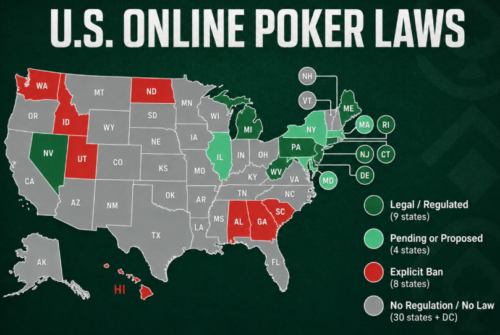
Sharing Player Pools Across State Lines
In order to protect players in jurisdictions where online gaming is regulated, licensed operators were previously limited to seating only players that resided in the same state. As a result of having smaller player bases, many small markets had trouble filling their tables.
To solve this problem, the Multi-State Internet Gaming Agreement (MSIGA) was established. In 2014, Nevada and Delaware became the first two states to sign the MSIGA. By signing into the MSIGA in 2017, New Jersey allowed its residents to compete against residents of both Nevada and Delaware. When Michigan joined the MSIGA in 2022, then when West Virginia also joined in 2023; and then when Pennsylvania joined the MSIGA in April of 2025, that addition became the largest of any member since the creation of the MSIGA.
Prior to connecting their games across state lines, operators must obtain licensure in each market individually. Players will experience increased field sizes for tournaments, fuller tables in cash games, and increased traffic during off-peak hours; all of which will occur in a licensed environment.
Where To Find Current Regulations And Licenses Of Operators
Operator and regulation details are subject to change over time. Marketing materials do not make good references for determining if a gaming operator is legally operating. The Division of Gaming Enforcement maintains a list of approved websites offering online gaming for patrons residing in New Jersey.
If you are considering whether your past participation in gaming has caused problems, New Jersey provides confidential assistance via the 1-800-GAMBLER hotline. This service is available around-the-clock.






Ridgewood Blog moderating out comments it’s editorial position disagrees with. Shame. You just lost a reader.