
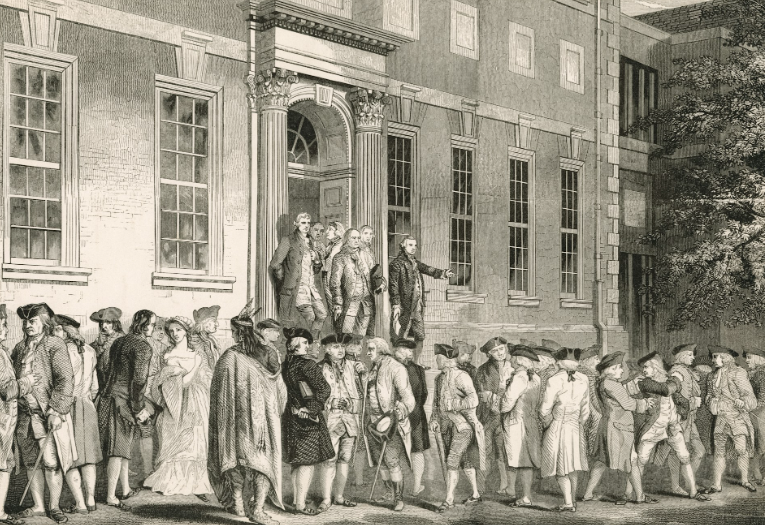
When most people picture the Founding Fathers, they think of powdered wigs, dramatic paintings, and serious-looking men staring out from old history books. Somehow, over time, these figures became less like actual people and more like permanent American symbols.
Today, their faces appear everywhere, on currency, monuments, souvenirs, and even patriotic fashion like a classic Navy hat. However, what’s often forgotten is that the Founding Fathers didn’t simply vanish after the Revolutionary War ended. This guide explores what happened to them after they made their mark on American history.
George Washington: The Reluctant President
After leading the Continental Army through years of war, George Washington wanted nothing more than to return home to Mount Vernon and live quietly as a farmer. In 1789, Washington became the first President of the United States, setting the tone for nearly everything that followed, when he voluntarily stepped down after two terms.
Washington’s decision to walk away helped establish the peaceful transfer of power Americans still value today. Washington died in 1799 after a sudden illness, leaving behind a legacy so massive that Americans still call him the “Father of His Country.”
Thomas Jefferson: Brilliant, Contradictory, and Complicated
Thomas Jefferson wrote some of the most famous words in American history when he drafted the Declaration of Independence. However, his life after the Revolution proved far more complicated than the inspiring phrases he penned in 1776.
Jefferson became the nation’s third president and oversaw the Louisiana Purchase, which dramatically expanded the size of the United States. He was also fascinated by science, architecture, books, and invention.
At the same time, his legacy remains controversial because he enslaved hundreds of people while publicly promoting ideals of liberty and equality. In one of history’s strangest coincidences, Jefferson died on July 4, 1826, exactly fifty years after the Declaration of Independence was adopted.
John Adams: America’s Most Stubborn Patriot
John Adams passionately supported independence long before it became popular, and he played a major role in pushing the colonies toward revolution. His presidency, however, was difficult and divisive.
Adams faced intense criticism and bitter political fights, especially with Thomas Jefferson. Ironically, the two former rivals later repaired their friendship through years of thoughtful letter-writing.
Adams died on the very same day as Jefferson on July 4, 1826. According to legend, Adams’ final words were, “Thomas Jefferson survives,” unaware that Jefferson had actually died hours earlier.
Benjamin Franklin: America’s Ultimate Multi-Tasker
Before America was even a country, Benjamin Franklin had already built a reputation as a writer, inventor, scientist, printer, and diplomat. Honestly, the man seemed incapable of sitting still.
During the Revolutionary War, Franklin played a crucial role in convincing France to support the American colonies. That alliance turned out to be one of the biggest reasons the United States won the war in the first place.
Even in his old age, Franklin kept working on political issues and public projects. He helped shape the Constitution and continued writing almost until the end of his life in 1790.
Alexander Hamilton: The Founding Father With a Hollywood Ending
Born in the Caribbean and raised in poverty, Alexander Hamilton climbed his way into the center of American politics through intelligence, ambition, and sheer determination.
After the Revolution, Hamilton became George Washington’s trusted advisor and eventually the country’s first Secretary of the Treasury. He helped create America’s financial system, established the national bank, and pushed for a strong federal government.
But Hamilton also had a talent for making enemies. His rivalry with politician Aaron Burr eventually exploded into one of the most famous duels in American history. In 1804, the two men met in Weehawken, New Jersey. Burr shot Hamilton, who died the following day.
The shocking duel instantly became part of American folklore. More than two centuries later, Hamilton’s dramatic rise and tragic ending still fascinate historians, writers, and Broadway audiences alike.
James Madison and James Monroe: The Nation Builders
Often called the “Father of the Constitution,” James Madison helped draft the framework of the American government. As president, Madison faced one of the country’s earliest major challenges during the War of 1812 against Britain. While the war was difficult, it strengthened America’s sense of independence and national identity.
Then came James Monroe, whose presidency became known as the “Era of Good Feelings.” Monroe focused on stability and expansion, and his Monroe Doctrine warned European countries against interfering in the Americas.
More Than Just Names in History Books
The Founding Fathers didn’t simply disappear after the American Revolution ended. Some became presidents, some became political rivals, and some spent the rest of their lives trying to shape the future of a country that was still finding its identity.
Over time, the Founding Fathers transformed into larger-than-life symbols of American history, but their real stories are far more entertaining than the polished legends. Behind the portraits and statues were complicated people living through chaotic, uncertain times, and somehow changing the world in the process.
Featured Image: The Miriam and Ira D. Wallach Division of Art, Prints and Photographs: Print Collection, The New York Public Library. “John Nixon reading the Declaration of Independence to the people in front of the State House immediately after its passage.” The New York Public Library Digital Collections. https://digitalcollections.nypl.org/items/510d47db-b097-a3d9-e040-e00a18064a99






Currently, they are all turning over in their graves.