
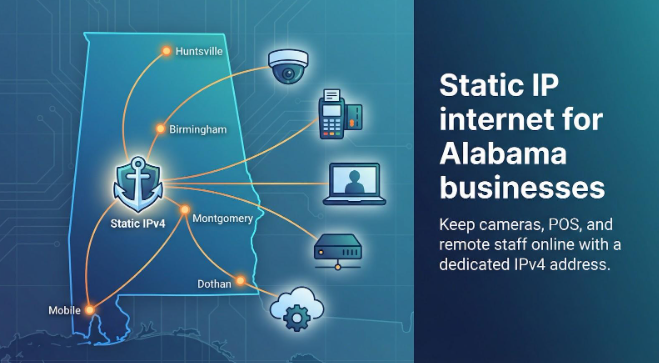
Running security cameras, keeping a point-of-sale system online, letting remote staff log in—everything breaks the moment your public IP changes. Across Alabama, from Huntsville start-ups to Dothan retailers, more companies now demand a plan with a fixed, public IP.
Search results still push generic residential lists, wasting hours of tab-hopping.
This guide ends the guesswork. In the next few minutes you’ll see which Alabama providers offer a true static IPv4 to small and midsize businesses, what it costs, how reliable each line is, and where service is available—including 2026 build-out news you might have missed.
Static IP vs. dynamic IP: why it matters
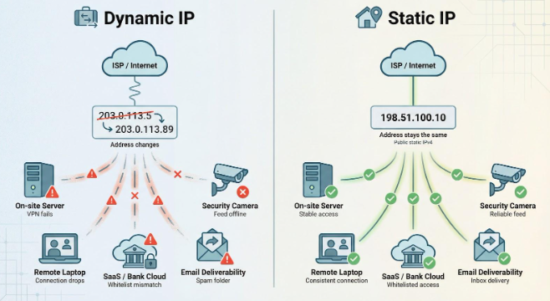
Every internet connection has an address. Most residential lines get a dynamic address that changes whenever the modem reconnects. Your router never notices, but any service that expects to see you at the same address breaks the moment it switches.
A static IP does the opposite. The number stays put, so remote users, firewalls, and cloud tools always know where to find you. Picture it as the business equivalent of a permanent street address instead of working out of rotating hotel rooms.
Here are the three benefits you’ll feel every day:
- Reliable inbound access. Employees can reach an on-site server, security camera, or PLC without updating VPN or ACL rules each week.
- Cleaner integrations. Many SaaS platforms and banks whitelist source IPs to block fraud. Traffic from a moving target stalls the connection.
- Email and domain reputation. Mail sent from a dynamic address often lands in spam. A static IP builds a steady reputation score.
Dynamic IPs are fine for browsing, but once you host or secure anything, the headaches appear: overnight address swaps, broken port-forwards, support calls from staff who can’t log in.
What about IPv6? Many business circuits hand out a large IPv6 prefix that rarely changes, and modern apps love that supply of addresses. The snag is compatibility: cameras, payment terminals, and legacy VPN clients still rely on IPv4. Until every partner and device speaks IPv6 fluently, a static IPv4 remains the simplest way to keep critical services online.
That’s why the rest of this guide focuses on Alabama providers that give you a true public static IPv4, with no dynamic DNS patches. In the next section we’ll show you how we compared them so you can pick the right plan for your storefront, clinic, or remote job site.
How we compared Alabama’s options
Clear rules beat guesswork. We began by mapping every wired or fixed-wireless provider that sells a static IPv4 address to small businesses in Alabama. Residential-only lines, satellite plans behind carrier-grade NAT, and enterprise circuits priced like a new truck all failed the first cut.
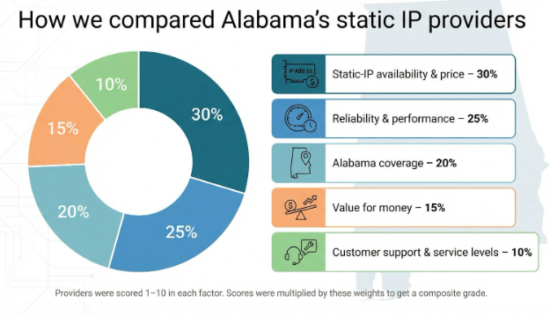
With the long list in hand, we scored each candidate on five factors that matter every day when you manage a business network. We assigned weights based on real-world impact, then used a 1-to-10 scale for each factor:
- Static-IP availability and price (30 percent) – Does the provider include a dedicated IP or at least keep the fee reasonable?
- Reliability and performance (25 percent) – Fiber with service guarantees outranks best-effort cable. We checked published SLAs, tech type, and user-reported uptime.
- Alabama coverage (20 percent) – A perfect plan is useless if you can’t order it. We cross-checked FCC data and recent build-out news to gauge footprint.
- Value for money (15 percent) – We divided promo pricing by advertised speed, noted contract terms, and flagged hidden data caps.
- Customer support and service levels (10 percent) – 24/7 business lines, same-day truck rolls, and credit-back SLAs earned bonus points.
Multiplying each score by its weight produced a composite grade. The math is simple enough to repeat on a napkin, yet it highlights meaningful differences, like paying $5.95 a month for Mediacom’s static IP versus buying a full /29 block from AT&T.
We then sanity-checked the numbers with human feedback: user forums, BBB complaints, and Reddit threads from Alabama owners. Data tells one story; lived experience shows whether the router stays online during a thunderstorm.
Five providers rose to the top: AT&T Business, WOW! Business, Spectrum Business, C Spire Business, and Mediacom Business. Starting with WOW! in the next section, we’ll walk through each one so you can see how the scores translate to practical strengths and trade-offs.
WOW! Business: affordable static IP with local fiber momentum
WOW! flies under the radar, but its Alabama footprint keeps growing, thanks to fresh grant-backed fiber builds in Dothan, Headland, and nearby towns. That local investment brings symmetrical gig speeds to areas that once juggled cable uploads of 20 Mbps.
Pricing stays equally down to earth. Entry cable tiers start near $50 for 300 Mbps, and adding a dedicated IPv4 address is painless: just $14.99 a month for a single static IP, ordered like any other line item on your bill. That small fee secures a fixed endpoint for self-hosted email, VPN, and camera feeds—the same use cases highlighted in WOW!’s business static IP service guide.
Setup is straightforward. The installer provisions your modem, hands over the static block, and you drop it into your firewall. Need more addresses? Move up to a /29 block when you’re ready. IPv6 is available on request, so you can dual-stack without extra fees.
Performance depends on which side of WOW!’s network you land. New fiber zones deliver symmetrical uploads and a 99 percent-plus uptime track record. Legacy coax markets still top out at 50 Mbps upstream and share bandwidth with the neighborhood, so time-sensitive workloads should budget for a 4G failover (WOW! sells one for about $45 monthly).
Customer support feels personal. Businesses get a dedicated line to Birmingham-based reps who can dispatch local techs the same day. No formal SLA exists on cable, yet most small offices find the responsiveness good enough at this price point.
Choose WOW! if you operate inside its patchwork footprint and want the lowest total cost for a fixed IP without signing a multi-year contract. It’s an easy win for retail shops, remote-access camera systems, and pop-up offices that value simplicity over five-nine guarantees.
AT&T Business: statewide reach and fiber reliability
Ask ten Alabama IT managers who connects their branch offices and seven will say AT&T. The former BellSouth footprint means copper, fiber, and fixed-wireless gear already hang on most utility poles, from Birmingham lofts to rural feed stores along Highway 84.

That reach powers AT&T Business Fiber. Symmetrical speeds start at 500 Mbps and climb to 5 Gbps, and you pay month to month unless you pick a promotional bundle. Plans at 1 Gbps or higher ship with a built-in wireless backup gateway, so a crew that cuts the fiber splice causes an inconvenience, not a crisis.
Static IPs aren’t bundled. You buy a block, typically five usable IPv4 addresses, for a modest monthly fee added to any Business Fiber tier. Paying for more than one IP feels wasteful if you only need one, yet the cost per address beats many cable rivals once you spread it across five servers or VPN endpoints.
Performance earns high marks. Fiber’s low latency keeps VoIP crisp, and AT&T’s backbone redundancy shows during storm season; customers report only minutes of downtime each year. If you need contractual guarantees, the Dedicated Internet product adds a 99.95 percent SLA, though pricing rises accordingly.
Support is another quiet strength. A 24/7 NOC in Atlanta monitors circuits and schedules truck rolls faster than consumer lines. Pair that with the self-install app for gateway swaps, and most businesses fix issues before staff notice.
Choose AT&T when coverage is non-negotiable, you want fiber’s upload muscle, and you like the safety net of automatic 5G failover. The static-IP surcharge is real, but so is the peace of mind that your clinic or multi-site franchise can get the same service anywhere in the state.
Spectrum Business: no-contract gig speeds for metro offices
Walk into most Alabama downtowns, such as Montgomery, Tuscaloosa, or Decatur, and you’ll likely find the coax tap on the wall belongs to Spectrum. That reach gives city-center businesses an easy path to half-gig or gigabit downloads without trenching new fiber.
Plans stay simple: 500 Mbps or 1 Gbps, both contract-free. Pricing hovers around the mid-sixties for 500 Mbps and just under one-fifteen for gigabit in year one, then rises unless you renegotiate. Every tier includes a free modem and, crucially, unlimited data, so nightly cloud backups never trigger surprise overages (highspeedinternet.com/business/spectrum).
Need a fixed IP? Spectrum adds a static IPv4 to any plan for $14.99 a month. The address travels through the provider’s managed gateway, so you plug your firewall into their modem and assign the IP—no complex BGP or VLAN gymnastics needed. Larger /29 blocks are available if you run multiple servers.
Uploads sit at 35 Mbps on coax. For most SMB VPNs and VoIP trunks that’s fine, yet heavy upstream work, such as architects pushing 4K renders to clients, can hit the ceiling quickly. Spectrum is testing mid-split upgrades to raise upstream capacity, but Alabama rollouts lag behind pilot markets.
Reliability lands in the respectable middle. Cable is a shared medium, so evening congestion can shave speed. Still, Spectrum’s business tier promises same-day truck rolls and a money-back guarantee, perks you rarely see on residential lines. Many owners keep a cellular hotspot in the drawer for true failover, but everyday uptime sits north of 99 percent.
If you rent space in a Spectrum city and dread contracts, the mix of fast installs, unlimited data, and a straightforward static-IP add-on makes this provider a stress-free choice. Just budget for limited uploads, or plan a fiber upgrade later when those render files start to pile up.
C Spire Business: premium fiber and an SLA you can bank on
C Spire doesn’t wire every block, but where its orange conduit surfaces in downtown Mobile, Troy business parks, or select Birmingham corridors, the service feels different.
Connections are pure fiber from core to premise. Gigabit symmetrical speed is the entry point, not the upgrade. C Spire backs each circuit with a 99.99 percent uptime guarantee and credits your bill if they miss it. That pledge spares headaches for hospitals, finance firms, or any operation that can’t afford an afternoon outage.
Static addressing is an easy add-on. A single public IPv4 address costs $10.00 per month, and a five-IP block runs $35. Just give the tech your router’s MAC and know your IP will never drift.
Support feels boutique. Alabama customers call a regional NOC staffed by engineers who live in the same area code. If a backhoe cuts fiber, you receive proactive texts, an estimated-repair time, and, if needed, a temporary wireless drop until splicing finishes. Larger accounts even get a named manager who checks usage trends before renewal.
The trade-off is price and reach. Quotes hover around $300 for a gig, and fiber construction can take 30 to 60 days if your building is dark. When downtime equals lost revenue or fines, many CFOs treat that premium as cheap insurance.
Choose C Spire when your address falls inside its limited footprint and uptime is mission critical. You’ll pay more than coax, yet you gain a low-cost static IP, near-perfect reliability, and local engineers who pick up by the second ring.
Mediacom Business: static IP on a shoestring for rural towns
Drive east toward Eufaula or south past Enterprise and you soon leave the big fiber footprints behind. In many smaller Alabama markets, the only pipe thicker than a phone line is Mediacom’s hybrid-fiber-coax. Performance can swing with network load, yet one feature keeps cash-strapped owners loyal: the static IP costs $5.95 a month for a single address, with five usable IPs only $19.95 (mediacombusiness.com/frequent-questions).
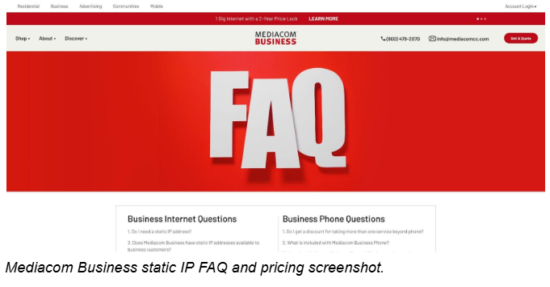
Mediacom Business static IP FAQ and pricing screenshot.
No other statewide provider matches that price. If you need stable camera feeds, a whitelisted payroll connection, or a remote desktop that never loses its bookmark, the bargain is compelling.
Download speeds reach 1 Gbps, though uploads top out around 50 Mbps. Most plans require a one-year term, but install fees stay low and Mediacom often waives them during promotions. The company MAC-binds your static IP to the modem, then steps back; configuring the firewall is on you, so keep an IT pro on standby.
Here’s the trade-off. User forums overflow with outage complaints and sluggish evening speeds. There’s no formal uptime SLA, and customer support hands off to an after-hours call center once the local office closes. Smart businesses pair the circuit with a wireless failover or schedule big uploads after hours.
Still, when options are limited, Mediacom’s low-cost static IP can turn a mediocre connection into a workable backbone for light-duty hosting. If your storefront or municipal office sits in its cable footprint and the budget is tight, this may be the stepping-stone you need until fiber money reaches the county budget.
Side-by-side at a glance
You’ve met our five contenders. Before we tackle the FAQs, let’s line them up so you can spot the key differences in one sweep.
| Provider | Static-IP cost | Connection type | Typical plan (down / up) | Notable extras | Footprint |
| WOW! Business | $14.99 per IP | Cable & fiber | 300 / 20 Mbps cable, 1 Gbps symmetrical fiber | LTE failover add-on, month-to-month options | Pockets of Huntsville, Auburn, southeast Alabama |
| AT&T Business | Block of 5 for about $20 | Fiber, DSL, fixed wireless | 1 Gbps / 1 Gbps fiber | Built-in 5G backup on 1 Gbps+, statewide support line | Statewide metro fiber plus rural DSL |
| Spectrum Business | $14.99 for 1 IP | Cable (HFC) | 500 / 35 Mbps cable | No contract, same-day truck rolls | Most cities and suburbs |
| C Spire Business | $10.00 for 1 IP | Fiber | 1 Gbps / 1 Gbps fiber | 99.99 percent SLA, local NOC | Select zones in Mobile, Troy, Birmingham |
| Mediacom Business | $5.95 for 1 IP | Cable (HFC) | 1 Gbps / 50 Mbps cable | Lowest static-IP fee, quick install | Small towns in east & south Alabama |
Numbers are current as of early 2026; promotional pricing varies by street address. Still, a pattern emerges.
If cost per IP rules your budget, Mediacom leads the pack. When upload speed or uptime matters most, fiber providers AT&T and C Spire take the edge. Spectrum sits in the middle with easy installs and no contracts, while WOW! stands out as the value wild card, thanks to its low static-IP fee and fresh fiber in new routes.
Use the table as a quick filter, then return to the deeper provider sections above when you’re ready to request quotes.
Key takeaways: match the line to your bottom line
Start with geography. If your address sits inside C Spire’s or AT&T’s fiber ring, symmetrical uploads and formal uptime guarantees are within reach. Everywhere else, cable rules, and Spectrum’s contract-free plans usually install the fastest.
Next, price the static IP. Mediacom’s $5.95 fee sounds tempting, but the savings disappear if an outage locks customers out of your POS for half a day. WOW!’s $14.99 middle ground balances cost and reliability in the towns it serves.
Consider upload needs. Hosting off-site backups, cloud CAD files, or live camera feeds? Fiber’s equal upload speed pays dividends. For lighter tasks such as remote desktop or credit-card terminals, Spectrum’s or WOW!’s 35–50 Mbps upstream works fine.
Think about business risk. A brewery can handle a two-hour drop during the afternoon lull; a medical clinic can’t. If downtime means fines or safety issues, lean toward providers with written SLAs or built-in wireless failover.
Finally, plan for growth. Ask how many additional static IPs you can add later and whether the provider offers IPv6 prefixes. Switching carriers is harder than upsizing a block of addresses.
Use these checkpoints as a quick litmus test. After a five-minute call with sales you’ll know which of the five fits your street, budget, and tolerance for risk. From there, ordering the static IP is just paperwork.





