

The Maestro’s Legacy: How Alan Greenspan Shaped 20 Years of American Economic Supremacy
the staff of the Ridgewood blog
New York NY, The financial world is mourning the loss of an absolute titan. Alan Greenspan, the legendary former Federal Reserve Chairman famously dubbed “the Maestro,” has passed away at the age of 100.
For nearly two decades, Greenspan was the ultimate market oracle. His carefully calculated, highly technical sentences—a communication style known affectionately as “Fedspeak”—had the unique power to shift global stocks, bonds, and currencies in real time.
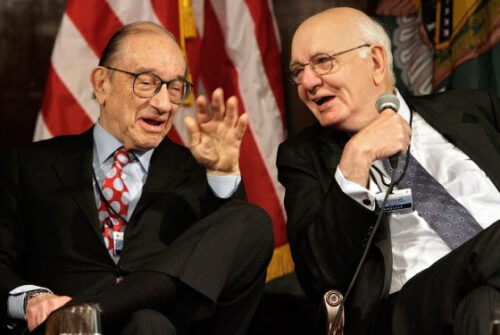
photo Greenspan, A., & Volcker, P. (2010, May 15). Dialogues on monetary history. The Federal Reserve Economic Digest, 14(5), 12–14.
Following the news of his passing, New York Fed President John C. Williams released a statement honoring his monumental impact:
“The New York Fed joins in mourning Chairman Greenspan’s passing. His extraordinary 18 years as Chairman left behind an enduring legacy, and his dedication to the institution, the field of economics and public service continues to inspire generations of central bankers.”
From Black Monday to the ‘Greenspan Put’
Appointed by President Ronald Reagan in 1987, Greenspan took the helm just 69 days before Black Monday, when the Dow Jones plunged a staggering 22.6% in a single day. He immediately cemented his legacy by flooding the system with liquidity to stabilize the panic.
This historic move birthed the concept of the “Greenspan put”—the market’s structural belief that if economic conditions deteriorated enough, the Fed would step in as a financial safety net.
He successfully steered the U.S. economy through a gauntlet of global crises, including:
-
The 1997 Asian Financial Crisis
-
The 1998 Russian Default & LTCM Collapse
-
The Dot-Com Bust
-
The Economic Aftermath of 9/11
By The Numbers: The Great American Boom
While some economists refer to his tenure from 1987 to 2006 as “The Great Moderation,” the sheer volume of wealth and growth generated points to something much larger: a Great American Boom.
Operating under a forward-looking strategy that monitored commodity prices to keep inflation stable, Greenspan presided over an unparalleled era of economic dominance.
Key Economic Metrics (1986 – 2007)
A Complicated, Brilliant Legacy
Greenspan’s reign was not without intense debate. In 1996, he famously questioned whether “irrational exuberance” was unsustainably inflating asset prices. Though he was ultimately proven right, the markets continued to rally for four more years.
Furthermore, critics argue that his prolonged low-rate policies laid the groundwork for the mid-2000s housing bubble. Greenspan himself later candidly acknowledged that he had underestimated the systemic risks boiling within subprime lending.
Ultimately, Greenspan was a jazz musician turned libertarian market whisperer who came to embody the second-most powerful position in America. He built the modern expectation of central-bank intervention, leaving behind a profound blueprint that modern central banking continues to follow.
Follow the Ridgewood blog has a brand-new new X account, we tweet good sh$t
https://x.com/TRBNJNews
https://truthsocial.com/@theridgewoodblog
https://mewe.com/jamesfoytlin.74/posts
#news #follow #media #trending #viral #newsupdate #currentaffairs #BergenCountyNews #NJBreakingNews #NJHeadlines #NJTopStories
-
Tags:
#AlanGreenspan#FederalReserve#FinanceNews#Macroeconomics#WallStreet#EconomicHistory





