
Redistricting Wars: How the GOP Gained up to 8 House Seats Through New Congressional Maps
the staff of the Ridgewood blog
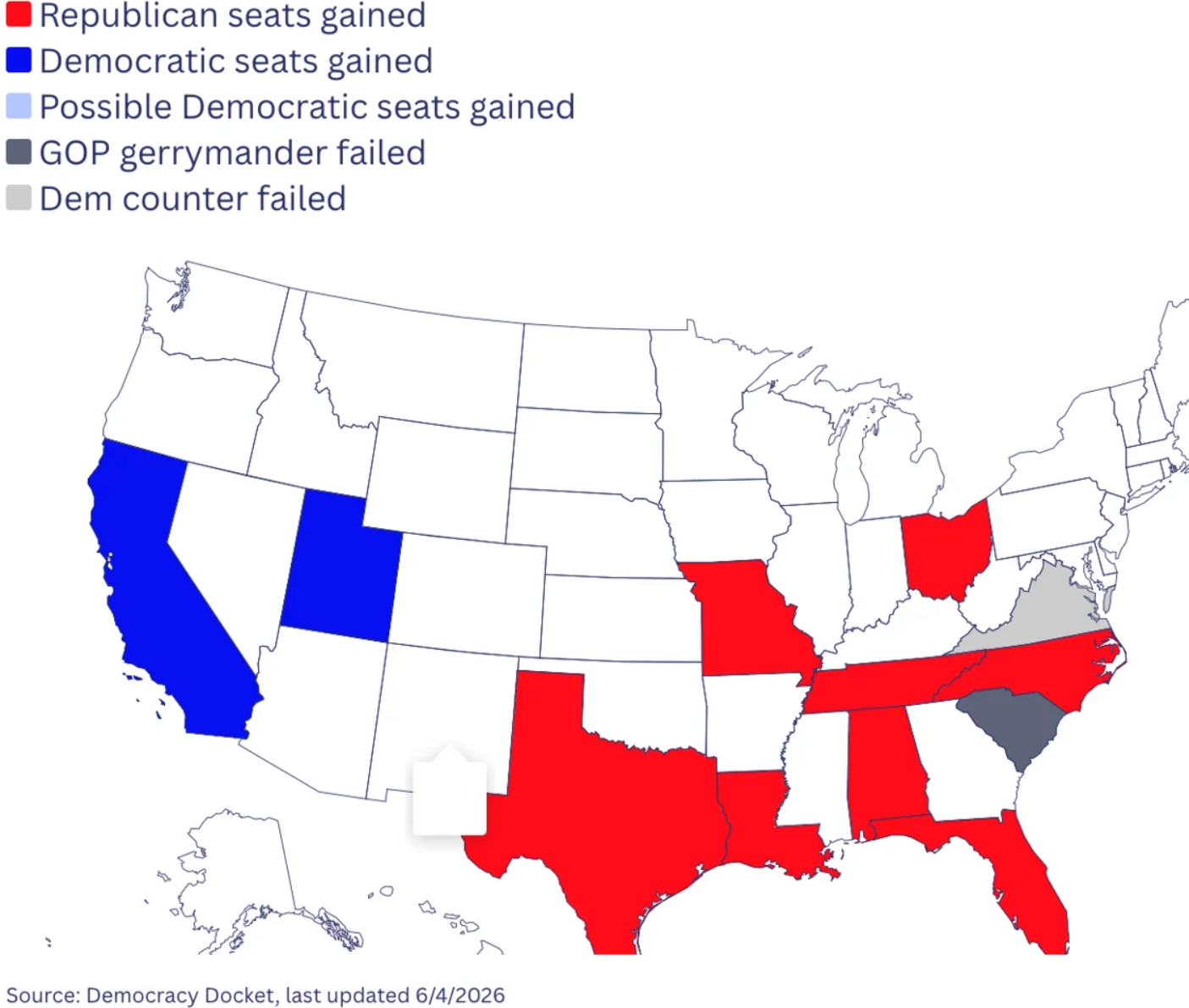
Trenton NJ, The battle lines for control of the U.S. House of Representatives have been redrawn, and recent data suggests a significant shift in the balance of power. While mid-decade redistricting and gerrymandering remain highly controversial tactics utilized by both major political parties, recent outcomes reveal that Republicans have executed their map-drawing strategies with notably higher efficiency in red states compared to Democratic efforts in blue states.
According to a recent analysis by the progressive tracking organization Democracy Project, these strategic boundary shifts have yielded clear structural advantages.
Breakdown of Projected Seat Changes by State
The data highlights a asymmetric map-making outcome across several key states, with net adjustments favoring the Republican column ahead of the upcoming November elections.
🔴 Republican Map Gains (Up to 14 Seats Potential)
-
Texas: +5 seats
-
Florida: +4 seats
-
Missouri: +1 seat
-
North Carolina: +1 seat
-
Tennessee: +1 seat
-
Louisiana: +1 seat
-
Alabama: +1 seat
🔵 Democratic Map Gains (Up to 6 Seats Potential)
-
California: +5 seats
-
Utah: +1 seat
Net Structural Impact: These shifts combine for a potential net gain of up to eight seats for the GOP. While this narrows the path for a decisive shift in leadership, current political betting markets still position Democrats as greater than 2-to-1 favorites to secure a House majority this November.
The Diversity Debate in Modern Redistricting
The structural adjustments have sparked intense debate regarding racial representation and incumbent protection. Critics frequently argue that revised maps intentionally dilute minority-heavy districts or target long-standing minority incumbents. However, proponents argue that the real-world outcomes of these new boundaries often complicate simple narratives about race and party alignment.
A prominent example of this dynamic is unfolding in Tennessee’s 9th Congressional District in Memphis:
-
The Background: The district has a 62% African-American demographic profile but has been represented for the past 20 years by Steve Cohen, a white Democrat.
-
The Shift: With Representative Cohen retiring, the newly adjusted district boundaries lean Republican.
-
The Successor: The leading GOP candidate positioned to win the seat is Charlotte Bergmann, a black Republican activist and former FedEx manager.
As congressional maps face continued legal challenges and political scrutiny, cases like Memphis highlight how modern redistricting can simultaneously shift partisan leanings while introducing new dynamics to demographic representation on Capitol Hill.
Follow the Ridgewood blog has a brand-new new X account, we tweet good sh$t
https://x.com/TRBNJNews
https://truthsocial.com/@theridgewoodblog
https://mewe.com/jamesfoytlin.74/posts
#news #follow #media #trending #viral #newsupdate #currentaffairs #BergenCountyNews #NJBreakingNews #NJHeadlines #NJTopStories
-
Tags:
#Redistricting#HouseElections#GOP#USPolitics#Gerrymandering#Election2026






democrats did this in NJ in order to get rid of scott garrett and install rebecca before she miraculously won the gov seat