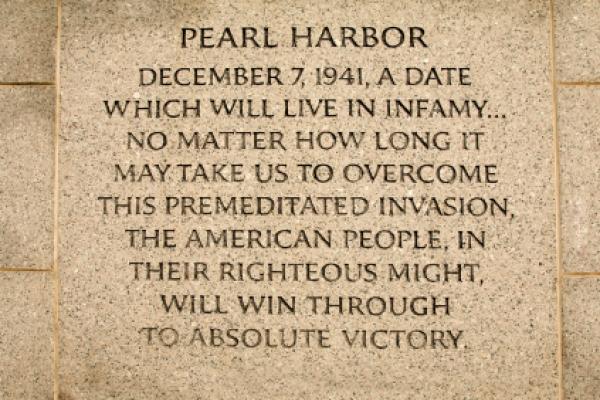
The Ridgewood blog wishes to commemorate the attack on Peal Harbor , on December 7, 1941 Japan’s attack on Pearl Harbor and six other military bases on the Hawaiian island of Oahu precipitated America’s entry into World War II.
Pearl Harbor endures as a symbol of American resilience and resolve, and the annual commemoration of the attack on Pearl Harbor fosters reflection, remembrance, and understanding.
This year is the 75th anniversary of the attack on Pearl Harbor and is an opportunity to honor the sacrifice and dedication of our “Greatest Generation” both civilian and military.
December 7, 1941, the “date which will live in infamy.” It would thrust America into World War II, changing Hawaii and America forever .The events of that date triggered our resolve as a nation, our can-do attitude and resourcefulness and an unmatched commitment to the defense of freedom.
From the Library of Congress :
On December 7, 1941, Japanese planes attacked the United States Naval Base at Pearl Harbor External, Hawaii Territory, killing more than 2,300 Americans. The U.S.S. Arizona was completely destroyed and the U.S.S. Oklahoma capsized. A total of twelve ships sank or were beached in the attack and nine additional vessels were damaged. More than 160 aircraft were destroyed and more than 150 others damaged.
A hurried dispatch from the ranking United States naval officer in Pearl Harbor, Admiral Husband Edward Kimmel, Commander in Chief of the United States Pacific Fleet, to all major navy commands and fleet units provided the first official word of the attack at the ill-prepared Pearl Harbor base. It said simply: AIR RAID ON PEARL HARBOR X THIS IS NOT DRILL.
The following day, in an address to a joint session of Congress, President Franklin Roosevelt called December 7, 1941 “a date which will live in infamy.” Congress then declared War on Japan, abandoning the nation’s isolationism policy and ushering the United States into World War II. Within days, Japan’s allies, Germany and Italy, declared war on the United States, and the country began a rapid transition to a wartime economy by building up armaments in support of military campaigns in the Pacific, North Africa, and Europe.
Independence Day, or the Fourth of July, celebrates the adoption by the Continental Congress of the Declaration of Independence on July 4, 1776. On the 236th birthday of the United States, explore nine surprising facts about one of America’s most important founding documents
When reading the Declaration of Independence, it is easy to focus only on the sweeping language of the second paragraph and skip over the names and mutual pledge of the signers at its conclusion.
Though the principles enunciated in its opening paragraphs, such as the self-evident truth that all men are created equal, provide the moral and philosophical foundation on which the American regime rests, it is important to acknowledge that declaring principles alone secures nothing.
Principles need to be enforced by individuals who have the habits of character necessary to fight for them, and perhaps even die for them, if need be. In a time where talk of rights dominates our political discourse, a focus on duties is indispensable in order to teach citizens the responsibilities they owe toward each other and their posterity.
The signers’ mutual pledge to themselves to sacrifice their lives, fortunes, and sacred honor for the cause of independence shows that these men took seriously their duties to the people of the new nation.
A look at the historical record will show this to be beyond dispute.
Of the 56 men who signed the declaration, 12 fought in battles as members of state militias, five were captured and imprisoned during the Revolutionary War, 17 lost property as a result of British raids, and five lost their fortunes in helping fund the Continental Army and state militias battle the redcoats.
Below we will explore the sacrifices the signers made on behalf of the American cause.
Thomas Heyward Jr., Edward Rutledge, and Arthur Middleton
Thomas Heyward Jr. of South Carolina was a signer of both the declaration and the Articles of Confederation. Heyward drew the ire of the British when, as a circuit court judge, he presided over the trial of several loyalists who were found guilty of treason. The prisoners were summarily executed in full view of British troops. In 1779, he joined the South Carolina militia as a captain of artillery.
Heyward’s compatriot in the South Carolina delegation, Edward Rutledge, also served in the state militia. At age 26, Rutledge was the youngest signer of the Declaration of Independence. After returning home from attending the Second Continental Congress in 1777, he joined the militia as captain of an artillery battalion.
Both Heyward and Rutledge aided their country in the battle at Port Royal Island, where they helped Gen. Moultrie defeat British Maj. William Gardiner and his troops.
Arthur Middleton, the last of the South Carolina delegation who served in the militia, took up arms against the British during the siege of Charleston in 1780. His fellow signers, Heyward and Rutledge, fought in that battle as well.
Upon the surrender of Charleston, all three men were captured by the British and were sent to a prison in St. Augustine, Florida, which was reserved for people the British thought were particularly dangerous. They were held there for almost a year before being released. On route to Philadelphia for a prisoner exchange in July 1781, Heyward almost drowned. He survived his fall overboard by clinging to the ship’s rudder until he could be rescued.
During the British occupation of Charleston, Commandant Nisbet Balfour ordered the seizure of many estates in Charleston, including those owned by Heyward and Middleton.
During his imprisonment, Heyward’s wife died at home, and his estate and property were heavily damaged. Rutledge’s estate was left intact, but his family had to sell many of their belongings in order to make the trip to Philadelphia to reunite with him after his release. Middleton’s estate was left relatively untouched, but his collection of rare paintings was destroyed during the British occupation of his home.
Thomas Nelson Jr.
Thomas Nelson Jr. of the Commonwealth of Virginia was appointed to the position of brigadier general and commander-in-chief of the Virginia militia by Gov. Patrick Henry in August 1777. At that time it was thought that the British would be making a full scale invasion of the state. Nelson was able to muster only a few hundred men to defend Virginia, but the British instead decided to attack Philadelphia.
Nelson inherited a vast family fortune, much of which he used to support the American effort. He personally paid for the return journey home of 70 troops he had led to meet the British in Philadelphia during the summer of 1778. In the spring of 1780, Nelson signed his name to a loan for $2 million that was needed to purchase provisions for the French fleet that was coming to America’s aid in the war.
As then-governor of Virginia, during the Battle of Yorktown he ordered American troops to fire upon his mansion, which had been commandeered by Gen. Cornwallis and his men.
Richard Stockton
A member of the New Jersey delegation, Richard Stockton, had his estate commandeered by the British for use as a headquarters. As they left, British troops burned all his personal effects—including his library, private papers, furniture, and clothes.
Though Stockton was in hiding at the time, he ultimately did not escape capture; a traitor led the British to his position in November 1776. He was held captive in Amboy, New Jersey, and was then sent to New York City where he was imprisoned in a jail reserved for common criminals. Incensed by his treatment, Congress worked with British Gen. William Howe to obtain his release.
George Walton
Because of his small build and stature, George Walton was thought to be the youngest of the signers of the declaration (he was actually in his mid-30s). He hailed from Georgia and served as colonel in the first regiment of the state militia in 1778. During the siege of Savannah, a cannonball broke Walton’s leg, which led to his being captured. He was held captive for nine months and was released in the early fall of 1779 in a prisoner exchange for a British navy captain.
At the same time Walton was held prisoner, his wife Dorothy was captured by the British. She was imprisoned on an island in the West Indies and was eventually freed after a prisoner exchange. During the Waltons’ confinement, the British ransacked their home.
George Clymer
British troops destroyed the home of George Clymer of Pennsylvania in September 1777 when they captured Philadelphia. Though his home was outside of the city, it was right in the middle of the path of the British march. American loyalists pointed out to the British homes belonging to patriots, which of course included Clymer’s estate.
Clymer also contributed to the war monetarily. He converted his entire fortune into continental currency, a risky move considering the likelihood that the currency would be rendered worthless. He also told wealthy friends to contribute to the American cause.
Robert Morris
A delegate from Pennsylvania, Robert Morris helped insure Washington’s victory at Yorktown by using his own credit to obtain the supplies necessary to defeat the British. He spent more than $1 million (not adjusted for inflation) of his own money to accomplish this.
While serving as superintendent of finance of the United States, Morris regularly used his own financial resources to obtain much needed supplies. Using his own funds, for example, he purchased one thousand barrels of flour for Washington’s men in late spring of 1778.
Lewis Morris
Lewis Morris of New York served as a major general in the state militia. Morris devoted himself to recruiting men to serve in the militia and to help keep supplies up, which was a constant problem. For almost the entire length of the war, the British occupied his home, Morrisania, and used it as their headquarters. This forced Morris to live off of his close friends and associates until the war ended in 1783.
John Hancock
John Hancock of Massachusetts, the man with the largest signature on the declaration, served in the militia as major general in 1778. Hancock was put in command of approximately 6,000 men during the Rhode Island campaign. That campaign was ultimately unsuccessful because the French failed to carry out their end of the bargain.
Caesar Rodney
Caesar Rodney served in the Delaware militia as well, attaining the rank of brigadier general. Rodney famously road on horseback straight from Dover to Philadelphia to cast his vote in favor of declaring independence (the Delaware delegation was split). He was with his men in the field during the brutal winter of 1776, helped quash an uprising in Delaware (there were a large number of loyalists within the state), and helped in George Washington’s effort to defend Philadelphia from being taken by the British.
Carter Braxton
Carter Braxton of the Virginia delegation accumulated massive personal debts helping the American effort in the war. He loaned 10,000 pounds sterling to Congress, which was never repaid. He also spent much of his wealth outfitting American ships so that they could carry more cargo. Due to the British capturing some of his vessels and others being lost out on the high seas, he suffered great financial calamity. These accumulated losses left him bankrupt by war’s end.
Oliver Wolcott
A delegate from Connecticut, Oliver Wolcott served as captain and then major general in the state militia. In 1776, he was appointed to lead 14 regiments in defense of New York City. He also commanded thousands of men in the Battle of Saratoga. Wolcott worked tirelessly to recruit for the Connecticut militia, which, like the army in general, was sorely lacking in numbers within its ranks.
William Whipple
William Whipple of New Hampshire served as brigadier general in the state militia. He fought against Gen. Burgoyne at the battles of Stillwater and Saratoga (commonly pointed to as the turning point for Americans in the war) in 1777. The following year, Whipple participated in the retaking of Rhode Island.
Thomas McKean
Thomas McKean of Delaware served as colonel in the Delaware state militia. Once McKean was appointed to the office of President of Delaware in 1777, he was targeted by the British (the British captured John McKinley, the previous president). He had to move his family on five occasions because of raids by both the British and local Indian tribes.
Francis Lewis
Francis Lewis of New York signed the declaration on August 2, 1776. Although he was present when independence was declared a month earlier, the New York delegation did not get permission from the state’s legislature to sign the document. A few months after affixing his signature on the declaration, British troops destroyed the Long Island estate of Lewis. They took Lewis’ wife and put her in prison where she was tortured on a regular basis. Under the direction of George Washington, she was finally returned in a prisoner exchange two years later.
Benjamin Franklin
Known as the sage of Philadelphia, Benjamin Franklin of Pennsylvania was the oldest of the signers of the declaration. Prior to setting sail for France in late 1776 to ask the French for assistance in the war, Franklin gave his entire fortune to Congress to help fund the war.
John Hart
Hessian mercenaries plundered signer John Hart’s 400-acre farm outside of Hopewell, New Jersey. Prior to his farm being captured, Hart was forced to leave his family because of advancing British troops. During his absence, his wife died, and his children were sent to live with neighbors.
William Ellery
The estate of William Ellery of Delaware was burned down during the British occupation of Newport, Rhode Island. Ellery served in the Second Continental Congress until the British left Newport, which they held for three years. He returned home in order to salvage what was left of his property.
Joseph Hewes
With his fortunes built on trade, Joseph Hewes of North Carolina was a vigorous proponent of the decision of the First Continental Congress to cut off all imports and exports with the British. This of course had the effect of drying up his wealth. Interestingly, Hewes also renounced his Quaker religion in order to support the war.
James Smith
A delegate from Pennsylvania, James Smith served in the Pennsylvania militia as captain, colonel, and then as brigadier general. He was one of the first to raise men for the possibility of defending his home state, a duty he took up beginning as early as 1774.
Benjamin Harrison
Benjamin Harrison of Virginia, whose son and grandson both served as U.S. presidents, complained in a letter to Gov. William Livingston of New Jersey that his debts had accumulated substantially because of the “ravages” and “plunderings” of the British.
William Floyd
While William Floyd of New York served as a delegate in the Second Continental Congress, the British sacked his estate, forcing his family to flee. Though they made it safely to Connecticut, his family was left without a home for the duration of the war.
William Hooper
William Hooper of North Carolina outlasted British raiders who were looking to capture him and his family. In 1782, he and his family fled Wilmington after it fell to the British. Though much of his property was destroyed, he and his family were reunited at the conclusion of the war.
Lyman Hall
The British destroyed the home and plantation of Lyman Hall of Georgia. Luckily, his family escaped before the British arrived and moved up North to be with him.
Ridgewood NJ, Prior to the iron plow, plowing a new field was hard work. Due to friction, it could take three men and several animals to turn a furrow when the ground was hard.
On April 1, 1807, New Jersey native David Peacock was granted a patent for an iron plow. But three only years after his patent was granted, he was successfully sued by another New Jersey native – Charles Newbold of Burlington County.
It turned out that Newbold had received a patent for a cast-iron plow in June, 1797. And even though he won $1500, early American farmers mistrusted Newbold’s plow, saying it “poisoned the soil” and encouraged weeds. So it was Peacock’s iron plow that came into use – and farming had its first labor saving device!
To learn more about farm life in Ridgewood hundreds of years ago, and howfarmers, their wives and children lived off the land, harvested food, prepared meals and developed a prosperous economy in the 18th and 19th Century, come to the
Schoolhouse Museum’s new exhibit “Farm and Home” using artifacts from the 18th and 19th century.
Schoolhouse Museum’s new exhibit “Farm and Home” using artifacts from the The Museum is located at 650 E. Glen Ave., Ridgewood, NJ, and visiting hours are Thursdays and Saturdays; 1 to 3 p.m. and Sundays; 2 to 4 p.m.
Exploring Our Agrarian Roots with Artifacts from the 18th and 19th Centuries
“A unique opportunity to see what life in Ridgewood was like hundreds of years ago.”
Ridgewood NJ, On March 20, 2016, between 2PM and 4 PM, the Ridgewood Historical Society’s Schoolhouse Museum will debut its new Exhibit – “Farm and Home”.This exhibit will show how farmers, their wives and children lived off the land, cleared forests, harvested food, prepared meals and developed a prosperous economy in 18th and 19th Century Ridgewood.
Using objects donated to the Museum over many decades, this exhibit will display a wide variety of objects from this period, including Lenape implements, early Dutch artifacts, farm tools, home furnishings, textiles and quilts, early cookbooks, and kitchenware.
Open to the public, the Schoolhouse Museum is located at 650 E. Glen Ave., Ridgewood, NJ. Museum’s hours are Thursdays and Saturdays; 1 to 3 p.m. and Sundays; 2 to 4 p.m.
On January 15, 1967, the Green Bay Packers defeated the Kansas City Chiefs 35-10 to win the first Super Bowl. As the Carolina Panthers and Denver Broncos prepare to take the field for Super Bowl 50, read about 10 ways in which the hastily arranged first Super Bowl differed from today’s modern-day sporting spectacle.
In June 1966, the venerable National Football League (NFL) signed an agreement to merge with the upstart, seven-year-old American Football League (AFL) after the completion of the 1969 season. In the interim, the two rival leagues agreed to stage an annual season-ending contest between their respective champions. The first Super Bowl featured the Green Bay Packers, who had defeated the Dallas Cowboys to win the NFL title, against the Kansas City Chiefs, who had beaten the Buffalo Bills to capture the AFL crown. Legendary Packers coach Vince Lombardi, who had never so much as watched an AFL game on television, was wound extra tight leading up to the game. He felt pressure not only to win—but to win big. “We got to win by 21 points to prove that the National Football League is superior to the AFL,” Lombardi told his team, which were 13.5-point favorites. The Packers ultimately won by 25 points.
AFL principal founder and Kansas City Chiefs owner Lamar Hunt suggested that the new championship game be known as the “Super Bowl,” an idea inspired by the ultra-bouncy Super Ball toy from Wham-O—producers of the Frisbee and Hula Hoop—that was popular with his kids and millions of others across America in the 1960s. NFL Commissioner Pete Rozelle, however, thought the name too gimmicky and lacking the weight worthy of his league. He suggested calling the championship game the “Pro Bowl” or even “The Big One” before settling on the “AFL-NFL World Championship Game.” That was quite a mouthful, however, for fans, journalists and broadcasters who instead followed Hunt’s lead and referred to the game informally as the “Super Bowl.” Not until the championship game’s third edition did Rozelle agree to follow suit and officially refer to the game as the Super Bowl.
Rep. Scott Garrett , “Today we honor the memory and the legacy of Dr. Martin Luther King, Jr. His inspiring courage and commitment to what is right stands as a testament to the human spirit and its endless desire for freedom, equality, and fairness” and ” His tireless efforts to secure rights and freedom for all people in the United States are a testament to the power that a single individual can have in the course of history. May we all strive together to protect those same hard-won liberties today.”
The Baptist minister and activist was born in Atlanta on Jan. 15, 1929, and was assassinated on April 4, 1968. The third Monday in January was first celebrated as a national holiday in 1986.
10 Things You May Not Know About Martin Luther King Jr.
APRIL 4, 2013 By Christopher Klein
1. King’s birth name was Michael, not Martin.
The civil rights leader was born Michael King Jr. on January 15, 1929. In 1934, however, his father, a pastor at Atlanta’s Ebenezer Baptist Church, traveled to Germany and became inspired by the Protestant Reformation leader Martin Luther. As a result, King Sr. changed his own name as well as that of his 5-year-old son.
2. King entered college at the age of 15.
King was such a gifted student that he skipped grades nine and 12 before enrolling in 1944 at Morehouse College, the alma mater of his father and maternal grandfather. Although he was the son, grandson and great-grandson of Baptist ministers, King did not intend to follow the family vocation until Morehouse president Benjamin E. Mays, a noted theologian, convinced him otherwise. King was ordained before graduating college with a degree in sociology.
3. King received his doctorate in systematic theology.
After earning a divinity degree from Pennsylvania’s Crozer Theological Seminary, King attended graduate school at Boston University, where he received his Ph.D. degree in 1955. The title of his dissertation was “A Comparison of the Conceptions of God in the Thinking of Paul Tillich and Henry Nelson Wieman.”
4. King’s “I Have a Dream” speech was not his first at the Lincoln Memorial.
Six years before his iconic oration at the March on Washington, King was among the civil rights leaders who spoke in the shadow of the Great Emancipator during the Prayer Pilgrimage for Freedom on May 17, 1957. Before a crowd estimated at between 15,000 and 30,000, King delivered his first national address on the topic of voting rights. His speech, in which he urged America to “give us the ballot,” drew strong reviews and positioned him at the forefront of the civil rights leadership.
5. King was jailed 29 times.
According to the King Center, the civil rights leader went to jail nearly 30 times. He was arrested for acts of civil disobedience and on trumped-up charges, such as when he was jailed in Montgomery, Alabama, in 1956 for driving 30 miles per hour in a 25-mile-per-hour zone.
6. King narrowly escaped an assassination attempt a decade before his death.
On September 20, 1958, King was in Harlem signing copies of his new book, “Stride Toward Freedom,” in Blumstein’s department store when he was approached by Izola Ware Curry. The woman asked if he was Martin Luther King Jr. After he said yes, Curry said, “I’ve been looking for you for five years,” and she plunged a seven-inch letter opener into his chest. The tip of the blade came to rest alongside his aorta, and King underwent hours of delicate emergency surgery. Surgeons later told King that just one sneeze could have punctured the aorta and killed him. From his hospital bed where he convalesced for weeks, King issued a statement affirming his nonviolent principles and saying he felt no ill will toward his mentally ill attacker.
7. King’s last public speech foretold his death.
King had come to Memphis in April 1968 to support the strike of the city’s black garbage workers, and in a speech on the night before his assassination, he told an audience at Mason Temple Church: “Like anybody, I would like to live a long life. Longevity has its place. But I’m not concerned about that now … I’ve seen the Promised Land. I may not get there with you. But I want you to know tonight, that we, as a people, will get to the Promised Land. And I’m happy tonight. I’m not worried about anything. I’m not fearing any man. Mine eyes have seen the glory of the coming of the Lord.”
8. Members of King’s family did not believe James Earl Ray acted alone.
Ray, a career criminal, pled guilty to King’s assassination but later recanted. King’s son Dexter met publicly with Ray in 1997 and argued for the case to be reopened. King’s widow, Coretta, believed the Mafia and local, state and federal government agencies were deeply involved in the murder. She praised the result of a 1999 civil trial in which a Memphis jury decided the assassination was the result of a conspiracy and that Ray was set up to take the blame. A U.S. Department of Justice investigation released in 2000 reported no evidence of a conspiracy.
Friday on ABC’s “The View,” actor Kurt Russell explained his view on the reasoning for the Second Amendment, saying in part it was established by the Founding Fathers for certain protections of its people.
Russell said, “In reality, when we’re dealing with things like, terrorism, whatnot, we’re all going to have different opinions on how to do it. How to deal with it. Mine happens to be that, I think there’s a very strong reason the Founding Fathers had for the Second Amendment. And that is that no government ever hasn’t had to fight its own people, and its own people hasn’t had to fight its own government. We had our civil war. If that Second Amendment hadn’t have been there, those people wouldn’t have had the opportunity to do what they considered defending their life, their way, their style of living. So I agree with that. I think that’s an important part of our existence. It’s basically that simple.”
Co-host Joy Behar said, “I think people more object to the excesses of the Second Amendment. Not the Second Amendment. It’s the boom, boom, boom, boom, boom guns.
Heavy equipment is placed on the Princeton battlefield overnight in June 2015. Development temporarily halted by temporary restraining order.
From Princeton Battlefield Society.
It started out as the British versus the Continental forces, a war of attrition that has come down now to Princeton University’s Institute for Advanced Studies versus Assemblyman Reed Gusciora (D-15), or so it would seem to hear the assemblyman’s passion for preserving a parcel of land ascribed to the Battle of Princeton. Max Pizarro, PolitickerNJ Read more
Ridgewood NJ, Today we’re reflecting on that infamous day in 1941 at Pearl Harbor. More than 2,400 American lives lost, 1,000 U.S. military and civilians wounded, 21 ships of the U.S. Pacific Fleet were sunk or damaged, 188 U.S. aircraft destroyed and 159 U.S. aircraft damaged.
Today “A date which will live in infamy.” 74 years later, and we honor their sacrifice.
74 years ago America was attacked at Pearl Harbor and America’s greatest generation responded with a courage and resolve that the world had never seen before. Today we remember the attack on Pearl Harbor. December 7, 1941.
Submitted by Tyler Durden on 10/23/2015 21:50 -0400
Submitted by Brandon Smith via Alt-Market.com,
There are very few legitimate cultural divisions in the world. Most of them are arbitrarily created, not only by political and financial elites, but also by the useful idiots and mindless acolytes infesting the sullied halls of academia.
It is perhaps no mistake that cultural Marxists in the form of “social justice warriors”, PC busybodies and feminists tend to create artificial divisions between people and “classes” while attacking and homogenizing very real and natural divisions between individuals based on biological reality and inherent genetic and psychological ability. This is what cultural Marxists do: divide and conquer or homogenize and conquer, whatever the situation happens to call for.
They do this most commonly by designated arbitrary “victim status” to various classes, thus dividing them from each other based on how “oppressed” they supposedly are. The less statistically prominent a particular group is (less represented in a job field, media, education, population, etc.) in any western society based on their color, ethnicity, sexual orientation, gender, etc., generally the more victim group status is afforded to them by social justice gatekeepers. Whites and males (straight males) are of course far at the bottom of their list of people who have reason to complain and we are repeatedly targeted by SJW organizations and web mobs as purveyors of some absurd theory called “the patriarchy”.
Although cultural marxism does indeed target every individual and harm every individual in the long run, my list of personal solutions outlined in this article will be directed in large part at the categories of people most attacked by the social justice cult today.
I do not write often about PC cultism and social justice because the movement is only a symptom of a greater problem, namely the problem of collectivism. The only true and concrete social (group) division is the division between collectivists and individualists: between those who believe the individual should be subservient to the group mind and those who believe the group is meaningless without the individual mind.
I have already spoken on the root dangers and logical inconsistencies of the social justice cult in articles such as‘The Twisted Motives Behind Political Correctness’ and ‘The Future Costs Of Politically Correct Cultism.’
There are many intelligent commentators on the Web who have consistently demolished the PC mob with reason and logic, and I leave that battle to them. In this article I would like to continue my examination but with the goal of presenting some real and tangible solutions. And like most solutions to most problems, it is the individual who is required to draw the line in the sand and change the way he approaches the realm of cultural Marxism. It is not up to groups, organizations or governments.
First, let’s be clear, cultural Marxism has already done most of the damage it can possibly do to our way of life. And by damage, I mean the end of long-standing foundational pillars of society that provide stability and prosperity, including traditional marriage (not government-licensed marriage), family, gender “roles,” etc. (which cultural Marxists openly boast about tearing down).
In Western nations male suicide rates are way up. Women’s proclaimed levels of happiness and contentment are way down, despite the fact that they have had wage equality for decades (yes, the wage gap is a perpetually pontificated Lochness monster-sized myth that was debunked years ago by economists like Thomas Sowell), despite the fact that they have surpassed men in educational participation and despite the fact that they have total control over family planning.
Thinking about Halloween …. Join us for a cemetery walk …. See information below …
The Ridgewood Historical Society’s Halloween family event …
Nothing says Halloween
like a night time walk
in a Cemetery.
Join us for a lantern-lit stroll through Valleau Cemetery
where soldiers and civilians come to life and tell their tales.
Back at the museum the party continues with music,
Halloween stories, locally produced cider and donuts.
October 23rd
6:00- 7:30pm Rain or shine
Call (201) 447-3242 or email [email protected] to reserve your spot
Meet at Ridgewood Historical Society
Schoolhouse Museum
650 E Glen Ave, Ridgewood
This fun-filled evening is best suited for families with children ages 7-13.
With reservations:
$10 per adult/$5 per child or $20 per family.
At the door: $15 per adult/$5 per child or $25 per family.
All children must be accompanied by an adult.
PJ Blogger at Independence National Historical Park
On this date two-hundred and twenty-eight years ago, the delegates to the Constitutional Convention completed their arduous work and signed the document designed to restore liberty to the citizens of a new nation.
The American Republic was born out of a struggle against British tyranny and a monarchical system that our forefathers deemed incompatible with the rights of free men and women. Consistent with the principles espoused by the Spirit of ’76 and enshrined in the Declaration of Independence, the United States Constitution was not imposed on the people. It was humbly submitted to the people for their approval.
A great national debate followed. If the people were to judge the Constitution, they were expected to understand the Constitution. The Federalist Papers, a series of 85 essays written by Alexander Hamilton, John Jay, and James Madison, responded to Antifederalist critics by serving as an invaluable guide to the Constitution’s provisions. Their arguments proved decisive and, eventually, the requisite number of states ratified the Constitution. Education was integral to the Constitution’s ratification.
At a time when the globe was dominated by kingdoms and empires, a skeptical world believed that a republic devoted to the ancient cause of liberty would inevitably fail. But the test of time has proven the wisdom, effectiveness, and durability of our great charter.
It has guaranteed our natural rights and preserved our cherished liberties.
It has inspired foreign peoples shackled by tyranny to seek to replicate what the Americans have accomplished.
It has resisted the waves of totalitarian ideologies that claimed human liberty to be a relic of antiquity.
On Constitution Day, Americans follow in the footsteps of the Founders, not only by recommitting ourselves to the Constitution’s enlightened provisions, but also by accepting the duty to provide the education necessary for the survival of a free people.
I commend all those that take the opportunity this day provides to promote the American ideals of human liberty and renew our commitment to the preservation of the Constitution of the United States.
Scott Garrett is the U.S. Representative for New Jersey’s 5th congressional district
Observed on the first Monday in September, Labor Day pays tribute to the contributions and achievements of American workers. It was created by the labor movement in the late 19th century and became a federal holiday in 1894. Labor Day also symbolizes the end of summer for many Americans, and is celebrated with parties, parades and athletic events.
Labor Day, an annual celebration of workers and their achievements, originated during one of American labor history’s most dismal chapters. In the late 1800s, at the height of the Industrial Revolution in the United States, the average American worked 12-hour days and seven-day weeks in order to eke out a basic living. Despite restrictions in some states, children as young as 5 or 6 toiled in mills, factories and mines across the country, earning a fraction of their adult counterparts’ wages. People of all ages, particularly the very poor and recent immigrants, often faced extremely unsafe working conditions, with insufficient access to fresh air, sanitary facilities and breaks.
As manufacturing increasingly supplanted agriculture as the wellspring of American employment, labor unions, which had first appeared in the late 18th century, grew more prominent and vocal. They began organizing strikes and rallies to protest poor conditions and compel employers to renegotiate hours and pay. Many of these events turned violent during this period, including the infamous Haymarket Riot of 1886, in which several Chicago policemen and workers were killed. Others gave rise to longstanding traditions: On September 5, 1882, 10,000 workers took unpaid time off to march from City Hall to Union Square in New York City, holding the first Labor Day parade in U.S. history.
The idea of a “workingmen’s holiday,” celebrated on the first Monday in September, caught on in other industrial centers across the country, and many states passed legislation recognizing it.Congress would not legalize the holiday until 12 years later, when a watershed moment in American labor history brought workers’ rights squarely into the public’s view. On May 11, 1894, employees of the Pullman Palace Car Company in Chicago went on strike to protest wage cuts and the firing of union representatives.
On June 26, the American Railroad Union, led by Eugene V. Debs, called for a boycott of all Pullman railway cars, crippling railroad traffic nationwide. To break the strike, the federal government dispatched troops to Chicago, unleashing a wave of riots that resulted in the deaths of more than a dozen workers. In the wake of this massive unrest and in an attempt to repair ties with American workers, Congress passed an act making Labor Day a legal holiday in the District of Columbia and the territories.More than a century later, the true founder of Labor Day has yet to be identified.
Many credit Peter J. McGuire, cofounder of the American Federation of Labor, while others have suggested that Matthew Maguire, a secretary of the Central Labor Union, first proposed the holiday.Labor Day is still celebrated in cities and towns across the United States with parades, picnics, barbecues, fireworks displays and other public gatherings. For many Americans, particularly children and young adults, it represents the end of the summer and the start of the back-to-school season.
Labor Day, the first Monday in September, is a creation of the labor movement and is dedicated to the social and economic achievements of American workers. It constitutes a yearly national tribute to the contributions workers have made to the strength, prosperity, and well-being of our country.
LABOR DAY LEGISLATION
Through the years the nation gave increasing emphasis to Labor Day. The first governmental recognition came through municipal ordinances passed during 1885 and 1886. From these, a movement developed to secure state legislation. The first state bill was introduced into the New York legislature, but the first to become law was passed by Oregon on February 21, 1887. During the year four more states — Colorado, Massachusetts, New Jersey, and New York — created the Labor Day holiday by legislative enactment. By the end of the decade Connecticut, Nebraska, and Pennsylvania had followed suit. By 1894, 23 other states had adopted the holiday in honor of workers, and on June 28 of that year, Congress passed an act making the first Monday in September of each year a legal holiday in the District of Columbia and the territories.
FOUNDER OF LABOR DAY
More than 100 years after the first Labor Day observance, there is still some doubt as to who first proposed the holiday for workers.
Some records show that Peter J. McGuire, general secretary of the Brotherhood of Carpenters and Joiners and a cofounder of the American Federation of Labor, was first in suggesting a day to honor those “who from rude nature have delved and carved all the grandeur we behold.”
But Peter McGuire’s place in Labor Day history has not gone unchallenged. Many believe that Matthew Maguire, a machinist, not Peter McGuire, founded the holiday. Recent research seems to support the contention that Matthew Maguire, later the secretary of Local 344 of the International Association of Machinists in Paterson, N.J., proposed the holiday in 1882 while serving as secretary of the Central Labor Union in New York. What is clear is that the Central Labor Union adopted a Labor Day proposal and appointed a committee to plan a demonstration and picnic.