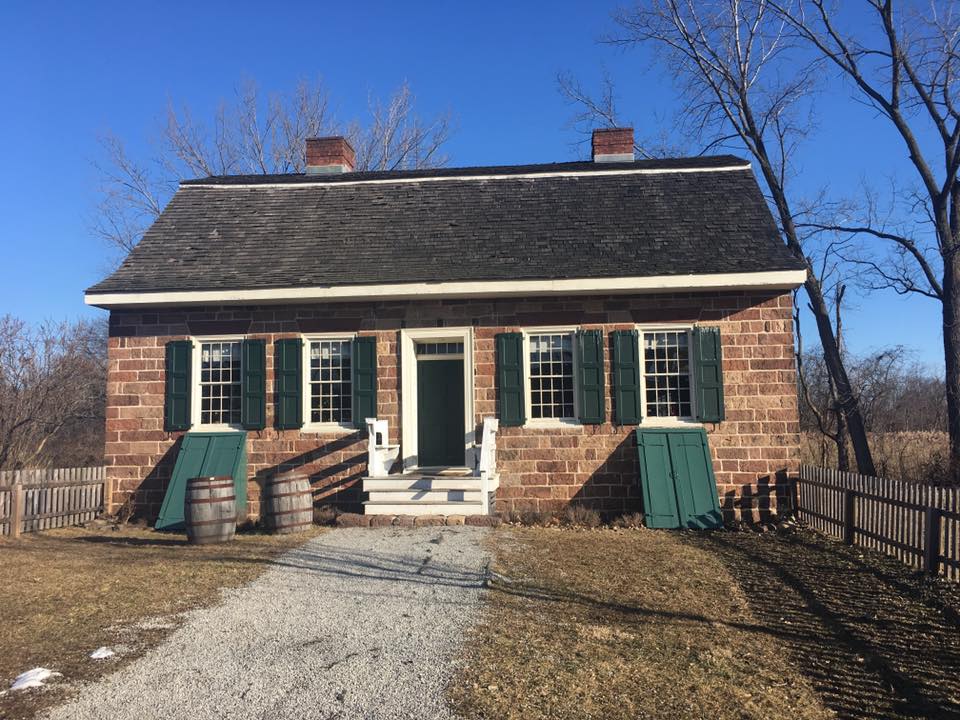
New Bridge Landing NJ, August 2019 marks the 400-year anniversary of the documented arrival of the first Africans arriving in colonial English America. Dr. Evelyn McDowell and Camile Amadio will discuss one of the women captives, Angela, and lead into a presentation about women, quilting, and slavery. We will briefly review the history of early colonial quilting and discuss the significance of quilting in the African-American community. We will end our talk with a discussion of the 400-year Commemoration Quilt Project currently underway and sponsored by Sons & Daughters of the United States Middle Passage. We will leave time for a hands-on demonstration of the block used for the commemorative quilting project. The talk begins at 1:30 pm in the Steuben House. The whole museum site is open for tours.
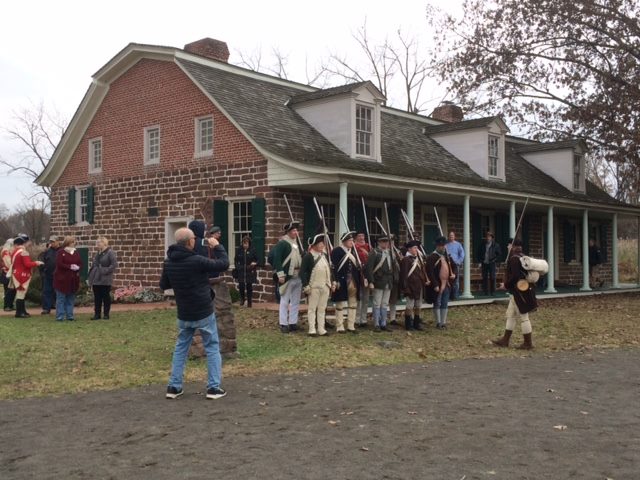
New Bridge Landing NJ, Dance mistress Denise Piccino and the Tricorne Dancers will give two one hour public performances in the Steuben House at 1:30 and 3:00 pm. Ridley & Anne Enslow will provide musical accompaniment on fiddle and hammered dulcimer. Throughout the afternoon, Rodger Yaden will portray General George Washington. Hot cider and crullers will be served in the restored 18th-century tavern in the Campbell-Christie House, where our gift shop is also located. Visitors may also see open-hearth cooking demonstrated in the Out-Kitchen featuring items that General Washington might have eaten during his stay at New Bridge in 1780 and recipes from Martha’s cookbook. Re-enactors from the 3rd New Jersey Regiment will demonstrate military life. Activities for children include: soldier drills, paper doll take-away project & scavenger hunt.
PATERSON NJ, the Bergen County Historical Society says, “This could be a game changer when it comes to historic preservation in NJ. Saving historic structures that provide communities their identities makes sense.”
On a street lined with former silk mills, only blocks away from the Great Falls of Paterson, Governor Phil Murphy detailed a new historic preservation tax credit program as part of his vision for incentives reform. The Historic Preservation Tax Credit will serve to revitalize and fully realize the potential of New Jersey’s storied cities and towns.
“50 Spruce Street is one of hundreds, if not thousands of similar buildings in our state that have vast unfulfilled potential and can be restored to their former glory and repurposed for modern day use,” said Governor Murphy. “Historic preservation tax credits have helped other states preserve and utilize their historic buildings. These beautiful structures are often hidden in plain sight and are waiting for the right investor. We are here to help with that.”
Ridgewood NJ, from the Bergen County Historical Society : As the cold weather breaks, a look back to one of the coldest winters during the Revolution, the winter of 1780.
1 February 1780. The coldest winter in human memory, something we can relate to this year, continued in Bergen County. Loyalist spies continue their detailed observations on the surrounding countryside, both to avoid surprise in New York City, and to look for opportunities for the British to strike at Washington’s isolated outposts, such as the one in Paramus…
photo courtesy of the Yogi Berra Museum & Learning Center
the staff of the Ridgewood blog
Ridgewood NJ, on this day in 1865, the United States of America abolished slavery with passage of the 13th Amendment!It was the first amendment to the Constitution in more than 60 years, as the initial 12 amendments occurred shortly after the Constitution was adopted.
There were still approximately 40,000 slaves remaining in Kentucky alone were freed by the 13th Amendment.”Neither slavery nor involuntary servitude, except as a punishment for crime whereof the party shall have been duly convicted, shall exist within the United States, or any place subject to their jurisdiction.”
The 13th amendment, along with the 14th & 15th, is one of the trio of Civil War amendments that greatly expanded the civil rights of Americans.
Today also marks what would have been Jackie Robinson’s 100th birthday. In 1947, Jackie Robinson became the first black player in the most popular sport in America, and helped change the way the country thought about racial integration.
If is often said the ,Babe Ruth changed baseball , while Jackie Robinson changed America.
It should come as no surprise that Dr. Martin Luther King, Jr. was a Republican. In that era, almost all black Americans were Republicans. Why? From its founding in 1854 as the anti-slavery party until today, the Republican Party has championed freedom and civil rights for blacks. And as one pundit so succinctly stated, the Democrat Party is as it always has been, the party of the four S’s: slavery, secession, segregation and now socialism.
It was the Democrats who fought to keep blacks in slavery and passed the discriminatory Black Codes and Jim Crow laws. The Democrats started the Ku Klux Klan to lynch and terrorize blacks. The Democrats fought to prevent the passage of every civil rights law beginning with the civil rights laws of the 1860s, and continuing with the civil rights laws of the 1950s and 1960s.
During the civil rights era of the 1960s, Dr. King was fighting the Democrats who stood in the school house doors, turned skin-burning fire hoses on blacks and let loose vicious dogs. It was Republican President Dwight Eisenhower who pushed to pass the Civil Rights Act of 1957 and sent troops to Arkansas to desegregate schools. President Eisenhower also appointed Chief Justice Earl Warren to the U.S. Supreme Court, which resulted in the 1954 Brown v. Board of Education decision ending school segregation. Much is made of Democrat President Harry Truman’s issuing an Executive Order in 1948 to desegregate the military. Not mentioned is the fact that it was Eisenhower who actually took action to effectively end segregation in the military.
Democrat President John F. Kennedy is lauded as a proponent of civil rights. However, Kennedy voted against the 1957 Civil Rights Act while he was a senator, as did Democrat Sen. Al Gore Sr. And after he became President, Kennedy was opposed to the 1963 March on Washington by Dr. King that was organized by A. Phillip Randolph, who was a black Republican. President Kennedy, through his brother Atty. Gen. Robert Kennedy, had Dr. King wiretapped and investigated by the FBI on suspicion of being a Communist in order to undermine Dr. King.
photo courtesy of BCHS the staff of the Ridgewood blog
New Bridge landing NJ, As one of the major events of Bergen’s Revolutionary War history, the Steenrapie Encampment brought the American army to present day River Edge and Oradell, and forever tied Washington himself to New Bridge Landing. Join author, military historian, and BCHS Past President Todd Braisted for his presentation on the history, legends, and luminaries that became part of Bergen County in September 1780.
For anyone interested in volunteering at Historic New Bridge Landing events as a docent, greeter, operations personnel, or living-history interpreter in period dress, the Bergen County Historical Society sponsors the School of Interpretation to hone communication skills, familiarize volunteers with Bergen’s unique history, give insight into the material culture of the past, and train volunteers in historical presentation. It also provides an opportunity for prospective participants to ask questions and learn about volunteering with BCHS. Please meet in the Steuben House (the house nearest the bridge), 1209 Main St, River Edge, NJ. No charge.
Bergen County Historical Society (BCHS) School of Interpretation & Volunteer Meeting Wednesday, January 16, 2019, 7:30 p.m. Topic: The Steenrapie (River Edge) Encampment of 1780
photo courtesy of the NJ Historic Preservation Office
the staff of the Ridgewood blog
Trenton NJ, from the New Jersey Historic Preservation Office ,Christmas takes on enormous historical significance in Trenton, NJ as the Revolutionary War Battles of Trenton are commemorated with reenactments & activities. The battle of Trenton was a major turning point in the Revolutionary War .
Make plans now to visit for the reenactment of the Battle of Trenton, and more Patriots Week events! More info here: www.destinationtrenton.com/events/patriots-week
On September 11, 2001, 19 militants associated with the Islamic extremist group al-Qaeda hijacked four airliners and carried out suicide attacks against targets in the United States. Two of the planes were flown into the towers of the World Trade Center in New York City, a third plane hit the Pentagon just outside Washington, D.C., and the fourth plane crashed in a field in Pennsylvania. Often referred to as 9/11, the attacks resulted in extensive death and destruction, triggering major U.S. initiatives to combat terrorism and defining the presidency of George W. Bush. Over 3,000 people were killed during the attacks in New York City and Washington, D.C., including more than 400 police officers and firefighters.
Washington DC, On September 22, 1862, partly in response to the heavy losses inflicted at the Battle of Antietam, President Abraham Lincoln issued a preliminary Emancipation Proclamation, threatening to free all the slaves in the states in rebellion if those states did not return to the Union by January 1, 1863. The extent of the Proclamation’s practical effect has been debated, as it was legally binding only in territory not under Union control. In the short term, it amounted to no more than a statement of policy for the federal army as it moved into Southern territory.
Ridgewood NJ, On this 73rd anniversary of D-Day let us remember, and honor, the soldiers who gave their lives for the freedoms of France and rest of Europe.
On June 6, 1944, more than 160,000 Allied troops landed along a 50-mile stretch of heavily-fortified French coastline, to fight Nazi Germany on the beaches of Normandy, France. Gen. Dwight D. Eisenhower called the operation a crusade in which, “we will accept nothing less than full victory.” More than 5,000 Ships and 13,000 aircraft supported the D-Day invasion, and by day’s end, the Allies gained a foot-hold in Continental Europe. The cost in lives on D-Day was high. More than 9,000 Allied Soldiers were killed or wounded, but their sacrifice allowed more than 100,000 Soldiers to begin the slow, hard slog across Europe, to defeat Adolf Hitler’s crack troops.
It was the beginning of the end for the Third Reich and a major turning point to free Europe and show that freedom can prevail over totalitarianism.
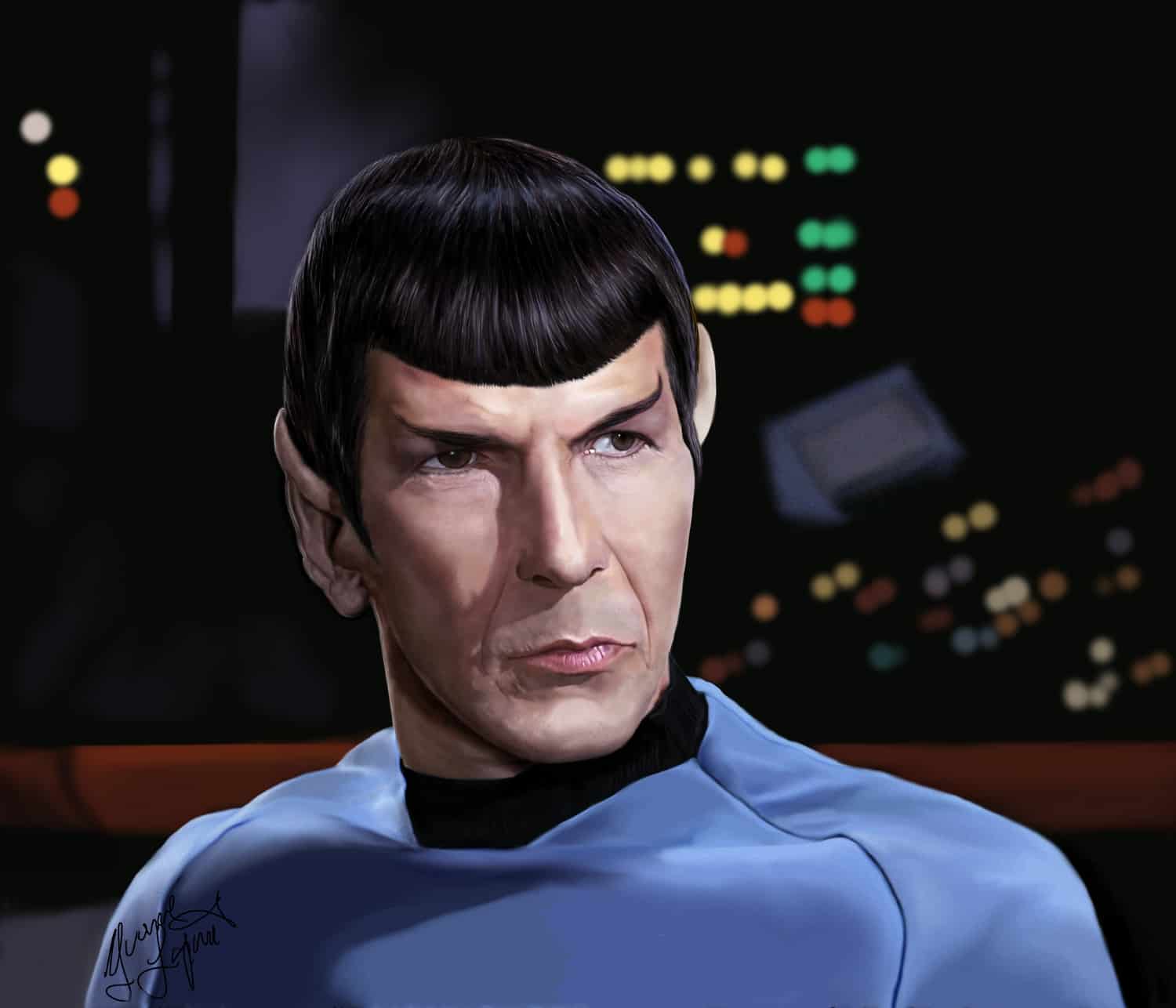
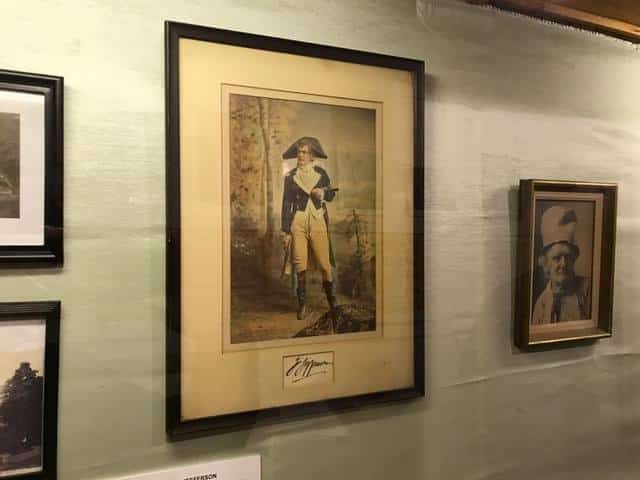
Ridgewood NJ, While most of us associated this phrase with Star Trek’s Mr. Spock, it was actually written and used by the most celebrated comedic actor of the late 19th century – Joseph Jefferson., who passed away 112 years ago, on April 23, 1905.
Joe Jefferson was the ‘Rock Star’ of his era. In 1859, he wrote and acted in a theatrical version of Rip Van Winkle. It was such a hit that audiences clamored for him to perform this role, which he willingly did for the next 40 years.
For 14 years, Jefferson lived in the house on Saddle River Rd., at the end of Hollywood Ave. While there, he entertained or met the key figures of his day. Grover Cleveland visited, and they fished in the Saddle River. A founding member of “The Players Club” in New York, he was friends with Edwin Booth, Samuel Clemens and Maurice Barrymore; and he communicated with Helen Keller and Nicole Tesla.
Jefferson’s passion for the theater has served as an inspiration for theatrical groups for more than a century. Locally, Ridgewood’s own troupe of Joe Jefferson Players, performed between 1936 and 1973. Today, Ridgewood High School’s ‘New Players’ (which launched the careers of Ali Stroker and David Turner) honors his memory by presenting two Joe Jefferson Awards each year for Technical Merit and Acting. David Turner (currently on Broadway in “Sunday in the Park with George”) won the award for acting in 1993.
The Schoolhouse Museum’s new exhibit “From the Revolutionary War to the 1960’s Revolution”displays photos and illustrations of Jefferson in the various roles he played; playbills from that era, those of the ‘Joe Jefferson Players’, and those from ‘The New Players’; the actual costume worn by Ali Stroker in the Glee Project; and more.
To see this display as well as other displays highlighting other significant events and people during this time, from wars, to the roaring twenties to the rocking 60’s; as well as histories of prominent Ridgewood area residents, visit the Ridgewood Historical Society’s Schoolhouse Museum, at 650 East Glen Avenue. The museum is open Thursdays and Saturday 1-3pm and Sundays 2-4pm. Please visit www.ridgewoodhistoricalsociety.org for more information.
Ridgewood NJ, On April 19, 1775, at 5am, 700 British regulars marched into Lexington, MA and were met by 77 American militiamen. The Americans initially began to disperse, and then from an undetermined gun, “the shot heard round the world” was fired. Ten Americans and 1 British soldier died there. Two hours later the British marched into Concord only to be met by hundreds of American Patriots. The British commander ordered his troops to hastily begin their 16 mile trek to Boston. Throughout the return, the Americans fired upon the troops – Indian style, from behind trees, rocks and bushes. By the time the British reached Boston, nearly 300 British soldiers had been killed, wounded, or were missing in action. The fight for Independence had begun!
With more battles being fought here than anywhere else, New Jersey played a key role in the Revolutionary War, While no major battles were fought in Bergen County there were a number of skirmishes between local Patriots and British troops or sympathizers. The Ridgewood area was constantly visited by Washington and his officers.
The Schoolhouse Museum’s new exhibit “From the Revolutionary War to the 1960’s Revolution”commemorates our war for Independence with actual artifacts, weapons and equipment; as well as examples of flags and uniforms from this period.
To see this display as well as other displays highlighting other significant events during this time, from wars, to the roaring twenties to the rocking 60’s; as well as histories of prominent Ridgewood area residents, visit the Ridgewood Historical Society’s Schoolhouse Museum, at 650 East Glen Avenue. The museum is open Thursdays and Saturday 1-3pm and Sundays 2-4pm. Please visit www.ridgewoodhistoricalsociety.org for more information.
Good Friday a good day for Republicans to stay away from the theater
April 14th 2017
the staff of the Ridgewood blog
Ridgewood NJ, on this day in 1865, Abraham Lincoln is shot by an assassin , John Wilkes Booth. Lincoln was shot on Good Friday. April 14 was Good Friday that year, just as it is this year.Unfortunately, as we all know, Lincoln would pass away the next day.
The President had decided to spend his Good Friday evening at a comedy at Ford’s Theatre in Washington, D.C. It had been only 5 days since General Robert E. Lee surrendered to General Ulysses S. Grant, effectively bringing the Civil War to a close. As the President watched the show from his box, an assassin burst through the door and shot Lincoln in the back of the head. The assassin, John Wilkes Booth, then dropped his pistol and began waving a dagger in the air.
Another occupant of the box, Major Henry R. Rathbone, lunged for Booth and forced him toward the railing. Booth slashed Rathbone in the arm and leapt from the box shouting “Sic semper Tyrannis! The South is avenged!” His boot caught on a flag as he jumped, and his leg was broken when he landed. Despite his injury, Booth managed to flee the scene.
In the meantime, a doctor in the audience had made it upstairs to Lincoln’s box. The bullet had lodged behind the President’s right eye. Lincoln was carried, barely breathing, across the street to a boardinghouse. Lincoln passed away at 7:22 a.m. the nest day.
Booth had co-conspirators who were trying to assassinate other members of Lincoln’s administration. One accomplice, Lewis Powell (a.k.a. Lewis Payne), attacked the Secretary of State, William Henry Seward, on the same night that Lincoln was shot. Through luck Seward survived .
Booth and his co-conspirators also intended to kill Vice President Andrew Johnson and General Ulysses S. Grant. Grant however changed his mind about attending Ford’s Theatre with the President that night.
In the end, four of Booth’s co-conspirators were captured, convicted, and hung.. One of them, Mary Surratt, became the first woman to be executed by the U.S. government. A few others were imprisoned for their involvement and Booth was discovered hiding in a barn in Virginia two weeks after he assassinated Lincoln, and mortally wounded during the attempt to capture him. It was the first time in American history, a President had been assassinated.
Yesterday in 1776, General George Washington makes a harrowing trip across the Delaware River, in the dead of night!
You’ll remember from previous posts that Washington and his army had just endured a series of crushing defeats: The British had won important battles in New York and had chased the Americans across New Jersey. Early in December, a defeated American army had narrowly escaped across the Delaware River. The river provided a barrier from further British attacks, at least for the moment, because Washington had ensured the destruction of every boat for miles around.
It was then that British General William Howe made a decision with serious ramifications for the British war effort. The weather had become much worse, and Howe decided to retire to winter quarters in New York City. He left behind a series of outposts in New Jersey to protect the ground that he’d won.
Washington did not realize that Howe was gone (or he may have thought that it was all a trick). He had roughly 6,000 men fit for duty, but many of those enlistments would end on New Year’s Day. He needed to recruit new soldiers or inspire the old ones to stay. The year had gone badly, and he needed to end it on a high note. On Christmas Eve, he met with his officers, and they finalized the details of a surprise attack. The army would go back across the Delaware in three different locations. The men would march to Trenton during the early morning hours, and they would attack before sunrise.
Washington’s army began its crossing on Christmas night. One of the American officers, Henry Knox, later described the “almost infinite difficulty” created by the icy conditions in the Delaware River. Making matters worse, a northeaster sprang up during the night. The bad news was that it made the crossing more difficult; the good news was that it covered up any noise created by the Americans.
Amazingly, the army managed to cross—even getting horses and cannon across the river. Yet the conditions were so difficult that the army completed its crossing 3 hours later than planned. Washington knew that the element of surprise might be difficult to achieve if his troops arrived after sunrise, but he determined to push on anyway. They had come too far to turn back now.
Washington could not know that the officers in charge of the other two crossings along the Delaware had called off their own troops, deeming the crossing too difficult. Washington’s planned three-pronged attack was down to only one.
The army pushed on relentlessly, through snow and ice. Knox would later write that the march was made “with the most profound silence.” Another lieutenant later wrote that Washington rode among the men, repeatedly telling them: “For God’s sake keep with your officers.” The weather was so severe that two men literally froze to death during the course of the night.
The army reached its destination, outside Trenton, at about 8 a.m. on December 26, three hours later than planned and one full hour after sunrise. Could the element of surprise be maintained?
————-
If you enjoy these history posts, please know that it is important to LIKE, SHARE & COMMENT. This site’s algorithm will weed these posts out of your newsfeed if you do not interact with them. (I don’t make the rules! Just following them.) 😉