What it means if Fed no longer says it’s ‘patient’ on rates
By MARTIN CRUTSINGER
AP Economics Writer
WASHINGTON (AP) — For the Federal Reserve, patience may no longer be a virtue.
Surrounding the Fed’s policy meeting this week is the widespread expectation that it will no longer use the word “patient” to describe its stance on raising interest rates from record lows.
The big question is: What will that mean?
Many economists say the dropping of “patience” would signal that the Fed plans to start raising rates in June to reflect a steadily strengthening U.S. job market. Others foresee no rate hike before September. And a few predict no increase before year’s end at the earliest.
Complicating the decision is a surging U.S. dollar, which is keeping inflation far below the Fed’s target rate and posing a threat to U.S. corporate profits and possibly to the economy. A rate increase could send the dollar even higher.
In a statement it will issue when its meeting ends Wednesday and in a news conference Chair Janet Yellen will hold afterward, the Fed isn’t likely to telegraph its timetable. Yellen has said that any decision to raise rates will reflect the latest economic data and that the Fed must remain flexible.
Still, nervous investors have been selling stocks out of concern that a rate increase – which could slow borrowing and spending and weigh on the economy – is coming soon.
Bolton calls Iran deal ‘unprecedented’ surrender
March 14, 2015, 11:18 am
By Mark Hensch
Former United Nations Ambassador John Bolton said Saturday that President Obama is negotiating “an unprecedented act of surrender” with Iran in discussions over its nuclear weapons program.
“This deal is fundamentally flawed,” Bolton said at the South Carolina National Security Action Summit in West Columbia, S.C. “There really is no deal I’d trust Iran with. It is a regime determined to have nuclear weapons and this deal will give it to them.”
The Obama administration is hoping Iran will slow or stop its nuclear armaments research in exchange for removing economic sanctions. Britain, China, France, Germany and Russia are aiding U.S. efforts to bargain with Iran. The two sides will resume talks in Lausanne, Switzerland, next week.
Controversy erupted over an open letterRepublicans sent Iran’s leadership Monday. It vowed Congress can void any deal it finds unsatisfying and was signed by 47 GOP senators.
Senate panel probing possible Obama administration ties to anti-Netanyahu effort
By Steven Edwards
Published March 14, 2015
FoxNews.com
A powerful U.S. Senate investigatory committee has launched a bipartisan probe into an American nonprofit’s funding of efforts to oust Israeli Prime Minister Benjamin Netanyahu after the Obama administration’s State Department gave the nonprofit taxpayer-funded grants, a source with knowledge of the panel’s activities told FoxNews.com.
The fact that both Democratic and Republican sides of the Senate Permanent Subcommittee on Investigations have signed off on the probe could be seen as a rebuke to President Obama, who has had a well-documented adversarial relationship with the Israeli leader.
The development comes as Netanyahu told Israel’s Channel Two television station this week that there were “governments” that wanted to help with the “Just Not Bibi” campaigning — Bibi being the Israeli leader’s nickname.
It also follows a FoxNews.com report on claims the Obama administration has been meddling in the Israeli election on behalf of groups hostile to Netanyahu. A spokesperson for Sen. Rob Portman, Ohio Republican and chairman of the committee, declined comment, and aides to ranking Democratic Sen. Claire McCaskill, of Missouri, did not immediately return calls.
The surging dollar is a signal that a colossal financial event is just around the corner
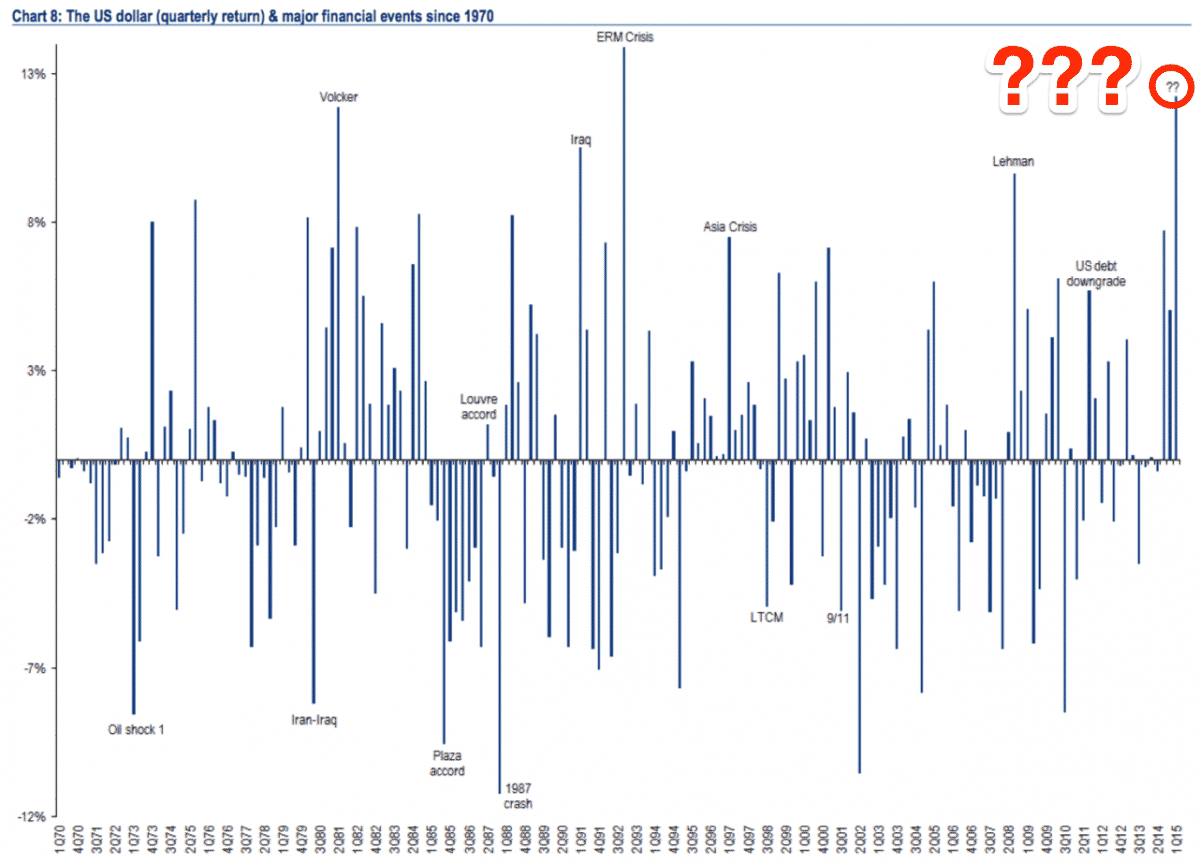
The dollar is set for its strongest quarterly strengthening since 1992, according to Bank of America, a good sign that a rate hike is around the corner.
When markets expect that US interest rates will be hiked, it typically strengthens the dollar. That’s because people rush to change other currencies into dollars — they can make more money in dollar-denominated investments. The higher demand for the US currency drives its value up.
In the past, significant dollar gains against other currencies have pretty much happened only during periods of extreme financial or geopolitical distress.
The last four large dollar shocks in the past 45 years have been symptoms of huge financial events: the collapse of Lehman, Britain’s panicky ejection from the European Exchange Rate Mechanism (ERM) in 1992, the first Gulf War, and Paul Volcker’s shock rate hikes in the early 1980s.
Today’s surge is already considerably larger than the one that surrounded Lehman’s collapse, although the economic conditions are very different.
Surprise: U.S. Economic Data Have Been the World’s Most Disappointing
Is this a sign of unanticipated weakness in the economy?
It’s not only the just-released University of Michigan consumer confidence report and February retail sales on Thursday that surprised economists and investors with another dose of underwhelming news. Overall, U.S. economic data have been falling short of prognosticators’ expectations by the most in six years.
The Bloomberg ECO U.S. Surprise Index, which measures whether data beat or miss forecasts, fell to the lowest since 2009, when the nation was in the deepest recession since the Great Depression.
There’s been one notable exception to the gloom, and it’s a big one: payrolls. The economy added 295,000 jobs in February and 1.3 million over four months, a reflection of a healthier labor market in which the unemployment rate has fallen to the lowest in almost seven years.
Most everything else? Blah.
This month alone, personal income and spending, manufacturing as measured by the Institute for Supply Management, auto sales, factory orders, and retail sales have all come in a bit weak.
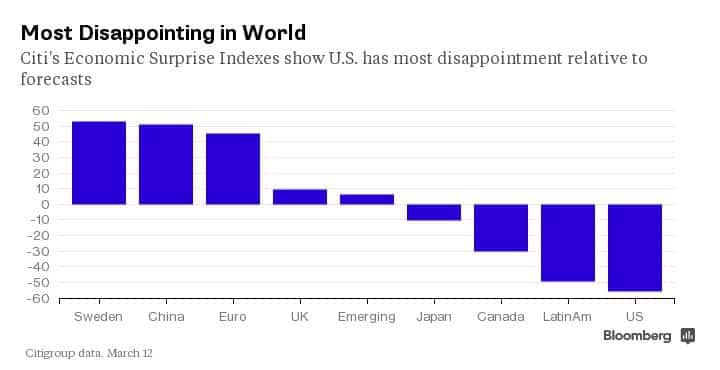
Citigroup keeps economic surprise indexes for the world, and its scoreboard shows the U.S. is most disappointing relative to consensus forecasts, with Latin America and Canada next, as of March 12. Emerging markets were supposed to be hurt by falling oil prices but are now delivering positive surprises. U.S. policymakers frequently talk about weakness in Europe and China, though both are exceeding expectations.
And there’s one rub. The surprise shortfall in the U.S. doesn’t necessarily mean the world’s largest economy is in dire straights. It’s just falling short of some perhaps overly elevated expectations.
Federal workers more financially secure than the taxpayers who pay them
By Karen Beseth / March 9, 2015
A new study by Gallup reports that federal workers are much more likely to say that they are thriving financially than the rest of us.
The findings are based on more than 80,000 interviews from February 2014 to February 2015, and Gallup concluded that “US federal workers have [an] edge in financial well-being over other workers.”
Only 34 percent of workers outside of the federal government say they are thriving financially, while 44 percent of federal workers report a strong sense of financial well–being, a full ten point difference. On the flip side, non-federal workers are much more likely to say they are struggling (42 percent) or suffering (24 percent) than federal workers, while only 17 percent of federal workers say they are suffering.
The findings cut across all income and education levels, and according to Gallup “for those who experience higher levels of financial well-being, they feel as if they can spend time and energy addressing other facets of well-being in their day-to-day lives, including their purpose, social, community and physical well-being.” In other words, working for the federal government brings benefits that extend beyond the financial realm and improve all aspects of life.
While most Americans want to see all of their fellow citizens thriving and doing well, to some it does seem unfair that the people paying the federal workers are worse off financially than their public servants. Investor’s Business Daily compares the situation to The Hunger Games, a popular book and movie series in which the people in the “Districts” struggle while residents of the “Capital” live the good life.
“Gallup says this “could mean good news.” Well, for federal workers it sure is. But it’s hardly good news for the rest of the country. What the survey shows is how our massive federal government has increasingly become a wealth transfer machine that takes money from working families and gives it to elites in and around Washington….
The U.S. is, in short, becoming a real-world version of the Hunger Games, where people living in far-flung impoverished districts toil for the benefit of an increasingly rich, corrupt and indifferent capital city.”
That hardly sounds like the vision our Founding Fathers had when they created the federal government.
This article was written by a contributor of Watchdog Arena, Franklin Center’s network of writers, bloggers, and citizen journalists.
Sen. Robert Menendez, comes out swinging against Obama Administration Foreign Policy
Amid Looming Federal Corruption Charges, N.J. Democrat Pushes Back Against Obama Administration Policy to Counter Russia
Melissa Quinn / @MelissaQuinn97 / March 09, 2015
Amid whisperings that the Justice Department will file criminal corruption charges against Sen. Robert Menendez, D-N.J., the long-time senator today spoke about the importance of the U.S. standing strong against Russia and warned that inaction could embolden countries with nuclear capabilities.
“The simple fact is we all want a diplomatic solution to this problem. But I believe this can only come about when Putin believes that the cost of continuing to ravage Ukraine is simply too high,” he said. “We have a responsibility to increase that cost.”
Menendez, speaking alongside former National Security Adviser Zbigniew Brzezinski, addressed a full house at the Center for Strategic and International Studies in Washington, D.C., on how the U.S. should respond to Russia’s aggression against Ukraine.
“It has never been in our nature to simply observe,” he said of the United States. “In my view, it is in our strategic interest to be an active participant in leading any effort to counter Russia.”
Don’t have time to read the Washington Post or New York Times?Then get The Morning Bell, an early morning edition of the day’s most important political news, conservative commentary and original reporting from a team committed to following the truth no matter where it leads.
Menendez, the ranking member of the Senate Foreign Relations Committee, has been a leading voice in calling for additional sanctions against Russia and advocated for the U.S. to arm Ukrainians as the neighboring country continues to make territorial gains.
The U.S. has sent nonlethal military aid to Ukraine, including blankets and night vision goggles, but Menendez joined a chorus of Republican and Democratic lawmakers pushing for lethal aid.
“That’s all well and good if I can see the enemy, but I have no wherewithal to stop them. It really is not responding to the fundamental challenge,” he said.
Specifically, the New Jersey senator called on the president to provide the country with equipment like counter-artillery radar, surveillance drones, anti-tank and anti-armor weapons, and ammunition.
Military leaders including Chairman of the Joint Chiefs of Staff Martin Dempsey and Secretary of Defense Ashton Carter back calls to arm Ukrainians. The president hasn’t yet said whether he will approve lethal aid to the country, but hasn’t ruled it out either.
“We need to send a very clear global message: If you violate and upend the international order, there will be consequences,” the New Jersey Democrat said. “And we have to mean it when we say it, and we have to back up our words with a menu of agreed upon actions that will follow. There should be no ambiguity about either our resolve or what actions we would consider.”
Menendez warned that the country’s response to Russia is being looked at by other global actors—particularly those with nuclear capabilities.
“Whether it’s China in the South China Sea that has territorial disputes with our allies, South Korea and Japan, or the challenge we face with a nuclear-armed North Korea, or the challenge of [President Nicolás] Maduro in Venezuela oppressing his people—I could go through a long list of global actors who, in the absence of assured consequence for violating the international order, will be emboldened,” he said. “That is an incredibly risky world to live in.”
The senator’s speech on Russia came just days after CNN reported that the Justice Department will file criminal corruption charges against the long-time senator. The charges center around his relationship with friend and political donor Salomon Melgen and are the culmination of a two-year investigation into the duo’s ties.
Menendez hasn’t been indicted yet, and the looming threat of the charges hasn’t stopped him from speaking out against the president’s policies.
“The United States must lead,” he said in closing today. “American leadership counts.”
Social Security Administration Expects Beneficiaries of Obama’s Amnesty Will Be Covered Starting Later This Year
by Ryan Lovelace March 9, 2015 1:29 PM
Illegal immigrants who take advantage of President Obama’s executive actions on immigration will soon collect another benefit: Social Security. Starting in 2017, the Social Security Administration expects that thousands of undocumented immigrants will begin collecting from the Old-Age, Survivor’s, and Disability Insurance (OASDI) program as a direct result of the president’s actions. In a letter to Republican senator Ron Johnson, chairman of the Homeland Security and Governmental Affairs Committee, the SSA’s chief actuary Stephen Goss indicated that an additional 16,000 people will begin collecting OASDI benefits come 2017, and that the number of beneficiaries would continue to increase for 40 years thereafter, topping out at 695,000 people. Goss’s projection may underestimate the number of potential beneficiaries, however, as it assumes that 50,000 fewer illegal immigrants will enter the country each year starting in 2016.
What’s more, the SSA is proceeding as if nothing has changed in the wake of a federal judge’s injunction against Obama’s November 2014 executive actions. Goss tells NRO that he expects 58,000 new workers will be covered under the OASDI program later this year, although they will not be eligible to collect benefits immediately. “Based on the best advice and counsel we have gotten, we’re working on the assumption that these [executive actions] will persist,” Goss says. “Most indications we seem to get are that it’s likely that this will get back on track, with some delay.” Goss notes that a law, additional regulation, or another executive action by Obama or a future president could alter the way SSA calculates and administers OASDI benefits, but says that he does not expect the court’s order will ultimately succeed in changing anything.
Hudson Dems back Menendez in face of allegations as they announce 2015 slate
JERSEY CITY – The Hudson County Democratic Organization (HCDO) announced its slate of candidates for state and county office on Friday in a building that took on an unexpectedly ironic meaning: a courthouse.
Analysis: More Mideast allies fear U.S. soft on Iran
Jim Michaels, USA TODAY
WASHINGTON — Israel is not the only vital American ally in the Middle East increasingly alarmed that the U.S. is working too closely with Iran. So are America’s most important Arab partners.
Israeli Prime Minister Benjamin Netanyahu has trumpeted his worries about a U.S.-Iranian nuclear deal, most recently to the U.S. Congress last week. Equally concerned but less vocal are Saudi Arabia and other moderate Arab states who play vital roles as bulwarks against radical Islamists in the region.
Shared interests Washington and Tehran have in driving the Islamic State out of Iraq and Syria are another source of worry for the allies, who do not want to see Iran’s radical leadership emerge as a more powerful and potentially nuclear-armed state in the region.
“Distrust in Saudi Arabia toward the United States hasn’t been this high since 1973,” during the oil embargo, said Michael Rubin, an analyst at the American Enterprise Institute.
Reports last week that Iran’s military was playing a prominent role in an Iraqi offensive to drive Islamic State militants from Tikrit, north of Baghdad, raised a fresh a wave of fear that the United States isn’t doing enough to blunt Iran’s expansionist designs.
62.8%: Labor Force Participation Has Hovered Near 37-Year-Low for 11 Months
March 6, 2015 – 10:01 AM
By Ali Meyer
(CNSNews.com) – The labor force participation rate hovered between 62.9 percent and 62.7 percent in the eleven months from April 2014 through February, and has been 62.9 percent or lower in 13 of the 17 months since October 2013.
Prior to that, the last time the rate was below 63 percent was 37 years ago, in March 1978 when it was 62.8 percent, the same rate it was in February.
“The civilian labor force participation rate, at 62.8 percent, changed little in February and has remained within the narrow range of 62.7 to 62.9 percent since April 2014,” the BLS said in its release on the February employment data.
92,898,000 Americans were not in the labor force in February, according to data released from the Bureau of Labor Statistics (BLS) on Friday.
The labor force participation rate is the percentage of the civilian noninstitutional population who participated in the labor force by either having a job during the month or actively seeking one.
In February, according to BLS, the nation’s civilian noninstitutional population, consisting of all people 16 or older who were not in the military or an institution, reached 249,899,000. Of those, 157,002,000 participated in the labor force by either holding a job or actively seeking one.
The 157,002,000 who participated in the labor force was 62.8 percent of the 249,899,000 civilian noninsttutional population, which matches the 62.8 percent rate in April, May, June, and October of 2014 as well as the participation rate in March of 1978. The participation rate hit its lowest level since February 1978 (62.7 percent) in September and December of 2014.
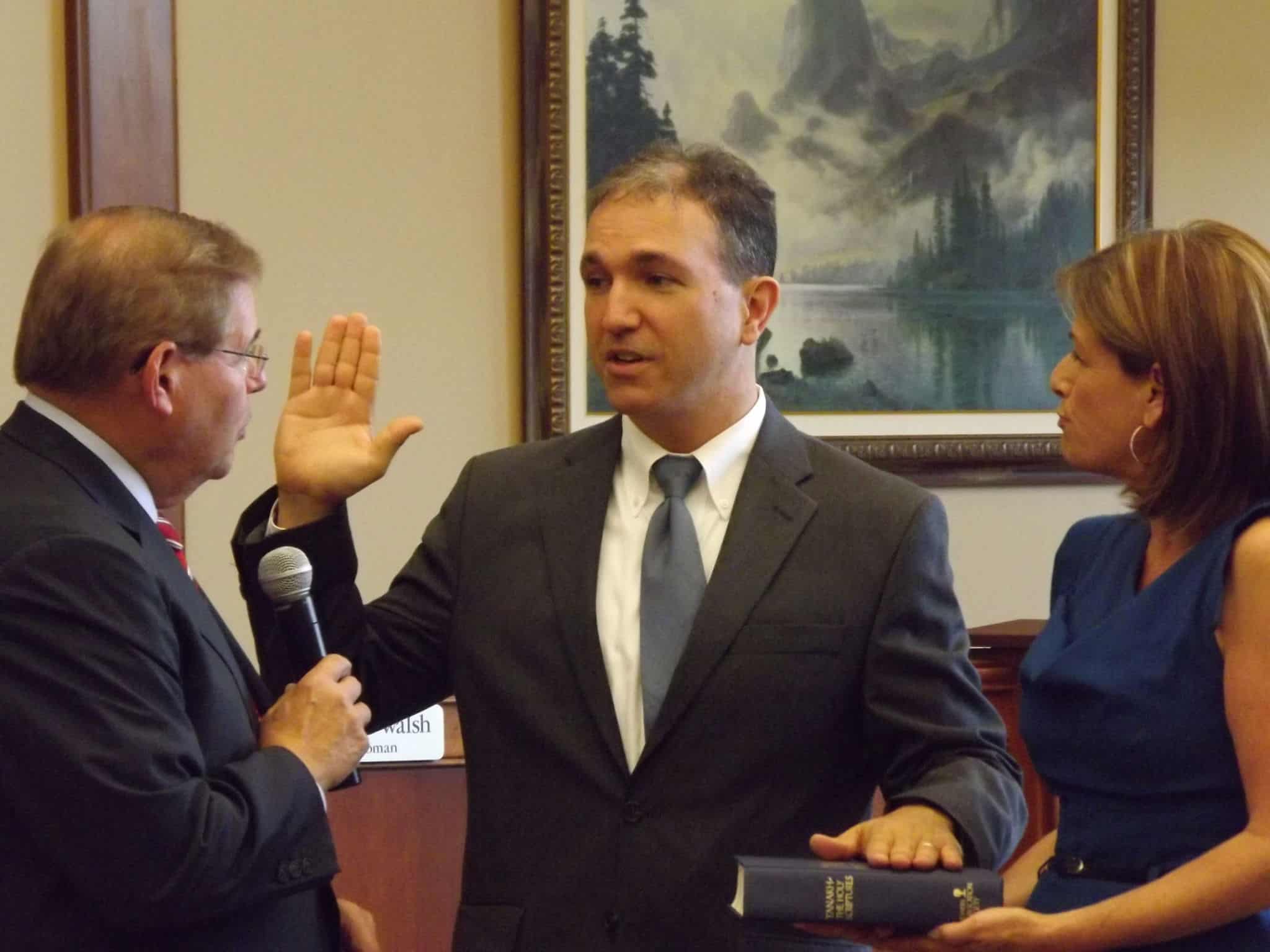
file photo by Boyd Loving Sen. Robert Menendez swearing in our mayor at Ridgewood REORG
Menendez: White House’s least favorite Dem
“I have to be honest with you, the more I hear from the administration and its quotes, the more it sounds like talking points that come straight out of Tehran,” Menendez. “And it feeds to the Iranian narrative of victimization when they are the ones with original sin–an illicit nuclear weapons program, going back over the course of 20 years, that they are unwilling to come clean on.” https://www.weeklystandard.com/blogs/dem-senator-obamas-iran-talking-points-straight-out-tehran_824204.html
WASHINGTON (CNN) —Sen. Robert Menendez might be a senior Democrat but he’s no friend of the White House.
In fact, he’s emerged as one of the most troublesome obstacles to President Barack Obama’s legacy-building effort to end decades of U.S. estrangement with Cuba and Iran. He’s also poked the administration on its troubled relationship with Israeli Prime Minister Benjamin Netanyahu, with whom he shares a hawkish outlook towards Tehran.
But the senior senator from New Jersey, 61, is now in the news for a different reason, after CNN first reported Friday that the Justice Department is preparing to bring criminal charges against him.
People briefed on the case say prosecutors plan to allege that Menendez used his Senate office to push the business interests of a Democratic donor and friend in exchange for gifts. The charges, which are expected to be formally laid within weeks, threaten to seriously imperil Menendez’s political prospects at a time when his influence in Washington has rarely been greater.
Menendez is currently the ranking Democrat on the Senate Foreign Relations Committee, after serving briefly as chairman when his predecessor John Kerry left to become Secretary of State and before Democrats lost the Senate majority last year.
But his position in the minority belies his influence.
Poll: Majority of Americans Believe Obama has ‘Done Little or Nothing’ to Help the Poor and Middle Class
By Barbara Boland | 24 hours ago
Most Americans believe the government of President Barack Obama has helped the rich, and believe it’s done “little or nothing to help” the poor or middle class, according to a Pew Research Center poll released yesterday.
72% believe the government’s policies have “done little or nothing to help middle class people;” 68% believe Obama’s policies have provided little or no help for small businesses and 65% say the same for the poor.
Obama’s 2016 Budget: Analysis shows plan would result in reduced GDP and the loss of upwards of 809,000 jobs
March 3,2015
Washington, DC ,In his 2016 budget, President Obama proposes a variety of tax increases on saving and investment as well as the creation or expansion of a number of tax credits. Some economists are concerned about the impact these changes could have on the U.S. economy, and according to the latest numbers, many of their concerns are warranted. A new analysis from the nonpartisan Tax Foundation indicates that the president’s budget would cost the U.S. a significant amount of full time jobs and result in the reduction of GDP and workers’ wages.The report’s key findings include:
The Taxes and Growth (TAG) Model finds the plan would shrink the economy by 3 percent, lower the level of investment by 8 percent, reduce wages by 2.4 percent, eliminate 809,000 jobs, and lose $12 billion in federal revenue over the long run due to lower growth.
If the revenue available for business tax reform were used to lower the corporate tax rate, it would result in a 3 percentage point cut in the rate—far less than a cut to a 28 percent rate as hoped for by the president’s budget.
With the lower corporate tax rate, the plan would still shrink the economy by 2.4 percent, decrease investment by 6.2 percent, reduce wages by 1.8 percent, eliminate 679,000 jobs, and lose $4 billion in revenue over the long run.
“The thrust of the individual income tax changes is to raise taxes on upper income taxpayers, primarily through higher taxes on income from savings and investment. The additional revenue would then be used to increase credits for families with young children, workers with low earnings, and two-earner couples,” said Tax Foundation Senior Fellow Stephen J. Entin, PhD. “However, the plan focuses only on redistribution, ignoring economic growth, and the resulting reduction in growth would hurt many of the people the plan is meant to help.”
This plan highlights a century-old debate over whether to tax income or consumption. The focus of the broad-based income tax (which taxes income when it is earned and again when investment earnings are realized) is to aid in wealth redistribution. On the other hand, the focus of a consumption based tax (one that falls equally on income used for consumption or saving and investment) is to avoid penalizing saving relative to consumption as to not discourage economic growth.
The 2016 budget aligns with the income based approach. Historically, reforms that have moved towards the broad-based income tax—like the 1986 Reagan tax reform and the Obama 2012 budget agreement and the tax elements of the Affordable Care Act—have generally reduced wages and employment and discouraged capital formation. Alternatively, reforms that moved away from this approach—such as the 1961-1963 Kennedy tax cuts, the 1981 Reagan tax cut, and the 2001-2003 Bush tax cuts—have helped to raise productivity, wages, and employment.
Obama “Very Interested” In Raising Taxes Through Executive Action
Conn Carroll | Mar 02, 2015
White House Press Secretary Josh Earnest confirmed Monday that President Obama is “very interested” in the idea of raising taxes through unitlateral executive action.
“The president certainly has not indicated any reticence in using his executive authority to try and advance an agenda that benefits middle class Americans,” Earnest said in response to a question about Sen. Bernie Sanders (I-VT) calling on Obama to raise more than $100 billion in taxes through IRS executive action.
“Now I don’t want to leave you with the impression that there is some imminent announcement, there is not, at least that I know of,” Earnest continued. “But the president has asked his team to examine the array of executive authorities that are available to him to try to make progress on his goals. So I am not in a position to talk in any detail at this point, but the president is very interested in this avenue generally,” Earnest finished.
Sanders sent a letter to Treasury Secretary Jack Lew Friday identifying a number of executive actions he believes the IRS could take, without any input from Congress, that would close loopholes currently used by corporations. In the past, IRS lawyers have been hesitant to use executive actions to raise significant amounts of revenue, but that same calculation has change in other federal agencies since Obama became president.