Ridgewood NJ, The nation’s second-lowest gas tax ended officially at 12:01 a.m. on Tuesday, Nov. 1, and was replaced by one of the highest per-gallon rates in the nation , The .23 cent increase gives New Jersey now 37.5 cents-per-gallon.
While the party line from Trenton is that money will be used to refill the depleted TTF or Transportation Trust Fund providing the money New Jersey bridges and roads need for a massive investment .
A few things to keep in mind when you pay up at the pump;
The average cost of road repair in the US is $39,000 per mile but in NJ it’s $2 million a mile; New Jersey spends eight times the national average on its state-controlled highways.
The Reason Foundation says New Jersey spends just over $2 million per state-controlled mile on construction, maintenance and administration, triple the roughly $675,000 spent by the next-highest state, Massachusetts, and more than eight times the national average of $39,000. I call it “out of control” spending.
The state DOT disputes that number. But with reports the reconstruction of Route 35 were more than $27 million per mile, it’s clear our costs are out of control.
The state of New Jersey funds highway, bridge, and rail projects through its Transportation Trust Fund, which relies on borrowing and gas tax revenue to contribute $1.225 billion to the state’s overall $1.6 billion construction budget this year. Can anyone say “Ponzi Scheme” ?
Why the deficit and lack of funds? Is it because the corruption in Trenton has already used these allocated tax monies to offset other programs, loans, or deficits. Bad deals are made by politicians looking to get elected, guaranteeing political donations from unions, keeping project labor agreements and prevailing wages artificially inflating the costs of road work.
By some accounts, New Jersey spends the 3rd most of any state on transportation funding.
So as we say good bye to cheap gas perhaps you are also saying good bye to one of the last reasons left for living in New Jersey .Let’s face it New Jersey is last in almost everything and being the worst place to live is also even getting more expensive.
Ridgewood NJ, On Friday, Governor Christie discussed the progress our state has made four years after Sandy as his administration continues to work with homeowners, business owners, and communities to rebuild and safeguard against future storms. He also conducted a small business tour in Seaside Heights, a community heavily impacted by Sandy.It is no doubt that so much more needs to be done and some homeowners are still struggling four years later trying to cut through the
the red tape .
The Governor outlined investments in rebuilding our infrastructure, getting families back in their homes and protecting our shores after Sandy including:
Nearly $2.5 billion in utility infrastructure hardening & resilience investments
More than $2 billion in FEMA public assistance directed towards recovery projects
Five large-scale NJ Transit projects designed to better safeguard critical components of our transportation grid
$7 million to fund Retail Fuel Station program to allow gas stations expedited access to back-up power during an energy emergency
Coordinated effort with Army Corps of Engineers to build 11 new coastal and flood protection projects statewide
More than $1.6 billion in federal housing assistance to help Sandy-impacted families
Majority of 7,600 homeowners participating in Reconstruction, Rehabilitation, Elevation and Mitigation program are back in their homes
Expanded Blue Aces program, allowing residents in flood-prone areas to sell homes damaged by Superstorm Sandy
$207 million dedicated to support economic revitalization in Sandy-affected communities through the Stronger NJ business programs.
The Christie administration is committed to finishing the job on Sandy recovery, revitalization and resilience efforts.
ATLANTIC CITY, N.J. (AP) – The New Jersey Senate approved a measure Thursday that would punish billionaire Carl Icahn for shutting down the Trump Taj Mahal casino by prohibiting him from holding a casino license for it for five years.
The bill would only apply to Icahn at this time, even though four other Atlantic City casinos have shut down since 2014.
Icahn’s Atlantic City management team says the bill is unfair and unconstitutional, making it virtually impossible to reopen the Taj Mahal should they decide to do so.
The bill has not yet been voted on in the state Assembly. If passed by the full Legislature, it is likely to be vetoed by Republican Gov. Chris Christie, who has made criticism of some labor unions a key part of his political agenda.
Ridgewood NJ, This week, presumptive Democrat Gubernatorial nominee and Corzine retread was exposed by WikiLeaks for exploiting loopholes in election law to further his political ambitions.
Democrats are poised to nominate another Wall-Street insider with expert knowledge on exploiting election laws to further his candidacy. The most recent revelations in the saga on Corzine 2.0 (aka- Phil Murphy) came after WikiLeaks furnished e-mail correspondence between Murphy and DC insider and Clinton advisor John Podesta, who has been at the heart of the latest WikiLeaks scandals.
Murphy has already spent a boat-load of money on television and print advertising claiming to be an outsider, but the latest leaked e-mails paint a much different picture of a politician that knows how to use his own money to get his way.
Murphy established a tax-exempt non-profit organization, allowed to take unlimited money without disclosing its donors, in a clear attempt to bolster his Gubernatorial ambitions. Under the law, this organization was supposed to be a “social welfare organization”, allowed to engage in political activity, but not as its primary mission.
As reported by WNYC News, While Murphy said publicly that this was simply a public advocacy think-tank, privately in e-mails to John Podesta, disclosed that the group was formed to boost his name ID as he was “VERY serious but not yet committed” to run for Governor.
With a direct line to one of Clinton’s main advisors and after his shameless acceptance of endorsements of corrupt county bosses and Trenton’s largest special interest group, the NJEA, Murphy’s wasted no time making it clear to voters that he is just another political insider with Wall Street values pretending to be someone he’s not to get elected.
Commissioner Martin Signs Administrative Order Designating Drought Warning for 14 Counties in Northern, Central and Northern Coastal New Jersey
October 22,2016
the staff of the Ridgewood blog
DIRECTIVE ACTIVATES DEP AUTHORITY TO CLOSELY MANAGE WATER SUPPLIES; PUBLIC STRONGLY URGED TO REDUCE WATER USE
Ridgewood NJ, Department of Environmental Protection Commissioner Bob Martin today placed 14 counties encompassing the northern, central and northern coastal areas of New Jersey under a drought warning due to ongoing precipitation deficits and deteriorating water-supply conditions, particularly storage levels in reservoirs.
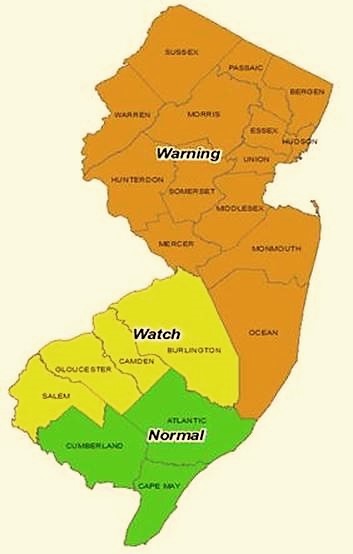
Commissioner Martin signed an Administrative Order designating a drought warning for Bergen, Essex, Hudson, Hunterdon, Mercer, Middlesex, Monmouth, Morris, Ocean, Passaic, Somerset, Sussex, Union and Warren counties.
This designation enables the DEP to more closely manage reservoir systems by directing water transfers among systems, controlling releases from reservoirs, and modifying the rate of flow in streams and rivers in order to balance ecological protection and needs of water suppliers.
The goal of the drought warning is to preserve and balance available water supplies in an effort to avert more serious water shortages in the future. The warning also elevates the need for residents and businesses in impacted counties to reduce their water use.
“The situation in our reservoir systems that serve some of the most densely populated regions of New Jersey is becoming more critical, with some systems dropping to half their capacity or less,” Commissioner Martin said. “Without knowing how much precipitation we are going to get over the fall and winter to replenish our water sources, it is vital that every resident and business step up efforts to voluntarily reduce water use in the hopes of averting a water emergency and mandatory restrictions.”
A drought watch calling for voluntary water conservation remains in effect for Burlington, Camden, Gloucester and Salem counties. The designation of a watch formally urges residents of these counties to voluntarily conserve water.
The only counties not under a warning or watch are Atlantic, Cape May and Cumberland, which have received near or above-normal rainfall over the past several months.
The decision to designate a drought warning comes a day after the DEP held a hearing to update water suppliers and the public. The warning is the first since November 2001, which subsequently became an emergency that was phased in by regions as drought conditions worsened. The emergency was phased out over the latter half of 2002 into early 2003.
The Administrative Order signed by Commissioner Martin establishes a formal process for the DEP to work with water suppliers in affected regions to ensure no single water supplier or region faces a significant shortfall should dry weather and high customer demand continue.
The DEP has been consulting with water suppliers for months to assess conditions and ensure they are fully aware of the situation and are ready to cooperate with the DEP.
“I want to thank water suppliers for working with the DEP to ensure the stability of our water supplies,” Commissioner Martin said. “At this point, we would need many periods of sustained precipitation over several months to return to normal. We are all in this together. Everyone must pitch in, whether taking simple steps to reduce water use within their homes and businesses or stopping watering of lawns and shrubs and letting them go dormant.”
Drought and abnormally dry conditions are affecting large portions of the nation, including California and a large swath of the nation from West Virginia into the Deep South and eastern Texas. Parts of Pennsylvania, most of New York State and all of New England are experiencing a range from abnormally dry conditions to extreme drought, according to the U.S. Department of Agriculture’s Drought Monitor.
The DEP utilizes indicators to gauge the impacts that a shortfall of precipitation has had on water supplies, including reservoir levels, stream flows, and levels in shallow groundwater sources, known as unconfined aquifers, which is important in the longer-term replenishment of streams and reservoirs.
The northern tier of the state, in particular, has been grappling with below-normal precipitation. In this area, precipitation deficits for the past 12 months are as much as 12.7 inches below normal.
Major reservoir systems are below their normal levels for this time of year, and will likely need transfers of water through interconnected infrastructure to balance storage.
The Northeast Combined Reservoir System – 12 reservoirs operated by four water suppliers serving the most densely populated region of the state – have dropped to 52 percent capacity, compared to a normal of about 67 percent for this time of year.
The North Jersey District Water Supply Commission’s two reservoirs have dropped to below 50 percent capacity, compared to a normal of about 68 percent for this time of year. The Commission serves portions of Bergen, Essex, Hudson and Passaic counties.
The New Jersey Water Supply Authority’s Raritan Basin reservoirs – serving densely populated central parts of the state – are 25 percent below their normal storage level of 89 percent for this time of year.
The Suez-NJ system (formerly United Water-NJ) consists of three reservoirs serving Bergen County that have dropped to less than 45 percent total capacity, compared to a normal capacity of 60 percent for this time of year.
The combined storage in reservoirs operated by New Jersey American Water and the New Jersey Water Supply Authority serving portions of Monmouth and Ocean counties are 14 percent below their normal level of 86 percent for this time of year.
Sussex and Warren counties rely primarily on groundwater and have been included in the warning because groundwater in this area is rated as extremely dry while precipitation and stream flows are rated as severely dry.
The southwestern part of the state – Burlington, Camden, Gloucester and Salem counties – relies primarily on groundwater. Precipitation in this part of the state is rated as moderately dry while stream flows and groundwater are rated as severely dry.
In the southern coastal region of the state – Atlantic, Cape May and Cumberland counties – rainfall is near or above normal. Still, stream flow is considered moderately dry. The DEP is continuing to monitor local conditions but at this time has not issued a drought watch or warning for these counties.
The DEP offers the following tips to reduce water use:
At this time of year, it is appropriate to let your lawns go dormant.
Turn sprinkler systems off automatic timers.
Use a hose with a hand-held nozzle to water flowers and shrubs, or let them go dormant.
Use a broom to sweep the sidewalk, rather than a hose.
Wash vehicles with a bucket and do not run the hose more than necessary, or use a commercial car wash that recycles water.
To save water at home, fix leaky faucets and pipes. Consider replacing your toilet with a low-flow version; this can save around 11,000 gallons per year.
Upgrade your showerhead to low-flow versions, which can save some 7,700 gallons per year.
Upgrade your faucets or install faucet aerators; this can save some 16,000 gallons per year.
For more state water supply status information and to view the Administrative Order, visit: www.njdrought.org
For more detailed information on water conservation technologies and interesting facts, visit:
By Alex Napoliello | NJ Advance Media for NJ.com
on October 19, 2016 at 2:15 PM, updated October 19, 2016 at 3:58 PM
HIGHLANDS — U.S. Rep. Frank Pallone’s attempt Wednesday to tout legislation for more oversight of the Federal Emergency Management Agency turned into an opportunity for Hurricane Sandy victims to vent about the agency.
“We need you to make a louder voice,” George Kasimos, one of the founders of the group Stop FEMA now, told Pallone (D-6th Dist.) “You’re a senior congressman with a lot of clout, and you got to stand up.”
Kasimos’ outburst from the rear of the Highlands Community Center came about six minutes into Pallone’s press conference.
Kasimos said there are 20,000 people nationwide who have been treated unfairly by FEMA, and maybe approximately 30,000 more who have lost their homes and are still waiting for a check.
Pallone acknowledged that FEMA and its National Flood Insurance Program have to do a better job. He even raised the possibility of getting rid of FEMA altogether.
“The reason I’m here … is because I believe there have been all sorts of problems and they continue, not because they’ve been solved,” Pallone said.
More than a year before New Jerseyans choose a replacement for Republican Governor Chris Christie, former Goldman Sachs Group Inc. executive Philip D. Murphy has lost a major competitor for the Democratic candidacy.
Murphy, 59, who most recently was U.S. ambassador to Germany, secured the endorsement of Senate President Steve Sweeney, a Democrat who announced Thursday that he won’t run for the state’s highest office. On Sept. 28, Jersey City Mayor Steven Fulop, a 39-year-old former investment banker, said that he, too, won’t run, and threw his support behind Murphy.
“The party is coalescing around Phil,” Sweeney said in a Thursday interview. “As a Democrat, I’m going to support Phil Murphy.”
Murphy’s rise parallels that of Jon S. Corzine, 69, the Democrat and onetime Goldman co-chairman whom Murphy has called a friend. Corzine, a multimillionaire who grew up on a farm in Illinois, was elected governor in 2005, declaring in his inaugural address, “Hold me accountable.”
He was defeated for a second term by Christie, 54, who ran on a promise to restore stability as New Jersey plunged into economic recession. Term limits prevent Christie from running for a third term in 2017. He abandoned his presidential campaign in February, became a surrogate and adviser to nominee Donald J. Trump and reached a new low in recent polls as voters disapproved of his handling of state finances.
Ridgewood NJ, Senator Mike Doherty (R-23) said that he opposes the newest plan to raise the state’s gas tax by $2 billion, and again called for the passage of legislation he sponsors which requires an analysis of New Jersey’s highest-in-the-nation road construction costs.
Sen. Jennifer Beck and Sen. Mike Doherty held a press conference to oppose a gas tax increase proposal at the New Jersey State House on June 15, 2016. (SenateNJ.com)
Under the tax increase proposal that is set to be voted upon by both houses of the New Jersey Legislature on Wednesday, the state’s current gas tax of 14.5 cents per gallon would increase by 158 percent to 37.5 cents per gallon.
“I opposed the 23 cent/gallon gas tax increase in June, and I continue to oppose it today,” said Doherty. “Until we get a handle on why New Jersey spends significantly more per mile than every other state, any new gas tax revenues we raise would be wasted. I don’t think that’s fair to drivers.”
Doherty has long called for a study to examine excessive state transportation costs as the starting point of any transportation funding discussion. He is the sponsor of S-1888, which would create the “State Transportation Cost Analysis Task Force.”
“The thousands of people who signed our ‘no gas tax’ petition are telling us that an increase would only add to the state’s already oppressive taxes,” added Doherty. “I guess some people aren’t satisfied with New Jersey having the third greatest tax burden in the nation. They won’t be happy until we’re number one.”
Princeton University is scheduled to go on trial this week in New Jersey tax court to defend its property tax exemption, in a closely watched lawsuit that a coalition of residents filed to make Nassau Hall pay more real estate taxes.
The case is due to start Thursday morning, before a judge who so far has rebuffed past attempts by the university to get the litigation thrown out. The initial phase of the case will be heard in Trenton, with university president Christopher L. Eisgruber the first witness the school intends to have testify.
Attorney Bruce I. Afran, the attorney for the four residents who brought the case, said Friday that both sides are preparing to go to trial. For its part, the university had no comment.
The two sides continue to try to settle the suit to avoid a trial and resolve a matter without enduring the uncertainty of a protracted legal battle that could end up at the state Supreme Court.
At Jersey City Mayor Steven Fulop’s City Hall press conference on Tuesday a recognizable local figure showed up and stood at the outskirts of the activity.
This person had shown up to “gloat,” in the words of one person familiar with the dynamics of how and why the endorsement went down. He was front and center, shaking people’s hands and saying things like “glad we are on the same team.”
Insiders knew him mostly because of a publicized row he had with the mayor going back to 2013.
It was former Police Chief Robert “Bubba” Cowen, and in the hours following Fulop’s shocking exit from the 2017 governor’s race he increasingly became the subject of considerable local speculation.
Two sources today told PolitickerNJ that Cowen possesses evidence backing up his claims in a lawsuit that Fulop tried to politicize his police duties in a mini local version of Bridgegate.
Trenton, NJ – First Lady Mary Pat Christie today announced that Drumthwacket, the Governor’s Official Residence in Princeton, will illuminate in red the evening of Monday, September 26th to celebrate the National Center on Addiction and Substance Abuse (CASA) Family Day – Be Involved. Stay Involved®. Family Day is a national initiative to promote simple acts of parental engagement as key ways to help prevent substance use in children and teens. This is First Lady Mary Pat Christie’s sixth year serving as an honorary chair of CASA Family Day.
“Confronting the issue of substance abuse and addiction is a public-private partnership, which involves leadership at the state, local and national levels with organizations like CASA,” said Mrs. Christie. “During Family Day and every day, it’s important to take time out from busy schedules to sit down to talk with and listen to your children about what’s on their mind. Being engaged in their lives keeps the lines of communication open, which is so important in fighting substance use.”
Adolescence is the critical period for the initiation of risky substance use. In fact, nine out of 10 Americans who meet the medical criteria for addiction started smoking, drinking, or using other drugs before age of 18. Research shows that children with more involved parents are less likely to smoke, drink, or use other substances.
Recognizing the importance of the issue, Mrs. Christie has addressed organizations such as Community in Crisis to discuss substance abuse prevention in the local community. During her visit, she met with parents who have suffered the loss of their children to opiate abuse.
Over the last six and half years, Governor Christie and First Lady Mary Pat Christie have put a strong emphasis on changing the conversation on substance use and addiction, including mandatory drug court, the significant expansion of the Narcan program to include training of family and friends of addicts and a recovery coach program.
Trenton, NJ , Governor Chris Christie demanded today that the Senate “do its job” and act on seven judicial vacancies that are jeopardizing the efficient delivery of justice to citizens in Mercer County, where the reassignment of a Superior Court judge this week underscored the emergent need for a full complement of judges in the vicinage.
In May, Governor Christie nominated seven qualified candidates, both Democrats and Republicans, to fill the Mercer County vacancies, but the Democrat-controlled Senate has failed to schedule them for a review and confirmation.
Now, Superior Court Judge Pedro Jimenez, a Middlesex County judge who has been assisting Mercer County in its criminal courts for the past seven years, is being reassigned back to his home county. Mercer County, which normally has a complement of 24 judges, has had one vacancy on the bench since March 2012 and six other vacancies since the departure of six judges in the fall of 2014.
“This is a complete disservice to the public and it falls firmly at the feet of Senate Democrats. They continue to fail in their constitutional responsibility to review and act on nominees to many key government posts in New Jersey, including the courts. Just as Senate Democrats created problems in Essex County a couple of years ago by blocking appointments, their inaction now in Mercer County is impeding the effective delivery of justice there,” said Governor Christie. “These judicial vacancies not only threaten our efforts to enact bail reform, but also leave the short-staffed Mercer County judicial system juggling to resolve serious matters, such as issuing restraining orders for victims of domestic violence and providing people accused of crimes a swift adjudication of their cases.”
Beyond Mercer County, the Senate also has failed to act on six other Superior Court nominees waiting to fill judicial vacancies elsewhere in the state and they are holding up 76 other nominations made by Governor Christie to various boards and commissions that serve the public.
Vetoes Legislation That Would Impede Economic Gains and Hinder Garden State Businesses
August 30, 2016
the Staff of the Ridgewood blog
Trenton, NJ , Taking action to protect New Jersey’s economic future, Governor Chris Christie today vetoed Assembly Bill No. 15, which would have raised the minimum wage to $15 per hour by the year 2021. Three years ago, New Jersey residents voted to raise the minimum wage to $8.25, along with annual adjustments based on the Consumer Price Index (CPI). This bill would have made New Jersey only the third state to adopt a $15 minimum wage.
“Despite having a constitutional mandate in place, the legislature now wants to increase the minimum wage by almost 80 percent just three years later,” said Governor Christie. “While this bill’s proposed increase surely is responsive to demands from Democrat legislators’ political patrons, it fails to consider the capacity of businesses, especially small businesses, to absorb the substantially increased labor costs it will impose, killing jobs and erasing gains of more than 275,000 private sector jobs since 2010. I cannot support a bill that undermines the positive results we have achieved in New Jersey and I am returning A-15 to the legislature with an Absolute Veto.”
Business owners would face added expenses from this substantial wage hike through increased payrolls, taxes and supply costs, leaving them with these undesirable options: laying off workers; reducing employee hours; raising prices; leaving New Jersey; or closing altogether. Other states and cities ramping up to a $15 minimum wage – California, Seattle and Washington, D.C., for example – are already seeing those negative economic impacts, from fewer jobs to increased costs for goods and services on college campuses, in restaurants and in the manufacturing sector.
Similar outcomes in New Jersey would be a significant step backward on the road to economic recovery and an affront to all of the accomplishments of our private-sector businesses over the past six-and-a-half years.
From offering $380 million in unemployment insurance tax relief to merging the State’s economic development incentive programs through the Economic Opportunity Act, Governor Christie has fought to make New Jersey more competitive and to encourage businesses not only to move to the Garden State, but also to stay here, and to expand their operations and hire new employees.
Governor Christie continues to focus on creating better paying, middle-class jobs in innovative sectors and through small business growth while continuing to build on New Jersey’s economic momentum.
IFPTE & IBEW Financial Terms Protect Taxpayers, Ensure Public Services
Trenton, NJ , Governor Chris Christie today announced a key public employee contract agreement with the International Federation of Professional and Technical Engineers (IFPTE), as well as two agreements with the International Brotherhood of Electrical Workers (IBEW). These state worker contracts, reflective of the state’s fiscal realities and budget challenges, will not require tax hikes, as taxpayers routinely experienced under past governors.
IFPTE’s negotiated settlement, ratified by the union last month, is retroactive to July 1, 2015 and extends through Fiscal Year 2019. Its financial terms include the following across-the-board salary increases: July 1, 2015 – 0 percent; July 1, 2016 – 0 percent; July 1, 2017 – 1.75 percent, and July 1, 2018 – 1.5 percent. This contract covers approximately 4,500 employees of the state and public higher education institutions.
The two negotiated settlements ratified by IBEW locals this month are also retroactive to July 1, 2015 and extend through Fiscal Year 2019, including the same across-the-board salary increases as IFPTE’s settlement. These two contracts cover an approximate total of 1,150 state employees, including several hundred in various managerial positions and hundreds of state attorneys.
“We have again negotiated fiscally responsible state employee contracts that protect taxpayers, provide the budgetary flexibility to fund public services and keep government wages in line with the private sector,” Governor Christie said. “This is how public worker negotiations should be, with union leaders and membership agreeing to sustainable fiscal decisions that they understand will benefit all residents. These are model public employee contracts to be followed by government at all levels in New Jersey and across the country.”
As Governor Christie has previously noted, he has similar expectations from the other public employee unions with which the Administration continues to negotiate another round of labor contracts.
In its first round of agreements with state employee unions, the Christie administration stood with taxpayers to produce 0-percent wage increases for tens of thousands of employees in 2011 and 2012, followed by a 1-percent increase and 1.75-percent increase in 2013 and 2014, respectively. Under the governor’s leadership, across-the-board wage increases have totaled only 6 percent over eight-years of negotiated agreements, an average of just .75 percent per year, which is in addition to the landmark pension and health benefit reforms enacted to save taxpayers tens of billions of dollars.
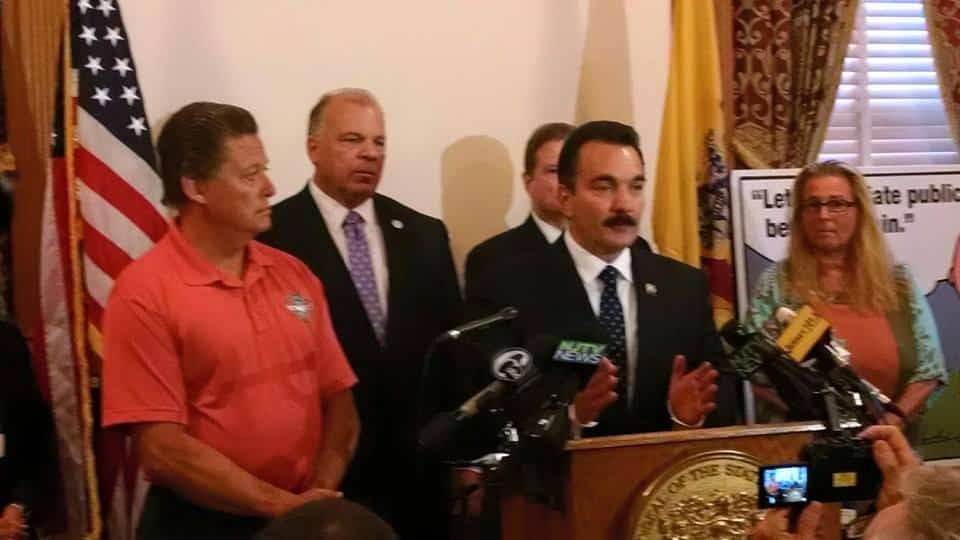
file photo Sweeney & Prieto
By Samantha Marcus | NJ Advance Media for NJ.com
on August 25, 2016 at 5:11 PM
TRENTON — New Jersey’s public pension fund is shakier than all but two U.S. states also known for their notoriously underfunded retirement systems, according to a new comparison by the Pew Charitable Trusts.
The pension fund was just 42 percent funded in 2014, based on the latest data available for 238 retirement plans in 50 states, Pew said.
Illinois and Kentucky were each only 41 percent funded. Only three states — South Dakota, Oregon and Wisconsin — were more than 100 percent funded.




 Ridgewood NJ, Department of Environmental Protection Commissioner Bob Martin today placed 14 counties encompassing the northern, central and northern coastal areas of New Jersey under a drought warning due to ongoing precipitation deficits and deteriorating water-supply conditions, particularly storage levels in reservoirs.