Posted on 4 Comments

Homeland Security Reveal Sanctuary Cities Released Illegal Aliens Charged with Assaults, Drug and Weapons Violations

ICE

October 23,2017

the staff of the Ridgewood blog

(Washington, DC) – Judicial Watch today released two new productions of documents (45 pages and 680 pages) from the Department of Homeland Security revealing that hundreds of counties across the U.S. denied Immigration and Customs Enforcement’s (ICE) detainer requests for criminal illegal aliens in the first quarter of fiscal year 2017. The retainer requests, containing specific information about scores of criminal charges against released aliens, were not included in the Declined Detainer Outcome Reports (DDOR) the Trump administration suspended in early April after only three weeks of publication.

Judicial Watch forced the release of the Homeland Security documents as a result of a court order in a May 26, 2017, FOIA lawsuit filed after Homeland Security failed to respond to an April 13, 2017 FOIA request (Judicial Watch v. U.S. Department of Homeland Security (No. 1:17-cv-01008)). Judicial Watch seeks:

All complaints received by ICE concerning the [Declined Detainer Outcome Report]
All records concerning the suspension of the weekly publication of the [Declined Detainer Outcome Report]
All records identifying the reporting methodologies used to create the [Declined Detainer Outcome Report]

Judicial Watch released several spreadsheets compiling statistics on the nature of criminal activities illegal aliens had committed during the first four months of 2017; a nationwide list of jails that failed to cooperate with the ICE detainer program; and the top 50 jurisdictions that failed to cooperative with the ICE detainer program.

Leading the pack of counties denying detainers between July 2015 were Ventura County, CA (188); Miami-Dade, FL (93); Denver, CO (74); Clark, NV (68); and Los Angeles, CA (57).

Nationwide, A total of 284 detainers involving serious offenses were declined during the first two months of fiscal year 2017, including, in part, various forms of assault (16); drug-and-alcohol-related charges (39); weapons charges and crimes against persons and property (18).

The Declined Detainer Outcome Reports highlighted state and local governments that did not comply with ICE’s detainer program (also known as sanctuary cities). According to one new ICE email, the DDOR was meant to easily understood:

So an American citizen sitting at home can open the report, see the total number of detainers issued in a week, detainers issued to jurisdictions that don’t cooperate, the confirmed declined detainer list, and the list of all jurisdictions that don’t honor detainers.  A snapshot, in essence.

In an April 6, 2017, email from Acting Director of Homeland Security, Thomas Homan, to Homeland Security staff in response to complaints about errors in the DDOR from U.S. Senator Chuck Schumer’s (D-NY) office, Homan said:

Certainly but NYC is extremely uncooperative. We will provide the information and work with OPLA and OGC staff to engage. They removed our officers from Rikers Island and will not honor detainers. I met with them personally last year in an effort to gain more cooperation. We will review asap.

In at least one instance, local law enforcement actions went beyond a simple lack of cooperation with ICE to turn over detained illegal aliens to outright obstruction of ICE’s efforts to pick up illegal immigrants in local custody. For example, according to a March 21, 2017, ICE email: “Hennepin County Adult Detention Center released an alien out the front door of the jail as an ICE officer was waiting in their sally port to take him into custody.”

“These new documents confirm that sanctuary policies are dangerous and help the worst of worst criminal element,” said Judicial Watch President Tom Fitton. “The complaints of sanctuary politicians aside, the Trump administration must catalogue the continued threat to the public safety caused by lawless sanctuary policies.”

In April, Judicial Watch obtained 204 illegal alien Detainer Requests denied to U.S. Immigration and Customs Enforcement (ICE) by the Travis County, Texas, Sheriff’s Office. The illegal aliens protected by the Sheriff’s Office were charged or convicted of 31 acts of violence, 14 thefts or burglaries, and three acts or threats of terrorism. Forty-four of the denied requests were for inmates originally detained by Homeland Security and temporarily transferred to Travis County (home to the state capital in Austin) for disposition of state or local charges.

According to CNN, the Trump Administration suspended publication of the Declined Detainer Outcome Reports on April 11, 2017, after only three weeks and three total reports due to “complaints.”  The Hill further reported that according to ICE spokeswoman Sarah Rodriguez, the Declined Detainer Outcome Reports were halted in order to “analyze and refine [the organization’s] reporting methodologies.”

The Declined Detainer Outcome Reports highlighted state and local governments, often referred to as sanctuary cities, that did not comply with ICE’s detainer program:

ICE places detainers on aliens who have been arrested on local criminal charges and for whom ICE possesses probable cause to believe that they are removable from the United States, so that ICE can take custody of the alien when he or she is released from local custody. When law enforcement agencies fail to honor immigration detainers and release serious criminal offenders, it undermines ICE’s ability to protect public safety and carry out its mission.

Posted on 2 Comments

20K New Jersey DWI Cases Could Be Thrown Out

Honda-Civics-collide-Ridgewood-Police-Ridgewood-Fire-Deparrtment3-300x225

file photo

October 22,2017

the staff of the Ridgewood blog

Trenton NJ, good news for those convicted in DWI cases in New Jersey .  According to NJ Advance Media Prosecutors are notifying more than 20,000 people charged with drunken driving that their cases are under review after a State Police sergeant who oversaw breath-testing devices was accused of falsifying records .

Multi-County prosecutors have been sending letters to people charged with driving while intoxicated between 2008 and 2016 informing them a specially appointed judge would weigh “whether you are entitled to relief” based on the accusations against the sergeant. These letters were sent in recent weeks to DWI defendants in Middlesex, Monmouth, Ocean, Somerset, and Union counties.

NJ Advance Media also reported that Prosecutors and defense attorneys claim the number of cases that could be thrown out as a result of the criminal inquiry is likely low. But the issue, which came amid a similar probe of the State Police drug lab, created a morass of legal challenges which could take years to sort out.

New Jersey prosecutors often rely on evidence of a defendant’s blood alcohol concentration (BAC) to prove guilt in driving while intoxicated (DWI) cases. Police officers typically determine a person’s BAC by testing a breath sample. All police departments in this state use a device known as the Alcotest for this purpose. The Alcotest is prone to errors, and it requires continual maintenance.

The Alcohol Drug Testing Unit (ADTU) of the New Jersey State Police is responsible for inspecting Alcotest devices throughout the state, performing calibrations and recalibrations, and maintaining the required documentation certifying that each device is in proper working order.

State Police Sgt. Marc Dennis, a coordinator in the State Police Alcohol Drug Testing Unit, was accused last year of lying on official documents about completing a legally required step in re-calibrating the machines, known as Alcotest devices, which are used to check the blood-alcohol level of accused drunken drivers.

Dennis, denies the charges against him, was allegedly observed skipping the step in calibrating just three machines. But the criminal accusations raised a cloud of doubt over every device touched by the trooper, who performed routine checks on devices used by local police across five counties.

“Sergeant Dennis’ alleged false swearing and improper calibrations of these three instruments may call into question all of the calibrations performed by Sergeant Dennis over the course of his career as a coordinator,” said one letter, a copy of which was obtained by NJ Advance Media.

Posted on 1 Comment

You Still Can Use a New Jersey Drivers Licenses to Board a Plane

NJ+Drivers+License[1]

October 21,2017

the staff of the Ridgewood blog

Ridgewood NJ, when is an ID not and ID? According to the Department of Homeland Security (DHS) 22 U.S. states including New Jersey missed the federal government’s REAL ID deadline, meaning their drivers licenses still don’t comply with government security standards.

Without certification from DHS, people who live in those states won’t be able to board commercial airline flights using their drivers licenses or state IDs. For most people, that would mean carrying a passport every time they go to the airport even for 100 percent domestic flights.

For some back ground ,the Department of Homeland Security (DHS) announced on December 20, 2013 a phased enforcement plan for the REAL ID Act (the Act), as passed by Congress, that will implement the Act in a measured, fair, and responsible way.

Secure driver’s licenses and identification documents are a vital component of our national security framework. The REAL ID Act, passed by Congress in 2005, enacted the 9/11 Commission’s recommendation that the Federal Government “set standards for the issuance of sources of identification, such as driver’s licenses.” The Act established minimum security standards for license issuance and production and prohibits Federal agencies from accepting for certain purposes driver’s licenses and identification cards from states not meeting the Act’s minimum standards. The purposes covered by the Act are: accessing Federal facilities, entering nuclear power plants, and, no sooner than 2016, boarding federally regulated commercial aircraft.

DHS is committed to enforcing the REAL ID Act in accordance with the phased enforcement schedule and regulatory timeframes and is not inclined to grant additional extensions to any states that are not both committed to achieving full compliance and making substantial and documented progress in satisfying any unmet requirements. It has been 12 years since the REAL ID Act was passed and half of all the states have already met the REAL ID minimum standards. It is time that the remaining jurisdictions turn their commitments to secure identification into action.

Posted on 3 Comments

Democrat Phil Murphy likes New Jersey grapefruit’s and broccoli

Grapefruit martini

“NJ” Grapefruit martini

October 19,2017

the staff of the Ridgewood blog

Ridgewood NJ, while everyone was watching the Yankee game , the two candidates for New Jersey Governor had their second debate . Most New Jersey voters seemed to be resigned to coming calamity and have zero faith in New Jersey politicians .

Republican Kim Guadagno has attempted to stay on her tax cutting message . During the debate she appeared calm, confident and comfortable and in an attempt to distance her self from Governor Chris Christie , she unequivocally pledged not to appoint him to the U.S. Senate in the event that Senator Bob Menendez resigns.

Voters seem luke warm to her tax cut pledge , most feeling Trenton lakes any credibility and Kim often comes off sounding like former governor and EPA chief “the air is ok, barrow from the pensions” Whitman .

On the other hand Democrat Phil Murphy known as Corzine 2.0 , has promised to make New Jersey a “sanctuary state” , he says he will raise your taxes in a massive tax increase of $1.3 billion . He treads water and will not commit  to extending the 2% arbitration cap for police and firefighter salaries and would not say weather the ethically challenged Democratic Senator Bob Menendez should resign if convicted of bribery. Murphy continues to push the Connecticut model, under the “tax the rich” mantra . The Connecticut model fell flat ,because the “rich” moved and so did General Electric and Aetna the states two largest tax payers and employers ,leaving Connecticut  on the verge of bankruptcy and collapse .

In probably the most telling question in the debate , Murphy clams to like New Jersey grapefruit’s and broccoli yes you heard me , while Kim likes Jersey tomatoes and cranberries, once again proving that you can buy a nomination , but it helps to live here and know something about the state your trying to govern .

Posted on 1 Comment

Pastors say they didn’t give permission to use their names on anti-Guadagno Democrat press release

Phill Murphy -Sara Medina del Castillo

October 15,2017

the staff of the Ridgewood blog

Ridgewood NJ, New Jersey Governor’s race gets ugly  as a Democratic press release circulating in New Jersey with the names of more than a dozen Hispanic pastors denouncing Republican gubernatorial nominee Kim Guadagno’s ad linking Democratic gubernatorial nominee Phil Murphy to a violent crime committed by an undocumented immigrant.

The problem is that the pastors claim they did not endorse or give permission to use their names on anti-Guadagno release. At least two of the pastors included so far on the Spanish-language release including one who is the father of a Guadagno adviser says their names were added without their knowledge, let alone their permission.

The Lieutenant Governor Kim Guadagno said on Facebook ,”It is beyond the pale for Phil Murphy to go as far as to create a fake organization and forge the signatures of Hispanic clergy members to falsely attack Kim Guadagno,” said Guadagno Spokesman Ricky Diaz. “It should give all New Jerseyans pause that Phil Murphy would take advantage of men of the cloth to lie to the people of New Jersey. Phil Murphy should immediately take responsibility and apologize to these clergy members.”

The Murphy campaigns denies any involvement in the press release .

Posted on Leave a comment

Weinstein had a top-secret meeting with Democrat Phil Murphy

Phill Murphy -Sara Medina del Castillo

October 11,2017

the staff of the Ridgewood blog

Ridgewood Nj, according to the New York Post page 6 , Robert De Niro and Harvey Weinstein had a top-secret meeting on Thursday, sources said, with Democrat front runner Phil Murphy ,yes that Phil Murphy (Corzine 2.0),  the Democratic favorite to succeed New Jersey Gov. Chris Christie.The trio was said to be meeting in Tribeca at the Greenwich Street offices that house De Niro and Weinstein’s film companies. It appears Democrats still love that Weinstein money .

Posted on 5 Comments

Over A Dozen N.J. mayors were forced from office over criminal charges in the Last Decade

Sopranos season3 episode011

October 1,2017
the staff of the Ridgewood blog

Ridgewood NJ, New Jersey has a long and proud history of public corruption.  A dozen Garden State mayors who have been forced to resign over the past decade due to criminal convictions. Mostly Democrats (10) ,but a few Republicans trying to get in on the action .

Paterson Mayor Jose “Joey” Torres, a Democrat, pleaded guilty on Friday to conspiracy to commit official misconduct for having employees with the Department of Public Works perform work for the mayor and his family members while bilking the city out of overtime. Torres follows a long line of Mayoral criminality .

Passaic Mayor Alex Blanco, a Democrat, was sentenced in April to more than two years in prison after pleading guilty to a federal bribery charge for soliciting $110,000 in bribes from developers in exchange for sending federal housing funds their way.

Passaic Mayor Samuel “Sammy” Rivera, a Democrat, pleaded guilty in 2008 to extortion for accepting $5,000 in cash from an insurance brokerage firm. Rivera, who was among 11 public officials swept up in a statewide FBI sting, was sentenced to 21 months in prison.

Newark Mayor Sharpe James, a Democrat, was convicted in 2008 on federal fraud and conspiracy charges for helping a woman described as his mistress buy nine plots in a city redevelopment zone, among other acts of wrongdoing. James was sentenced to 27 months in prison.

Trenton Mayor Tony Mack, a Democrat, was sentenced in May 2014 to nearly five years in prison in connection with a $119,000 bribery scheme linked to a parking garage project operated by FBI informants.

Hamilton Mayor John Bencivengo, a Democrat, was released from prison in December 2014 after serving more than 18 months in federal prison. He was sentenced to 38 months in prison for accepting $12,400 in bribes from Marliese Ljuba, a close friend and health insurance broker for the school district.

Hoboken Mayor Peter Cammaranno, a Democrat, was among 44 people swept up in Operation Bid Rig. Cammarano, who’d been in office for only 22 days before his arrest, was sentenced in August 2010 to two years in prison, and later disbarred.

Secaucus Mayor Dennis Elwell, a Democrat, was sentenced in April 2012 to two-and-a-half years in prison after he was convicted of accepting $10,000 in cash through a middleman from Solomon Dwek, as part of Operation Bid Rig. Elwell, who resigned from his position shortly after his arrest, later lost an appeal challenging his conviction.

Northvale Mayor Paul Bazela, a Democrat and a former foreman for the Passaic Valley Sewerage Commission, pleaded guilty to theft in March 2016 to having his workers perform renovations at the home of the commission’s former superintendent, Kevin Keogh, while on agency time. He was sentenced to three years in prison.

Guttenberg Mayor David Delle Donna, a Democrat, and his wife were each sentenced in 2008 to more than four years in prison for accepting more than $40,000 in gifts and cash campaign contributions from a local bar owner.

Of coarse Democrats don’t have all the fun ;

Manalapan Mayor Andrew Lucas, a Republican, was sentenced to five years in prison for fraud in connection with a $1.2 million farm deal. Convicted on charges of wire fraud, an illegal monetary transaction, loan application fraud, false statements to the IRS, aggravated identity theft, obstruction of a grand jury investigation and falsification of records in a federal investigation.

Chesterfield Mayor Lawrence Durr, a Republican, was sentenced in April 2016 to four years probation after he admitted to filing false ethics disclosure forms that failed to disclose his financial relationship with a real estate developer. Durr was accused in an indictment of selling development rights on his farm to Renaissance Properties at a profit and then using his official positions to advance the company’s interests in Chesterfield.

Posted on 2 Comments

Supreme Court Agrees to Hear Case Against Compulsory Public-Sector Union Fees

l_20140108-trenton-capitol-building-1200


SCOTUS will hear Janus v. American Federation of State, County, and Municipal Employees, Council 31 this term.

Damon Root|Sep. 28, 2017 10:55 am

Today the U.S. Supreme Court agreed to hear a case that has the potential of delivering a death blow to the legal privileges enjoyed by public-sector unions.

The case is Janus v. American Federation of State, County, and Municipal Employees, Council 31. At issue is whether it is constitutional for state governments to compel public-sector workers to pay union fees as a condition of employment even when those workers are not union members.

The case was brought by Mark Janus, a state employee in Illinois who objects to paying mandatory fees to a union that he has refused to join. Janus argues that the state’s scheme violates his First Amendment rights by forcing him to support political speech and activity that he does not wish to support.

Janus’s overarching goal is to overturn the Supreme Court’s 1977 precedent in Abood v. Detroit Board of Education, in which the Court approved mandatory public-sector union fees on the grounds that non-union “free riders” should have to contribute something toward collective bargaining activities that benefit them too. That ruling provided a massive boon to public-sector unions nationwide.

https://reason.com/blog/2017/09/28/supreme-court-agrees-to-hear-major-case

Posted on 1 Comment

NJEA Flexes Its Muscles, Takes on Sweeney

Steve-Sweeney-Atlantic-City-finances

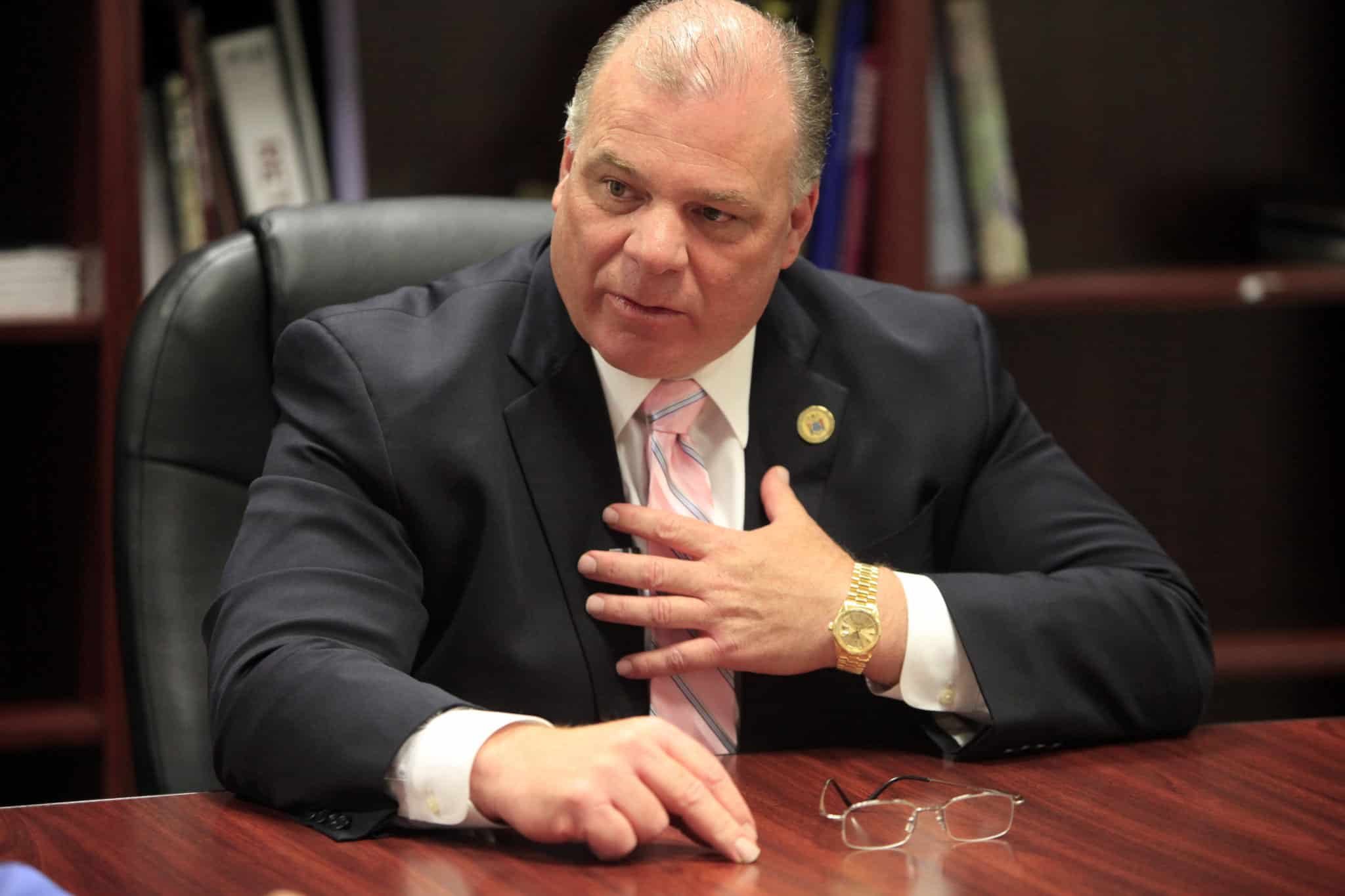
file photo Senate President Stephen Sweeney

Chase Brush | September 25, 2017

The teachers union faults the Senate president for his stand on public-employee pensions and school funding — and they want to make him pay.

What has 200,000 members, a deep-pocketed super PAC, and one of the most powerful presences in all New Jersey politics?

It’s the New Jersey Education Association, and it’s not to be trifled with.

That’s the apparent message being conveyed by the relevant-as-ever group this election season, as it continues to wield its influence in several state and local races following a hard-fought primary and ahead of a November general election. Through special-interest spending and public endorsements, the group has sought to advance its agenda by aligning itself with both Republicans and Democrats, ultimately making itself known in nearly every corner of the state.

The organization has issued endorsements in 37 out of 40 legislative districts, including one for Democrat Phil Murphy in the state’s high-profile gubernatorial election.

https://www.njspotlight.com/stories/17/09/25/njea-flexes-its-muscles-takes-on-sweeney/

Posted on 1 Comment

Opinion: Doing the Murphy Math — Taxing Millionaires Won’t Cut It

Phill Murphy -Sara Medina del Castillo

Carl Golden | September 20, 2017

Dragging the Christie anchor behind her, Guadagno can’t get any traction when it comes to warning voters what her rival’s programs could cost

Carl Golden

The year was 1938. Franklin D. Roosevelt occupied the White House, struggling to lift the nation from the depths of its most punishing Great Depression.

History has it that Harry Hopkins, head of the Works Progress Administration (WPA) and Roosevelt’s closest and most trusted advisor, recommended unprecedented massive government intervention as the solution.

“We shall tax and tax, spend and spend, elect and elect,” Hopkins is supposed to have said to the president, a blunt assessment for breaking the bleak economic circumstances of the time by extracting money from the wealthy, spending vast sums of it on public works job creation, and basking in subsequent electoral victories delivered by a grateful nation.

Hopkins later disputed reports of his rather cynical political calculation, but the legend lives on. (Note: Hopkins’ remark was first reported by the New York Times. His denials may be the first recorded allegation of “fake news” directed at the Times.)

https://www.njspotlight.com/stories/17/09/19/opinion-doing-the-murphy-math-taxing-millionaires-won-t-cut-it/

Posted on 1 Comment

We owe HOW much? Why NJ has worst taxpayer burden in nation

for sale Ridgewood_Real_Estate_theRodgewopodblog

By David Matthau September 19, 2017 7:13 PM

Here’s a real shocker.

A new report gives New Jersey a grade of “F” for having the worst finances of any state in the nation.

According to Sheila Weinberg, the CEO of Truth in Accounting, a think tank that analyzes government financial reporting, New Jersey’s finances have been in a free-fall for the past three years.

“If you divide the amount of money needed to pay all of New Jersey’s outstanding bills by the number of state residents, each taxpayer’s burden is $67,200,” she said.

“This represents the amount that each taxpayer would have to send to the state capital just to bring the state’s finances back into a balance.”

She pointed out another way to look at it is this is the amount of money New Jerseyans will have to pay in the future in taxes, but they won’t receive any benefits or services.


Read More: We owe HOW much? Why NJ has worst taxpayer burden in nation | https://nj1015.com/we-owe-how-much-why-nj-has-worst-taxpayer-burden-in-nation/?trackback=tsmclip

Posted on Leave a comment

Budget Basics: How New Jersey Spends Your Money

Trenton_New_Jersey


Richard F. Keevey | September 13, 2017

A series that details the fundamentals of New Jersey’s budget, as well as its current budget woes

Richard F. Keevey

This is the first in a multipart series outlining New Jersey’s fiscal fundamentals, written by Richard F. Keevey, the former budget director and comptroller for New Jersey and currently a senior policy fellow at the School of Planning and Policy at Rutgers University. The idea behind this series is to demystify some of the state’s financial challenges, and put them in context of the broader issues New Jersey faces. It’s also intended as a way to underscore the importance of state government in a year that will see a new governor and a new Legislature chosen by voters.

New Jersey has a strong central government. The governor has potent appointment and financial powers. New Jersey’s local governments like to tout their home-rule powers — and they’re correct in certain circumstances — but when it comes to municipal, county, and school finance the state’s powers and oversight are quite significant.

The office of the governor is viewed as the strongest in the country. Unlike many states, New Jersey’s governor (and lieutenant governor) are the only officers elected statewide, and all cabinet officers and principal state officials are appointed by the governor — unlike Pennsylvania, Delaware, and New York, for example, where several cabinet officials are elected.

https://www.njspotlight.com/stories/17/09/12/budget-basics-how-new-jersey-spends-your-money/

Posted on Leave a comment

Tax Facts: Getting Beyond All the Talk About New Jersey’s Taxes

for sale Ridgewood_Real_Estate_theRodgewopodblog

file photo by Boyd Loving

John Reitmeyer | September 13, 2017

More taxes, no new taxes, higher taxes, marijuana taxes, corporate taxes, tax relief, and even a new tax structure — it’s definitely an election year in the Garden State

Tax reform is becoming a hot topic in Washington, D.C., as President Donald Trump is looking for Congress to cut both corporate and personal income-tax rates. Similarly, the future of New Jersey tax policy is also expected to become a key issue in Trenton once the state welcomes its next governor early next year.

Democrats who control New Jersey’s Legislature signaled several months ago as they were hashing out a new state budget with Gov. Chris Christie that they would be pushing once again for a millionaires tax to bring in more funding for local school districts once the term-limited Republican governor leaves office in January 2018.

And if Democratic gubernatorial candidate Phil Murphy ends up winning the gubernatorial election in November — something that the latest public-opinion polls suggest is likely — legislative leaders should find a willing partner. Murphy’s own fiscal platform includes a call for enacting a higher levy on the state’s wealthiest residents, among other tax-policy changes.

But even if Murphy’s opponent, Republican Kim Guadagno, ends up pulling off an upset, she’s also talking about tax reform. The centerpiece of her economic agenda is a more than $1 billion “circuit breaker” property-tax relief initiative.

https://www.njspotlight.com/stories/17/09/12/tax-facts-getting-beyond-all-the-talk-about-new-jersey-s-taxes/

Posted on Leave a comment

Christie administration pushes on in labor dispute over public worker pay increases

look_4_the_Union_label_theridgewoodblog


Posted on September 3, 2017 at 7:20 AM

By Samantha Marcus

[email protected],

NJ Advance Media for NJ.com

TRENTON — Gov. Chris Christie’s administration is digging in on a labor dispute in which it refuses to pay public employees’ step increases after their contracts expired, despite state court rulings that have largely upheld the practice.

The administration has asked the Public Employment Relations Commission to block the union’s request to go to arbitration to argue that the state should pay their step increases.

Tens of thousands of state employees have missed one or more of these longevity pay bumps as the state froze salaries for workers whose contracts expired June 30, 2015. The state relied on a decision from PERC that upended a four-decades-old custom of step increases outliving the term of a contract.

Hetty Rosenstein, state director of the Communications Workers of America, New Jersey’s largest state employee union, said that despite a state Supreme Court ruling in August rebuking PERC, Christie’s administration is still seeking to freeze employees on the salary guide.

https://www.nj.com/politics/index.ssf/2017/09/christie_pushes_on_in_labor_dispute_over_pay_incre.html#incart_2box_nj-homepage-featured

Posted on Leave a comment

IN NJ, AS IN NEARBY STATES, COMPETITIVENESS DRIVES AFFORDABILITY

for sale Ridgewood_Real_Estate_theRodgewopodblog

file photo by Boyd Loving

The only way to stem our tide of outmigration is to bring our economic policies in line with our direct regional competitors — Pennsylvania and New York

September 4,2017
written by OpportunityNJ June 26, 2017

Ridgewood NJ, New Jersey has many positive attributes. We added almost 60,000 jobs in 2016, the state’s largest gain since 2000, according to the New Jersey Department of Labor and Workforce Development. We have among the best K-12 public education systems in the nation and a highly skilled workforce including the highest concentration of scientists and engineers in the world — more than 225,000 statewide.

New Jersey also has a strong transportation network. We are home to the Port of New York and New Jersey, the third largest seaport in North America and the largest and busiest maritime cargo center on the East Coast. And we are among the national leaders in logistics and distribution. New Jersey is also a great recreation state with more than 130 miles of shoreline, beautiful parks, and mountains.

Despite these great assets, New Jersey remains a significant outlier, both nationally and regionally when comparing competitiveness and affordability including our state’s high cost of living and its heavy tax burden. New Jersey’s border states, Pennsylvania and New York, continue to be the No. 1 and No. 2 outmigration states for New Jersey residents and are challenging our competitiveness.

To reverse this trend we must examine our policies on taxation, revenue generation, and spending, and we must do so through the filter of competitiveness and affordability.

Outmigration by the numbers

In February 2016, the NJBIA issued Outmigration by the Numbers: How do we Stop the Exodus? This report found that New Jersey lost $18 billion in net-adjusted gross income over a decade. We have now updated this data to include 2015 data and have learned the loss has since grown to nearly $21 billion over 11 years (2004-2005 through 2014-2015). Further, we found the largest outmigration group continues to be millennials followed second by those nearing retirement and retirees.

Last November, New Jersey took the first step in the long road toward comprehensive tax reform by phasing out the estate tax and sharply increasing the income tax exclusion for pension and retirement income. The estate tax elimination and the pension tax reduction should help stem the outmigration of seniors and small businesses. While this is a good start, there is much more that must be done.

New Jersey ranks in the bottom six of every single tax category — income, property, sales, corporate, and inheritance. And we are in the bottom 10 of all states in combined state and local debt. Further, New Jersey residents pay the fifth-highest percentage of their household income on rent of any state and pay the fourth-highest median monthly rent of any state.

New Jersey’s top income tax rate is 8.97 percent and ranks as the sixth highest in the country. Our neighbors to the north and the west offer a better income tax rate than we do, with New York’s top income tax rate at 8.82 percent and Pennsylvania’s income tax rate flat at 3.07 percent.

Out-of-control property taxes

New Jersey has an average property tax bill of $8,549 and collects $2,924 per capita in property taxes, both of which are the highest in the nation. New York at $2,435 and Pennsylvania at $1,338 per capita are considerably lower than New Jersey, as is the national per capita of $1,300.

New Jersey has the fifth-highest corporate income tax (9 percent) in the nation. New York ranks 24th, offering a lower corporate tax rate of 6.5 percent. While Pennsylvania has a higher corporate income tax rate at 9.9 percent, it has a much more favorable personal income, property, and inheritance tax climate that offsets this tax impact.

While New Jersey is in the process of eliminating the estate tax by 2018, we still have an inheritance tax. Only five other states — Nebraska, Kentucky, Iowa, Pennsylvania, and Maryland — even have an inheritance tax. Further, while Pennsylvania has an inheritance tax, the state mitigates the impact of this tax on small businesses.

New Jersey’s debt picture is no different than its tax climate. We are near the bottom of the national rankings in every debt category. Overall, as of June 30, 2015 the state had more than $153 billion in bonded and nonbonded indebtedness according to the fiscal year 2015 state debt report.

The state’s high level of debt and the need to generate revenue to pay off the debt is a major factor that affects the ability to lower the state’s tax burden to improve the level of affordability for individuals, families, and businesses. However, we can no longer increase our tax burden in order to raise revenue to pay down this enormous debt. This would only make New Jersey even less competitive and would surely feed into an exit strategy for New Jersey businesses and residents.

The time is now to revisit and completely review our economic policies on taxation, revenue generation, and spending and we must do so with a sense of urgency. We must look at how we spend our tax dollars and be honest about the fact that our current economic paradigm is just not sustainable. Failing to do so now will compound the problem for the generations to come.

The only way to stem our tide of outmigration is to bring our economic policies in line with our direct regional competitors — Pennsylvania and New York. Becoming more competitive means becoming more affordable so that businesses will want to locate here and taxpayers will want to live here.