Riders on NJ Transit are already hopping mad about a proposed 9 percent fare increase. Hundreds of them have bombarded the agency since April with angry emails, letters and in-person testimonials opposing the move, which will fill a $56 million budget gap if approved three weeks from now by NJ Transit’s board members.
But what if this fare increase is only the beginning? (Maag/The Record)
Taxing the 1% won’t cover the under-funding gap, you’d either have to raise state income taxes by 29% overall or raise the NJ sales tax to 10% just to maintain existing benefits…such measures would face significant obstacles from State constitutional mandates on the use of specific revenue sources for particular purposes, such as the dedication of all income taxes to property tax relief. In addition, the State must obey federal mandates, honor bonded obligations and meet other funding demands. As a result, roughly 87% of State revenues are effectively committed to specific purposes before the budgeting process begins. The remaining funds—$4.3 billion in the current budget—are counted on for vital functions such as law enforcement, public safety, the judiciary, and executive department offices. A “millionaires’ tax” imposing an average $50,000 additional annual tax on each millionaire, for example, would make only a small dent in the funding shortfall. It would still require the State to impose a 23% income tax increase on every other taxpayer. As a matter of political reality, potential tax increases of this magnitude would first be preceded by substantial benefit reductions. If existing pension and retiree health benefits are considered beyond reach, the remaining options would involve actions such as reducing active employees’ health benefits to the equivalent of Bronze-level coverage under the Patient Protection and Affordable Care Act (“ACA”) and eliminating retirement benefits for employees hired after 2010.
Very few private sector jobs offer pensions anymore, and subsidized health care coverage until age 65 is only for public sector workers. So why are my taxes going to subsidize these things for public workers, some of whom make more than the median household income in Ridgewood? The original contract to provide a pension and healthcare coverage for those in public service was based off of trade-off: lower wages in return for retirement security. That trade-off no longer holds true, and because retirees are living longer in to their mid-80s on average, the pension and healthcare bills are piling up… and yet these guys in Trenton just want to keep on raising my taxes?
Ridgewood NJ, Despite the contention by Ridgewood Deputy Mayor Albert Pucciarelli that nobody on the dais knows exactly how much the new parking garage will cost (“. . . no price has been set. . . “) the number $15 million was put into play during Wednesday evening’s Village Council Work Session. The last I heard (just a few weeks ago), the number being kicked around was $10 million. A 50% increase in less than 60 days; I must say, somewhat surprising, but not utterly shocking.
Ridgewood Mayor Paul Aronsohn said on Wednesday evening that between $10-$15 million in public finding would “presumably” be “asked for.” Then the Mayor read the draft of a question intended to be part of a non-binding referendum the Council is considering including on the ballot of November’s general election.
The draft question was read as follows: “Do you support a proposal to finance and build a downtown parking garage on the Hudson Street lot, located on the corner of Hudson Street and South Broad Street, by bonding up to $15 million of public funds through Parking Utility revenues.”
Remember folks; following damage caused by Hurricane Floyd, renovations to Village Hall were expected to cost $4.5 million (or at least that’s what taxpayers were told). Change orders approved by the Village Council back then escalated the actual costs to above $11 million. How far above $11 million we spent is a closely guarded secret.
So now we’re being told, by our mayor, that we might spend up to $15 million to build a single garage. Anyone out there want to hazard a guess on what the real number will turn out to be? Will history (the Village Hall renovation fiasco) repeat itself?
And what about the language of that draft question (and you can insert any number you want into the equation). Is it just me, or would many of you interpret that language to indicate Parking Utility revenues will completely pay for the project (including bond interest?). Translation, our property taxes won’t increase? Am I the only one who’s a bit worried by that statement?
I am neither for nor against the financing and construction a parking garage at this point, but I am completely against being misled as to projected costs and the impact on an average homeowner’s property tax bill. I refuse to be fooled again.
If there is a non-binding referendum on your November ballot, be sure to read the entire financing plan very carefully before you make a choice.
By Victor Morton – The Washington Times – Monday, June 22, 2015
National Democrats tried Monday evening to raise funds off the South Carolina Confederate flag flap.
In a blast email sent after 7 p.m. Monday, the Democratic Congressional Campaign Committee said the issue of the Confederate flag, which zoomed to the front of national consciousness after a white supremacist was charged with nine counts of murder after a shooting at a historic black church in Charleston, was “not over yet.”
The email says Gov. Nikki Haley’s announcement is not legislation and asked recipients to answer the question, “Should South Carolina take down the Confederate flag from its state Capitol?”
It reads, “41,338 people have recorded their answer — but we still haven’t heard from you,” it asks the subscriber by name.
A person cannot answer the survey question at the DCCC site without putting in an email address, which gives the DCCC the ability to solicit contributions.
Once the person answers the question and provides an address, the page reads, “Thanks for taking the instant poll today! Now take the next step: Donate $3 or more to support Democrats, and we’ll send you this free ‘Yes. I Voted Obama’ sticker in the mail!”
TRENTON — Moving a step closer on its fast track to the governor’s desk, the Assembly Appropriations Committee voted up acomplex bill aimed at modernizing and streamlining New Jersey’s voter laws today.
Along party lines, members of the committee debated and ultimately passed the bill, introduced by Democratic leaders in both houses last week and dubbed the “Democracy Act” for its intended goal of increasing voting rights access to certain demographics in the state. Sponsors of the bill say it would make it easier for residents to register to vote and vote in state elections by implementing measures like online voter registration, same day registration, and new technologies at the ballot boxes — all of which would help increase voter turnout in the state, which ranks 39th in the country in terms of registered voters at 64 percent, with an average voter turnout of 54.5 percent. (Brush/PolitickerNJ)
TRENTON—State Democrats plan to advance budget bills Tuesday that raise taxes on high earners and corporate profits to shore up the state’s underfunded pension system, a proposal likely doomed because Republican Gov. Chris Christie has pledged to veto any tax increases.
The annual budget dance in Trenton typically leads to interparty fighting in June, but observers said that this year’s proceedings were particularly defined by gridlock, resulting in more political theater than fiscal negotiations. (Haddon/Wall Street Journal)
When Condoleezza Rice headlined a 2009 fundraising luncheon for the Boys and Girls Club of Long Beach, she collected a $60,000 speaking fee, then donated almost all of it back to the club, according to multiple sources familiar with the club’s finances.
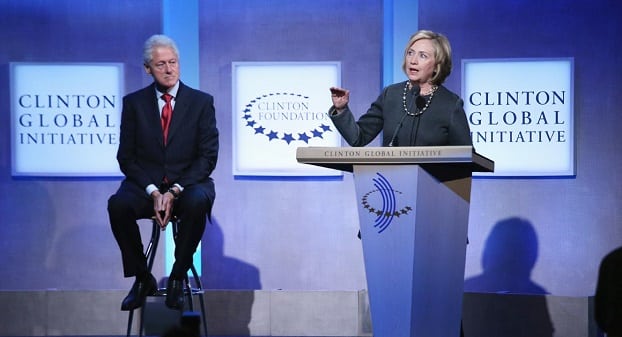
Hillary Clinton was not so generous to the small charity, which provides after-school programs to underprivileged children across the Southern California city. Clinton collected $200,000 to speak at the same event five years later, but she donated nothing back to the club, which raised less than half as much from Clinton’s appearance as from Rice’s, according to the sources and tax filings.
Instead, Clinton steered her speaking fee to her family’s own sprawling $2 billion charity.
This “charity” would primarily be a cookie jar for the Clinton’s and their coterie of progressive catchfarts. About 90% of its annual budget on things like salaries, travel, etc. rather than actually doing something useful.
Research shows that resveratrol, an ingredient fround in grapes, berries and red wine can help turn flab into calorie-burning ‘brown’ fat. Just drink responsibly!
By Agency
3:50PM BST 21 Jun 2015
Wine lovers rejoice! New research has shown that an ingredient in grapes, berries and red wine can turn excess flab into calorie-burning “brown” fat. The discovery suggests that diets containing the substance, resveratrol, may help combat obesity.
Scientists gave mice amounts of resveratrol equivalent to humans consuming 12 ounces of fruit per day. They found that despite a high fat diet, the mice gained 40% less weight than animals not fed the compound.
When a doctor told Susan Levin her 4-year-old son, Ben, was autistic, she was shocked. It was October 2007, and autism wasn’t mentioned in the media nearly as much as it is today.
“I remember thinking, ‘Oh my God. What are we going to do?’ ” Levin recalls. “Everyone knew autism was a lifelong disorder and couldn’t be cured.”
Except that in Ben’s case, it could be. And it was.
The family’s journey — the many treatments tried and dismissed, from biomedical interventions to speech therapy to occupational therapy and more — is detailed in her new memoir, “Unlocked: A Family Emerging From the Shadows of Autism.”
Levin doesn’t call this particular cure a silver bullet for autism: There is no silver bullet, no one-size-fits-all approach. Rather, she credits his transformation to a number of things, including a home based and child centered social-relational program called the Son-Rise Program.
Greece is facing a full-blown banking crisis after a meeting of eurozone finance ministers broke down in acrimony and recrimination, forcing leaders to meet next week.
Greece is facing a full-blown banking crisis after a meeting of eurozone finance ministers broke down in acrimony and recrimination on Thursday evening, bringing the prospect of Greek exit from the eurozone a step nearer.
Some €2bn of deposits have been withdrawn from Greek banks so far this week – including a record €1bn yesterday – triggering fears that a breakdown in talks would spark a further flight of funds. The German leader Angela Merkel, French president François Hollande and Greek prime minister Alexis Tsipras agreed to stage an emergency EU summit on Monday as a last critical attempt to prevent Greece going bankrupt. A representative of the European Central Bank told the meeting it was unsure whether Greek banks would have the funds to be able to open on Monday.
Eurozone talks end without deal as Greek proposals rejectedRead more
As thousands of pro-EU protestors gathered outside the Athens parliament building, leaders of the eurozone and the International Monetary Fund aimed bitter criticism at the leftwing Greek government, accusing it of lying to its own people, misrepresenting and misleading other EU leaders, refusing to negotiate seriously, and taking Greece to the brink of catastrophe.
Dylann Storm Roof was taking habit-forming drug suboxone
by PAUL JOSEPH WATSON | JUNE 18, 2015
Charleston shooter Dylann Storm Roof was reportedly taking a drug that has been linked with sudden outbursts of violence, fitting the pattern of innumerable other mass shooters who were on or had recently come off pharmaceutical drugs linked to aggression.
According to a CBS News report, earlier this year when cops searched Roof after he was acting suspiciously inside a Bath and Body Works store, they found “orange strips” that Roof told officers was suboxone, a narcotic that is used to treat opiate addiction.
Suboxone is a habit-forming drug that has been connected with sudden outbursts of aggression.
A user on the MD Junction website relates how her husband “became violent, smashing things and threatening me,” after just a few days of coming off suboxone.
Another poster on the Drugs.com website tells the story of how his personality completely changed as a result of taking suboxone.
The individual relates how he became “nasty” and “violent” just weeks into taking the drug, adding that he would “snap” and be mean to people for no reason.
Another poster reveals how his son-in-law “completely changed on suboxone,” and that the drug sent him into “self-destruct mode.”
A user named ‘Jhalloway’ also tells the story of how her husband’s addiction to suboxone was “ruining our life.”
June marks the 800th anniversary of Magna Carta, the ‘Great Charter’ that established the rule of law for the English-speaking world. Its revolutionary impact still resounds today, writes Daniel Hannan
By
DANIEL HANNAN
May 29, 2015 11:07 a.m. ET
Eight hundred years ago next month, on a reedy stretch of riverbank in southern England, the most important bargain in the history of the human race was struck. I realize that’s a big claim, but in this case, only superlatives will do. As Lord Denning, the most celebrated modern British jurist put it, Magna Carta was “the greatest constitutional document of all time, the foundation of the freedom of the individual against the arbitrary authority of the despot.”
It was at Runnymede, on June 15, 1215, that the idea of the law standing above the government first took contractual form. King John accepted that he would no longer get to make the rules up as he went along. From that acceptance flowed, ultimately, all the rights and freedoms that we now take for granted: uncensored newspapers, security of property, equality before the law, habeas corpus, regular elections, sanctity of contract, jury trials.
Magna Carta is Latin for “Great Charter.” It was so named not because the men who drafted it foresaw its epochal power but because it was long. Yet, almost immediately, the document began to take on a political significance that justified the adjective in every sense.
The bishops and barons who had brought King John to the negotiating table understood that rights required an enforcement mechanism. The potency of a charter is not in its parchment but in the authority of its interpretation. The constitution of the U.S.S.R., to pluck an example more or less at random, promised all sorts of entitlements: free speech, free worship, free association. But as Soviet citizens learned, paper rights are worthless in the absence of mechanisms to hold rulers to account.
If you go to the beach, it’s probably crossed your mind at least once: Shark attacks can happen.
It’s hard not to think about it since they’re in the news every summer. The latest terrifying story is of two teens who were attacked by sharks on Sunday in two separate incidents along the same stretch of beach in North Carolina.
According to the Associated Press, a 12-year-old girl lost part of her arm and suffered a leg injury, and a 16-year-old boy lost his left arm a little more than an hour later. Even scarier, both were in waist-deep water.
The most recent attacks weren’t the only ones the area has seen. A shark bit a 13-year-old girl’s foot a few days before, about 15 miles away.
There were 52 reported shark attacks in the U.S. last year, none of which were fatal, says Andrew Nosal, Ph.D., a marine biologist at the Scripps Institution of Oceanography. California, Florida, North Carolina, South Carolina, and Texas are where they happen the most often, he says.
While that number seems low when you think about everyone who hops in the ocean each year, any shark attack is one too many. Should we be worried?
Probably not, says John Carlson, Ph.D., National Oceanic and Atmospheric Administration Fisheries shark expert. “While we can’t downplay the tragedies that occurred with these teenagers, we have to emphasize that shark attacks are an extremely rare event,” he says.
Carlson also points out that sharks don’t usually seek out humans and only attack when they confuse us for their natural prey.
Hillary Clinton’s record as secretary of state became a hot-button issue this week after Russian Foreign Minister Sergei Lavrov told Bloomberg Television that the Barack Obama administration’s failed “reset” policy with Moscow was her “invention.”
Here’s why it matters: Her campaign chairman, John Podesta, gave an interview to Bloomberg View’s Al Hunt in April in which he said holding up the “major accomplishments” from her State Department tenure would be a centerpiece of her campaign. Podesta may want to reconsider that plan. Running on Clinton’s signature diplomatic initiatives is fraught with risks because, on closer inspection, most that he mentioned don’t hold up to scrutiny.
“She put together that sanctions package that’s led to at least the possibility of having a deal on the Iran nuclear program,” Podesta told Hunt in the interview, which was aired on PBS’s “Charlie Rose” show. “That took very careful and longtime careful diplomacy.”
In fact, the State Department under Clinton vigorously opposed almost all of the Iran sanctions passed by Congress while she was in office. Top officials, including Undersecretary of State Wendy Sherman, openly advocated against many bills, including the sanctions on Iran’s central bank, which dealt the true crippling blow to the Tehran regime. The Senate passed that bill 100-0 and Obama reluctantly signed them into law. The State Department did implement them, but was criticized by lawmakers and advocacy groups for using waivers in the law to exempt several countries, including China and our allies Japan and South Korea.
Clinton can also expect to be pressed during the campaign over her involvement in the secret negotiations that led to the controversial Iran nuclear negotiations now nearing completion. Her deputy, William Burns, and her top foreign policy advisor, Jake Sullivan, heldmonths of clandestine meetings with Iranian officials to set up the talks. In the run-up to her campaign announcement, Clinton wascautiously supportive of the nuclear talks; leaving herself some wiggle room by saying she won’t render a final judgment until the deal is done.
Podesta then went on to say that Clinton “restored America’s place in the world, which had been very badly battered through the previous administration.”
While it’s true that global opinion of the U.S. soared when Barack Obama was first elected president, during Clinton’s State Department tenure of 2009 to 2013 there was no measurable upswing in foreigners’ views of America, according to the Pew Research Center’s polling on global attitudes. In most major countries, approval of the U.S. actually went down by the time Clinton left office, including by 11 percentage points in each of France, Germany and the U.K.
A poll conducted in 33 countries by the BBC World Service just after Clinton stepped down as secretary found that overall world opinion of the U.S. by 2013 was the lowest since the presidency of George W. Bush. If Clinton wants to run on having polished America’s image abroad, she’ll be hard pressed to come up with data to back it up.
“She engineered the so-called ‘pivot to Asia,’ ” Podesta continued. “Her first trip was to China.”
Clinton did lead parts of what the White House now calls the “rebalance” to Asia, but as Governor Scott Walker, a top Republican contender, pointed out last week, that policy has fallen well short of expectations. With China building fake islands around the South China Sea and threatening to enforce an air-exclusion zone in the area, the pivot policy now looks inadequate.
Along with Treasury Department officials, Clinton initiated a newstrategic dialogue with China, but after several high-level summits, the effort has produced few if any tangible results. The State Department did succeed in creating an opening with Myanmar, an effort led by her top Asia official, Kurt Campbell. Unfortunately, the military junta has not eased up its brutal persecution of Muslim minorities, leading to a vast refugee crisis in Southeast Asia, and political reform has now slowed to a crawl.
“She put some new issues on the table for American diplomacy,” Podesta went on, “including internet freedom, the importance of women’s rights as human rights, of LGBT rights as human rights, as part of our diplomatic package, which I think restored values to the way America projects its power around the world.”
This is hard to square with the fact that, in her first visit to China, Clinton insisted that human rights advocacy “can’t interfere with the global economic crisis, the global climate change crisis, and the security crisis.” Clinton’s State Department repeatedly waived lawsthat would have cut aid to countries guilty of gross human rights violations, such as Egypt. This record won’t be helped by Clinton’s family foundation having taken millions of dollars from foreign governments that systematically abuse their citizens and deny basic liberties to women.
Enters crowded Republican presidential field with the party faithful divided over the GOP’s direction
Jeb Bush and Hillary Clinton are the two most “bought and paid for ” political hacks to run for office in the history of the presidency
If the GOP cant win this time around it may be time to close up the party and go home
By BETH REINHARD
Updated June 15, 2015 7:33 p.m. ET
MIAMI— Jeb Bush, heir to one of American’s most successful political dynasties, sought to jump-start his presidential campaign Monday as a scrappy political outsider after failing in recent months to emerge as the undisputed front-runner for the 2016 Republican nomination.
“Not a one of us deserves the job by right of resume, party, seniority, family or family narrative,” said Mr. Bush, kin to two American presidents and a former two-term Florida governor. “It’s nobody’s turn. It’s everybody’s test, and it’s wide open.”
In the six months he has been building his campaign, Mr. Bush has dropped in the national polls and finds himself unable so far to break from a crowded pack of GOP candidates, even though he is expected to raise the most money and has nabbed name-brand political talent.Mr. Bush is reviving the logo he used for three gubernatorial campaigns—Jeb!—to emphasize that he is running not as a political scion but as his own man. Casting himself as a can-do chief executive, Mr. Bush drew his strongest contrasts to date with GOP rivals serving on Capitol Hill, including his former protégé, Florida Sen. Marco Rubio.
“Executive experience is another term for preparation, and there is no substitute for that,” Mr. Bush, who appeared without jacket or tie, told a cheering crowd his staff estimated at 3,000 people. “We are not going to clean up the mess in Washington by electing the people who either helped create it or have proven incapable of fixing it.”