River Edge Nj, from the Bergen County Historical Society a tip to keep deer away from young trees .To help repel deer, the Buildings and Grounds Committee of the Bergen County Historical Society has begun placing soap (Irish Spring) on the younger native trees that line the fences at Historic New Bridge Landing. The scent of the soap prevents deer from eating the leaves of the young trees so in turn, the trees can develop the strength they need as they grow. In late August cages will be put up to prevent fall deer damage. Interested in volunteering? [email protected]
photos courtesy of the Bergen County Historical Society
the staff of the Ridgewood blog
River Edge NJ, The tradition continued on, July 9, at the Bergen County Historical Society annual Vintage Baseball Game. Fans gathered at HNBL’s Meadow at 11 a.m. to watch a double header between the Flemington Neshanocks and our very own Enterprise Club of New Bridge with nineteenth century rules, uniforms, and equipment from 11 am to 2 pm at Historic New Bridge Landing, 1201 Main St, River Edge.
River Edge NJ, then bring your chair and sunscreen to Historic New Bridge Landing as the Bergen County Historical Society hosts Vintage Baseball on Saturday July 9th 11 am -2 pm 1201 Main Street River Edge, NJ 07661. Its the Flemington Neshanocks verses the The Enterprise Club!
photos courtesy of Bergen County Historical Society
the staff of the Ridgewood blog
Hackensack NJ, Reverend Everritt Zabriskie joins the Bergen County Historical Society remembering General Enoch Poor and other American Revolutionary soldiers buried here.
River Edge NJ, Friday’s Fare at Historic New Bridge Landing Hot Toddy Any five mixologists will give you five different versions, accounting for its murky origin. It was [and still is] popular in 18th century Edinburgh pubs serving Scotch Whisky & boiling water to fend off the bitter damp. [Water for the drinks was drawn from Tod’s Well, the largest pub that time. Could be the origin of “Toddy” and “well drinks”?].
photo courtesy of Bergen County Historical Society
the staff of the Ridgewood blog
River Edge NJ, this year primitive technologist Steve Adams will be flint knapping – making projectile points – arrowheads – by the Campbell-Christie House. Chwame Gischuch, Under the Shad Moon.
River Edge Nj, Bergen County Historical Society on April 15th presented Friday’s Fare at Historic New Bridge Landing . Hot Cross Buns A traditional spiced/sweet bun eaten on Good Friday, marking the end of Lent, was incised with a cross representing the crucifixion, & with spices used for embalming, as well as believed to carry magical or medicinal properties. The 6th century AD Greeks were making spiced cakes marked with a cross, & Pagan Saxons honored the goddess of spring Eostre [Easter] with loaves marked with crosses, representing the four stages of the moon or four seasons
River Edge NJ, Friday’s Fare from Historic New Bridge Landing is Peach Ice Cream . Thomas Jefferson, enamored with French cooking, brought one back along with the recipe from his stint as US Ambassador to France. A sabotiere is a copper cylinder can with a handle placed in a bucket of salted ice. First, a [French] custard of eggs, cream and sugar is cooked the day before. A flavoring is then added in. Some flavors back then were oyster, parmesan cheese and orange blossom. We added in chopped peaches, preserved from last year. The cooked custard is left to cool overnight in a spring house [in the fridge]. The sabotiere is placed in a bucket of ice with salt, and then is 1/3 filled with custard. It sits to get the metal cold, then is turned 10 times, the inside is scraped down to move the more frozen custard to the center and stirred, then turned 10x; repeating this procedure until the contents have thickened. It takes awhile, and does not get rock hard like today’s confection. It’s more like a very stiff cold custard. FYI – French ice cream has eggs, whereas American generally does not. A special treat from last month’s General Washington’s birthday celebration was making ice cream using a sabotiere. Our ad hoc version gave our young visitors a hand at turning it, as they counted the 10 turns. There were so many, they were it turning all day and had fun. https://www.bergencountyhistory.org/
River Edge Nj, Friday’s Fare from Historic New Bridge Landing Dublin Coddle Though well known for the Dutch who settled here, a large group of Irish names can be found in the old records, and they certainly brought their culture to Bergen County. Coddle, more than likely derived from the French word caudle, means is to cook slowly, gently, and just below the boiling point in a liquid. Seems it was found mentioned in 1651 (no more info on that), and later considered developed during the First Irish Famine 1740-41. Many rural Irish moved into the cities looking for work, this simple one-pot meal could be set up to cook all day, and come home for a good hot meal at day’s end. Meats and vegetables are arranged in layers covered with a liquid, and simply allowed to slow cook all day. Liquid used here is from the meat [bacon and sausage] with a bit of flour, broth, and 12 oz of Guinness. Vegetables; potatoes, onions, and ‘cos had’em on hand – cabbage, carrots and a parsnip with some seasonings then simmered in the pot 3 to 5 hours. Served with some soda bread and pint, a great way to celebrate. Happy St. Patrick’s Day from BergenCountyHistory.org .
River Edge NJ, Historic New Bridge Landing is open for Washington’s Birthday, visit 3 Jersey-Dutch Sandstone Houses and come celebrate Washington’s Birthday with the Bergen County Historical Society on Sunday February 27th 1 pm- 4 pm at Historic New Bridge Landing. 1201 Main Street, River Edge NJ! Come home to history and walk in the footsteps where history was made.
River Edge NJ, on the 21st of January for the Friday’s Fare from Historic New Bridge Landing the Bergen County Historical Society showcased Rumbledethumps. Rumbledethumps is a whimsical name for a traditional dish from the Scottish Boarders. “Rumble” is a old culinary term for pounding or mashing vegetables together, then they are “thumped” into a pan for cooking. A Scottish mainstay using what could be grown locally, easy and cheap to make, but also healthy. Was it Sir Frances Drake, or Sir Walter Raleigh, or Sir Thomas Harriott; there are conflicting reports on just who is responsible, in the late 16th century for introducing the potato to the British Isles. Another source says it came by way of Spanish traders. But before the spud, the Scots’ main source of carbohydrates was bread made from oats or barley. Now, cabbage was considered a medical cure-all health food dating back to ancient Rome, and possibly they brought it as they moved north into the British Isles. Rumbledethumps is made of cooked potatoes [tatties], cabbage [cal], and chives [syboes], then baked with butter, cream, and a good Scottish cheddar. Scotland’s National Bard Robbie Burns’ birthday, 01.25.1759, is a major celebration, with reading of his poetry, feasting, dancing, and drinking in this northern nation [but not independent of the UK]. A contemporary of Alexander Hamilton, Burns is known for penning “Auld Lang Syne”, “Tam o” Shanter”, and “The Selkirk Grace”. A fair number of Scots settled here in Bergen County, as well as Dutch, French, Irish, English, etc. So raise a pint, and enjoy a Burn’s Supper of rumbledethumps with a a couple slices of gammon on Burn’s Night, January 25. Oidhche Bhlas Burns from BergenCountyHistory.org
Historic New Bridge Landing ,River Edge NJ, Friday’s Fare presented by the Bergen County Historical Society was Ontbijkoek A Dutch breakfast cake spiced with ginger, cloves and nutmeg, then balanced with brown sugar and molasses is a recipe from Elizabeth Piccino [nee du Fossé], 1922-2020. Born in Sluis, Zeeland, The Netherlands, she was an active BCHS member at HNBL events, always attired in traditional Dutch apparel hosting refreshments with her daughter Denice, in the Campbell-Christie House. A member of both the Unicorn Dance Ensemble, and Tricorn Dance & Performing Ensemble; Elizabeth performed & sewed costumes. As a gourmet cook winning several state awards for her baking, she was acknowledged twice by the State of New Jersey and was honored by then Gov. Jon Corzine for her cooking & baking. Ontbijkoek: 2 cups self-rising flour, 1/2 cup brown sugar, 1/3 cup molasses, 1 cup milk, 1 teaspoon each ground cloves and ground ginger, 1/2 ground nutmeg, 1/4 teaspoon salt, and 5 pieces crystallized ginger-chopped up. All mixed together and baked in a well-buttered loaf pan at 300F for around a hour. It’s done when knife inserted in center comes clean. Drizzled icing of powdered sugar and cream fancied it nice for company. Denise tells that Elizabeth baked & served this moist ontbijkoek at home on holidays, so it’s fitting as a cake for New Year’s or 12th Night.
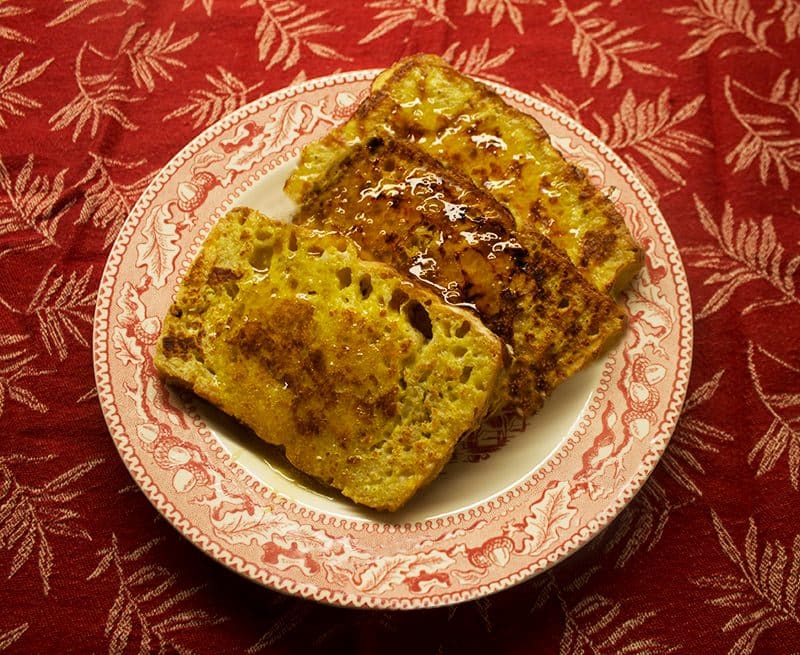
New bridge Landing, River Edge NJ, French toast is a dish made of sliced bread soaked in beaten eggs and typically milk, then pan fried. The Bergen County Historical Society gives us the run down on the history and back ground of “French Toast”.
photos courtesy of the Bergen County Historical Society
the staff of the Ridgewood blog
New Bridge Landing NJ, marking the 245th Anniversary of this pivotal event during the Rev War, the Bergen County Historical Society, along with the Brigade of the American Revolution, co-sponsored a day of living history on Sunday, November 21st, 10 am-4 pm at Historic New Bridge Landing. The 3rd New Jersey Regiment, “Jersey Grays” marched, retracing the 7-mile retreat of Washington’s Army, arriving from Fort Lee around 10:30AM, then engaged in a skirmish with three other units for the bridge in a tactical weapons demonstration portraying the action that occurred when British troops forced the Continental Army away from the area and captured this vital crossing point over the Hackensack River. Up to the challenge of feeding an army, the Out Kitchen cooked for over 65 [reenactors from, I believe, four units present, along with the ladies] a hearty stew of 20 pounds of beef, 12 pounds of potatoes, 15 pounds of carrots, 8 onions, and a celery head in a tasty broth served with good crusty bread. Pictured are unit ladies who volunteered to serve.
Historic New Bridge Landing , on November 20th, 1776, five thousand British, Hessian and Loyalist troops, under command of Lt. Gen. Lord Cornwallis, scaled the Palisades at Lower Closter Dock and marched against Fort Lee. Warned by an alert officer, the American garrison escaped entrapment by safely crossing the Hackensack River at New Bridge, now known as “the Bridge That Saved a Nation,” and lived to fight another day. To mark the 245th Anniversary of the “times that try men’s souls,” the Bergen County Historical Society, along with the Brigade of the American Revolution, will co-sponsor a day of living history on Sunday, November 21st 10 am-4 pm. 1201 Main Street, River Edge NJ.