JANUARY 19, 2016, 6:02 PM LAST UPDATED: TUESDAY, JANUARY 19, 2016, 7:35 PM
BY PATRICIA ALEX
STAFF WRITER |
THE RECORD
The pipeline from community college to a bachelor’s degree needs some work, according to a national report released Tuesday.
New Jersey is three percentage points above the national average, but only 17 percent of students who start at a community college in the state wind up getting a bachelor’s degree within six years, according to a report from the Community College Research Center at Columbia University.
Among students who started at community college and successfully transferred to a four-year college, only 42 percent completed a bachelor’s degree, compared with the 60 percent degree attainment rate of students who started at public four-year colleges, according to the report.
All but one of the state’s 19 community colleges were surveyed in the report that included data from 43 states, according to the center. The statistics were not broken down by college and only a statewide figure was provided.
Community colleges have been promoted as providers of an affordable first step toward a bachelor’s degree, but graduation rates remain low, particularly among low-income and minority students.
Over five million jobs will be lost by 2020 as a result of developments in genetics, artificial intelligence, robotics and other technological change, according to World Economic Forum research.
About 7 million jobs will be lost and 2 million gained as a result of technological change in 15 major developed and emerging economies, WEF founder Klaus Schwab and managing board member Richard Samans said in “The Future of Jobs.” The findings are taken from a survey of 15 economies covering about 1.9 billion workers, or about 65 percent of the world’s total workforce.
New Jersey is among U.S. states least equipped to respond to an economic downturn, according to a new study comparing states’ savings. Samantha Marcus, NJ.com Read more
January 4, 2016 — 8:00 AM EST
Americans are increasingly foregoing paychecks due to disability, school or retirement
Kasia Klimasinska kklimasinska
How come more people are retiring in their early 20s? Why are middle-age men becoming stay-at-home dads? What’s keeping women out of the workforce other than illness, kids or school?
Those are some of the questions raised in a new Bureau of Labor Statistics report that shows changes over the past decade in why people stay out of the labor
Here’s what the bureau found, broadly: Thirty-five percent of the U.S. population wasn’t in the labor force in 2014, up from 31.3 percent a decade earlier. (You’re considered out of the workforce if you don’t have a job and aren’t looking for one. That’s distinct from the official unemployment rate, which tracks those out of work who are actively job hunting.)
Drilling down into the numbers reveals more about the shifts in the reasons some people forego a paycheck. In all age groups, for instance, more people cited retirement as the reason for being out of the labor force, and it wasn’t just older people.
For Americans between the ages of 20 and 24, the share of those sidelined over the past decade because they were in school increased, unsurprisingly, during the decade that included the Great Recession. What’s more unusual is that the share of 20- to 24-year-olds who say they’re retired doubled from 2004 to 2014.
Bill to restart BEIP payments angers some NJ businesses
DECEMBER 20, 2015 LAST UPDATED: SUNDAY, DECEMBER 20, 2015, 1:21 AM
BY HUGH R. MORLEY
STAFF WRITER |
THE RECORD
The passage last week of a bill that would restart incentive payments to about 270 New Jersey companies owed hundreds of millions of dollars for creating jobs in New Jersey sounds, at first glance, like good news for the companies.
Yet the legislation has upset some of the businesses by including a delayed payment schedule that means some won’t get their money for years.
The state stopped funding the Business Employment Incentive Program (BEIP) more than two years ago, after underfunding it and skipping payments for years because of budget constraints. The revived program changes the method of payment, from rebates needed to be provided for in the state budget, to tax credits, which are reductions in taxes the businesses have to pay.
But the new system’s delayed payment schedule has only renewed criticism from the companies affected, which are now owed $785 million.
Payments not made between 2008 and 2013, for example, will now be paid in five installments, beginning in 2017 and concluding in 2021 – more than a decade after some first became due. Payments not made in 2014 and 2015, won’t be paid until 2019, and all payments for the next five years will be paid at least three years after they are accrued.
Sponsors of the bill, which passed both houses of the Legislature on Thursday and is expected to be signed by Governor Christie, say the payment delays are needed to cope with an estimated total obligation of $1.267 billion once all the bills are paid by 2025. The estimate comes from the state Economic Development Authority, which manages the state economic development programs.
But the delays are too long for some companies already irate that they reshaped their business – in some cases moving into New Jersey from out of state – based on a commitment that the state hasn’t kept.
“That’s absolutely asinine, literally,” said Thomas Churchill, vice president for operations at Model Electronics in Ramsey, of the delayed payment schedule.
Churchill, whose company remanufacturers audio navigation and other auto parts, added, “If they are doing it over a period of time, it becomes monotonous, and idiotic. It becomes very, very hard to manage, and it’s probably not worth the cost.” He said spreading payments over several years makes calculating how much money the company receives, and the taxes owed on it, more complicated and burdensome.
Churchill’s company moved from Rockland County, N.Y., to Bergen County in 2005 with the help of a grant for $468,000 over 10 years, contingent on bringing 85 new jobs to the state. After he fulfilled that commitment, the state at first paid the annual rebate checks on schedule, but the company has not received a check since getting the company’s 2011 incentive payment.
Another business owner, who is owed payments but declined to be identified, welcomed the bill but added: “However, I cannot get excited for something that is four years away, and six years after the first payment was due initially.” In a reflection of how the BEIP history has damaged confidence in the state’s development efforts, the owner added: “I am sure anything can happen and change by then anyway, as it did two years ago.”
N.J. revenues fell further behind Christie projection in November
New Jersey tax collections so far this year were set back further in November by increasingly sluggish corporation business tax collections. Samantha Marcus, NJ.com Read more
DECEMBER 14, 2015, 7:30 PM LAST UPDATED: MONDAY, DECEMBER 14, 2015, 7:59 PM
BY SALVADOR RIZZO
STATE HOUSE BUREAU |
THE RECORD
Democrats and Republicans in the state Senate unveiled competing economic plans for New Jersey on Monday, with each side promising a lasting fix to the haphazard way the state has been funding major expenses such as pensions and road projects over the years.
The dueling plans are as ambitious as their details are hazy.
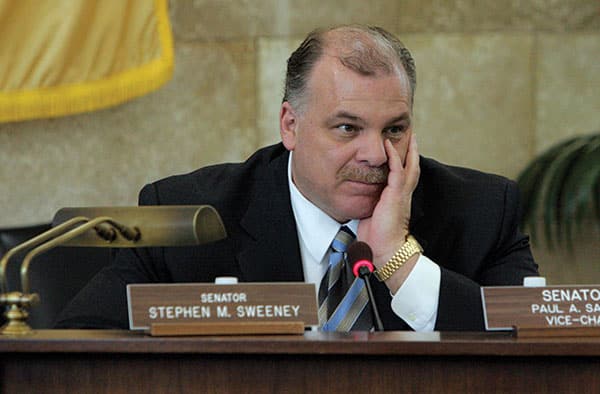
On the Democratic side, Senate President Stephen Sweeney outlined a plan to invest at least $1 billion over the next four years on transportation projects, school initiatives, new study commissions and a new “infrastructure bank.”
His plan calls for expanding pre-kindergarten to 17 school districts that do not now offer it; extending light rail service farther into Bergen County and widening the eligibility range for tax breaks on retiree income, raising the income limit for married couples from $10,000 to $100,000. Funding for higher-education scholarships also would grow.
But Senate Democrats did not include a funding mechanism; Sweeney said his proposal would spur enough economic activity to pay for itself, namely by enticing older residents to stay in-state instead of moving after they retire.
“This state has been starved of investment for too long, and we now need to refocus,” he said at a Statehouse news conference.
Ridgewood NJ, Senator Kevin O’Toole (R-Bergen, Essex, Morris, Passaic) said New Jersey’s addition of 15,200 private-sector jobs in October and an updated total of 24,100 new jobs in the past two months shows that Republican reforms are working and the state’s economic rebound would be enhanced with the advancement of more Senate Republican jobs policies.
“New Jersey is creating jobs at a fast pace under Governor Christie’s administration not seen in recent memory, thanks to ample reductions in red tape and our investments in real private sector job creation, workforce training and smart economic development,” said O’Toole, a member of the Senate Budget & Appropriations Committee. “Our unemployment rate has fallen nearly a full point this year to 5.4 percent, and in the months ahead we’re on track to recover all of the 258,000 jobs lost under the previous administration. Indeed, this is a far cry from what happened under the previous governors where taxes and fees were raised 115 times while the unemployment rate skyrocketed to 9.8 percent.”
O’Toole emphasized, “Not counting Great Recession years, the 15,200 private-sector jobs we created in October alone are more than twice the 7,400 private-sector jobs created in former Gov. Jon Corzine’s best year and more than six times the 2,400 jobs created in Gov. Corzine’s second-best year.”
Senator O’Toole also pushed for the continued advancement of the Senate Republican’s 36-bill package to jumpstart job creation and economic growth without costing taxpayers extra money. So far, 15 of the bills have garnered Senate Democrat sponsorship; 12 have garnered Assembly Democrat sponsorship; the Senate has advanced or fully passed 11 of them and the Assembly has advanced or passed a number of them as well, and the governor just signed into law an innovation bill to help start and grow small businesses by allowing private online investments.
“The investments and incentive programs we’ve enacted under this governor to attract and retain job creators are working, and must continue in a transparent and accountable way until legislative Democrats allow votes on bills to make New Jersey’s nation-high taxes competitive with other states,” O’Toole said. “This new state jobs report is positive and we need to continue that momentum built under Governor Christie by passing Senate Republican solutions to lower costs of doing business and cut even more red tape.”
Ridgewood NJ, Many state governments, including NJ, have funds set aside to train your workforce at no cost to you. The intent is to create a better skilled workforce that will translate into better productivity and increased profitability for these companies.
These extraordinary state programs allow you to realize income with no strings attached and without deviating from your company’s day-to-day activities. These programs are intended for most companies regardless of size.
In today’s economy, trained and effective workers can mean the difference between a competitive business and an extinct business. The Customized Training initiative is a component of the Workforce Development Partnership program and is funded by a small allocation from employers and workers.
TNT Educational Services is in the business of securing government funding by way of training grants and offering a wide range of training classes targeting an increase of productivity at no cost to the company. Bergen IT LLC (www.bergenit.net) is partnering with TNT Educational Services (www.tntedu.com) in order to become a provider of technology training.
To Request additional Information, please call Bergen IT at – 201-689-1823 or email[email protected]
By Susan Jones | December 4, 2015 | 8:44 AM EST
The Bureau of Labor Statistics says economy added 211,000 jobs in November, and the unemployment rate was unchanged at 5.0 percent.
(CNSNews.com) – The number of Americans not in the labor force last month totaled 94,446,000–a slight improvement from the 94,513,000 not in the labor force in October–and the labor force participation rate increased a tenth of a point, with 62.5 percent of the civilian noninstitutional population either holding a job or actively seeking one.
(The labor force participation rate of 62.4 percent in September and October was the lowest in 38 years.)
The Bureau of Labor Statistics says economy added 211,000 jobs in November, and the unemployment rate was unchanged at 5.0 percent.
In November, according to the Labor Department’s Bureau of Labor Statistics, the nation’s civilian noninstitutional population, consisting of all people 16 or older who were not in the military or an institution, reached 251,747,000. Of those, 157,301,000 participated in the labor force by either holding a job or actively seeking one.
NOVEMBER 28, 2015 LAST UPDATED: SATURDAY, NOVEMBER 28, 2015, 1:21 AM
BLOOMBERG NEWS |
WIRE SERVICE
Could Americans be losing their holiday spending spirit? More than 20 years of retail sales data suggest it’s a distinct possibility.
U.S. retailers have come to rely on a shopping frenzy toward the end of the year, as the annual gift-giving season compels people to open their wallets. That holiday bump, though, appears to be shrinking.
Last year, December’s share of annual retail sales (excluding gasoline) amounted to 9.9 percent, according to the U.S. Census Bureau. That compares with a high point of 10.6 percent in 1993 — a difference worth more than $30 billion. Although the holiday boost tends to fluctuate with economic cycles, the trend is down. Here’s how that looks:
What’s going on? Black Friday could be partly responsible, if retailers have pulled some of the holiday action into November with deep discounts and special opening hours. However, that particular shopping event is on the wane. And even combining sales for November and December doesn’t do much to change the long-term trend.
Another potential explanation is that the kinds of items people buy around the holidays — Xboxes, iPads and the like — have become relatively cheap, because of the efforts of Chinese manufacturers. This would make the dollar value of December’s spending look smaller, even if people were purchasing just as many items. That said, prices on imports from China are higher than they were a decade ago, so maybe not.
There’s also a more troubling possibility: Declining incomes may have left a large portion of Americans less willing to splurge. The median U.S. household income has fallen more than 3 percent over the past decade in inflation-adjusted terms. December’s share of spending tends to suffer when budgets are tighter, as evidenced by the sharp drop during the 2008 recession.
Record number of N.J. residents living in poverty, study finds
More New Jersey residents are in poverty now than in the past five decades and the outlook for the future is bleak, according to a report released Sunday, which aims to redefine the definition of poor in the state. MaryAnn Spoto, NJ.com Read more
The main union for construction workers is accusing President Obama of throwing them “under the bus” by rejecting the Keystone XL oil pipeline.
The Laborers’ International Union of North America (LIUNA) is one of the few labor unions that broke with the majority of Democrats and supported the project, which Obama rejected Friday after a seven-year review.
“We are dismayed and disgusted that the President has once again thrown the members of LIUNA, and other hard-working, blue-collar workers under the bus of his vaunted ‘legacy,’ while doing little or nothing to make a real difference in global climate change,” Terry O’Sullivan, the union’s general president, said in a statement. “His actions are shameful.”
The group’s statement cited a State Department report that Keystone could reduce greenhouse gas emissions when compared with oil transportation by rail.
“But facts apparently mean as little to the president as the construction jobs he repeatedly derided as insignificant because they are ‘temporary,’ ” O’Sullivan said. “Ironically, the very temporary nature of the president’s own job seems to be fueling a legacy of doing permanent harm to middle- and working class families.”
Biggest quarterly drop since the aftermath of the financial crisis
This U.S. earnings season is on track to be the worst since 2009 as profits from oil & gas and commodity-related companies plummet.
So far, about three-quarters of the S&P 500 have reported results, with profits down 3.1 percent on a share-weighted basis, data compiled by Bloomberg shows. This would be the biggest quarterly drop in earnings since the third quarter 2009, and the second straight quarter of profit declines. Earnings growth turned negative for the first time in six years in the second quarter this year.
The damage is the biggest in commodity-related industries, with the energy sector showing a 54 percent drop in quarterly earnings per share so far in the quarter, with profits in the materials sector falling 15 percent.
The picture is brighter for the telecom services and consumer discretionary sectors, with EPS growth of 23 percent and 19 percent respectively so far this quarter.
When compared with analyst expectations, about 72 percent of companies have beaten profit forecasts. That’s only because the consensus has been sharply cut in the past few months, Jeanne Asseraf-Bitton, head of global cross-asset research at Lyxor Asset Management says in a telephone interview.
For the year as a whole, S&P 500 earnings are expected to fall 0.5 percent, data compiled by Bloomberg shows. For 2016, earnings growth is now seen at 7.9 percent, down from 10.9 percent in late July.
New Jerseyans already know it to be true, but a Forbes analysis of state-by-state tax burdens places the Garden State near the top of its “Worst States for Taxes” list. Samantha Marcus, NJ.com Read more