The bike lane benefits few. There are a handful of hardy souls who bike to the train. No one is biking to town to shop or for dinner. When do you see kids bike into town? I doubt the bike path is for them and I would not want to see teens trying to navigate the mean streets of Ridgewood.
A bike lane through the town is a crazy pipe dream. If anything a bike lane should skirt the town not go through it.
Downtown Ridgewood is a dangerous place for pedestrians. Add in bike lanes and you have a recipe for disaster.
I am writing this tonight because the gravity of what happened today seems to have been lost in the shuffle of the weekend l, and impending Halloween festivities.
A massive, tree-sized, tree branch fell across part of the playing field, the entire sidewalk and half of Bogert Ave at about 11:35 or so this morning. The entire 3rd grade was playing outside- 2 of whom are my children.
I am the Travell safety chair, and while this may seem frivolous, or decorative, it is in fact, a role I take VERY seriously. Twice in the last month, thanks to my persistent pressing of the safety issues brought to me by my fellow Travell parents, Travell safety has been on the agenda for the village council. I’ve attended the Citizen Safety Advisory Committee meetings to address them. I am the only parent in attendance to address the issues. I am the only person at all to represent our school and it’s safety issues.
I take this role very seriously, evidenced by the fact that in my own free time I have walked the streets surrounding the school, and I look for safety issues within the neighborhoods. Broken sidewalks, overgrown shrubs, parking issues, speeding concerns, sight triangles issues, property maintenance issues. These are just some of the issues I have seen. I bring them some times repeatedly- to the attention of the code enforcement officer. Sometimes she sends them on to a more appropriate party. Many, many violations have been addressed in the last few weeks thanks to our combined efforts.
I have mentioned several concerning trees to her. Many that are dead and overhang designated safe walking routes, or heavily traveled walking routes to Travell.
I walked all of the streets surrounding Travell with the assistant village engineer last spring. I mentioned several of the trees including the one which fell today. I was told trees really aren’t their department. A huge part of this tree fell in the early fall across the exact same area!! A Travell parent roped off the area until it could be addressed. This was on the walk to the school in the morning. Prime drop off time for hundreds of students. Another near miss. What else is it going to take?
Do we need a child to actually be struck and hurt- or worse, by a dead tree limb ON actual school grounds in order to take a very serious look at where there needs to be some work done?
We can have forum after forum about full day kindergarten. Spending God only knows how much money, just to spend more money, and then say we don’t have any money??
We can send newsletters and we can print signs and yet we can’t find it in the budget to hire a tree expert, an actual arborist, for the day, to ensure that the school grounds and the sidewalks surrounding them are safe? Or hire a safety expert to do a study of the area and see where we need some change? Often it’s small changes, signage or enforcement, that make ALL the difference. It doesn’t always have to be large ticket answers. It just requires some attention and concern.
I’m actually incensed at how close MY daughter was to this tree falling today.
Feet. She was feet from this. I happen to pass down this street EVERY day between 11:35- 11:45 on the way home from another school pick up. Many many days my daughter and her best friend see me and come run to the fence to yell hello to me as I pass. Today, I was running a touch late. I very literally went to turn left down Bogert and instead went the other way. It is absolutely chilling to know, unequivocally, that they would have been standing IN this exact spot saying hello to me had I made a left turn and not a right.
We need to stop addressing every other issue as if it is life and death and pay closer attention to the ones that actually are.
I heard from parents over the last weeks, as we begged parents to walk their children to school for walk to school month, a myriad of safety complaints. Several times I was informed that they no longer have crossing guards to cross their elementary school children (ages 5-11 as a reference) at Van Dien and Glen because the BF one now leaves too early due to new changes with the outsourcing.
I am on record for EIGHT years at CSAC meetings requesting advice and help about the repeated parking on the Bogert/Cambridge ave curves which force dozens of students to walk in to the center of the street on a blind curve to walk to their school. Eight years and I’ve been brushed off and given every answer or response you can possibly imagine. Not one has made the situation safer. Not one suggestion stopped my daughter from being thrown from her stroller in an attempt to get out of the way of a speeding, texting driver last year with no where to go due to cars parked in the long documented, dangerous spots along the curve.
We are year after year refused even the conversation of a crossing guard at Bogert and Glen where no less than 65 school children LIVE, and dozens more use as a pass through-it’s too expensive! It’s $8k! We can’t even get simple pedestrian crossing signs at that crossing or another along Glen (Northern Parkway) because the town refuses to pay for them (they’re about $400 each!!!imagine!) so the Generous Travell HSA, at my request, will pay for them. So to actually break that down, these parents will pay some of the highest taxes in NJ, we have one of the highest per student spending budgets in NJ, and then we are going to pay EXTRA, out of pocket, for the signage that allows for our kids to have a way to cross the street safely to access their school.
What is next? What will it take before all of YOU put the safety of these students ahead of an agenda, or just the belief that “it’s not really our department”??
Today, any number of children were FEET from this massive tree branch falling, and a complete tragedy. What will you do to ensure that this doesn’t happen again? What will you do now that a documented issue has now presented itself so many times? I guess we could give them hard hats, or we could solve the actual problem.
I know we can’t solve every safety problem at every school without which a miracle occurs, but we have repeated, documented safety issues that are being ignored or shuffled off to someone else to deal with. There are hundreds of children in YOUR care and we expect that that is something you take seriously enough to ensure their safety.
I am sure you’re all familiar with the areas in question, but I implore you to come and walk these streets with me, and any other interested parent.
In fact, at this point, I can’t see why you wouldn’t.
Thank you for your sincere attention to this matter.
In September 2016, the Nevada Supreme Court upheld education savings accounts (ESAs) as constitutional in the Silver State. ESAs are distinct from other parental choice mechanisms in education, especially K–12 private-school vouchers. Other options only enable parents to choose the school for their children—something which, in the case of vouchers, opponents have argued constitutes state aid to religious institutions because some children attend religious schools. Teachers unions and other associations have used this argument in court, citing so-called Blaine amendments in state constitutions to block vouchers. Blaine amendments are state constitutional provisions that prohibit public funds from flowing to private religious institutions.
Both research and legal precedent demonstrate that the ability to direct ESA funds to multiple education services and products separates ESAs from school vouchers. This is a critical distinction for states to recognize when considering parental choice options. Blaine amendments to state constitutions, such as the provisions in the Arizona and Nevada constitutions, have an ignoble history and should be repealed. Moreover, the distinctive policy design of ESAs makes the accounts well-positioned to withstand legal challenges based on Blaine amendments.
Diversity and Customization in ESA Use Among Arizona Families
In 2011, Arizona lawmakers enacted the nation’s first law establishing ESAs. The state deposits a portion of a child’s allotted funds from the state education formula into a restricted-use bank account that parents use to buy educational products and services for their children. Parents and students can use the accounts for online classes, private school tuition, personal tutors, saving for college, and financing a variety of other learning experiences. Every child is different, and with an account, students and their parents can design an education as unique as they are.
After lawmakers enacted ESAs, teachers unions and other special interests challenged their legality in court. Arizona unions based their suit on the state’s Blaine amendment, which prohibits public funds from flowing to religious institutions. In 2014, Arizona courts ruled in Niehaus v. Huppenthal that ESAs do not violate the state constitution.
Arizona families have used these accounts to pay for a wide variety of education-related services, products, and providers. In 2013, the Friedman Foundation for Educational Choice (now EdChoice) conducted the first study of Arizona families’ purchases with the accounts.[1] Among those students, the study found that approximately 34 percent of account recipients used their funds for multiple learning experiences.[2]
Between 2012 and 2014, lawmakers expanded ESA eligibility to include children from active duty military families, children who had been adopted through Arizona’s foster care system, preschoolers with special needs, siblings of account holders, and students in public schools rated “D” or “F” on the state report card system. An updated analysis using ESA data from the Arizona Department of Education from the end of the 2013–2014 school year and the complete 2014–2015 school year, and including these new populations of eligible students, found relative stability in the proportion of families using their accounts to customize their children’s learning experience. Research from this time period found 28 percent of families using their ESAs to pay for multiple education services, products, and providers.
Although there was a modest decrease in the percentage of families using their ESAs for multiple services over the course of the two evaluations—from 34 percent to 28 percent—these results demonstrate that with a larger and different cohort of students over a different time period, a similar percentage of students still customized their learning experience with an account. In the analysis of families participating in the 2011–2012 school year, all participating students were children with special needs. These latest data include students made eligible through changes in the law since the first report. New eligibility criteria and the passage of time did not change how families value the accounts’ flexibility. Parents continue to access a diverse menu of products and services to meet their children’s learning needs.
Legal Challenge to ESA in Nevada
The American Civil Liberties Union (ACLU) brought a lawsuit similar to that in Arizona against a recently established ESA program in Nevada. In September 2016, the Nevada Supreme Court upheld the accounts as constitutional as far as the state’s own Blaine amendment provisions are concerned. The program remains suspended, however, because the court ruled that lawmakers must revise the statute’s funding provisions—statutes specific to Nevada law that do not have national implications.
The research findings from Arizona are relevant for Nevada families waiting to use ESAs. In 2015, Nevada lawmakers made history by making every child attending a public school in the state eligible for an ESA. Before any children were able to take advantage of the new option, the ACLU filed suit to block the program. In Duncan v. State of Nevada, the ACLU made claims similar to claims made by teachers unions in Niehaus v. Huppenthal. Citing the Nevada constitution’s Blaine amendment, the ACLU attempted to block the Silver State’s ESA program by arguing that it constitutes state aid to religious institutions.
Blaine Amendments’ Ignoble Roots
During the latter half of the 19th century, Catholic families sought to establish Catholic schools as an alternative to the publicly funded common schools emerging in the United States at the time. Common schools sought to assimilate all students to a general sort of Protestantism, including use of the King James Bible and conducting devotional activities.[3] Maine Senator James G. Blaine sought to prohibit aid to “sectarian” schools. As the U.S. Supreme Court acknowledged in Mitchell v. Helms, the effort had “a shameful pedigree that we do not hesitate to disavow…. Consideration of the amendment arose at a time of pervasive hostility to the Catholic Church and to Catholics in general, and it was an open secret that sectarian was code for Catholic.”[4]
Although the federal amendment failed, Congress subsequently required territories seeking admittance to the union to include similar prohibitions on public funds supporting religiously affiliated schools. That requirement, in conjunction with the 14 states that already had Blaine-type language prior to the federal effort, resulted in 29 states having such restrictions by 1890, and 38 states had adopted Blaine amendments by 1959.[5]
ESA Design: Helping to Withstand Blaine-Based Lawsuits
Nevada’s Blaine amendment says that “no public funds of any kind or character whatever, State, county or Municipal, shall be used for sectarian purpose.”[6] Thankfully for Nevada families, in September 2016, the state supreme court upheld ESAs as constitutional. The court held that ESAs provide money to families, who can use funds to pay for a variety of education-related products and services such as private tutors, private school tuition, and other expenses.[7] Families will be able to access ESAs pending identification of an appropriate funding source for the accounts.[8]
The defining feature of ESAs—that parents can make multiple choices for their children’s education—helped them survive a Blaine-based legal challenge in Arizona where the state supreme court had deemed a voucher program unconstitutional. In the 2013 Arizona Court of Appeals’ unanimous opinion, Judge Jon Thompson wrote that “[t]he ESA does not result in an appropriation of public money to encourage the preference of one religion over another, or religion per se over no religion. Any aid to religious schools would be a result of the genuine and independent private choices of the parents.”[9] In 2014, the Arizona Supreme Court denied the union’s appeal of the lower court’s decision, allowing the court of appeals decision to stand.
Critically, ESA funds are not reserved for specific schools or education providers. Funds are deposited into parent-controlled accounts, and parents can use the funds for an education-related provider, product, or service of choice. The ESA option “does not require any student to be enrolled in a private school, much less a ‘sectarian’ private school.”[10] The ability to direct dollars to multiple education services is a critical distinction between ESAs and other parental choices in education, including K–12 private school vouchers.
Customization Makes ESAs Unique Education Choice Mechanisms
The distinctive policy design of ESAs enables accountholders to finance multiple learning options beyond tuition at a private school. It also makes the accounts well-positioned to withstand Blaine amendment–based legal challenges. Such lawsuits against private school vouchers have alleged that these scholarships constitute state aid to religious institutions. Yet nearly 30 percent of Arizona ESA families are making multiple education decisions simultaneously in determining how and where their children learn. In this way, Arizona parents’ customization demonstrates what the courts have reasoned: ESAs are functionally different from other parental choices in education. Nevada courts reached the same conclusion.
—Lindsey M. Burke is Will Skillman Fellow in Education Policy Studies in the Institute for Family, Community, and Opportunity at The Heritage Foundation. Jonathan Butcher is the Director of Education Policy at the Goldwater Institute.
Ridgewood NJ, It’s that time of year again when beleaguered parents constantly remind disobedient children that it’s more important than ever to do the right thing.
Otherwise, they could end up on Santa’s notorious naughty list – the one specially reserved for kids who fight with siblings, refuse to do their homework, throw temper tantrums and don’t eat their vegetables.
While banishment to the naughty list has long been a handy tool in the disciplinary arsenal, any responsible parent wants their children to be good the rest of the year, too, when the threat of empty stockings holds less sway over those impressionable minds.
“I suspect most children deep down want to do the right thing, but they struggle with temptation,” says K.J. Hales, author of It’s Hard to Be Good, the first volume in the Ellie the Wienerdog (www.elliethewienerdog.com) series of educational picture books for children.
“A lot of it comes down to self-control – being able to control both your emotions and your actions when things don’t go your way or you don’t get what you want.”
Hales, who creates teachers’ guides and educational activities to go along with the lessons in her books, says the earlier parents start teaching children to do the right thing, the better.
She says some of the ways they can reinforce good behavior and discourage bad behavior include:
• Be generous with praise. Don’t underestimate the importance of your words. It’s easy to notice when children do the wrong thing and to chastise them about it. But take note when they do the right thing, too, and praise their good choices or good behavior. “Everyone loves words of approval and children will want to please you as a result,” Hales says. • Make good choices a fun activity. One way to encourage good decisions could be to set aside one week in which each day you ask your children to write or draw about a good decision they made or they saw someone else make. Hales says this is an activity she suggests for classroom teachers, but it can work in the home as well. Be sure to discuss those good decisions with the children. • Reward them. Discipline so often focuses on punishments for bad behavior, but children should also be rewarded for good behavior. This doesn’t have to be anything elaborate or expensive. A reward could be a picnic in the park or a favorite dessert after dinner.
“I’m sure every parent wants their child to gain independence, grow emotionally and learn to make good decisions about their own behavior,” Hales says. “And this is important 365 days a year, not just in the weeks before Santa Claus comes to town.”
About K.J. Hales
K.J. Hales (www.ellietheweinerdog.com) is author of the Ellie the Wienerdog series of educational children’s books for children. The first volume in the series is It’s Hard to Be Good. The Ellie character is based on Hales’ own dachshund also named Ellie.
These people purporting to having their children make “their own” statements need to better consider the long term impact of having their children make public fools of themselves. Remember how awkward we all felt when that kid stood up at the council meeting and stammered and fumbled his way through his parents speech for him as he told the adults on the dais that they were on the take? Where were his parents?? That will require years of deep therapy to overcome for sure.
Lilith Starr, a devil’s advocate in every sense, is in a rush to get her After School Satan Club started.
As founder of the Satanic Temple of Seattle, she’s under pressure from national satanic headquarters — located in the Colonial witch trials city of Salem, Mass. — to launch a counter-strike strike against grade school Christianity by opening an after-school Satan Club.
“I think many people have the misunderstanding that we are some kind of tongue-in-cheek troll group,” said Starr, 44, a Harvard grad who sometimes dresses in church robes and, when circumstances demand, paints her lips and part of her face black.
“But in reality we are a very serious religion, with our own shared narrative, culture and symbols, a code of ethics — our Seven Tenets — and worship in the form of activism.”
They don’t hold their kids back because they are young, small or not ready.
They hold them back because they want their kid to be the oldest, largest, and most socially and athletically dominant child in their class. They want to make sure their kid is always the Louisville Slugger, and never the ball.
Nothing like setting your kid up to hit their peak in life sometime in middle school!
There’s a reason kids are more anxious and depressed than ever.
Posted Jan 26, 2010
Rates of depression and anxiety among young people in America have been increasing steadily for the past 50 to 70 years. Today, by at least some estimates, five to eight times as many high school and college students meet the criteria for diagnosis of major depression and/or anxiety disorder as was true half a century or more ago. This increased psychopathology is not the result of changed diagnostic criteria; it holds even when the measures and criteria are constant.
The most recent evidence for the sharp generational rise in young people’s depression, anxiety, and other mental disorders comes from a just-released study headed by Jean Twenge at San Diego State University.[1] Twenge and her colleagues took advantage of the fact that the Minnesota Multiphasic Personality Inventory (MMPI), a questionnaire used to assess a variety of mental disorders, has been given to large samples of college students throughout the United States going as far back as 1938, and the MMPI-A (the version used with younger adolescents) has been given to samples of high school students going as far back as 1951. The results are consistent with other studies, using a variety of indices, which also point to dramatic increases in anxiety and depression—in children as well as adolescents and young adults—over the last five or more decades.
Norwegian Study: Marriages are stronger with traditional arrangements.
Devin Foley | March 9, 2016
A while back, Medical Daily reported on a Norwegian study of couples to see “how married and cohabiting men and women divided housework and childcare throughout various life stages.” It might make a few heads explode.
“Couples may be better off living in a ‘traditional’ household where women do all the housework if they want to stay together, according to a report from the Oslo and Akershus University College of Applied Science.”
The reason why the study came to that conclusion is up for debate, though.
“Researchers did not find an association between a traditional share of housework (women do most of the work) and a lower risk of divorce — but they did report untraditional couples had a greater risk for divorce. Men who did as much or more of the housework were more likely to get divorced than couples where the woman did most of the housework over a period of four years.
For many parents, the most traumatic family battles are fought at the very place which should be a place of harmony and connection: the dinner table.
The bad news is that those dinnertime battles are often the result of food habits that parents have unconsciously established.
The good news, however, is that those habits can be reversed.
In her book French Kids Eat Everything, Karen Le Billon lays out 10 food practices her family discovered while living in France. The results were life-changing, and now Le Billon’s children are fans of everything from beets to mackerel. The 10 food rules are summarized below:
My wife and I are among the only 28% of parents today who make their children do chores. And, like many children when forced to do undesirable work, ours do their fair share of complaining and dawdling.
In these moments, the reminder we frequently give them is this: “It’s not your job to play.”
Perhaps to some this sounds harsh. After all, the idea that they have a special mandate for play and “free time” is exactly what our current society communicates to children. From the moment they first exit the womb, America’s youth are surrounded by a constantly updated slew of toys and devices for entertainment. They very quickly learn that adults primarily require that they play and do what they want, which these days usually means screen time. The average child now spends over six hours in front of a screen each day.
Even now in school—which most of history deemed a very “un-fun” place—it’s expected that teachers will make the curriculum appropriately engaging and that plenty of activities (read: useless assemblies and fairs) and time for socialization will be provided.
Need an experienced, certified NJ plumber for basement renovation plumbing in NJ? Call us today at A1 Sewer & Drain Services:
201-645-0888
Many homes in New Jersey are built with a basement, which may or may not have been converted yet into useable living space. A finished basement is a great way to add hundreds of square feet of useable living space to your home, with less cost and hassle than building a whole new addition. Many homes have over a thousand square feet of basement, meaning there’s plenty of space for that new bedroom, rec room, or man cave you’ve always wanted.
Basement renovation often involves installing plumbing to create an extra bathroom. At A1 Sewer & Drain Service, we’re drainage and sewer service contractors who specialize in wastewater, outdoor drainage, and bathroom plumbing. If you’re planning a new bathroom addition, call us any time for a free consultation and cost estimate from our experienced local plumbers, at 201-645-0888.
Adding a New Bathroom Addition in your Basement
Need an extra bathroom to accommodate a growing family? If you have an existing basement, you may not even need to build a new addition. Finishing all or part of your basement can add a great deal of extra living space, including much-needed extra toilets and showers. A new basement bathroom addition can even add market value to your home.
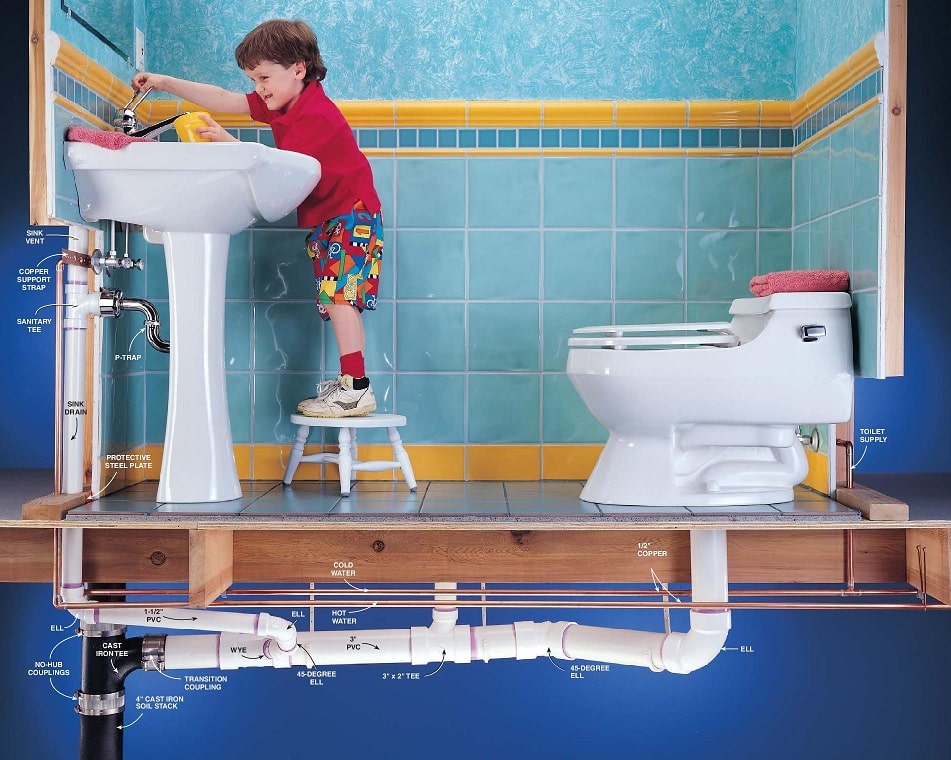
Basements are almost always located below the level of the main sewer line. Because of this, installing bathroom plumbing can be complicated. Vent, waste pipe, and drain pipe installation is the most difficult part of basement plumbing, and you’ll need experienced renovation plumbing and sewer service contractors to make sure that everything is installed correctly.
Basement Plumbing for a New Bathroom Addition
Any new drain lines in your basement bathroom addition will need to flow into your existing main sewer line. Before construction begins, contractors need to locate the sewer pipe, generally by finding the main stack and the cleanout. In urban and most suburban areas, the main sewer line runs into a municipal sewer system. If you have a private septic tank, the pipe will run toward the septic drain field.
To flow correctly, drains and sewer lines need a downward slope of at least ¼” per linear foot. This ensures that liquids and solids move at the same rate through the pipe via gravity, preventing clogs and sewer backflow. This can be tricky in basements, where the main line may not be deep enough to allow the correct drop per foot. To send water and effluent through the drain pipes against the force of gravity, you may need sewer ejector pump installation.
Sewage Ejector Pumps for Bathroom Plumbing
When the level of the main sewer line is too high for wastewater to flow in the right direction due to gravity, you may need sewage ejector pump installation to ensure that wastewater doesn’t back up inside the drain pipes. Ejector pumps are equipped with float switches, which trigger the pump to activate when the water in the ejector pump tank reaches a certain level. The wastewater is forced into the drain pipes, allowing wastewater from toilets and other fixtures to be safely removed without relying on gravity.
For toilets, many homeowners opt to install a grinder pump. This type of ejector pump grinds up solid waste into a fine slurry, helping to prevent clogged drain pipes and backflow.
Basement Sump Pump Installation in NJ
Regardless of whether your basement is used as living space, or whether it contains a bathroom, you may need to consider sump pump installation. Sump pumps remove water into the drainage system, preventing flooding and costly water damage. Because basements are located below grade, they’re at heightened risk for flooding from severe weather, burst plumbing pipes, sewer backups, and other emergencies.
Installing a basement sump pump can prevent thousands of dollars of costly water damage, making it a worthwhile investment for New Jersey homeowners.
Local NJ Sewer Service Contractors for Basement Bathroom Plumbing
Need an experienced plumber for toilet, shower, vent, and drain pipe installation in NJ? At A1 Sewer & Drain Services, we’re sewer service experts. We work with homeowners to install reliable, high quality plumbing for basement bathrooms and new bathroom additions. For a free cost estimate, call us today at 201-645-0888.
Check your test center, and learn about makeup tests.
RegisterNext Tests:1/23 , 3/5
SAT Test Center Closings
Information about SAT test center closings for the January SAT administration date will be posted to this page as it becomes available. If a makeup date or alternate test center information has been confirmed, that information will also be included.
SAT Test Center Supervisors are instructed to notify local media outlets when their centers are unable to open due to inclement weather, natural disaster, power failure, or other problems. Please check your local media for test center closings in your area.
If your center is listed as closed:
A new center may appear in the listing. In this case, access your online account and print a new, updated ticket with the new center information noted on it. You must bring your updated ticket with you on test day to the reassigned center.
If no new center appears, please be patient while we work to arrange a makeup date — you will be contacted as soon as a makeup is scheduled. Remember: don’t try to test elsewhere on test day — supervisors cannot admit standbys or walk-ins.
Please note: If you had a Waitlist Ticket for a closed center, your original Waitlist request was canceled, and you are not eligible for makeup testing. Please register for the next available date as soon as possible.
The Ridgewood blog was founded in March of 2006 by James J Foytlin aka PJ Blogger . Mr. Foytlin was born and raised in Ridgewood ,New Jersey and is a graduate of Ridgewood High School .
Ridgewood NJ, – Oct. 26, 2009 – RIDGEWOOD, N.J. — The Ridgewood blog ( https://theridgewoodblog.blogspot.com/ ) was founded in March of 2006 by James J Foytlin aka PJ Blogger .[1] Mr. Foytlin was born and raised in Ridgewood ,New Jersey and is a graduate of Ridgewood High School .[2] [3]
After many years living in New York City[4] Mr Foytlin returned to Ridgewood after a divorce and the tragic events of 9/11 . Once he settled in he noticed a lack of sufficient news coverage of local events . One day a friend from Brazil[5] showed him her home town on the internet and to Mr. Foytlin’s great surprise when he tried to reciprocate he was utterly dismayed at the absolute lake coverage of his home town. After all Ridgewood is only 18 miles from midtown Manhattan[6] the media capitol of world and there was not a single picture of Ridgewood to be found . How could this be? Ridgewood is a picturesque upper middle class village of around 25,000 located in Bergen county in northern New Jersey[7] . Founded by Dutch settlers before it became an English colony[8] . The town or village as its called is steeped in rich history and tradition .Known for a large amount of Victorian era housing , a quality school system and a family friendly atmosphere.
Though busy getting reacquainted with his home town the fact that the Village of Ridgewood was so under represented on the internet continued to disturb Mr. Foytlin. Mr. Foytlin had been writing news letters for his job in financial services since the mid 1990’s . The popular flip, off beat investment strategy news letters had become email blasts with the advent of readily accessible internet.[9] By 2004 the email blasts were converted into blog format for the One Small Voice blog (https://onesmallvoice.blogspot.com/ ). [10]
Around that time the Village of Ridgewood had finally completed it’s much anticipated and long delayed renovation of the Village hall which has been flooded out due to Hurricane Floyd.[11] The renovation was marred by huge cost over runs and lengthy delays. In 2005 it opened with great fan fare , was once again flooded with the very first rain . Mr. Foytlin was more shocked by the abject lack of responsibility taken by elected officials than the fact that the $9 million dollar renovation had to some extent been a failure . That was the breaking point and Mr. Foytlin had had enough so he decided to give , citizen journalism a go and created the Ridgewood blog in March of 2006. [12]
The birth of PJ Blogger .By this time Blogging its seems had become quite the rage and mainstream news anchors such as Dan Rather had questioned the validity of information from non professionals sitting around in their Pajama’s blogging.[13] Mr. Foytlin not a fan of Dan Rather or any of the mainstream media decided to blog under the name PJ Blogger as a play on words and to plant himself firmly in the camp of the new digital media.
Innovations by the Ridgewood blog to citizen journalism.
“The Fly” is a column on the Ridgewood blog the originates from the expression ,”I’d like to be a fly on the wall “ . The idea is that every citizen has both a unique perspective and experience and these two factors can be used to gather news and opinions about local issues. Originally only of handful of people in town participated but with time the Ridgewood blog can now count on 20–40 semi regular contributors. These post are both anonymous and signed and are largely opinion as well a breaking news.[14]
The Ridgewood blog brings a free market lassie fare point of view to local issues . Mr. Foytlin aka PJ Blogger has stated that for local issues there are only two kinds of people ;the ones who say spend what every you want because I will not be around to pay the bill and the second group which are more focused on the ,”be careful this is my money your spending” . The Ridgewood blog is dedicated to the interplay of there two groups.[15]
[1][12] the Ridgewood blog website https://theridgewoodblog.blogspot.com/
[2] Birth Certificate born in Valley Hospital , Ridgewood 04/09/1962
[3] Ridgewood High School Class 1980
[4] 444 East 86th street ,530 East 72nd
[5] Monica Rocha
[6] Mapquest
[7] United States 2000 Census, the village population was 24,936.
[8] https://www.americantowns.com/nj/ridgewood/organization/vi…
[9] Fahnestock & Co. now Oppenheimer & Co.
[10] https://onesmallvoice.blogspot.com/
[11] https://www.ridgewoodlibrary.org/localhistory/lh_vh_pease.htm
[13] https://www.opinionjournal.com/diary/?id=110005611
[14] [15] James J Foytlin
FEBRUARY 6, 2015 LAST UPDATED: FRIDAY, FEBRUARY 6, 2015, 12:31 AM
BY MARK KRULISH
STAFF WRITER |
THE RIDGEWOOD NEWS
Over the course of two evenings, Ridgewood residents had the chance to speak their minds about the proposed amendment to the master plan currently being sought by three developers who wish to build apartment complexes in the village’s downtown.
Citizens brought a variety of concerns before the Planning Board, with some favoring the high-density development and others calling for a scaled-back proposal decreasing the amount of units per acre currently being entertained.
Three separate developments are being proposed: the Dayton, a 106-unit luxury development in the old Brogan Cadillac lot; Chestnut Village, a 52-unit luxury development slated for Chestnut Street near the village’s central garage; and the 52-unit Enclave proposed for the intersection of East Ridgewood and North Maple avenues (the site of the old Sealfons building).
While very few of the more than 50 residents who spoke at the two meetings were completely against development, the idea of tripling or quadrupling the housing density in the Central Business District did not sit well with the majority of those who came to the podium to oppose the changes.
“It’s time for a compromise,” said resident Frank Schott. “Going from 12 units per acre to 50 is not a compromise, it is a surrender. Let’s make a generous offer of settling for doubling the permitted density to 24 units per acre.”