Posted on Leave a comment

THE WELFARE WAIVERS:How They Really Do Water Down Work Requirements

money for weed theridgewoodblog.net

THE WELFARE WAIVERS:How They Really Do Water Down Work Requirements

Russell Sykes, Senior Fellow

https://www.manhattan-institute.org/html/ir_27.htm#.UHWwXK5L_D5

The author is the former deputy commissioner for the Center for Employment and Economic Supports (CEES) in New York State’s Office of Temporary and Disability Assistance. In that role he was responsible for policy development, federal, state and local relations, and oversight of many of New York’s major income support programs, including the Temporary Assistance for Needy Families (TANF) Block Grant to states and Welfare to Work Programs.

Background

The federal welfare reform of 1996, formally known as the Personal Responsibility and Work Opportunity Reconciliation Act, was among the most significant domestic policy achievements in modern American history.[1]

Its passage meant that, for the first time, welfare recipients would be expected to work toward self-sufficiency and that the welfare bureaucracy’s focus would be on facilitating employment rather than simply writing checks. For decades prior to the reform’s passage, welfare had essentially been viewed as an entitlement. Benefits were offered to qualified participants, with few strings attached. But under the new program, Temporary Assistance to Needy Families (TANF), beneficiaries were required to go to work, search for work, participate in short-term training or education, or undergo drug and alcohol counseling.

And it worked. Since 1996, welfare caseloads have dropped by more than 50 percent. Millions of Americans once consigned to a lifetime of dependency have moved into the mainstream culture of work.

Now, however, welfare reform is potentially being undercut. In July 2012, the federal Department of Health and Human Service (HHS) announced that it would begin “encouraging states to consider new, more effective ways to meet the goals of TANF, particularly helping parents successfully prepare for, find, and retain employment.” To that end, HHS issued a “guidance” memorandum expressing its willingness to unilaterally waive existing TANF rules “to allow states to test alternative and innovative strategies, policies, and procedures that are designed to improve employment outcomes for needy families.”[2] The HHS memo undermines TANF’s work rules by:

Doing away with work participation rates in some instances;
Extending periods of education and training;
Liberalizing the counting of subsidized employment; and
Discouraging one-time non-assistance payments.
The Obama administration said that the change was a response to requests by governors for more flexibility in administering the program and that it was not intended to “waive or dismantle” the work requirement.[3] But in some key respects, the HHS waiver is inconsistent with this statement. The language itself signals the agency’s willingness to water down the program’s current focus on work participation rates as the primary test of each state’s compliance with the goals of welfare reform.

How TANF has Succeeded

The 1996 welfare reform was in large measure a corrective to a previous policy failure. The Aid to Families with Dependent Children (AFDC) program, enacted in 1935, was a well-intentioned New Deal effort to provide financial assistance to single-parent households during the Great Depression. At the time, AFDC beneficiaries were mostly widows. By the 1960s and 1970s, it had evolved into a gigantic entitlement program primarily serving never-married mothers and undermining the values of work and family formation.

Numerous reform efforts sputtered before 1996. Then, a Republican Congress and a Democratic president, Bill Clinton, swept away AFDC, replacing it with TANF. TANF was structured as a $16.5 billion block grant to states, providing them with the flexibility to shape their own welfare programs within four broad parameters set by the federal government.[4]

First, and most significantly, able-bodied welfare recipients would now be required to work. Caseworkers could no longer write checks and let clients languish on the rolls. In order to receive their federal block-grant monies, states had to ensure that 50 percent of adult clients receiving assistance met defined work requirements.[5] Additionally, the reform required that states maintain 75 percent of their pre-TANF welfare spending, known as their maintenance of effort level, in order to receive federal block-grant funds. That requirement rose to 80 percent of pre-TANF spending for states that did not meet work participation rates.

States could be penalized for not meeting work participation rates or maintaining the maintenance of effort level but also could receive credit in the form of reduced required work participation rates for additional spending above the maintenance of effort level.[6]

Three other key aspects of the reformed program:

Federal TANF benefits were temporary, limited to five years in a lifetime, beyond which states would pay for any continuing benefits.
Clear child-support cooperation rules were adopted, compelling single mothers to help identify and locate the fathers of their children.[7]
Assistance in job search, job placement, and other crucial support services were regularly provided. Where adults failed to comply with work rules, their entire family’s TANF benefits could be suspended.[8]
Many states took a “work first” approach, focusing on getting people rapidly employed and then using the savings resulting from reduced caseloads to help clients stay on the job, including by:

Allowing clients to keep more of their earnings before completely losing welfare cash assistance;[9]
Increasing spending on child care and other work supports such as transportation, short term job training, and ramped-up child support collections;
Creating or expanding state earned income tax credits, adding significant economic benefits to working households (New York is a prime example of this approach);[10] and
Offering more one-time payments for emergency expenses that could otherwise push a family onto the full-time welfare rolls.[11]
The reforms were highly successful. Dire predictions of widespread homelessness or families driven into poverty were proved wrong. Welfare caseloads dropped an average of 50 percent in the first 15 years after TANF’s enactment, with decreases in some states reaching 85 percent.[12] In New York State, the caseload fell by nearly two-thirds—from 1.6 million in 1996 to 564,427 in the most recent 2012 figures.[13]

The national poverty level did not increase but instead fell from 13.7 percent in 1996 to 12.5 percent in 2007, before beginning to rise thereafter because of the prolonged recession.[14] Greater numbers of poor, single mothers entered the labor market than ever before.

In 2005, TANF was reauthorized for five years. In response to the actions of some states that weakened work requirements by allowing questionable activities to qualify as employment, the reauthorizing legislation defined 12 categories of activities that could be counted toward work participation standards.[15]

Since 2010, TANF has been temporarily extended through a series of continuing resolutions.[16] The program’s most recent extension was for only six months, and it expires on March 27, 2013.[17]

How the Waiver Could Undermine Work Rules

The HHS memo assumes that the agency has the administrative authority to waive the work participation rate requirement in the law in order to test different approaches to holding states accountable. But in the 16 years since TANF was enacted, HHS has repeatedly turned down waiver requests from states regarding work requirements or other provisions of the law, stating on each occasion that the agency did not have the authority to grant waivers.[18] For the first three years of the Obama administration, HHS adhered to this historical stance. In July 2012, it abruptly abandoned it.

Despite the administration’s claims that waivers will not be allowed that dilute the emphasis on work, some of the specific language can be read otherwise.

Doing away with work participation rates in some instances

In at least two sections, the HHS memo uses specific language indicating that the agency will approve other activities “in lieu of work participation rates,” including:

“[P]rojects that test the impact of a comprehensive universal engagement system in lieu of certain participation rate requirements”;[19] and
“[P]rojects that demonstrate attainment of superior employment outcomes if a state is held accountable for negotiated employment outcomes in lieu of participation rate requirements.”[20]
The clear concern here is that the administrative memo could actually lead to an expanded TANF caseload by allowing activities that are not governed by work participation rates.

Extending periods of education and training

Another permissible waiver would be for “projects that test systematically extending the period in which vocational educational training or job search/readiness programs count toward participation rates, either generally or for particular subgroups, such as an extended training period for those pursuing a credential.”

“The purpose of such a waiver,” the HHS memo adds, “would be to determine through evaluation whether a program that allows for longer periods in certain activities improves employment outcomes.”

States have tried these approaches before, to little avail. That is the main reason that current TANF law limits vocational education to 30 percent of the countable caseload.[21] Able-bodied adults in pre-TANF times could languish in training and education programs for long periods without actively looking for or finding employment.

Liberalizing the counting of subsidized employment

HHS says that it would allow “projects under which a state would count individuals in TANF-subsidized jobs but no longer receiving TANF assistance toward participation rates for a specified period of time in conjunction with an evaluation of the effectiveness of a subsidized jobs strategy.”[22]

Subsidized employment is sometimes a useful strategy for moving people off welfare because it provides job experience and skills in the workplace. But subsidized public and private employment is already an allowable activity for those receiving TANF assistance. How the new requirements differ from current rules and what is meant by the phrase “no longer receiving TANF assistance” are not clear.

All or a portion of a TANF grant for a subsidized job is often given to a private or public employer to be passed on to the beneficiary as wages. Those in subsidized jobs may no longer technically be counted on the caseload, but to say that these households are no longer receiving TANF assistance is misleading. And, if the subsidized job does not turn into an unsubsidized job within a reasonable period of time—say, six months—then the employer has received a free or near-free employee who could ultimately return to TANF.

Greater clarity is needed to ensure that subsidized employment is not substantially extended while still being counted against work participation rates.

Discouraging one-time non-assistance payments

The HHS memo states that the agency “will not approve a waiver for an initiative that appears substantially likely to reduce access to assistance or employment for needy families”—an indication that the federal government will not support further efforts to help people without adding them to the rolls.

Under current law, under an approach known as “diversion,” states can utilize TANF funds as one-time payments to meet the short-term needs of poor people. These needs include child care, transportation, or help paying a utility bill. New York has been a leader in providing such emergency assistance, helping poor people find or keep jobs without having to enroll them in the TANF program. Nationally, such “non-assistance” expenditures accounted for 70 percent of TANF funds in 2009, but recipients of these supports are not counted in the TANF caseload.[23]

While it may be reasonable to offer states added flexibility, it should not be achieved at the cost of sacrificing clear, straightforward, and measurable work participation rates. Unfortunately, as things now stand, the states currently in penalty status for failing to meet work requirements and others might jump at the chance to be held to more permissive guidelines.

How HHS intends to apply these various changes remains unclear. The five-page memo is often vague and seemingly contrary in passages that propose alternatives to a clear focus on work. For example, the memo does not define the phrase “comprehensive universal engagement system.” The phrase “superior employment outcomes” might be interpreted as simply allowing the addition of more people to the TANF caseload and assigning them to poorly defined activities that may not constitute real work. Education and training are worthwhile pursuits, but they are not the same as actual work. There is cause to worry that the core TANF message of welfare-to-work could be undermined

States Already Have Great Flexibility

As noted earlier, while states must provide cash benefits to eligible participants, they have great flexibility to invest block-grant funds in efforts to help people get jobs as well as provide work support to those who leave welfare.

States also have leeway to reduce their nominal 50 percent work participation rate. The federal government provides a 1 percent reduction in a state’s work rate for each 1 percent decrease in caseload. Alternatively, a state can use its own funds to exceed maintenance of effort spending. For every $100 million that states spend over their required level, they can reduce their work rate by roughly 1 percent.

HHS defines “maintenance of effort” spending very broadly. In New York, for example, nearly $800 million of the total amount spent on the state’s counterpart to the federal earned income-tax credit (EITC) by itself reduces the nominal 50 percent rate to 42 percent.[24] After accounting for all caseload reduction since 2005 and the additional maintenance of effort spending, New York’s effective work participation rate was only 11.5 percent in 2009. [25] Numerous other states take advantage of this provision.

In general, this provision has fostered spending on programs that help people move from welfare to work rather than returning to TANF dependency, but it has faced harsh criticism from some members of Congress. States may disinvest in certain post-welfare supports if their ability to reduce their effective work participation rate is repealed, as has been suggested.[26]

What Should be Done to Build on Welfare Reform

The next Congress and president should work together, in the same bipartisan spirit reflected in the original 1996 reform, to produce a TANF reauthorization law that builds on the success of reform, rather than turning back the clock through waivers. Several changes to TANF—pursued, preferably, through actual legislation or regulation—would help states without undermining work participation rates. Possibilities include:

While the 2005 TANF reauthorization tightened the definition of work, it added reporting requirements and strict work verification provisions that went beyond the scope of reasonable federal oversight.[27] Reducing reporting requirements and greatly altering work-verification reporting through technology, such as finger imaging to verify attendance at activities, would allow states to focus less on compliance and more on moving beneficiaries into meaningful employment.
State TANF programs work diligently to enroll disabled adults in the Federal Supplemental Security Income (SSI) program. But some people who do not meet SSI eligibility rules also cannot meet the 30-hour weekly TANF work requirement. As disability advocates clamor for work rights under the Americans for Disability Act, the federal TANF program should grant partial credit for at least 15 hours of work by those who qualify as borderline-disabled.
Assessing the “work readiness” of those newly eligible for TANF assistance is time-consuming. Furthermore, there is currently no allowance made for the time it takes to develop an individualized plan for moving beneficiaries into short-term activities that will ultimately lead to employment. To solve this problem, the first 45 days of TANF eligibility should be exempted from the rate requirement.
The 90 percent work participation rate requirement for two-parent, intact families on TANF should be legislatively eliminated and conformed to the 50 percent rate for singles and all-family households. The 90 percent rate is unattainable and conflicts with two other TANF goals: marriage and family formation. Why give low-income couples a financial disincentive to marry?
Conclusion

Some leading congressional Republicans have challenged HHS secretary Kathleen Sebelius’s legal authority to unilaterally waive existing TANF requirements. Legislation to overturn the waiver authority passed the House but not the Senate. [28]

Moreover, the Government Accounting Office says that HHS’s issuance of the change as an administrative memo circumvents the normal requirement for public and congressional comment on such regulatory changes.[29] While the dispute over the legality of the department’s action continues—and could even result in litigation—the department’s offer to waive the established TANF work guidelines will remain in effect. The intense scrutiny of this backdoor action may force meticulous review of any state proposal to alter the program rules, if any are submitted. But the risk remains that some of the progress of the past 15 years will be squandered. If the new HHS policy survives a potential legal challenge and ongoing congressional challenges, it is hard to see how it would not undermine the clear work participation rates in TANF.

When the latest TANF extension expires in late March of 2013, Congress should fully reauthorize the program, making necessary changes and maintaining the measurable focus on work. Returning to the old days of welfare—when virtually any assignment counted as work—is a step in the wrong direction and a truly bad idea.
Endnotes

Temporary Assistance for Needy Families (TANF) was passed as part of the Personal Responsibility and Work Opportunity Reconciliation Act (PRWORA) of 1996, Public Law 104-193.
U.S. Department of Health and Human Services, Office of Family Assistance, “TANF-ACF-IM-2012-03, Guidance concerning waiver authority under Section 1115,” July 12, 2012, https://www.acf.hhs.gov/programs/ofa/resource/policy/im-ofa/2012/im201203/im201203?page=all (hereafter cited as TANF-ACF-IM-2012-03).
White House Blog, “Welfare, Work and America’s Governors,” https://www.whitehouse.gov/blog/2012/08/12/welfare-work-and-america-s-governors.
Gene Falk, Congressional Research Services (CRS) Report for Congress, “The Temporary Assistance for Needy Families (TANF) Block Grant: A Primer on TANF Financing and Federal Requirements,” 2007, https://www.policyarchive.org/handle/10207/bitstreams/2326.pdf.
TANF has three work participation rates: 50 percent for single-parent households; 90 percent for two-parent households (a rate that virtually no state can attain); and a 50 percent all-families rate, which is a combination of the first two rates.
45 CFR 261.43 (b), https://cfr.vlex.com/vid/261-case-rdquo-calculating-caseload-19933792.
This provision has helped states greatly increase their level of child-support collections on behalf of custodial parents (usually mothers) and has provided another significant source of income to supplement wages when the household leaves welfare.
Some states, including New York, have chosen to suspend benefits only for adults in such cases, but the vast majority of states end the total benefit until the adult complies with work requirements.
This is known as an earnings disregard. By disregarding a portion of a TANF recipient’s earned income, overall household income increases by combining work with welfare and providing an incentive to work.
New York’s generous efforts turn an $8.50/hour job ($17,680 annually) for a single-parent household of three in New York City into an annual income of over $33,000, as evidenced by this chart: https://otda.ny.gov/resources/work-supports/worksupports-NYC.pdf.
Such payments typically go to car repairs, maintaining child-care arrangements, avoiding evictions, or meeting utility or fuel emergencies.
Pamela J. Loprest, Urban Institute and HHS Office of Planning, Research and Evaluation, Brief no. 08, “How Has the TANF Caseload Changed over Time?,” March 2012, https://www.acf.hhs.gov/sites/default/files/opre/change_time_1.pdf.
New York State Office of Temporary and Disability Assistance, “Temporary and Disability Statistics,” July 2012, https://otda.ny.gov/resources/caseload/2012/2012-07-stats.pdf; of the total, 253,029 are TANF recipients and 311,427 are state safety-net recipients because they are not TANF-eligible or because they have exhausted their five-year federal eligibility or because they are enrolled in a separate state program for two-parent families.
According to U.S. Bureau of the Census reports, Poverty in the United States: 1997 and 2007, https://www2.census.gov/prod2/popscan/p60-201.pdf and https://www.census.gov/hhes/www/poverty/data/incpovhlth/2007/highlights.html.
Gene Falk, CRS Report to Congress, “A Guide to the New Definitions of What Counts as Work Participation,” 2006, https://www.nationalaglawcenter.org/assets/crs/RS22490.pdf.
Continuing resolutions are agreements by Congress to extend the current appropriations of a program for a designated period of time, usually no longer than a year.
“H.J. Res. 117, the Continuing Appropriation Resolution, 2013,” https://www.cbo.gov/publication/43581.
GAO 12-1028R, “Waivers Related to the Temporary Assistance for Needy Families Block Grant,” September 2012, https://www.gao.gov/products/GAO-12-1028R.
TANF-ACF-IM-2012-03.
Ibid.
TANF changed previous welfare policy by placing new limits on “vocational education,” limiting TANF participants’ enrollment in higher education to 12 months over their maximum five years in the program, and asserting that only 30 percent of working participants per state could be enrolled at any one time.
TANF-ACF-IM-2012-03.
Loprest, “How Has the TANF Caseload Changed over Time?.”
New York actually spends closer to $1 billion on its state EITC, but some of it is disallowed as excess maintenance of effort spending under TANF, including spending that was already in place before the 1996 passage of TANF and spending for non-TANF-eligible populations.
Gene Falk, Congressional Research Service, “Temporary Assistance to Needy Families Welfare Waivers,” appendix, p. 14, September 6, 2012, https://democrats.edworkforce.house.gov/sites/democrats.edworkforce.house.gov/files/documents/112/pdf/TANF-CRSMemo-9.6.12.pdf.
National Governors Association, October 6, 2008 letter—TANF MOE Rule, https://www.nga.org/cms/home/federal-relations/nga-letters/archived-letters–2008/col2-content/main-content-list/title_october-6-2008.html.
The 2005 TANF reauthorization and subsequent HHS final rule included a new federal fiscal penalty of 1–5 percent of the state’s TANF block grant that will be applied if states fail to meet the new work-verification procedures, which include rigorous documentation of work activity participation. The work-verification rules are complex, time-consuming, and overly prescriptive. They divert time away from finding people jobs, and they place an added burden on staff, employers, and other third parties who must adhere to them.
H.R. 6140 and same as S.3397 https://www.gpo.gov/fdsys/pkg/BILLS-112hr6140ih/pdf/BILLS-112hr6140ih.pdf and https://www.gpo.gov/fdsys/pkg/BILLS-112s3397is/pdf/BILLS-112s3397is.pdf.
Alfred Regnery, “Did Obama Change Work Law?,” American Conservative Union, Sept. 26, 2012, https://conservative.org/battleline/did-obama-change-work-law.

https://www.manhattan-institute.org/html/ir_27.htm#.UHWwXK5L_D5

Posted on Leave a comment

“Stories, Snacks, and Songs” at Ridgewood CRC on October 20

slideshow86620 1

“Stories, Snacks, and Songs” at Ridgewood CRC on October 20

RIDGEWOOD – On October 20th and The third Saturday of each month, Ridgewood Christian Reformed Church on Lincoln Avenue (corner of West End) is providing a free, fun-filled “Stories, Snacks, and Songs” time from 10 a.m. to noon designed for area youngsters of suggested ages 4 – 8.

Leading the story time is the church’s new Pastor, Mary Stegink. Before her clergy career she spent 23 years as a storyteller, speaker, and evaluator of youth fiction for one of the Midwest’s major children’s bookstores, Pooh’s Corner in Grand Rapids MI. The mother of three will draw upon her extensive library of children’s literature and experience in presenting songs as well as stories to children. Stegink sang the past seven seasons with the Opera Grand Rapids Chorus.

Also leading the programs is Joyce Monsma of kidscookingcraft.com, which provides hands-on cooking classes and birthday parties for children in the 4 – 12 age group. She has bachelor’s and master’s degrees in education and 11 years of teaching experience.

Posted on 2 Comments

The All-Time Biggest Student Debt Burdens On Record

The All Time Biggest Student Debt Burdens On Record

The All-Time Biggest Student Debt Burdens On Record
October 10th 2012
by Lindsey Gay
https://www.onlinecolleges.org/the-all-time-biggest-student-debt-burdens-on-record/

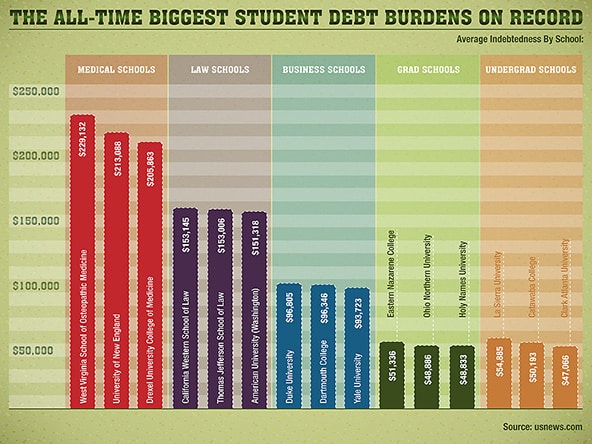
With student loan debt now topping $1 trillion, it’s clear that student debt is huge, and getting even bigger every year. With some individual student debts topping $200,000, it’s easy to understand how we got to this point. Here, we’ll examine some of the schools with the highest student debt burdens on record, broken into categories to highlight the most expensive college in each particular type of education: medical, law, business, graduate, and undergraduate. Read on to explore some of the craziest student debt burdens in the U.S. and find out what makes them just so expensive.

Medical Schools

Becoming a doctor is hardly cheap, a fact that students at these super-indebted medical schools know firsthand.

West Virginia School of Osteopathic Medicine: Students at the West Virginia School of Osteopathic Medicine are in more debt than any other medical school in the country with an average indebtedness of $229,132. Plus, it’s the only public school in the top 10 schools that graduate physicians with the most debt. But West Virginia offers something unique: it’s one of few schools to offer the Doctor of Osteopathic Medicine degree.

University of New England: The University of New England medical school is right on the heels of West Virginia School of Osteopathic Medicine with an average indebtedness of $213,088. The University of New England is home to Maine’s only medical school, the University of New England College of Osteopathic Medicine.

Drexel University College of Medicine: Another medical school with incredibly high average indebtedness is Drexel University, at $205,863 per student. Drexel boasts the nation’s largest enrollment for a private medical school, and was the nation’s first medical school for women. The college of medicine also holds the distinction of being the first U.S. college of homeopathy.

Law Schools

Medical school is easily the most expensive kind of student debt you can get into, but law school isn’t far behind, with average indebtedness reaching more than $153,000 at some top schools.

California Western School of Law: Annual tuition and fees at the California Western School of Law adds up to $42,600, and students at this law school graduate with average indebtedness of $153,145. Commonly known as the private Cal Western, this is the oldest law school in San Diego. The high price of Cal Western might just be worth it: overall bar exam pass rates in California tend to be between 35% and 55%, but at Cal Western, 78% of first time takers pass. Plus, 82% of grads were employed nine months after graduation.

Thomas Jefferson School of Law: Following behind California Western School of Law by just over $100, Thomas Jefferson School of Law’s debt load is practically just as high at $153,006. But Thomas Jefferson students enjoy a similarly high bar pass rate as well, with 60% passing the test for the first time. And Thomas Jefferson Grads edge out Cal Western when it comes to employment: 86.4% of grads were employed within nine months.

American University (Washington): This private law school is an expensive degree, with the average graduate leaving with about $151,318 in debt. But as is the case with Cal Western and Thomas Jefferson, American University’s expensive price also delivers excellent results. An impressive 84% of first timers pass the bar after attending Washington College of Law.

Business School

A great business school degree can open up many doors, but first, these business schools have students opening their wallets with almost $100,000 in average indebtedness.

Duke University: Duke University’s Fuqua School of Business graduates leave school with an average of $96,805 in debt. But for many students, that debt is well worth it, with a history of top 10 rankings for its MBA programs. Fuqua is recognized for its intellectual capital, classroom experience, and exclusivity, and has graduated the likes of Apple CEO Tim Cook and Melinda Gates.

Dartmouth College: A degree from Dartmouth College’s Tuck School of Business is ever so slightly more affordable than Fuqua, with an average indebtedness of $96,346. With this huge debt load comes a rich history, as Tuck is the oldest graduate school of business in the world, and the first institution to offer the MBA. And with the highest percentage of alumni donors of any business school in the world, it’s clear that Tuck graduates have been able to keep up with their heavy debt loads after graduation.

Yale University: Graduates of the Yale School of Management will typically graduate with an incredible sum of debt: $93,723. It’s a high figure to leave school with, but Yale graduates have the potential to wipe out their entire debt with their first post-grad annual salary: in Yale’s class of 2001, the mean base salary was $106,157, and the mean signing bonus was $29,276.

Grad Schools

Once you get past the super-expensive medical, law, and business schools, average total indebtedness gets a little less scary, with the most expensive grad school debt loads hovering around $50,000. But we’re certainly not saying it’s cheap!

Eastern Nazarene College: Most of the grad students at Eastern Nazarene College borrow to pay for school, 87% of them to be exact. And they’re borrowing quite a bit, with an average of $51,336 per student. With this debt load, Eastern Nazarene College graduates typically go on to do great things, with alumni including American Red Cross CEO Richard Schubert and YMCA CEO Neil Nicoll.

Ohio Northern University: Ohio Northern University has a similarly high rate of student borrowing, at 85% of students, who take on an average $48,886 in student debt. We’re willing to bet graduates think it’s worth it, though, with a number two ranking among Midwest colleges in U.S. News and World Report.

Holy Names University: At Holy Names University, borrowing is slightly lower at 79%, but not by much, and students still take on nearly $50,000 in debt with an average total indebtedness of $48,833. This private school delivers a good value for the money, though, with small class sizes and a student to faculty ratio of 17:1, with more than 90% of faculty holding the highest degree in their fields. Despite the high cost, Holy Names University has regularly been recognized by U.S. News & World Report as a “best value” university.

Undergraduate

Expensive grad schools are one thing, but these undergrad schools regularly graduate students with debt loads of about $50,000.

La Sierra University: La Sierra University in California undergraduates often leave school with a debt load that rivals that of graduate level education at an average of $54,885. Students at this private college enjoy a strong social responsible education, with the school boasting multiple national and world titles in the Students in Free Enterprise competition.

Catawaba College: The bad news is that students at Catawba College often graduate with about $50,193 in debt, but the good news is that with a borrowing rate of just 59%, not as many students have to pay back so much after graduation. Another expensive private school, Catawba College is affiliated with the United Church of Christ and is often recognized in best colleges reviews, including a number 17 ranking in U.S. News and World Report‘s best baccalaureate colleges of the South and consistent recognition as one of the top 10 school theater programs in the nation.

Clark Atlanta University: Clark Atlanta University is one of the best historically black colleges and universities, with a debt load to match: students who graduate from this school typically owe $47,066 in student loans. And nearly all students suffer this fate, with a 94% borrowing rate at the school. But even with a high debt load, there’s no denying Clark Atlanta’s value, especially for students who plan to make research a major part of their career: Clark Atlanta is one of only four historically black colleges and universities to earn a Carnegie classification of “Research University – High Research Activity,” and the university receives annual research grants of more than $17 million.

https://www.onlinecolleges.org/the-all-time-biggest-student-debt-burdens-on-record/

Posted on Leave a comment

Ridgewood Garage ,Yard,Moving and Estate Sales – Updates

Ridgewood garage sales theridgewoodblog.net 1

Great block yard sale on Pershing Ave and Eastern court in Ridgewood today

Big Garage Sale- A unique opportunity to quietly amass one of the largest collections of “STUFF” the free world has ever known!

Hey Folks,

You, your friends and family have a unique opportunity to quietly amass one of the largest collections of “STUFF” the free world has ever known! Yes, that’s right. For one day only, this Sunday, October 14th from 9a-5p, you are invited to peruse a pack-rat’s collection of some of the finest finds ever. Some of the highlights: end tables, chairs, oak workbench, granite slab, golf clubs, scale, air conditioners, golf travel bag, camping gear, hockey equipment, rugs, inflatable boat w paddles and PFD’s, life vest, bike wheels/jerseys/frame and fork, draperies, CD juke box, stereo, cabin tent, vacuum, wine chiller, electronic telescope, clothing, jackets, hats, purses, jewelry, games and toys, CD’s, DVD’s, BOSE speakers and headphones, books, etc. etc. Some items brand new still in box! There’s WAY too much STUFF to list…but I think you get the idea.

Keep it a secret for yourself, tell one, tell all…it’s up to you if you want to share. Just let it be known that this is a once-in-a-lifetime event, so DON’T MISS IT!!!

A portion of the proceeds will go as a donation to Dad’s Night in Ridgewood.

Sunday, 10-14-12 9a-5P
413 Addison Place
Ridgewood, NJ 07450


Multifamily garage sale (436&439 E. Saddle River Rd. Ridgewood NJ)

Sat/Sun 10/13&14 from 10:00 am – 4:00pm
Antique 4 drawer oak dresser with beveled mirrors, camel back large travel trunk, Antique Adlake Railroad Lantern, vintage Burroughs adding machine, cast iron antique bathroom scale weighs in lbs & English stones (not in good condition). Some beer steins (1980 Christmas Fair German lidded/vintage Dir und mir stonewear/vintage Olympia Brewery ceramarte). Kitchen items. Books & magazines. General womans clothing. Man’s med Tannery West leather jacket/XL Polo suede jacket. Movies, baskets, tins, record player, camping equipment, general furniture, couple of oil paintings, garden and hand tools, some holiday items & Grandmother battery operated clock. And a lot of other stuff.

Block Garage Sale (sat. 10/13) – $1 (Eastern Ct/Pershing Ave – Ridgewood)

Multiple house Garage Sale at end of Pershing Ave/Eastern Court (cul-de-sack) in Ridgewood
Something for everyone!!

Saturday, October 13, 9am-3pm
No Early Birds please

Rain date Sat 10/20 Location: 436&439 E. Saddle River Rd. Ridgewood NJ

Posted on 1 Comment

WEATHER ALERT: FREEZING TEMPERATURES LATE TONIGHT INTO SATURDAY MORNING…

network11

WEATHER ALERT: URGENT – WEATHER MESSAGE NATIONAL WEATHER SERVICE NEW YORK NY 320 AM EDT FRI OCT 12 2012

…FREEZING TEMPERATURES LATE TONIGHT INTO SATURDAY MORNING…

NORTHERN FAIRFIELD-NORTHERN NEW HAVEN-NORTHERN MIDDLESEX-
NORTHERN NEW LONDON-SOUTHERN FAIRFIELD-SOUTHERN NEW HAVEN-
SOUTHERN MIDDLESEX-SOUTHERN NEW LONDON-WESTERN PASSAIC-
EASTERN PASSAIC-WESTERN BERGEN-WESTERN ESSEX-WESTERN UNION-ORANGE-
PUTNAM-ROCKLAND-NORTHERN WESTCHESTER-
320 AM EDT FRI OCT 12 2012

…FREEZE WARNING IN EFFECT FROM 1 AM TO 9 AM EDT SATURDAY…

THE NATIONAL WEATHER SERVICE IN UPTON HAS ISSUED A FREEZE
WARNING…WHICH IS IN EFFECT FROM 1 AM TO 9 AM EDT SATURDAY. THE
FREEZE WATCH IS NO LONGER IN EFFECT.

* LOCATIONS…SOUTHERN CONNECTICUT…THE LOWER HUDSON VALLEY…AND
PORTIONS OF INTERIOR NORTHEAST NEW JERSEY.

* HAZARDS…SUB-FREEZING TEMPERATURES.

* TEMPERATURES…IN THE MID 20S TO LOWER 30S.

* TIMING…AFTER MIDNIGHT FRIDAY NIGHT INTO SATURDAY MORNING.

* IMPACTS…TEMPERATURES BELOW FREEZING COULD KILL CROPS AND
SENSITIVE VEGETATION.

PRECAUTIONARY/PREPAREDNESS ACTIONS…

A FREEZE WARNING MEANS BELOW FREEZING TEMPERATURES ARE IMMINENT
OR HIGHLY LIKELY. THESE CONDITIONS WILL KILL CROPS AND OTHER
SENSITIVE VEGETATION.

Microsoft Store

Posted on Leave a comment

Principal evaluation mandate will put administrators under microscope

RHS BEST theridgewoodblog.net 3

Principal evaluation mandate will put administrators under microscope

As New Jersey schools begin to rethink how they evaluate their teachers, districts are also getting a getting a crash course in assessing an equally important group of employees: school principals.

Fourteen districts have been chosen to participate in a trial run of a principal evaluation system that the state hopes to put in place next fall.

At the same time, New Jersey’s remaining 500-plus districts are being asked to choose the system they will use next year to evaluate their principals.

The effort involved in this task has led to some concern among school leaders, who are already revamping their teacher evaluation systems under the state’s new tenure law. And those jobs don’t include preparing for new testing and curriculum in the coming years as well.   (Mooney, NJ Spotlight)

https://www.njspotlight.com/stories/12/10/11/principal-evaluation-mandate-will-put-administrators-under-microscope/

Posted on Leave a comment

DOE $1.6 billion in stimulus money, safeguards are still not in place in too many places.

rodney

DOE follows $1.6 billion in stimulus money…but only so far

When the first round of federal stimulus money was handed out several years ago, New Jersey public schools were scolded by state monitors for not having adequate safeguards in place to ensure that the $1.6 billion was properly spent.

With the money gone and the state’s monitoring completed, the Department of Education this month released the summary findings for the nearly 100 districts getting the bulk of the aid.

Guess what: According to the state at least, safeguards are still not in place in too many places.

In his department’s annual summary of the results of the monitoring sent to all districts last week, state Education Commissioner Chris Cerf wrote that there continues to be a number common failings.   (Mooney, NJ Spotlight)
https://www.njspotlight.com/stories/12/10/10/doe-follows-1-6-billion-in-stimulus-money-but-only-so-far/

Posted on Leave a comment

Atlas Shrugged turns 55

427872 10151255312692534 934114547 n

Atlas Shrugged turns 55 

On 55th Anniversary of Atlas Shrugged, Ayn Rand More Prominent Than Ever
Wednesday, October 10, 2012

https://www.aynrand.org/site/News2?page=NewsArticle&id=27556

New movie based on the 1957 novel; new book by Ayn Rand Institute authors hits best-seller lists; Playboy to reprint Rand interview as e-book

IRVINE, Calif.—October 10 marks the 55th anniversary of the publication of Atlas Shrugged, the Ayn Rand masterpiece that sold more than 445,000 copies last year alone. Rand continues to be a pervasive figure in American culture, as politicos and business leaders regularly cite her works and opening weekend approaches for the second installment of the motion picture series based on the novel.

The book by Ayn Rand Institute executive director Yaron Brook and ARI fellow Don Watkins, Free Market Revolution: How Ayn Rand’s Ideas Can End Big Government, applies Rand’s philosophy to current economic events. The book hit four best-seller lists, including the Washington Post, Publishers Weekly, and USA Today, and also earned a spot on the Tea Party Patriots’ recommended reading list.

Playboy will republish its 1964 interview with Rand as an Amazon e-book on Oct. 10.

“Millions of individuals have read Rand’s novels, and she has inspired and shaped many people’s thinking,” said Brook. “What’s unique about what’s happening today is that her ideas, and especially herself explicitly, are entering the mainstream debates.”

Ayn Rand’s ideas of limited government and free markets, and her philosophy—particularly her moral philosophy—are what more and more Americans across the political spectrum are looking at more closely,” Brook said.

In addition to Atlas Shrugged, Rand also wrote The Fountainhead, Anthem, and We the Living. ARI’s high school essay contests, which are based on the novels, received more entries this year than ever before, and ARI has distributed more than 2.5 million copies of Rand’s novels to high schools around the country through its Books to Teachers program.

“It is encouraging to see more people talking about Ayn Rand and her ideas,” Brook said. “Even Paul Ryan, who doesn’t agree with all of her ideas, is certainly correct when he says that ‘Ayn Rand, more than anyone else, did a fantastic job of explaining the morality of capitalism, the morality of individualism.’”

https://www.aynrand.org/site/News2?page=NewsArticle&id=27556

Posted on Leave a comment

Backers of $750 million bond for NJ colleges and universities rally

animal house the musical

Backers of $750 million bond for NJ colleges and universities rally

Supporters of a $750 million bond to fund building and renovation projects at New Jersey’s colleges and universities say the initiative could create as many as 10,000 jobs in the construction trades.

They rallied at Rutgers University in New Brunswick on Monday to support the referendum, which will be at the bottom of a crowded presidential ballot next month.

New Jersey Senate President Stephen Sweeney said he realizes that people are reluctant to approve spending in an off economy but he said the bond, which had overwhelming bipartisan support in the Legislature, is about jobs as well as much-needed facilities for the schools.

“It’s always easy to vote down spending but this is something we can’t afford not to do,” said Sweeney, D-Gloucester.  (Alex, The Record)

https://www.northjersey.com/news/education/Supporters_of_750_million_bond_for_New_Jersey_colleges_and_universities_will_rally_today.html

Posted on Leave a comment

Mitt Romney Hammers President Obama On Libya In a Wide-Ranging Foreign Policy Speech

s MITT ROMNEY OBAMA LIBYA large

Editors Note : Romeny dispels the ‘blame America first ” and culture of cowardice that has dominated foreign and cultural policy for sometime 

Mitt Romney Hammers President Obama On Libya In a Wide-Ranging Foreign Policy Speech
Courtesy of CNN

Republican nominee Mitt Romney is giving a highly pumped-up foreign policy speech hammering President Barack Obama on the recent attacks in Libya.

Here’s the full text of Romney’s speech:

“I particularly appreciate the introduction from my good friend and tireless campaign companion, Gov. Bob McDonnell. He is showing what conservative leadership can do to build a stronger economy. Thank you also Congressman Goodlatte for joining us today. And particular thanks to Gen. Peay. I appreciate your invitation to be with you today at the Virginia Military Institute. It is a great privilege to be here at an Institution that has done so much for our nation, both in war and in peace.
For more than 170 years, VMI has done more than educate students. It has guided their transformation into citizens, and warriors, and leaders. VMI graduates have served with honor in our nation’s defense, just as many are doing today in Afghanistan and other lands. Since the September 11th attacks, many of VMI’s sons and daughters have defended America, and I mourn with you the 15 brave souls who have been lost. I join you in praying for the many VMI graduates and all Americans who are now serving in harm’s way. May God bless all who serve, and all who have served.

Of all the VMI graduates, none is more distinguished than George Marshall—the Chief of Staff of the Army who became Secretary of State and Secretary of Defense, who helped to vanquish fascism and then planned Europe’s rescue from despair. His commitment to peace was born of his direct knowledge of the awful costs and consequences of war.

General Marshall once said, “The only way human beings can win a war is to prevent it.” Those words were true in his time—and they still echo in ours.

Last month, our nation was attacked again. A U.S. Ambassador and three of our fellow Americans are dead—murdered in Benghazi, Libya. Among the dead were three veterans. All of them were fine men, on a mission of peace and friendship to a nation that dearly longs for both. President Obama has said that Ambassador Chris Stevens and his colleagues represented the best of America. And he is right. We all mourn their loss.
The attacks against us in Libya were not an isolated incident. They were accompanied by anti-American riots in nearly two dozen other countries, mostly in the Middle East, but also in Africa and Asia. Our embassies have been attacked. Our flag has been burned. Many of our citizens have been threatened and driven from their overseas homes by vicious mobs, shouting “Death to America.” These mobs hoisted the black banner of Islamic extremism over American embassies on the anniversary of the September 11th attacks.

As the dust settles, as the murdered are buried, Americans are asking how this happened, how the threats we face have grown so much worse, and what this calls on America to do. These are the right questions. And I have come here today to offer a larger perspective on these tragic recent events—and to share with you, and all Americans, my vision for a freer, more prosperous, and more peaceful world.

The attacks on America last month should not be seen as random acts. They are expressions of a larger struggle that is playing out across the broader Middle East—a region that is now in the midst of the most profound upheaval in a century. And the fault lines of this struggle can be seen clearly in Benghazi itself.

The attack on our Consulate in Benghazi on September 11th, 2012 was likely the work of forces affiliated with those that attacked our homeland on September 11th, 2001. This latest assault cannot be blamed on a reprehensible video insulting Islam, despite the Administration’s attempts to convince us of that for so long. No, as the Administration has finally conceded, these attacks were the deliberate work of terrorists who use violence to impose their dark ideology on others, especially women and girls; who are fighting to control much of the Middle East today; and who seek to wage perpetual war on the West.

We saw all of this in Benghazi last month—but we also saw something else, something hopeful. After the attack on our Consulate, tens of thousands of Libyans, most of them young people, held a massive protest in Benghazi against the very extremists who murdered our people. They waved signs that read, “The Ambassador was Libya’s friend” and “Libya is sorry.” They chanted “No to militias.” They marched, unarmed, to the terrorist compound. Then they burned it to the ground. As one Libyan woman said, “We are not going to go from darkness to darkness.”
This is the struggle that is now shaking the entire Middle East to its foundation. It is the struggle of millions and millions of people—men and women, young and old, Muslims, Christians and non-believers—all of whom have had enough of the darkness. It is a struggle for the dignity that comes with freedom, and opportunity, and the right to live under laws of our own making. It is a struggle that has unfolded under green banners in the streets of Iran, in the public squares of Tunisia and Egypt and Yemen, and in the fights for liberty in Iraq, and Afghanistan, and Libya, and now Syria. In short, it is a struggle between liberty and tyranny, justice and oppression, hope and despair.

We have seen this struggle before. It would be familiar to George Marshall. In his time, in the ashes of world war, another critical part of the world was torn between democracy and despotism. Fortunately, we had leaders of courage and vision, both Republicans and Democrats, who knew that America had to support friends who shared our values, and prevent today’s crises from becoming tomorrow’s conflicts.
Statesmen like Marshall rallied our nation to rise to its responsibilities as the leader of the free world. We helped our friends to build and sustain free societies and free markets. We defended our friends, and ourselves, from our common enemies. We led. And though the path was long and uncertain, the thought of war in Europe is as inconceivable today as it seemed inevitable in the last century.

This is what makes America exceptional: It is not just the character of our country—it is the record of our accomplishments. America has a proud history of strong, confident, principled global leadership—a history that has been written by patriots of both parties. That is America at its best. And it is the standard by which we measure every President, as well as anyone who wishes to be President. Unfortunately, this President’s policies have not been equal to our best examples of world leadership. And nowhere is this more evident than in the Middle East.

I want to be very clear: The blame for the murder of our people in Libya, and the attacks on our embassies in so many other countries, lies solely with those who carried them out—no one else. But it is the responsibility of our President to use America’s great power to shape history—not to lead from behind, leaving our destiny at the mercy of events. Unfortunately, that is exactly where we find ourselves in the Middle East under President Obama.

The relationship between the President of the United States and the Prime Minister of Israel, our closest ally in the region, has suffered great strains. The President explicitly stated that his goal was to put “daylight” between the United States and Israel. And he has succeeded. This is a dangerous situation that has set back the hope of peace in the Middle East and emboldened our mutual adversaries, especially Iran.
Iran today has never been closer to a nuclear weapons capability. It has never posed a greater danger to our friends, our allies, and to us. And it has never acted less deterred by America, as was made clear last year when Iranian agents plotted to assassinate the Saudi Ambassador in our nation’s capital. And yet, when millions of Iranians took to the streets in June of 2009, when they demanded freedom from a cruel regime that threatens the world, when they cried out, “Are you with us, or are you with them?”—the American President was silent.

Across the greater Middle East, as the joy born from the downfall of dictators has given way to the painstaking work of building capable security forces, and growing economies, and developing democratic institutions, the President has failed to offer the tangible support that our partners want and need.

In Iraq, the costly gains made by our troops are being eroded by rising violence, a resurgent Al-Qaeda, the weakening of democracy in Baghdad, and the rising influence of Iran. And yet, America’s ability to influence events for the better in Iraq has been undermined by the abrupt withdrawal of our entire troop presence. The President tried—and failed—to secure a responsible and gradual drawdown that would have better secured our gains.

The President has failed to lead in Syria, where more than 30,000 men, women, and children have been massacred by the Assad regime over the past 20 months. Violent extremists are flowing into the fight. Our ally Turkey has been attacked. And the conflict threatens stability in the region.
America can take pride in the blows that our military and intelligence professionals have inflicted on Al-Qaeda in Pakistan and Afghanistan, including the killing of Osama bin Laden. These are real achievements won at a high cost. But Al-Qaeda remains a strong force in Yemen and Somalia, in Libya and other parts of North Africa, in Iraq, and now in Syria. And other extremists have gained ground across the region. Drones and the modern instruments of war are important tools in our fight, but they are no substitute for a national security strategy for the Middle East.
The President is fond of saying that “The tide of war is receding.” And I want to believe him as much as anyone. But when we look at the Middle East today—with Iran closer than ever to nuclear weapons capability, with the conflict in Syria threating [sic] to destabilize the region, with violent extremists on the march, and with an American Ambassador and three others dead likely at the hands of Al-Qaeda affiliates— it is clear that the risk of conflict in the region is higher now than when the President took office.

I know the President hopes for a safer, freer, and a more prosperous Middle East allied with the United States. I share this hope. But hope is not a strategy. We cannot support our friends and defeat our enemies in the Middle East when our words are not backed up by deeds, when our defense spending is being arbitrarily and deeply cut, when we have no trade agenda to speak of, and the perception of our strategy is not one of partnership, but of passivity.

The greater tragedy of it all is that we are missing an historic opportunity to win new friends who share our values in the Middle East—friends who are fighting for their own futures against the very same violent extremists, and evil tyrants, and angry mobs who seek to harm us. Unfortunately, so many of these people who could be our friends feel that our President is indifferent to their quest for freedom and dignity. As one Syrian woman put it, “We will not forget that you forgot about us.”

It is time to change course in the Middle East. That course should be organized around these bedrock principles: America must have confidence in our cause, clarity in our purpose and resolve in our might. No friend of America will question our commitment to support them… no enemy that attacks America will question our resolve to defeat them… and no one anywhere, friend or foe, will doubt America’s capability to back up our words.

I will put the leaders of Iran on notice that the United States and our friends and allies will prevent them from acquiring nuclear weapons capability. I will not hesitate to impose new sanctions on Iran, and will tighten the sanctions we currently have. I will restore the permanent presence of aircraft carrier task forces in both the Eastern Mediterranean and the Gulf region—and work with Israel to increase our military assistance and coordination. For the sake of peace, we must make clear to Iran through actions—not just words—that their nuclear pursuit will not be tolerated.
I will reaffirm our historic ties to Israel and our abiding commitment to its security—the world must never see any daylight between our two nations.

I will deepen our critical cooperation with our partners in the Gulf.

And I will roll back President Obama’s deep and arbitrary cuts to our national defense that would devastate our military. I will make the critical defense investments that we need to remain secure. The decisions we make today will determine our ability to protect America tomorrow. The first purpose of a strong military is to prevent war.

The size of our Navy is at levels not seen since 1916. I will restore our Navy to the size needed to fulfill our missions by building 15 ships per year, including three submarines. I will implement effective missile defenses to protect against threats. And on this, there will be no flexibility with Vladimir Putin. And I will call on our NATO allies to keep the greatest military alliance in history strong by honoring their commitment to each devote 2 percent of their GDP to security spending. Today, only 3 of the 28 NATO nations meet this benchmark.

I will make further reforms to our foreign assistance to create incentives for good governance, free enterprise, and greater trade, in the Middle East and beyond. I will organize all assistance efforts in the greater Middle East under one official with responsibility and accountability to prioritize efforts and produce results. I will rally our friends and allies to match our generosity with theirs. And I will make it clear to the recipients of our aid that, in return for our material support, they must meet the responsibilities of every decent modern government—to respect the rights of all of their citizens, including women and minorities… to ensure space for civil society, a free media, political parties, and an independent judiciary… and to abide by their international commitments to protect our diplomats and our property.

I will champion free trade and restore it as a critical element of our strategy, both in the Middle East and across the world. The President has not signed one new free trade agreement in the past four years. I will reverse that failure. I will work with nations around the world that are committed to the principles of free enterprise, expanding existing relationships and establishing new ones.

I will support friends across the Middle East who share our values, but need help defending them and their sovereignty against our common enemies.

In Libya, I will support the Libyan people’s efforts to forge a lasting government that represents all of them, and I will vigorously pursue the terrorists who attacked our consulate in Benghazi and killed Americans.

In Egypt, I will use our influence—including clear conditions on our aid—to urge the new government to represent all Egyptians, to build democratic institutions, and to maintain its peace treaty with Israel. And we must persuade our friends and allies to place similar stipulations on their aid.

In Syria, I will work with our partners to identify and organize those members of the opposition who share our values and ensure they obtain the arms they need to defeat Assad’s tanks, helicopters, and fighter jets. Iran is sending arms to Assad because they know his downfall would be a strategic defeat for them. We should be working no less vigorously with our international partners to support the many Syrians who would deliver that defeat to Iran—rather than sitting on the sidelines. It is essential that we develop influence with those forces in Syria that will one day lead a country that sits at the heart of the Middle East.

And in Afghanistan, I will pursue a real and successful transition to Afghan security forces by the end of 2014. President Obama would have you believe that anyone who disagrees with his decisions in Afghanistan is arguing for endless war. But the route to more war – and to potential attacks here at home – is a politically timed retreat that abandons the Afghan people to the same extremists who ravaged their country and used it to launch the attacks of 9/11. I will evaluate conditions on the ground and weigh the best advice of our military commanders. And I will affirm that my duty is not to my political prospects, but to the security of the nation.

Finally, I will recommit America to the goal of a democratic, prosperous Palestinian state living side by side in peace and security with the Jewish state of Israel. On this vital issue, the President has failed, and what should be a negotiation process has devolved into a series of heated disputes at the United Nations. In this old conflict, as in every challenge we face in the Middle East, only a new President will bring the chance to begin anew.

There is a longing for American leadership in the Middle East—and it is not unique to that region. It is broadly felt by America’s friends and allies in other parts of the world as well— in Europe, where Putin’s Russia casts a long shadow over young democracies, and where our oldest allies have been told we are “pivoting” away from them … in Asia and across the Pacific, where China’s recent assertiveness is sending chills through the region … and here in our own hemisphere, where our neighbors in Latin America want to resist the failed ideology of Hugo Chavez and the Castro brothers and deepen ties with the United States on trade, energy, and security. But in all of these places, just as in the Middle East, the question is asked: “Where does America stand?”

I know many Americans are asking a different question: “Why us?” I know many Americans are asking whether our country today—with our ailing economy, and our massive debt, and after 11 years at war—is still capable of leading.

I believe that if America does not lead, others will—others who do not share our interests and our values—and the world will grow darker, for our friends and for us. America’s security and the cause of freedom cannot afford four more years like the last four years. I am running for President because I believe the leader of the free world has a duty, to our citizens, and to our friends everywhere, to use America’s great influence—wisely, with solemnity and without false pride, but also firmly and actively—to shape events in ways that secure our interests, further our values, prevent conflict, and make the world better—not perfect, but better.

Our friends and allies across the globe do not want less American leadership. They want more—more of our moral support, more of our security cooperation, more of our trade, and more of our assistance in building free societies and thriving economies. So many people across the world still look to America as the best hope of humankind. So many people still have faith in America. We must show them that we still have faith in ourselves—that we have the will and the wisdom to revive our stagnant economy, to roll back our unsustainable debt, to reform our government, to reverse the catastrophic cuts now threatening our national defense, to renew the sources of our great power, and to lead the course of human events.

Sir Winston Churchill once said of George Marshall: “He … always fought victoriously against defeatism, discouragement, and disillusion.” That is the role our friends want America to play again. And it is the role we must play.

The 21st century can and must be an American century. It began with terror, war, and economic calamity. It is our duty to steer it onto the path of freedom, peace, and prosperity.

The torch America carries is one of decency and hope. It is not America’s torch alone. But it is America’s duty – and honor – to hold it high enough that all the world can see its light.

Thank you, God bless you, and God bless the United States of America.”

Read more: https://www.businessinsider.com/mitt-romney-foreign-policy-speech-vmi-obama-virginia-military-institute-libya-2012-10#ixzz28jEwzKTx

Posted on Leave a comment

2012 Election: Watch your Candidate Debate

us election 2012

2012 Election: Watch your Candidate Debate 

Vice Presidential and Presidential Debate
October 11, Thursday – 9:00 pm – Vice Presidential Debate
Hosted by ABC, Martha Raddatz

October 16, Tuesday – 9:00 pm Presidential Debate
Hosted by CNN – Candy Crowley

October 22, Monday – 9:00 pm Presidential Debate
Hosted by CBS – Bob Schieffer

Boteach v Pascrell 
Congressional Seat – 9TH District
First debate -Sunday, October 14 – 930 a.m. (MORNING)
Temple Sinai of Bergen County in Tenafly
One Engle Street
Tenafly, New Jersey 07670
Phone: (201) 568-3035

Second debate – Monday October 22 – 7pm
Daniel F. Ryan School # 19 – Passaic NJ
320 Highland Ave
Passaic, NJ 07055
973-470-5201

Third Debate – Thursday, October 25 – 630 pm
Gallery 1&9 Ridgefield NJ
1 Remsen Pl
Ridgefield, NJ 07657-2321
(201) 945-8270
*notice which are a.m. and which are p.m.
Bergen County Freeholder Debates
Hermansen(incumbent)/Watkins & Tanelli/Zur
AARP Candidates Forum – Monday, October 8, 2012 – 1:00 pm
Knights of Columbus Hall, 61 Armour Place, Dumont
This is a AARP members only event

The Jewish Federation of Northern New Jersey’s
Jewish Community Relations Council and The Jewish Standard
Sunday, October 14, 2012 – 9:30 – 11:00 am (MORNING)
Temple Avodat Shalom
385 Howland Avenue
River Edge

The Record
Monday, October 15, 2012 – 7:00pm
The Tech Center at Bergen Community College
Room TBA, 400 Paramus Road, Paramus

The Korean American Civic Empowerment (KACE)
Thursday, October 18, 2012
6:30PM to 7:30PM
The Gallery 1&9, 1 Remsen Pl. #107, Ridgefield

League of Women Voters of Bergen County
Tuesday, October 23, 2012 – 2:00pm
Bergen Community College, 400 Paramus Road, Paramus

Posted on 1 Comment

5th District contenders Garrett, Gussen Square off at Temple Beth Haverim Shir Shalom in Mahwah

11675821 small

file photo

5th District contenders Garrett, Gussen Square off at Temple Beth Haverim Shir Shalom in Mahwah
October 8, 2012
the staff of the Ridgewood blog

Ridgewood NJ , Democratic challenger Adam Gussen deputy mayor of Teaneck tried Sunday to take advantage of his only face-to-face debate with incumbent Rep. Scott Garrett in voter-rich Bergen County by criticizing Garrett’s votes on economic and government social programs.

While Garrett focused his barbs mainly at President Obama and ignored the challenger, who is largely unknown in a redrawn 5th District and has struggled to raise money or gain any traction .

The debate was not carried on TV or radio,with only about 100 people or so in attendance , most were supporters of either candidate.

Gussen, who is the deputy mayor of Teaneck, tried in vain at one point to get Garrett to focus on the challenger in the room instead of Democrats in Washington: “I’m not President Obama, and there’s no empty chair for Clint Eastwood to talk to, either.”

Gussen is viewed as mostly as an “Obamabot” other than his doubts about the administration’s policy toward Iran, Gussen’s own positions mirrored those of Obama and other Democrats. Garrett is viewed as the quintessential conservative share many of the same positions as Mitt Romney .

While Garrett’s detractors continually attack him for being out of touch and far too “conservative” for left leaning Bergen county , voters disagree by voting Garrett in by landslides even in very “liberal” towns like Ridgewood.

Gussen while no gaff prone Joe Biden , he seems to be out of ideas other than the very tried , “evil Republics are all for rich people ” ,given by most standards Bergen county is full of those same “rich people” , who seem to vote Democrat , and love the president Obama .

Microsoft Store

Posted on 1 Comment

Do you have a right to resell your own stuff ?

Garage sale today theridgewoodblog.net 1

Do you have a right to resell your own stuff ?
It could become illegal to resell your iPhone 4, car or family antiques
By Jennifer Waters, MarketWatch

CHICAGO (MarketWatch) — Tucked into the U.S. Supreme Court’s agenda this fall is a little-known case that could upend your ability to resell everything from your grandmother’s antique furniture to your iPhone 4.

At issue in Kirtsaeng v. John Wiley & Sons is the first-sale doctrine in copyright law, which allows you to buy and then sell things like electronics, books, artwork and furniture, as well as CDs and DVDs, without getting permission from the copyright holder of those products.

A Supreme Court case could limit the resale of goods made overseas but sold in America.
Under the doctrine, which the Supreme Court has recognized since 1908, you can resell your stuff without worry because the copyright holder only had control over the first sale.

Put simply, though Apple Inc. AAPL -0.88% has the copyright on the iPhone and Mark Owen has it on the book “No Easy Day,” you can still sell your copies to whomever you please whenever you want without retribution.

That’s being challenged now for products that are made abroad, and if the Supreme Court upholds an appellate court ruling, it would mean that the copyright holders of anything you own that has been made in China, Japan or Europe, for example, would have to give you permission to sell it.

“It means that it’s harder for consumers to buy used products and harder for them to sell them,” said Jonathan Band, an adjunct professor at Georgetown University Law Center, who filed a friend-of-the-court brief on behalf of the American Library Association, the Association of College and Research Libraries and the Association for Research Libraries. “This has huge consumer impact on all consumer groups.”

Another likely result is that it would hit you financially because the copyright holder would now want a piece of that sale.

https://www.marketwatch.com/story/your-right-to-resell-your-own-stuff-is-in-peril-2012-10-04

Posted on Leave a comment

‘Smart’ traffic signals may ease traffic backups

GT shutterstock traffic+light

‘Smart’ traffic signals may ease traffic backups
Oct. 7, 2012, 12:11 p.m. EDT
The Record (Woodland Park, N.J.)

NORTH ARLINGTON, N.J. (AP) — Within a two-mile radius of where Schuyler Avenue and Belleville Turnpike intersect in North Arlington, drivers confront day-to-day traffic backups at stop lights and road-construction projects on roads built before World War II.

With bends and single-lane stretches, they are among the region’s busiest roadways, passing industrial zones, strip malls and apartments, leaving little room for widening or straightening to ease congestion.

To improve flow, Meadowlands region officials are turning to a new sort of traffic signal that can sense traffic jams, communicate with other “smart” traffic lights and automatically clear up congestion.

The project — called Meadowlands Adaptive Signal System for Traffic Reduction — an innovative network that includes cameras, computerized radios and sensors that will adjust the timing of traffic signals — began construction last year in Secaucus.

Once the system is up and running, it should cut travel time on historically congested roads and save on fuel consumption.

https://www.nj.com/newsflash/index.ssf/story/smart-traffic-signals-may-ease-traffic-backups/1151a27a8ea74621acf38e7f41600664

Posted on Leave a comment

Gold/Blue Star Dinner

gold star mothers day

Gold/Blue Star Dinner
ROBERT PAOLI

American Legion Post 53, Ridgewood will be honoring all Gold Star and Blue Star families in our community. We will have a dinner for them at Our Lady of Mt. Carmel Parish Center on Friday, October 19th at 6:30 pm.

You are invited to attend. Our guest speaker is James Dao, N.Y.Times writer covering military affairs who has been in Afghanistan. Meet and greet Gold Star Mother June Augusta and many other Ridgewood families.