>“Grow Your Business” Luncheon Networking for July Thu, July 22, 2010 – Thu, July 22, 2010 Time: 11:15 AM – 1:00 PM Location: The Office Beer Bar & Grill, 32 Chestnut St., Ridgewood Cost: $20 per person
Event Description
The Ridgewood Chamber of Commerce presents “Grow Your Business” Networking Luncheon at The Office Beer Bar & Grill. Learn about new marketing ideas from Constant Contact representative Wendi Caplan to always stay in front of your customers. Today, it’s all about communicating with your customers regularly, reminding them of your value and setting yourself apart from the competition. Constant Contact is committed to the success of small businesses like yours and will make it easy for you to get an effective e-mail marketing up and running. They will help you start, grow and maintain your list of contacts, all at a price that makes sense for your business.
Please RSVP by July 20th to the Chamber Office at 201-445-2600 or [email protected]. There is a parking lot located on Chestnut Street that offers metered parking. Respond early as seating will be limited. We hope to see you there!
The latest Rasmussen Reports national telephone survey of Adults shows 75% say the unwillingness of politicians to reduce government spending is more to blame for current state budget crises than the unwillingness of taxpayers to pay more in taxes.
Only 13% take the opposing view and blame taxpayers’ unwillingness to pay more to the government. Another 12% are undecided.
Americans have expressed this level of skepticism toward their elected officials for some time now. In February, 83% blamed the federal budget deficit on politicians’ unwillingness to cut spending. In May of last year, 77% said politicians’ unwillingness to cut spending is the bigger problem in America today.
The majority of adults of all political affiliations blame politicians’ lack of spending cuts for state budget problems. But Democrats are slightly more inclined to criticize taxpayers for their unwillingness to pay more.
One-in-three government employees (33%) say taxpayers are to blame more than politicians.
Recent job reports show that government hiring is up, while layoffs are more common than hirings in the private sector. Many Americans believe government workers make more money than their counterparts in the private sector, and they don’t like the idea of the government hiring more workers.
Steven Adler Wednesday, July 28 @ 12:00 noon. Former drummer of Guns N’ Roses, Steven Adler will sign his new book: My Appetite for Destruction
Tony Dungy Tuesday, August 3rd @ 6:00pm Former Indianapolis Colts Head Coach, Tony Dungy will sign his new book: Mentor Leader.
Forrest Griffin Wednesday, August 4th @ 7:00pm Former UFC Lightweight Champion, Forrest Griffin, will be signing his new book:Be Ready When the Sh*t Goes Down.
Dave Mustaine Tuesday, August 10th @ 7:00pm Guitarist and founding member of Megadeth, Dave Mustaine, will sign his new book:Mustaine.
Leonard Marshall Wednesday, August 25th @ 6:00pm Former Defensive End for the New York Giants, Leonard Marshall, will sign his new book:When the Cheering Stops
Don Maynard Tuesday, September 14 @ 6:00pm Former Super Bowl III Champion New York Jets Wide Receiver, Don Maynard, will sign his new book: You Can’t Catch Sunshine.
BOOKENDS 232 East Ridgewood Avenue Ridgewood, NJ 07450-3816 (201) 445-0726
>Christie Takes Aim at School Administration Salaries : this kind of micro-management is PRECISELY what gave us the unfunded retirement issues
I would think that this blog, and the group of people that read it would react negatively to the government dictating what we can and can’t as a community decide to pay our superintendent.
I would like to continue to have the choice — whether it be more or less — about what we pay.
AND this kind of micro-management is PRECISELY what gave us the unfunded retirement issues we have today. By keeping published salaries artifically low, fringe benefits are jacked up artifically high. Creating the budget busting that we see today as the costs of the fringe benefits escalate wildly.
This is not my favorite idea from my favorite Governor.
I can’t wait to see the NJEA try to argue against this plan, Save Jerseyans!
Governor Christie visited a Spotswood (Middlesex County) classroom today and announced plans for an administrative salary cap covering all of New Jersey’s school districts. Pegging pay increases to district size would remove some of the arbitrariness from the administrative pay process and save the taxpayers plenty of dough going forward. Superintendents can get an additional $5,000 for each district they cover, but school boards will not be permitted to go beyond the cap. Assemblymen Rible (R-Monmouth) and DiCiccio (R-Gloucester) have been tapped to introduce the legislation.
According to the Governor, 366 superintendents would see their salaries reduced with this cap in place. I’m looking at you, Dave Verducci.
More background:
Under the proposal, the maximum base salary that a district could pay a superintendent would rise with the size of the school district. The top salary for the superintendent of a K-8 district with fewer than 250 students would be $120,000. From there, salary maximums would gradually step up with the size of the school district to the point that the superintendent of a district with up to 10,000 students could be paid a maximum of $175,000. A superintendent in one of New Jersey’s 16 districts with more than 10,000 students could earn a higher base salary.
In addition, administrator compensation would be restructured to provide the opportunity for non-pensionable, individual year merit stipends if superintendents achieve significant, state-defined improvements in student learning from the year before.
This is the change teachers deserve, too.
It’s not fair to let promising young educators lose their jobs when fat cat administrators collude with their union reps and local school boards to maintain astronomically high salaries. Of course teachers need to start paying for their bennies and pensions at normal private sector levels. That’s clear, but school superintendent salaries, if you can believe it, have actually risen 46% since 2001… a $100 million kick in the ass for state taxpayers. Not a bad gig, huh? I’m going to be a superintendent in my next life, Save Jerseyans.
Example? My favorite Bergen superintendent, David Verducci, earns almost $190,000 annually. Laying him off would’ve freed up enough cash to save 247 teaching jobs in 2010. An extraordinary amount of public money is tied up in salaries for paper pushers!
What will be VERY interesting to see, as I mentioned at the beginning of my post, is how the NJEA responds to this latest toolkit proposal. Will they side with administrators who earn more than the Governor? Or will they support a measure that will save teaching jobs a free up additional funds for classrooms? In essence, it’s their last chance to be something other than a transparently partisan organization. Just don’t hold your breath waiting for a cathartic moment.
PSE&G Proposes to Lower Residential Natural Gas Bills by 6.8 Percent, On Top of 4 Percent Reduction Implemented July 9
Changes would be effective in time for winter heating season (July 14, 2010 – Newark, NJ) – Citing the continuing decrease in the wholesale cost of natural gas, PSE&G has proposed to lower residential gas bills this fall by an additional 6.8 percent, or about $14 per month for the typical residential customer. The company’s annual filing with the New Jersey Board of Public Utilities (BPU) today would follow a net 4 percent reduction PSE&G implemented on July 9 for residential gas customers.
A customer’s gas bill is composed of two parts: delivery, which includes the cost of maintaining and upgrading the gas distribution system, and supply, which reflects the cost of the natural gas PSE&G purchases on behalf of its customers.
• On June 18, the BPU approved a modest 0.9 percent increase in residential gas bills to resolve the utility’s request to increase gas delivery rates. The new delivery rates took effect on July 9.
• At the same time, PSE&G lowered residential bills by 5 percent because of lower supply charges, which more than offset the increase in delivery charges. This decrease also took effect July 9, for a net reduction of 4 percent.
If approved by the BPU, today’s filing would lower gas bills even further heading into the winter heating season. Under the proposed new gas supply rates, a residential gas heating customer who uses 160 therms in a winter month, or 1,050 therms per year, would see a decrease of $94 on an annual basis. This customer’s monthly winter bill would be $194.13, a decline of $14.26.
Including the reduction this coming fall, PSE&G will have lowered gas bills for supply a total of approximately 28 percent since January 2009, when wholesale prices started to drop. PSE&G makes no profit on the sale of natural gas and passes along what it pays to customers. If the price of natural gas increases, the New Jersey Board of Public Utilities allows the state’s natural gas utilities, including PSE&G, to recover those costs. Conversely, reductions in the gas supply price may be implemented at any time if market conditions warrant.
>Tech Notes : Email Security & Data Loss Prevention On July 13, 2010.
Email has become the lifeblood of the modern business. E-mail is a powerful communication tool and must be protected as part of your backup strategy.
As dependence on email and its use have grown, so has the governmental and legal scrutiny regarding email. Email is now just as admissible in court, and just as critical for any business to maintain, as are its paper-based records.
However, e-mail has been proven to be a very insecure means of communication. This causes great concern when an e-mail message contains confidential information, such as PHI. When used recklessly it can open the provider up to several potential legal and ethical dilemmas.
Ask yourself if a client/patient makes a claim and you need to refer to a written email record from two years ego, can you find this email?
Lost email is a very common occurrence, with companies struggling each day to restore key messages, attached files, and entire correspondence threads. Hours are spent performing restores and searching for the right email messages.
Having the ability to quickly and easily retrieve email records in your original format is essential for any business. It also gives companies a competitive edge in customer satisfaction and employee effectiveness.
Management needs to be assured that their correspondence is safe and easily retrieved. You need to make sure that your business email is available regardless of the failure of any system and right now is the right time to take care of it.
>Monmouth Poll: voters like cap, but preferred a hard cap
Although many state residents approve of a 2 percent property tax agreement, more wanted a hard cap over a soft one, and a majority say a cap won’t fix the structural problems that cause high property taxes, according to a Monmouth University/Gannett New Jersey Press Media Poll released this morning. Among a group of 3-in-4 New Jerseyans who say they are familiar with the special session, 48% approve of the deal reached by the governor and legislature compared to 31% who disapprove. However, it is not clear that these residents are actually aware of the plan’s details. Asked about specifics regarding the 2 percent cap with exemptions for health care, pension, and debt payments that Gov. Chris Christie will sign into law this afternoon, only 35% of New Jerseyans say they favor this type of cap versus 45% who oppose. By comparison, a majority of 54% favor a hard 2.5% cap like the one the governor originally proposed, with 31% opposed. (Pizarro, PolitickerNJ)
What is the political agenda sought by public teachers in South Carolina?
Do they seek a pay scheme that rewards them based on their classroom success?
Do they want a reduction of the administrative bureaucracy that siphons their time and money away from the classroom?
Or do they aspire to achieve broader policy aims, such as the elimination of far-reaching inequalities in student access to great classrooms?
If schools exist (and are funded) to provide children with appropriate and effective instruction, then it stands to reason that teachers’ unions ought to support policies proven to promote those goals.
But that is not always the case. More often, union bosses exploit the political naivete of well-meaning teachers by using so-called “education associations” to promote an agenda strikingly at odds with the public interest.
These political hacks, far-removed from the classroom, leech resources away from the classrooms, defend persistent school failures and mislead the teachers they claim to serve. Their ultimate political objective is a massive and perpetual growth in government spending on schools – the lions share of which goes to politically connected contractors, consultants and career bureaucrats.
Now, the National Education Association (NEA), America’s largest and most controversial teachers’ union, has sent one of its henchmen here to South Carolina to do just that.
Robert A. Bonazzi has been “appointed” by the DC-based NEA to take over the South Carolina Education Association (SCEA). The SCEA has, despite its role in the stimulus debate, experienced a major decline in membership and political clout in recent years. All the while the ultra-political administrators’ union (SCASA) and the school boards’ union (SCSBA) have rushed in to fill the controversial “advocacy role” once envisioned for the SCEA.
Bonazzi’s most recent post for the NEA was in New Jersey, where he served a leader of the New Jersey Education Association – nationally recognized as one of the most politically noxious and anti-parent NEA affiliates in the country.
In New Jeresy, Robert Bonazzi fought hard against home-rule and even homeowners who wanted to limit the growth of property taxes – bizarrely calling property taxpayers “different from other folks.” Bonazzi threatened moderate Republican Governor Christina Todd Whitman with “electoral consequences” when she proposed a plan to halt public subsidies for teachers’ pensions.
He was also part of a NEA plan to setup a “social welfare” front group that channeled teachers’ dues and NEA political contributions into a shell organization with greater scope, fewer legal restrictions, and fewer critics, than the beleaguered NEA.
The group took in over $4 million from the NEA to run attack ads during the 2004 election cycle.
Bonazzi’s “total war” approach to political organizing of public school teachers remains legendary in the Garden State.
“The [NJ] teachers union makes the Teamsters look like pussycats,” said Alan R. Geisenheimer, one-time president of the Bergen County School Boards Legislative Committee. “The question I would ask, is there any legislation the NJEA has asked for that they haven’t gotten? I don’t know of any.”
And it worked well for the union:
“To some of my colleagues in the Senate, the [NJ] teachers union is tangible and the general public is not,” said Sen. Gerald Cardinale, R-Demarest. “The teachers union is a monolithic force; the public is not.”
Things did not work out so well for the students though – but that is not how NEA quantifies success.
>Steve Lonegan: Will Cap 2.0 Solve New Jersey’s Property Tax Problem?
Politicians in Trenton are patting one another on the back after passing the “compromise” Cap 2.0 proposal yesterday.
Trendy sounding Cap 2.0 purports to limit property tax hikes at 2% with several exceptions, including exemptions for “pension costs, health care costs, debt payments and states of emergencies.” Towns could exceed the 2% cap by putting the proposal up for referendum and receiving a majority vote.
But will Cap 2.0 work? Do New Jersey homeowners, who are subject to the nation’s worst property taxes, have reason for optimism? If history is any judge, then the answer is a resounding NO. In 1976, New Jersey taxpayers were promised relief when the state enacted an income tax with a corresponding cap. Funds from the income tax were dedicated to the “Property Tax Relief Fund” to be returned to municipalities in the way of municipal aid, school aid, and property tax rebates. But as Columnist Paul Mulshine pointed out in a Star-Ledger article last week, towns began to circumvent the cap and avoid referendum – instead issuing bonds and accruing debt.
In that year, voters were told the new cap would have several exemptions and that an increase in excess of that cap would have to go before the voters. That’s right-this law has been on the books for 34 years! Since 1976, different permutations of the cap have been enacted during the administrations of various governors including Jim McGreevey and Jon Corzine. Yet, New Jersey’s property taxes have continued to escalate. Now, New Jersey property tax payers are being told once again that a cap is the answer. That this time it will be different and finally we will be able to resolve our state’s intractable property taxes.
But the fact of the matter is New Jersey’s property tax problem will not be resolved with the mere passage of another cap scheme – let alone new political posturing that does not stop the runaway spending in Trenton. Massive, bloated state government is subject to no such cap, and it is big government in Trenton that is the problem, not the solution.
Abbott District funding, state mandates, COAH requirements, Project Labor Agreements, and binding arbitration are the driving forces behind high property taxes.
The property tax problem is one of Trenton’s making. Until the Governor and the Legislature address these issues head on, property taxes will remain on the rise in New Jersey and Cap 2.0 will do nothing to stop it.
What kind of person would volunteer to serve on a zoning board? It’s not exactly a lucrative position. So it’s perhaps unsurprising that a new study by Jerry L. Anderson, Aaron Brees, and Emily Renninger finds that most zoning board members have something to gain from their positions: “[C]ertain types of professional occupations — business, real estate, law, bankers, planners, and architects — are disproportionately represented. In some cities, the majority of board members have some direct or indirect interest in the development process.” The authors argue that this disproportionate representation may lead to predictable building patterns — the prevalence of urban sprawl and gated communities or why “high-impact land uses are located most often in poorer sections of town.” In Norway, there’s a quota for women on corporate boards, which seems to be working out well; is there a corollary to consider for U.S. zoning boards? (11)
>This is what happens when you have weak form of local government. The Faulknarian, non-partisan, village charter is proving our undoing. There is no counter balance or opposing parties to keep the other in check. While this Utopian set-up worked for many decades, due to the fact that we were in essence a one party village, in the past few years it has made governing all but impossible.
Without political parties to provide support to elected officials and a counter weight to the other, a void of political courage arises in times of trouble and hence no one takes responsibility for anything.
In the meantime, a hired hand runs our village. We have effectively, removed our representatives from governing us and placed our fate in bureaucrats. Our model of local government is a relic of days gone by and should be replaced with one which fosters the competition of ideas. The Rockwellian world of Ridgewood being a sleepy little commuter town is a thing of the past. We need real leadership in this day and age and our form of government prohibits such.
As the institution that provides parking for events at George Washington Middle School in Ridgewood, the West Side Presbyterian Church is used to large events there. The recent Planning Board meeting at George Washington was peculiar and seemed, to the church management, to be set up for confrontation and anger.
Why was the meeting suddenly (from our perspective) moved from the larger venue with parking to the smaller venue without parking? Since it would be providing parking, why wasn’t the church informed? We read about it in the paper on Monday morning, then scrambled to make as much parking as possible available. Two events were scheduled at the church that night, so we could not have accommodated the overflow from George Washington.
We asked the village for police help to direct traffic, which would have maximized our parking and assured safety. Our request was refused. For a meeting of this sort, would not police support just be a given? It should have been in the plan from the beginning to have village police there, without having to call in police from other agencies in such a dramatic fashion.
We have never before seen a crowd not allowed into the George Washington School. There are massive meetings at George Washington requiring use of the entire parking lot and the field below our Youth Barn in addition to neighborhood parking.
For the June 21 meeting, was it not possible to televise the meeting in the dining hall so people could be inside? Any attempt at accommodation could have worked wonders in defusing an ugly situation. Creating a crowd outside, as happened June 21, invited a riot.
From the church’s perspective across the street, the whole thing seemed to be designed to be confrontational. This is probably not the case, but we are curious why this was so different from every other large event.
Kent Smith
Ridgewood, June 28
The writer is a pastor at the West Side Presbyterian Church in Ridgewood.
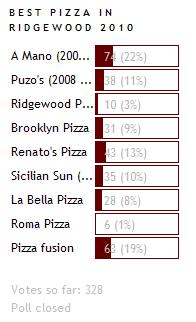
>I am a bit confused though, as last Wednesday after the polls had closed, your website showed the below poll results, showing A Mano had won with 22% of the vote and 74 votes. Did the voting reopen ?
At 12:00pm today I witnessed an elderly man get struck by I car at the intersection of Oak and Franklin Ave. He was crossing on the crosswalk when a woman making a left on to Franklin Ave hit him.