The issue is school choice. The opposition is the teachers unions
Shortly after Betsy DeVos was sworn into office as U.S. Secretary of Education, I was invited, as a trustee of Excellent Education for Everyone (E3), to meet with her at the Department of Education. I accepted the invitation with pleasure.
When I posted a picture of myself with DeVos on Facebook, it got some likes from conservative friends and some acerbic comments from others, including my sister, who asked me, “When did you start drinking the Kook-Aid?” I replied to her that I’ve supported school choice for decades and was the only member of the New Jersey Congressional delegation to vote for the first school-choice floor amendment in 1994.
Dick Zimmer and U.S. Secretary of Education Betsy DeVos
I am a product of New Jersey public schools, K–12, as are my parents and my children, but ever since I read Milton Friedman’s proposal for school vouchers in “Capitalism and Freedom” as a college freshman, I have been convinced that parents should be allowed to have the government pay for the school they choose for their children, whether it be traditional public, public charter, private, or religious.
There is no reason why all parents shouldn’t be given this choice, but the stakes are particularly high for the poorest families in the inner cities, including those in New Jersey where, despite tens of billions of dollars of supplemental state funding, traditional public schools have abjectly failed to prepare several generations of children for college or a career.
By Adam Clark | NJ Advance Media for NJ.com
on April 09, 2017 at 7:00 AM, updated April 09, 2017 at 9:47 AM
TRENTON — None of Piscataway Township’s teachers took a sick day last year, faculty at one Sussex County school were absent for nearly half of the year, and teachers at another school showed up only 10 percent of the time.
Those unlikely scenarios all played out last school year, at least according to data released in the state’s school report cards.
New Jersey for the first time last week released statistics for how often teachers and support staff miss school, showing that the vast majority of teachers are in the classroom more than 90 percent of the time.
But the faculty attendance rates, released amid a national push to judge schools on more than just test scores, also include a series of implausible statistics and misleading mistakes, school officials say.
The truth will out. Teachers’ unions are 100 percent motivated to advance the interests of their tenutred members. When push comes to shove, the unions ALWAYS reveal their contempt for public school students. New laws are needed to stop this nonsense in its tracks. Teachers’ unions, bulletproof tenure, and foolish “last in first out” teacher hiring/firing rules HAVE TO GO. Take what the municipality chooses to give you or quit.
Get past all the noise, and the opposition to Betsy DeVos, President Trump’s pick for the Education Department, is all about the teachers unions — which consider it their right to have a friendly face running federal policy even in Republican administrations.
Yes, two Senate Republicans have come out against DeVos — the only two who routinely get A’s on the National Education Association’s “report card” because they vote the union line. Efforts to find another GOP vote against her will almost surely fail, because the other 50 Republicans aren’t in unions’ pocket, and Vice President Mike Pence can deliver a 51st vote if needed.
School Choice — Who Opposes It and Why?
1)The leaders of teachers unions(NJEA), though not all of the teachers themselves, see school choice as a threat to their “virtual monopoly on education.”
2)Other critics of school choice think that it violates the First Amendment’s clause separating church and state, because some religious schools can end up receiving taxpayer funds.
5 Myths About School Choice
To help you better understand the ongoing debate, we want to dispel some common myths about school choice. But first:
What is school choice?
School choice isn’t just about charter schools. It refers broadly to a range of options and policies which provide alternatives to public school, including but not limited to publicly funded charter schools, magnet schools, school vouchers, and tax credits.
The goal of school choice is to improve student outcomes by giving parents a wider range of educational options and find what works best for their children.
Myth #1: School choice promotes inequality.
Opponents of school choice believe that increasing choices will benefits mostly middle and upper class families, leaving low-income students stuck in failing public schools with dwindling resources. They believe parents, if given a choice, won’t want to send their kids to school with minority or low-income students, and that increased choice will lead to increased segregations.
Fact: Public schools are already segregated; charter schools see increased diversity.
Under the current public school system, the school you go to is determined by where you live. What happens under this system is that higher-income households move to communities with other high-income families and better schools, while low-income families who can’t afford to move are stuck with the local public school. The segregation of race and income in public schools is a direct result of this self-segregation in housing.
School choice programs can create more diverse schools by overcoming this location-based segregation. Indeed, research shows that school choice programs create to more integrated, less segregated schools.
Myth #2: School choice harms public schools.
Opponents worry that school choice programs will harm public schools by diverting away much-needed funds, and forcing public schools to compete with other alternatives.
Fact: Losing students can help public schools, and so can competition.
There are several assumptions in this argument: 1. That losing students will cost public schools money, 2. That losing money will lead to a decline in school quality, and 3. That competition is harmful to public schools.
First, while public schools may lose money when students leave, the money lost may be less than the cost of educating the student, leaving more resources to educate the remaining students.
Second, more money doesn’t always lead to better outcomes. For many schools, budget concerns are less about how much money they have, and more about how that money is spent.
Finally, research shows that competition improves performance in public schools. When public schools are forced to compete, they have to show improvement in order to keep students and resources. When there are no alternatives to public schools, there is no incentive to prioritize student-focused improvements.
Myth #3: School choice is bad for teachers.
Opponents of school choice argue that holding teachers accountable by measuring their students’ performance on standardized tests punishes teachers and does nothing to improve the quality. They also argue that more charter schools, whose teachers are often non-unionized, harm the teachers unions, and by extension teachers.
Fact: School choice is good for teachers.
While it might be unfair to punish teachers for poor test scores when outside factors like poverty and lack of funding affect student performance, it is also unfair to students to keep poor-quality teachers employed.
It can be very hard to fire bad teachers in public schools. When budget cuts require layoffs, tenure rules can protect older, less competent teachers, while newer, more competent teachers are let go. Increased school choice means more options, not just for students, but also for teachers.
Myth 4: it doesn’t empower parents.
While the goal of school choice is to provide families with more educational options, opponents argue that through school choice, parents actually have less power to control their children’s education. Without parent-teacher associations at charter or private schools, parents would have less direct influence over school policy. Meanwhile, opponents express concern that parents aren’t equipped to consider all the different educational choices available and determine what’s best for their children.
Fact: Parents get to choose what’s best for their children.
In a public school system, parents might be able to influence some policies at their child’s public school—but if they can’t, or that school doesn’t have the resources their child needs, they have no other options.
Parents know their children’s education needs best, and school choice empowers parents to pick the option that’s best for their them. Indeed, when asked, most Americans favor some form of school choice.
Myth #5: School choice doesn’t work.
Opponents argue that charter and privates schools perform no better than public schools. This myth often refers back to Myth #2, saying that if charter and private school don’t perform better than public schools, then they shouldn’t be allowed to divert resources from them.
Fact: School choice improves outcomes across the board.
School choice improves educational outcomes for those in choice programs, but it also improves educational outcomes of the public schools which compete with alternative educational choices.
by DAVID HARSANYI January 20, 2017 12:00 AM @DAVIDHARSANYI
Betsy DeVos wants better education for minority and low-income kids. There’s something perverse about an ideology that views the disposing of an unborn child in the third trimester of pregnancy as an indisputable right but the desire of parents to choose a school for their kids as zealotry. Watching President-elect Donald Trump’s pick for education secretary, Betsy DeVos, answer an array of frivolous questions this week was just another reminder of how irrational liberalism has become.
Democrats often tell us that racism is one of the most pressing problems in America. And yet, few things have hurt African Americans more over the past 40 years than inner-city public-school systems. If President Obama is correct and educational attainment is the key to breaking out of a lower economic stratum, then no institution is driving inequality quite as effectively as public schools.
Actually, teachers’ unions are the only organizations in America that openly support segregated schools. In districts across the country — even ones in cities with some form of limited movement for kids — poor parents, typically those who are black or Hispanic, are forced to enroll their kids in underperforming schools when there are good ones nearby, sometimes just blocks away.
Ridgewood NJ, so who’s Afraid of Betsy DeVos? “Mrs. Devos’s Most Important Qualification is that She Has the Courage of Her Convictions”, in an editorial the Wall Street Journal attempts to answer the critics and make the case to provide poor children with better educational opportunities. We know the unions don’t like it and neither do Democrat, lawmakers looking to stifle their constituents keeping them fat, dumb and happy. Who’s Afraid of Betsy DeVos?
The Wall Street Journal
Wall Street Journal Opinion
January 14th, 2017 Click Here to Read
Democrats are searching for a cabinet nominee to defeat, and it’s telling that progressive enemy number one is Betsy DeVos. Donald Trump’s choice to run the Education Department has committed the unpardonable sin of devoting much of her fortune to helping poor kids escape failing public schools.
Mrs. DeVos’s most important qualification is that she has the courage of her convictions.
The DeVoses have donated tens of millions of dollars to charity including a children’s hospital in Michigan and an international art competition in Grand Rapids. They’ve also given to Christian organizations, which the left cites as evidence of concealed bigotry. Yet education has been their main philanthropic cause.
During the 1990s, they patronized a private-school scholarship fund for low-income families and championed Michigan’s first charter school law. In 2000 they helped bankroll a voucher initiative, which was defeated by a union blitz. The DeVoses then turned to expanding charters, which have become Exhibit A in the progressive campaign against her.
Two studies from Stanford’s Center for Research on Education Outcomes (2013, 2015) found that students attending Michigan charters gained on average an additional two months of learning every year over their traditional school counterparts. Charter school students in Detroit gained three months.
The real reason unions fear Mrs. DeVos is that she’s a rare reformer who has defeated them politically. Prior to being tapped by Mr. Trump, she chaired the American Federation for Children (AFC), which has helped elect hundreds of legislators across the country who support private school choice.
AFC has built a broad coalition that includes black and Latino Democrats, undercutting the union conceit that vouchers are a GOP plot to destroy public schools. In 2000 four states had private-school choice programs with 29,000 kids. Today, 25 states have vouchers, tax-credit scholarships or education-savings accounts benefitting more than 400,000 students.
You know progressives have lost their moral bearings when they save their most ferocious assault for a woman who wants to provide poor children with the education they need to succeed in America.
Chad Livengood , Jonathan Oosting and Michael Gerstein , The Detroit News11:39 a.m. EST November 25, 2016
President-elect Donald Trump’s planned nomination of west Michigan philanthropist Betsy DeVos for education secretary has ignited a debate about how the country delivers a high-quality education for every child.
DeVos, 58, supports increasing school choices, which she has called an attempt to “empower” parents to find good schools for their children, whether they be traditional public schools, alternative public academies known as charters, virtual schools or private and religious institutions.
“Betsy DeVos is a brilliant and passionate education advocate,” Trump said Wednesday in a statement. “Under her leadership, we will reform the U.S. education system and break the bureaucracy that is holding our children back so that we can deliver world-class education and school choice to all families.”
Atlantic City NJ, with a state takeover in the air Atlantic City has had its share of bad fortunes lately and this November, when voters in A.C. head to the polls, they’ll not only decide whether to gamble on the state-wide casino gaming referendum but also vote on a pair of city-specific school choice ballot questions.
RESOLUTION TO PLACE NON-BINDING REFERENDUM QUESTIONS REGARDING SCHOOL VOUCHERS AND TAX CREDITS WHEREAS,
The City Council of Atlantic City is empowered with the authority to submit nonbinding referendum questions to the public in order to ascertain the sentiment of legal voters; and NOW, THEREFORE, BE IT RESOLVED that the Council of the City of Atlantic City hereby submits the following questions to be printed upon the official ballots to be used at the next ensuing General Election as follows: “Shall the State of New Jersey designate the City to begin offering vouchers to families with children ages 6-16 so they can select the school they want their children to attend?” “Shall the State of New Jersey designate the City of Atlantic City to begin offering property tax credits to families with children ages 6-16 who choose to home school?”
The non binding Atlantic City school resolution was passed unanimously by the Democrat controlled governing body . The resolution is the creation of home schooled freshman GOP Councilman Jesse Kurtz, who is also a teachers union (NJEA) member .
Amazingly if the proposal is enacted, Atlantic City would become the first municipality in New Jersey to provide school vouchers. There is currently no law in New Jersey that would allow the city to give out vouchers to parents.
Kutz told the Atlantic City Impact a local paper ,”The vouchers would be redeemable at both private and public schools, pending space, and could save the city money if more students choose to attend private schools, Kurtz said. Students leaving the Atlantic City School District for private schools would reduce the district’s budget, therefore lowering the city’s budget as council tries to stave off a state takeover”
According to their website the Atlantic City teachers union the Atlantic City Education Association
(ACEA) clearly sees school choice as a threat ,and assures its members it “is vigorously fighting against these proposals.”
The Urban Institute a Washington DC think tank takes a different tact , “Evidence indicates that school choice programs can improve the educational and life outcomes of low-income students, but not all programs are equally effective. Charter schools such as KIPP and the Harlem Children’s Zone Promise Academy have large positive effects on the academic achievement of their (mostly disadvantaged) students.”
The Institute goes on to say , “School choice policy, like most education policy, is largely made at the state and local levels. But the federal government could allow states to enact funding systems where federal, state, and local dollars follow students to the public schools of their choice”.
Atlantic City’s gamble on the future of educational opportunities now rests on residents taking the first step and showing up on election day and making the choice for choice . Success of Atlantic City’s school choice and voucher initiative will be determined by parents , students and local administrators who can then craft educational policy that works best for the students of Atlantic City.
If the teachers do not like the way they are being treated by the RW BOE then they can leave and go to another district (i hear patterson has openings)
…but wait… they’d have to give up the nice working environment, the great pay and benefits, the safe environment, the interesting and dedicated students and parents and much, much more. But most importantly, they’d have to give up tenure— the guarantee of employment — where they have the OPTION of working hard or hardly working at all and still get the same pay as their peers with no risk of getting fired.
.
.The RW teachers KNOW what a great deal they have and are just greedy and have no real conviction of their stated beliefs – otherwise they would leave this “horrible” situation and get a “better” job elsewhere where they are “appreciated” and “paid what they deserve”.
.
DO IT FER DA KIDZ… WE LOVE YER KIDZ…
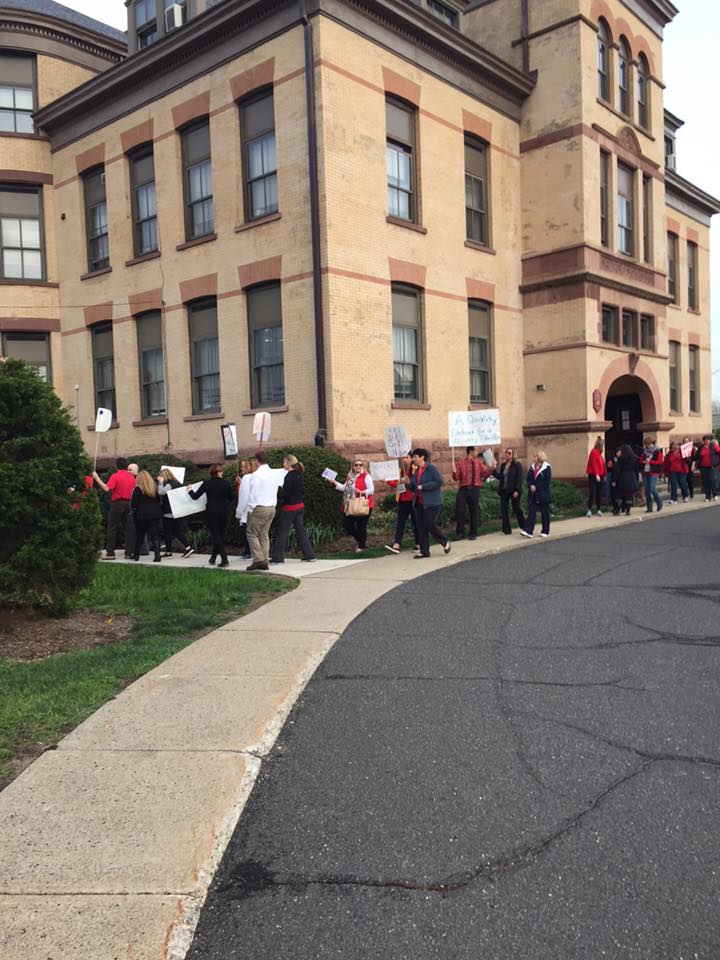
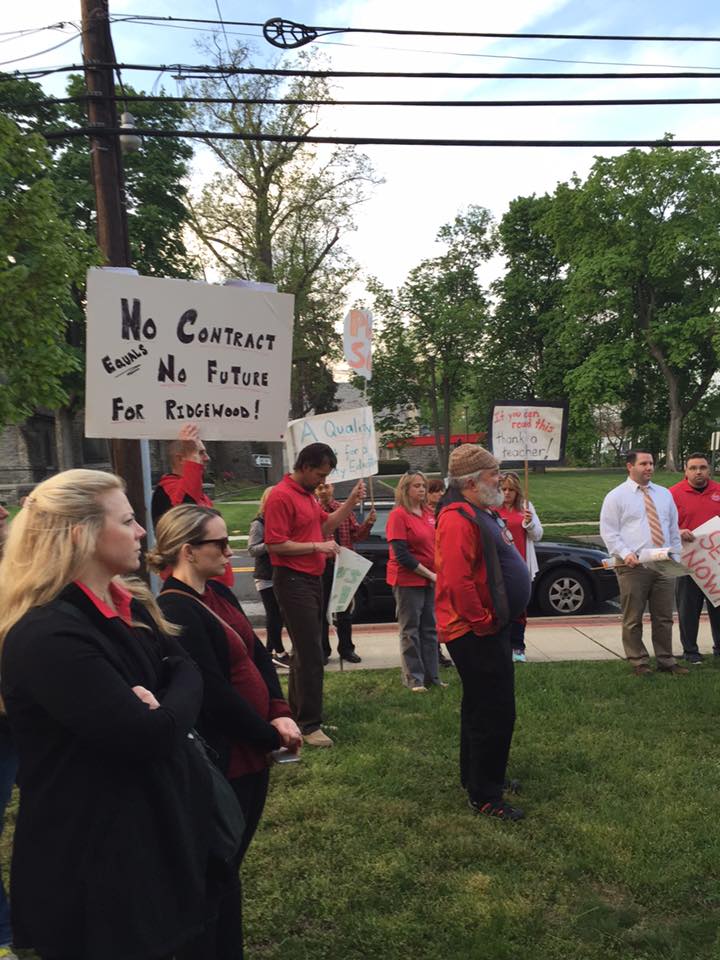
Ridgewood NJ, Ridgewood Board of Education rejects state-appointed fact finder’s recommendations for a new teachers’ contract. The BOE’s rejection sends contract negotiations, at an impasse since July 2015, back to Square One.
As we have said for some time the gravely train for public employees has come to an end and proof postive is the BOE’s rejection of the compromise .The public is just not buying paying more for healthcare for teachers than for themselves and teacher union support for “Obamacare” has left many taxpayers to feel if it good enough for us its good enough for you.
However teacher advocates in town say , that the “BOE rejected third party, neutral, unbiased fact finder recommendations and refused to settle. REA was willing to compromise on several major issues and settle the contract. Teachers have been working without a contract for a full year and still performed all of their contractual duties.”
While other readers are glad the BOE is taking a stand , “God forbid you don’t agree with the teachers’ demands. I hope the BOE takes a tough position. Agree that with the schools’ ratings sliding downwards and raises should be performance based. As for the healthcare plans – why would you think you are entitled to a better plan than the taxpayers who pay for yours? The teachers obviously do not care about the children or their profession as much as they care about the almighty dollar. They need to work a little harder and bring the school ratings up before any increases and either contribute more towards their medical insurance or agree to a less expensive plan. Yes, that means $25 co-pays and higher deductibles”
While BOE members have taken the heat say one reader , “The withering and abusive “behind the scenes” attacks on our elected BOE officials should be an embarrassment to all teachers. Why should teachers get better health benefits than the taxpayers who help subsidize them? Surely some of the things these teachers and the REA have pulled are cause for dismissals? Why not bring in some younger teachers who actually want to work with our kids and would be thrilled to teach here?”
Paterson school board members reacted with shock and outrage Wednesday night when district officials presented them with a preliminary 2016-17 budget that would increase property taxes by 27.2 percent to support the school district.
After more than 10 years without an increase, the tax levy for the district would jump from $38.9 million to $49.5 million for the school year beginning on July 1, according to budget documents made public Wednesday night.
That proposal comes at a time when Paterson property owners also face a 6.1-percent increase in municipal taxes, a hike that precipitated a partial shutdown of city government this week.
“We just can’t afford to increase taxes at this time,” said board member Nakima Redmon.
School board members asserted that they were blindsided by the proposed increase and vowed to remove it from the budget. But they delayed taking a vote to do that until the district administration provides them with more information on what spending cuts would be made to offset the elimination of the $10.6-million tax increase.
“Why is it you always seem to run out of money?” parent Rainbow Williams asked district officials during Wednesday night’s meeting. “Last year, you were $50 million in the hole. This year it’s $45 million … It seems somebody needs to learn how to do math.”
Eighth-grader Fabliha Zaman bemoaned the impact that last year’s budget cuts had on instruction in city schools, saying she missed terminated teachers who helped her learn. ”It doesn’t make sense to me,” said Zaman who attends School 7. “We all don’t deserve this.”
Law’s expiration may renew battle over benefits
February 2,2016
PLEASANTVILLE, N.J. (AP) — A state law requiring public employees to pay a percentage of their health benefit premiums expired last year, setting the stage for a battle over benefits between school boards and teachers unions.
At issue is whether school boards will be able to maintain those payments during contract negotiations or whether the unions will have the clout to roll them back, The Press of Atlantic City reported ().
At stake are millions of dollars that ultimately would be passed on to local taxpayers. Statewide, school districts budgeted almost $4 billion for all employee benefits for the 2015-16 school year.
That represents almost 18 percent of all state aid and local taxes spent on education.
Steve Baker, director of communications for the New Jersey Education Association, wrote in an email that they expect many local unions will make the payment an important part of their negotiations.
“Different locals will pursue different strategies, but I think you should expect to see that issue raised in nearly all negotiations once the sunset is reached,” Baker said.
The New Jersey School Boards Association is advising members to expect that request. In a November memo, NJSBA manager of labor relations Patrick Duncan noted that in the last year prior to the law, only 13 percent of contracts analyzed by the NJSBA required any employee contribution.
America’s students as a whole lag behind many other industrialized nations on international tests. Government expenditures on K-12 education have more than doubled over the last 40 years (adjusted for inflation), and yet U.S. students’ academic performance at the end of high school is flat.
NOVEMBER 27, 2015 LAST UPDATED: FRIDAY, NOVEMBER 27, 2015, 12:31 AM
THE RIDGEWOOD NEWS
Teachers should be ‘thankful’
To the Editor:
As a 33-year resident of Ridgewood, I am perplexed by the dissent of the Ridgewood teachers and their union about their current contract. The teachers are unhappy about paying for the increase in their healthcare costs. Everyone today is paying for their healthcare increases: medical personnel, retirees, and pharmaceutical company employees. The reason healthcare costs are continually rising (and will be in the future) are: Obamacare for the masses, an aging baby boomer population now requiring geriatric, cardiac, cancer, psychiatric, specialty care and designer drugs to help everyone live a longer life. Did the New Jersey Education Association think its Democratic-endorsed, union wishes for a national healthcare program would be absorbed by the public when in fact other municipalities in New Jersey and other states have opposed the taxpayer absorbing this substantial cost? Who did they think would pay for this? Ridgewood taxpayers should not be penalized for their selfish/unrealistic union demands.
New Jersey teacher’s pay ranks second highest in the nation. Teachers in Ridgewood earn a six-figure salary within five years. In addition, master’s degrees, additional credits, tutoring, tutoring for SAT’s allows them to earn additional/substantial monetary compensation. Their annual increases are more generous than some state employees. There shouldn’t be a financial problem for any teacher to absorb the costs as they are earning a 1 percent upper compensation in the United States in education. There are places that are more expensive to live in than Ridgewood. In the past, certain teachers who were unhappy with contract negotiations refused to give recommendations to the seniors for college.
The teachers have job security (unlike the corporate sector), do not face age discrimination, receive 80 percent of their salary in a pension as well as a taxpayer-payer paid two-day vacation in November for a teacher convention. I say “vacation” because I have never met anyone who goes to Atlantic City for the convention but goes to a destination such as Florida.
Unfortunately their healthcare provider, Horizon Blue Cross/Blue Shield, of the New Jersey Education Association is the most expensive. As a matter of fact, some teacher’s spouses working in corporate America have dropped their corporate health plan (Cigna, Aetna, etc.) coverage because the state employee plan is more lucrative. The taxpayers of NJ are paying for the healthcare benefits of these teacher’s families.
In summary: I think the teachers of Ridgewood and New Jersey should be most “thankful” for the generosity of the Ridgewood taxpayer this Thanksgiving Season and not “thankless.” I sincerely hope the arbitration board will take a firm stand on their role in representing the Ridgewood residents.