New Jersey is one of five of the states where government union membership rates exceed 50 percent.
How powerful are public employee unions in your state?
By Jason Hart / February 26, 2015 | Watchdog.org
More than half of the public employees in 13 states are union members, and government union membership rates exceed 25 percent in 27 states.
Labor unions work against employers — local, state and federal taxpayers, in the case of public employees. While slamming labor reforms as “anti-worker,” America’s four largest unions enrich themselves and their members at taxpayer expense.
The National Education Association, Service Employees International Union, American Federation of Teachers and American Federation of State, County and Municipal Employees have a combined total of more than 7.5 million members.
Over 3.3 million unionized public employees work in California, New York, Illinois, New Jersey and Pennsylvania, five of the states where government union membership rates exceed 50 percent.
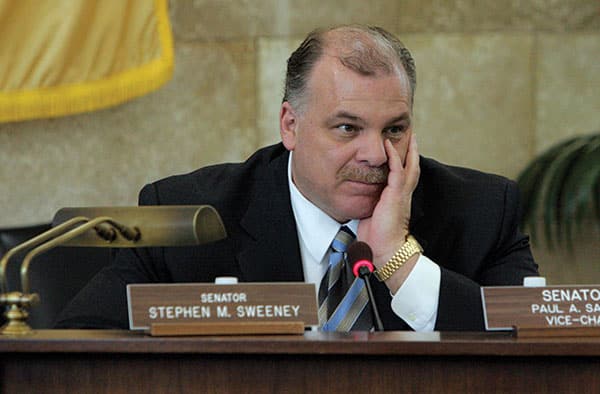
‘Shocked’ by budget address, Sweeney and Senate Dems upbraid Christie’s pension plans
TRENTON — Senate Democrats, calling the Republican’s new proposal to overhaul the pension and benefit system a “some roadmap written on a cocktail napkin,” roundly condemned Gov. Chris Christie’s budget address today for failing to lay out a vision for the state’s economy and finances in 2016. (Brush/PolitickerNJ)
Assembly Dems question administration budget big on pension fixes but short on other issues
TRENTON — Assembly Democrats bashed Gov. Chris Christie’s budget address today for being heavy on talk about fixing a broken public pension and benefit system — but virtually nonexistent on anything else. (Brush/PolitickerNJ)
PBA head challenges Christie to ‘look beyond presidential ambitions’ on pension front
Following up on an earlier statement clarifying that his organization would “never support freezing pensions for our members who have continued paying their required pension contributions while government has skipped their legal responsibility to do so,” the president of a major public sector union in New Jersey further distanced himself from Gov. Chris Christie’s new proposal to overhaul the state’s pension and benefit system. (Brush/PolitickerNJ)
Firefighter Rep Donnelly goes after NJEA leadership after Christie budget speech
TRENTON – Gov. Chris Christie won the support of key Building Trades unions’ reps in his first term by seizing on fractures between those private sector unions and public sector labor.
This afternoon, his budget address sparked a fight among public sector reps, as New Jersey State Firefighters Mutual Benevolent Association (NJFMBA) President Eddie Donnelly trained his immediate sights on the New Jersey Education Association (NJEA). (Pizarro/PolitickerNJ)
Judge rules Christie’s $1.6 billion pension cut must be reversed
February 23, 2015, 4:13 PM Last updated: Monday, February 23, 2015, 4:36 PM
By MELISSA HAYES
State House Bureau |
The Record
A Superior Court judge has ruled that Governor Christie must reinstate a $1.6 billion cut he made to the state’s pension payments for the current fiscal year.
Mercer County Superior Court Assignment Judge Mary C. Jacobson issued her ruling Monday, one day before Governor Christie is set to deliver his budget for the next fiscal year, which begins July 1.
Jacobson said the state must also reimburse the public employee unions for legal costs.
“The word for me is not vindication, it’s hope that in fact hundreds of thousands of workers will not have their pensions taken away from them,” said Hetty Rosenstein, state director of the Communications Workers of America, one of the unions in the lawsuit.
The governor’s office did not immediately comment Monday.
New Jersey Tries to Make Excuses for Expensive State Highways in Poor Condition
Taxpayers get traffic congestion, poor pavement conditions, deficient bridges and a big bill for state roads
David T. Hartgen and Baruch Feigenbaum
February 23, 2015
Reason Foundation’s Annual Highway Report, which found New Jersey’s state-controlled highway system ranks 48th out 50 states in cost-effectiveness and performance, has resonated with New Jersey’s taxpayers who have long complained of bumpy pavement and gridlocked roads and highways.
The Annual Highway Report measures the condition and cost-effectiveness of state-owned roads in numerous categories, including pavement condition on urban and rural Interstates, urban traffic congestion, deficient bridges, unsafe narrow lanes, traffic fatalities, total spending and administrative costs.
With a proposed increase to the state gas tax putting New Jersey’s roads under new scrutiny, Jamie Fox, commissioner of the New Jersey Department of Transportation, recently commented on the Annual Highway Report. Mr. Fox wrote, “Without the benefit of having the numbers the Reason Foundation used to base its calculations, there is no way to independently review its findings.”
That’s strange. Our Annual Highway Report is based on data that New Jersey, and other states, provide themselves to the federal government. And we’ve readily shared the report’s data with state transportation departments and members of the media across the country. The full Annual Highway Report is here (.pdf). Many of the tables we used are publicly available on the Federal Highway Administration’s website. Some of the key tables are HM-10 (mileage), SF-3 (Revenues for State-Administered Highways) and SF-4 (Disbursements for State-Administered Highways).
Mr. Fox also wrote, “NJDOT has jurisdiction over only 6 percent of the entire roadway network in the state.” That’s right, and the Reason Foundation’s Annual Highway Report ranks New Jersey based only on the roads the state actually controls. And that should be even more worrying New Jersey’s taxpayers: Despite the small size of the state-controlled highway system, New Jersey still has big trouble taking care of it. The state ranks near the bottom in poor pavement condition — 46th in urban Interstate pavement condition, 46th in rural primary road pavement condition—and 36th in deficient bridges.
New Jersey’s state government controls just over 3,300 miles of highway. Texas and North Carolina, for comparison, each control more than 20 times as much — over 80,000 miles of highway each. Texas ranks 11th in overall highway performance and cost-effectiveness, while North Carolina ranks 20th, and New Jersey ranks 48th.
Mr. Fox takes issue with how the state’s transportation spending is reported:
New Jersey gives out nearly $330 million a year in local transportation aid to counties and municipalities. This helps local government take care of local roads without having to raise property taxes. The Reason Foundation counts the spending we give to local government but doesn’t count all the miles of local roads that are repaired or built.
Like it does for county and municipal aid, the Reason Foundation also counts the investments made to maintain and run New Jersey Transit as part of our highway spending but gives the state no benefit for that spending. New Jersey is the only state that operates a statewide transit system, so including transit expenditures into highway construction costs is both inaccurate and unfair.
The report’s spending totals are pulled directly from numbers the state of New Jersey provided to the Federal Highway Administration under the category of “Disbursements For State-Administered Highways – 2012.” This federal table, used in our report, shows the breakdown that New Jersey provided for its spending on “capital outlays for roads and bridges; maintenance and highway services; administration research and planning; highway law enforcement and safety; interest; bond retirement; reserves for highway work; and reserves for debt service.”
None of those categories include “local transportation aid” or “statewide transit system.” If the state is claiming it mistakenly included local aid and mass transit spending in clearly defined state highway categories, New Jersey should correct the data it provided to FHWA.
Mr. Fox makes another claim:
The Reason Foundation uses a centerline mile as its denominator. A centerline mile measures the total length of a given road from Point A to Point B, but it doesn’t measure how many actual lanes of highway are going from Point A to Point B.
When was the last time you were on a single-lane highway in New Jersey? There are some, but not many. When we spend money to maintain or build a multiple lane highway, the Reason Foundation acts as if all that spending is to construct a single lane of highway, not the multiple lanes that are actually built.
Lane-miles are part of the report’s calculations. In fact, lane miles are inherent in calculating many of the report’s rankings, including traffic congestion and pavement condition. The Annual Highway Report clearly states: “The average number of lanes per mile is 2.40 lanes, but a few states (New Jersey, Florida, California and Massachusetts) manage significantly wider roads, averaging more than 3.0 lanes per mile.” The report goes on to detail the miles, lane miles and the average number of lanes for all 50 states. These factors are then used to adjust our figures to account for wider roads in some states, like New Jersey. So if New Jersey’s big spending were resulting in smoother pavement and less traffic congestion across many lanes, the state’s overall ranking and its rankings in those individual categories would be better. Instead, New Jersey ranks 31st or worse in nine of the 11 categories, and 41st or worse in seven of 11 categories.
It is incorrect, but let’s test the claim anyway — if the spending per mile metric is punishing New Jersey for having highways that are six or eight lanes wide, as Mr. Fox alleges, then it would make sense that other states with wide highways would suffer too. But that is not the case. California, home to many of the busiest and widest highways in the country, spends $500,000 per mile. New Jersey spends four times that — $2 million per mile. New Jersey spends three times as much as Massachusetts ($675,000 per mile), three-and-a-half times more than Florida ($572,000 per mile), four times as much as New York ($462,000 per mile), and 12 times more than Texas ($157,000 per mile), which is home to six of the 20 most populous cities in America.
Doherty on Transportation Trust Fund funding debate: New Jersey must make “informed decisions”
February 19, 2015
By Senator Mike Doherty (R-23)
There has been much discussion recently about a report on state highway systems by the Reason Foundation that found New Jersey’s roads to be the nation’s most expensive to build, operate and maintain.
According to that report, New Jersey’s state-administered highways cost taxpayers $2 million per mile, which the Reason Foundation claims to be 12 times the national average, three times the cost in the next highest state and four times the cost in New York.
The next most expensive state, according to the Reason Foundation, is Massachusetts, which spends a comparatively paltry $675,000 per mile. By most measures other than cost, apparently, our highway systems and the conditions they face seem nearly identical.
We have similar population densities — we are ranked first and they third in the nation — and our roads are both heavily travelled.
We share harsh northeast winters and maintain a comparable surface area of highway — they have 9,572 highway lane miles to our 8,496.
We also have similarly sized highways, with our state maintained roads averaging 3.65 lanes per mile and theirs 3.17 lanes per mile.
It also should be noted that Massachusetts is home to America’s most-expensive transportation project – the $24 billion “Big Dig” – that Bay State taxpayers will be paying off for the next 20+ years.
Despite all of the similarities in density, climate, actual area of road surface maintained and its own massive transportation spending, Massachusetts still manages to build and operate highways for what the Reason Foundation contends is one-third of what New Jersey pays.
If those numbers are correct, New Jersey’s taxpayers should be outraged and policymakers should take action.
Some, including state Transportation Commissioner Jamie Fox, have questioned the report’s findings and underlying methodology. Those concerns are valid and deserve to be investigated.
Despite his objections, Commissioner Fox concedes, however, that it is “more expensive to build a mile of road in New Jersey,” and few dispute the claim that New Jersey drivers and taxpayers pay more for our highways than anyone else in the nation.
It’s for that reason that the Reason Foundation report has suddenly become a central issue in the growing debate over how to address the long-term funding needs of the state’s Transportation Trust Fund (TTF).
The TTF, which helps pay for road and bridge projects around New Jersey, is in a perpetual state of financial distress and debt. Some would say it’s broke.
While we shouldn’t base state transportation funding policy on one organization’s report, we should pay attention when a seemingly well-formulated analysis raises such serious questions about where our money is going.
The Reason Foundation report, with its shocking conclusions, has fueled the argument that our transportation funding problem isn’t one of insufficient money, but of unreasonable spending.
A TTF plan put forward by New Jersey Democrats – who control both houses of the Legislature – doesn’t address spending, however. They simply want to increase the state’s gas tax, perhaps by 25 cents per gallon.
Such an increase would cost the average New Jersey driver $300 more per year at the pump, and the additional expense to our businesses would drive up the cost of virtually every product and service sold in the state.
According to the Tax Foundation, New Jersey residents already shoulder the second highest combined state and local tax burden, driven by our state’s highest in the nation property and business taxes, and sales and income taxes that are among the highest.
Perhaps the only source of relief for New Jerseyans in our entire tax structure is our gas tax, currently 14.5 cents per gallon, which is the second lowest in the nation.
Yet, this is precisely why Democrats see our gas tax as ripe for increasing. In their myopic view, we’re undertaxed!
Before we let Trenton politicians reach into the pockets of taxpayers yet again, shouldn’t we demand that we first find out why we spend so much more for our highways than every other state?
Shouldn’t we ask why we spend so much more than our peers, including Massachusetts, that have highway systems that are so similar to ours?
I think so, which is why I will introduce legislation requiring our own analysis of the factors that drive New Jersey’s road costs and a look at other states to determine how they are able to operate more efficiently.
If there were objections to the methodology employed by the Reason Foundation, the study I am proposing will be our opportunity to address those concerns and reach our own conclusions.
I hope Commissioner Fox, Governor Christie and other legislators will agree that this is necessary.
Until we determine exactly why we spend more than every other state, it will be impossible to lower our costs or make informed decisions about how much funding is really needed to complete important transportation projects at a cost reasonable to New Jersey taxpayers.
Reader says Time for Beneficiaries of Squandered NJ Transportation Funds to Return Them
When a Ponzi scheme goes broke prosecutors appoint a trustee and use a “clawback” cause to force those who received beneficial $$$ to return it, and it’s distributed to investors/victims.
The same needs to be applied to the municipalities/homeowners who received the “benefit” of the sounds walls from money that was dedicated to road repairs, NOT to improve privat property of those who chose a poor location to live.
Until those funds that were pissed away on sound barriers are returned from the beneficiary homeowners and municipalities, no increase in taxes.
Union Group pushes for new ways to fund N.J. transportation projects
February 9, 2015, 3:01 PM Last updated: Monday, February 9, 2015, 3:03 PM
By JOHN REITMEYER
STATE HO– USE BUREAU |
The Record
A group that’s been pushing state lawmakers and Governor Christie to come up with a new way to fund transportation projects in New Jersey brought that effort to Trenton on Monday, holding a news conference to put more pressure on leaders to act.
“Now is the time for the final push,” said Tom Bracken, chairman of Forward New Jersey, a group made up of 75 different organizations, including labor unions, local government representatives and business groups.
New Jersey pays for its road, bridge and rail work primarily using funds raised from borrowing and from the state’s gas tax. But later this year the revenue generated by the gas tax will be going only to pay off debt, with few funds left in the state Transportation Trust Fund for new projects.
Bracken called that “the most critical issue facing the state right now.” He stopped short of endorsing an increase of the gas tax, which at 14.5 cents per gallon is among the lowest in the country, but said it should be among the options up for discussion as the leaders try and find a solution.
“I support a long-term, sustainable, dedicated solution,” Bracken said.
Members of labor unions had the strongest presence at Monday’s event, filling much of the room.
“There is as much as a $4 trillion gap between what states have promised its public workers in retirement pensions and what has actually been set aside and invested in order to pay for them.
What would you do to solve the pension crisis?”
Most realize the problems, but they don’t want tax increases or spending cuts to fix them.
Scott Shackford | February 6, 2015
There is as much as a $4 trillion gap between what states have promised their public workers in retirement pensions and what they’ve actually set aside and invested in order to pay for them. There are enough reasons this has happened to count as a survey question on the most boring episode of Family Feud ever—states and cities didn’t set aside enough money, employees didn’t contribute enough, and guaranteed investment returns are overestimated, among many other problems.
But what does the average American think about the pension crisis and what would they do? A small number of communities like Phoenix, Arizona, and San Jose, California, have put pension reform in the voters’ hands, with mixed results. In our latest Reason-Rupe poll, we decided to focus almost entirely on the pension crisis, asking Americans how seriously they view the problem and what sort of trade-offs they would accept to fix it.
Yes, Americans Are Concerned About the Pension Crisis
Pension worriers will be pleased to hear that Americans are at least paying attention. A full 72 percent of those polled are either “very” or “somewhat” concerned about state and local governments’ ability to fund the pensions they’ve promised to public employees. A similar number (74 percent) are concerned that state or local governments will raise taxes in the future in order to meet these pension obligations. When asked to prioritize dealing with the pension crisis, 35 percent said pension reform should be a top priority, while 41 percent said pension reform should be an important but lower priority.
Actually tackling the pension crisis is a much more complicated affair. The poll asked participants to consider a host of different possibilities—raising taxes, reducing services, capping maximum pension payments, requiring workers to pay more, and transferring public employees to 401(k)-style defined contribution plans, rather than guaranteed pensions.
The most consistent response is probably also the most obvious: Americans want pension reform solutions that push public employees to play a greater role in their own retirements rather than relying on taxpayers to bail them out. Those surveyed were significantly opposed to raising taxes (74 percent) or cutting government services (77 percent) in order to fix funding problems with public employee pensions. Instead, when given a list of choices, participants strongly supported (82 percent) requiring public employees to contribute more to their own retirement funds. When asked to rank potential solutions, “Require current employees to contribute more toward their own pensions and benefits” blew every other option out of the water with 63 percent of the vote as the first choice. No other option even hit double digits.
But that list of solutions assumed states and cities would keep the existing pension systems and salvage them. The Reason-Rupe poll also asked whether participants would like to switch public employees from pension funds to 401(k)-style defined contribution retirement funds. The answer was yes. The poll asked participants whether they would favor such funds for current public employees and a separate question for just future hires. In both cases, the majority said yes, but support for shifting over future employees was notably higher (67 percent) than for current employees (59 percent).
But when comparing the two types of retirement systems in different ways, differences in responses were notable. The poll asked participants a question where the benefits of switching to a 401(k)-style plan were described (“401k style programs give employees the flexibility to take the plan with them from job to job and are less costly to the taxpayer”) as well as the concerns about switching to a such a plan (“benefits would not be guaranteed and would depend on how well the employees saved and how the market performed”). When those descriptions were used to ask whether they supported or opposed a shift to 401(k)-style programs, 66 percent still supported the shift. But when asked to consider a shift to 401(k)-style programs given only the concerns, support dropped to 50 percent. And when people polled are asked if they’d support shifting to 401(k)-style programs if it meant “breaking a contract made with public employees when they first accepted their jobs,” support plummets down to 38 percent. When asked to trade off a shift to 401(k)-style programs with either raising taxes or reducing services to pay for retirement, support for 401(k) programs climbed back up (66 percent and 59 percent). Those polled even opposed increasing taxes or reducing government services in order to pay the current pension benefits for already retired employees.
The lesson here: Americans don’t necessarily want to break an agreement with public employees or push them into retirement plans where the future benefits are not guaranteed, but they are willing to do so in order to avoid additional tax increases or reductions in government services.
“But what do the millennials think?” You may ask. Do they understand the crisis they’re getting themselves into as they take up a larger and larger chunk of the workforce? Yes and no. Those polled under the age of 30 do have concerns, but the numbers are more muted than for older generations. The number of millennials who say they’re concerned about pension funds drops down to 59 percent, and they’re less likely to see dealing with pension problems as a top priority (only 25 percent). Nevertheless, millennials also supported shifting public employees to 401(k) plans and requiring employees to contribute more into their retirement plans. Variations in responses by millennials may indicate more that they have less experience in these workplace issues or with dealing with taxation impacts rather than any sort of generational differences. For example, millennials were more likely to believe (34 percent) that public employee and private employees received fundamentally the same retirement benefits, something older workers know is untrue (public employees are widely understood to generally get better retirement benefits). They were also the only age group where a majority (59 percent) believed that pension calculations for retiring employees should be increased by using unused sick time, vacation pay, and specialty pay, a system that has led to the abuse known as “pension spiking,” with public employees getting six-figure annual pension guarantees. When we break down the millennial age demographic further, millennials’ attitudes start to shift toward the overall average the older they are, more closely aligning with the over-30 crowd.
Public Employees Are Not in Complete Denial
The poll asked respondents whether they worked in the public or private sector (or if they were retired from the public or private sector) so their responses could be compared. Public employees accounted for 17 percent of the working respondents and 36 percent of the retired respondents. Public employees are certainly paying attention to the impacts of bankruptcy in cities like Detroit and Stockton, California. Public employees are more concerned (80 percent) about the state of pensions than private employees (67 percent). It’s understandable they’re concerned, since they are the most directly affected should their cities or states fail to address underfunding.
State lists 40 bridges that may need fixing fast, but the question remains what did they do with all the money in the Transportation fund ?
FEBRUARY 3, 2015, 4:25 PM LAST UPDATED: WEDNESDAY, FEBRUARY 4, 2015, 10:12 AM
BY JOHN CICHOWSKI
RECORD COLUMNIST |
THE RECORD
As Governor Christie’s new transportation commissioner sees it, you don’t need a civil engineering degree to recognize some of the obvious weaknesses in the 40 bridges that his engineers have placed on the Department of Transportation’s high-priority list for immediate inspection, including the Route 3 link over the Hackensack River that’s now undergoing emergency repair.
Related: High priority N.J. bridges for 2015
“It’s quite simple,” Jamie Fox observed. “As anyone can see, our bridges are old and crumbling. If we don’t identify a dedicated funding source now, we’ll have no choice but to close more bridges to ensure public safety.”
In addition to the Route 3 span that connects East Rutherford to Secaucus, 12 of the 40 are in North Jersey — four in Bergen County, four in Hudson and two each in Morris and Essex. Replacing or rehabilitating all 13 would cost a minimum of $300 million — a preliminary DOT estimate that would surely rise sharply by the time work is completed.
FEBRUARY 1, 2015, 10:45 PM LAST UPDATED: SUNDAY, FEBRUARY 1, 2015, 10:46 PM
BY HANNAN ADELY
STAFF WRITER |
THE RECORD
In an effort to cut down on rising costs, the state is capping a program that allows students to attend schools outside their own district at no extra cost, limiting some Bergen and Passaic schools to just a handful of open spots for the coming school year.
“It’s fiscally unsustainable,” state Education Commissioner David Hespe said in an interview. “The program has increased fivefold. The cost has increased fivefold.”
The education commissioner is also considering preventing additional students from high-performing schools, which would include many in Bergen County, from participating. The program was meant to give students access to better schools, but many of the students who took advantage already had good schools in their hometown, Hespe said.
State officials say they need to stop the Interdistrict Public School Choice Program’s growth because it has ballooned to about 5,000 students at a cost of $50 million a year. But supporters of the program say the decision to cap it seems to contradict the Christie administration’s stated policy of creating more taxpayer-financed options for students who don’t want to attend struggling local schools.
How did Camden, N.J. come to have one of the highest spending AND worst performing school districts in the nation?
The recent history of Camden, New Jersey, which is the poorest small city in America, provides a case study of the tragic ineffectiveness of government programs at ameliorating poverty. State and federal taxpayers have spent hundreds of millions of dollars on various redevelopment programs in Camden over the years, but the money never ended up where it was supposed to and the promised revival of this fallen manufacturing town never happened.
By far, the largest initiative to combat poverty with government largess has been directed at Camden’s public schools. New Jersey spends about 60% more on education per pupil than the national average according to 2012 census figures, or about $19,000 in 2013. In Camden, per pupil spending was more than $25,000 in 2013, making it one of the highest spending districts in the nation.
But all that extra money hasn’t changed the fact that Camden’s public schools are among in the worst in the nation, notorious for their abysmal test scores, the frequent occurrence of in-school violence, dilapidated buildings, and an on-time graduation rate of just 61 percent.
This is the story of how Camden became one of the nation’s best funded and worst performing school districts, which is the first in a three-part video series on Camden public school system.
Labor leader Thomas J. Sullivan Jr. takes oath to fill Bergen County freeholder vacancy
JANUARY 28, 2015, 8:36 PM LAST UPDATED: WEDNESDAY, JANUARY 28, 2015, 10:06 PM
BY JOHN C. ENSSLIN
STAFF WRITER |
THE RECORD
HACKENSACK — Bergen County’s newest freeholder, labor leader Thomas J. Sullivan Jr., was sworn in Wednesday, vowing to “listen to everyone’s voice.”
Flanked by his family, Sullivan took the oath of office administered by County Executive and fellow Democrat James Tedesco during the board meeting.
Sullivan was chosen Sunday by members of the county Democratic Committee to fill the seat vacated by Tedesco on Jan. 1. He would next have to run in the November election to serve the last remaining year on Tedesco’s three-year term.
“I can’t think of somebody that would represent the people of Bergen County, and all the people of Bergen County, better than Tom,” Tedesco said.
Tedesco previously had sworn Sullivan in at a private ceremony in the freeholder chambers on Monday morning.
Melissa Quinn / @MelissaQuinn97 / January 23, 2015
New information from the federal government suggests workers’ interest in unions continues to fall, with union membership reaching its lowest rate in 100 years.
According to data released by the Bureau of Labor Statistics today, the union membership rate fell to 11.1 percent, with just 14.6 million wage and salaried workers maintaining membership.
In 2013, the union membership rate was 0.2 percentage points higher, at 11.3 percent.
The rate of union membership has been on a steady decline over the past three decades. It grew slightly from 12.1 percent in 2007 to 12.4 percent in 2008. During President Obama’s first year in office, however, it fell once more.
Richard Trumka, president of the AFL-CIO, said in a statement today that though there has been job growth over the past 58 months, many of the jobs created do not provide fair wages.
“A strong recovery must be built on family-sustaining, not poverty-level jobs,” he said. “Today’s news confirms what most of us already knew: workers are finding good union jobs despite political ideologues—and jobs are coming back as the economy slowly rebounds, but neither are nearly enough.”
According to the Bureau of Labor Statistics, the rate of union membership for public-sector workers last year was 35.7 percent, compared to just 6.6 percent for the private sector.
Of those working in the public sector, government had the highest union membership rate.
James Sherk, a labor economics policy economist at The Heritage Foundation, told The Daily Signal that the drop in the rate of union membership can likely be attributed to the antiquated union model.
“They’re selling a product that hasn’t changed that much since the 1930s when America’s labor laws were founded,” he said. “Today’s workers simply aren’t that interested in purchasing what unions have to sell.”
Sherk said that unions have failed to modernize over time and noted that workers are moving away from joining because their contracts are no longer relevant.
Trumka disagreed.
“Today’s release of the annual union membership numbers by the Bureau of Labor Statistics shows that in this economic recovery, people are either seeking out good union jobs or taking matters into their own hands by forming unions to raise wages and ensure that new jobs are good jobs,” he said in his statement.
December 25, 2014 Last updated: Thursday, December 25, 2014, 1:21 AM
By SARA BURNETT
THE ASSOCIATED PRESS |
Wire Service
* Leaders say Obama’s move gives protection from retaliation
CHICAGO — Unions across the U.S. are reaching out to immigrants affected by President Obama’s recent executive action, hoping to expand their dwindling ranks by recruiting millions of workers who entered the U.S. illegally.
Labor leaders say the president’s action, which curbs deportation and gives work permits to some 4 million immigrants, will give new protection to workers who have been reluctant to join for fear of retaliation.
“I think we’ll see very positive changes” because of the action, said Tom Balanoff, president of Service Employees Interna-tional Union Local 1. “One of them, I hope, is that more workers will come forward and want to organize.”
SEIU, whose more than 2 million members include janitors and maintenance workers, recently announced a website where immigrants can learn about the action. The AFL-CIO says it’s training organizers to recruit eligible workers. And the United Food and Commercial Workers and other unions are planning workshops and partnering with community groups and churches to reach out to immigrants.
The efforts come even as Republicans and other opponents of Obama’s action work to undo it, saying it will hurt American workers, and as some labor experts say they Are skeptical immigrants will feel safe enough to unionize in large numbers.
Labor unions have struggled over the past decade to maintain their membership and political muscle. The ranks fell by more than 1.2 million between 2003 and 2013, when there were about 14.5 million members nationwide, according to the Bureau of Labor Statistics. The percentage of workers who were union members fell from 12.9 percent to 11.3 percent during that same period.
Business-friendly Republican governors have approved measures in recent years aimed at weakening labor, even in places such as Michigan that were once considered union strongholds. In Obama’s home state of Illinois, a GOP businessman unseated the Democratic governor last month in part by promising to constrain labor’s influence in government.
Unions say they can help protect immigrants against abuses such as wage theft and discrimination. And even if the immigrants aren’t citizens and cannot vote, they can help unions by paying dues and doing the heavy lifting needed around election time — knocking on doors, driving voters to the polls and making phone calls for pro-labor candidates. Republicans say the executive actions — which would affect people who have children and have been in the U.S. more than five years — will make it tougher for Americans already struggling to find good-paying jobs. They’ve pushed legislation to void the new protections.
Democrat Senate President Steve Sweeney Pushes for Gas tax Increase for unions ,criticizes Christie
DECEMBER 20, 2014, 11:55 AM LAST UPDATED: SATURDAY, DECEMBER 20, 2014, 4:37 PM
ASSOCIATED PRESS
TRENTON, N.J. (AP) — Senate President Steve Sweeney has gone on offense, criticizing Gov. Chris Christie and calling on him to detail his plan for saving the imperiled transportation trust fund. But Sweeney has not said how he would pay for his own ideas.
As the Legislature wraps up the calendar year without a deal to address the fund, Sweeney along with Assembly Speaker Vincent Prieto and Republican Gov. Chris Christie are still working behind the scenes to come to an agreement.
Thus far, Sweeney, the influential southern New Jersey Democrat, has been upfront in expressing what he wants the deal to look like: the fund should be beefed up to $2 billion from $1.26 billion, and money to municipalities should nearly double to $400 million.
In an interview with the Associated Press, Sweeney said his “bottom line” is the inclusion of rail projects in Hudson and Bergen counties, in Camden and Gloucester counties as well as freight rail infrastructure projects in the central part of the state.
“We are not gonna pit regions against each other,” he said. “The needs are great, they’re real and we have to advance them together. Too often it’s like us against them and that’s not how it should be,” Sweeney said.
While he says a tax increase is probable, he has not written or endorsed legislation detailing exactly what that tax would look like.
In part, that’s because talks with Christie and Prieto are still underway and no agreement would be possible without their support, Sweeney said. To publicly embrace a plan to pay for the fund — like an increase in the state’s 10.5 cent gas tax — could scuttle those talks, Christie said in an interview on 101.5 FM last week.