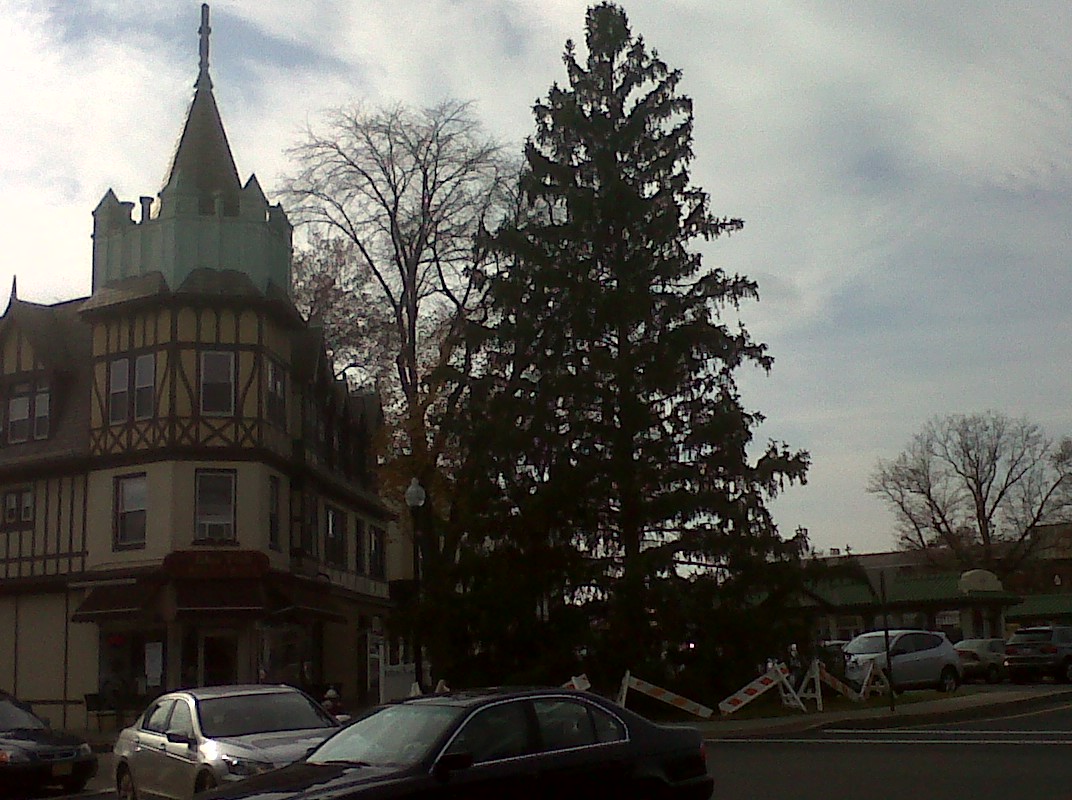
>Merchants, businesses, village officials, residents and the Ridgewood Chamber of Commerce all contributed something to bring the village Christmas tree back
‘Community’s tree’ journeys to train station
Friday, December 3, 2010 BY MICHAEL SEDON The Ridgewood News STAFF WRITER
Returning a tradition takes a village, with holiday “green” sprinkled into the mix.
Merchants, businesses, village officials, residents and the Ridgewood Chamber of Commerce all contributed something to bring the village Christmas tree back to the spot it occupied for 22 years at the train station.
The village planted a live tree in Van Neste Square Memorial Park two years ago and moved the annual tree lighting celebration from its original spot at the train station. Residents debated the move, and many discussed the possibility of getting it back for the event’s 25th anniversary.
The effort was led by resident, business owner and chamber member Paul Vagianos, but required donations and volunteerism from many inside and outside of Ridgewood. Vagianos first met with Deputy Mayor Tom Riche to discuss some of the issues involved with putting the plan into motion. Riche told Vagianos that if he could garner the Chamber of Commerce’s approval and raise the $6,500 necessary to move the tree, the deputy mayor would support the idea.
“During the election campaign of 2010 when I was running for office, at a lot of the coffees with all of the things we have going on in Ridgewood, it seemed to always come up,” Riche said of returning the Christmas tree to the train station. “I kind of made a commitment that I would do the very best I could to fulfill the wish of what seemed like a large percentage of people in Ridgewood at the time.”
The chamber’s board of directors unanimously approved the idea, and several local merchants donated a total of $8,500 in about three hours, Vagianos said.
“The one who put it over the top was Capital One Bank who gave us $2,500,” Vagianos said. “Everybody wanted to give money. I had people walking up to me wanting to give money on this.”
Armed with the full backing of the chamber, Riche’s support and $8,500, the tree’s return to the station seemed like a slam dunk — but the effort was just getting started.
>Gov. Christie authorizes state to hire lawyer to fight $271 million tunnel bill
Governor Chris Christie’s administration plans to file a federal lawsuit to fight the U.S. government’s $271 million bill to New Jersey to pay for work on canceled rail tunnel to Manhattan, an administration source said. (Method, Home News Tribune)
>Associated Press-CNBC Poll : Americans prefer cutting federal services to raising taxes by nearly 2-1
AP-CNBC Poll: Cut services to balance the budget
WASHINGTON (AP) – To ease surging budget deficits, Americans prefer cutting federal services to raising taxes by nearly 2-1 in a new poll. Yet there is little consensus on specific, meaningful steps – and a wariness about touching two gargantuan programs, Social Security and Medicare.
An Associated Press-CNBC Poll showed widespread anxiety about budget shortfalls exceeding $1 trillion a year. Eighty-five percent worry that growing red ink will harm future generations – the strongest expression of concern since AP polls began asking the question in 2008. Fifty-six percent think the shortfalls will spark a major economic crisis in the coming decade.
Mises Daily: Saturday, November 20, 1999 by Richard J. Maybury
Each year at this time school children all over America are taught the official Thanksgiving story, and newspapers, radio, TV, and magazines devote vast amounts of time and space to it. It is all very colorful and fascinating.
It is also very deceiving. This official story is nothing like what really happened. It is a fairy tale, a whitewashed and sanitized collection of half-truths which divert attention away from Thanksgiving’s real meaning.
The official story has the pilgrims boarding the Mayflower, coming to America and establishing the Plymouth colony in the winter of 1620-21. This first winter is hard, and half the colonists die. But the survivors are hard working and tenacious, and they learn new farming techniques from the Indians. The harvest of 1621 is bountiful. The Pilgrims hold a celebration, and give thanks to God. They are grateful for the wonderful new abundant land He has given them.
The official story then has the Pilgrims living more or less happily ever after, each year repeating the first Thanksgiving. Other early colonies also have hard times at first, but they soon prosper and adopt the annual tradition of giving thanks for this prosperous new land called America.
The problem with this official story is that the harvest of 1621 was not bountiful, nor were the colonists hardworking or tenacious. 1621 was a famine year and many of the colonists were lazy thieves.
In his ‘History of Plymouth Plantation,’ the governor of the colony, William Bradford, reported that the colonists went hungry for years, because they refused to work in the fields. They preferred instead to steal food. He says the colony was riddled with “corruption,” and with “confusion and discontent.” The crops were small because “much was stolen both by night and day, before it became scarce eatable.”
In the harvest feasts of 1621 and 1622, “all had their hungry bellies filled,” but only briefly. The prevailing condition during those years was not the abundance the official story claims, it was famine and death. The first “Thanksgiving” was not so much a celebration as it was the last meal of condemned men.
But in subsequent years something changes. The harvest of 1623 was different. Suddenly, “instead of famine now God gave them plenty,” Bradford wrote, “and the face of things was changed, to the rejoicing of the hearts of many, for which they blessed God.” Thereafter, he wrote, “any general want or famine hath not been amongst them since to this day.” In fact, in 1624, so much food was produced that the colonists were able to begin exporting corn.
What happened?
After the poor harvest of 1622, writes Bradford, “they began to think how they might raise as much corn as they could, and obtain a better crop.” They began to question their form of economic organization.
This had required that “all profits & benefits that are got by trade, working, fishing, or any other means” were to be placed in the common stock of the colony, and that, “all such persons as are of this colony, are to have their meat, drink, apparel, and all provisions out of the common stock.” A person was to put into the common stock all he could, and take out only what he needed.
This “from each according to his ability, to each according to his need” was an early form of socialism, and it is why the Pilgrims were starving. Bradford writes that “young men that are most able and fit for labor and service” complained about being forced to “spend their time and strength to work for other men’s wives and children.” Also, “the strong, or man of parts, had no more in division of victuals and clothes, than he that was weak.” So the young and strong refused to work and the total amount of food produced was never adequate.
To rectify this situation, in 1623 Bradford abolished socialism. He gave each household a parcel of land and told them they could keep what they produced, or trade it away as they saw fit. In other words, he replaced socialism with a free market, and that was the end of famines.
Many early groups of colonists set up socialist states, all with the same terrible results. At Jamestown, established in 1607, out of every shipload of settlers that arrived, less than half would survive their first twelve months in America. Most of the work was being done by only one-fifth of the men, the other four-fifths choosing to be parasites. In the winter of 1609-10, called “The Starving Time,” the population fell from five-hundred to sixty.
Then the Jamestown colony was converted to a free market, and the results were every bit as dramatic as those at Plymouth. In 1614, Colony Secretary Ralph Hamor wrote that after the switch there was “plenty of food, which every man by his own industry may easily and doth procure.” He said that when the socialist system had prevailed, “we reaped not so much corn from the labors of thirty men as three men have done for themselves now.”
Before these free markets were established, the colonists had nothing for which to be thankful. They were in the same situation as Ethiopians are today, and for the same reasons. But after free markets were established, the resulting abundance was so dramatic that the annual Thanksgiving celebrations became common throughout the colonies, and in 1863, Thanksgiving became a national holiday.
Thus the real reason for Thanksgiving, deleted from the official story, is: Socialism does not work; the one and only source of abundance is free markets, and we thank God we live in a country where we can have them.
* * * * * Mr. Maybury writes on investments.
This article originally appeared in The Free Market, November 1985.
The members of Bethlehem Lutheran Church invite everyone to a Christmas concert on Sunday, November 28 at 3:00PM. Please join us for this free concert at in our sanctuary located at 155 Linwood Ave. in Ridgewood, NJ. What better place than Bethlehem to start off the Christmas season!
The concert will feature classic and contemporary Christmas songs and instrumentals plus a carol sing along. Greg Caldarone and The New Jersey Brass Quintet will perform a free concert “Christmas: The Joy and Spirit 2010”. Come celebrate this joyous time of year with old classics and contemporary Christmas favorites. The NJ Brass Quintet is a fabulous ensemble that will immediately give you that warm wonderful feeling of an old fashioned Christmas.
Greg Calderone will feature some classic Christmas songs as well as some newer ones. Greg Caldarone, award winning singer/recording artist, has been sharing his vocal talents in our local churches and establishments for several years. He will feature Christmas classics such as “O Holy Night” and “Gesu Bambino” as well as more recent songs such as Mark Lowry’s “Mary Did You Know” and of course Michael Card’s ” Joseph’s Song’ ( a signature for him). Greg will also feature David Freidman’s “ We Can Be Kind” . In light of recent tragic events in our country, this song simply states “what can we do when there’s nothing we can do… We can be kind”.
The New Jersey Brass Quintet will be performing a special holiday concert featuring music from their CD “Christmas; The Joy and Spirit” They will perform Christmas; The Joy and Spirit, Ceremonial Music for Brass and Organ arr. by S. Drummond Wolff along with other holiday pieces. There will also be a sing along to get us all in the spirit of Christmas. The sing along will include O Come All Ye Faithful, What Child Is This, Angels We Have Heard on High, Hark the Herald Angels and Joy to the World. The New Jersey Brass Quintet is a non-profit corporation dedicated to the cultural enrichment of the community in which it serves. The musical ensemble’s programs include educationally oriented children’s concerts, park concerts in a “Village Brass Band” setting, and special concerts for various occasions in addition to traditional chamber music concerts. Its repertoire ranges from earliest madrigals to the most contemporary compositions available. The dedicated professional musicians that compose the NJBQ bring a high degree of talent and creativity to the ensemble. Each member of the quintet is an experienced educator as well as an accomplished performer. Greg Caldarone is a singer/entertainer/ recording artist, specializing in popular standards and Italian favorites, recipient of the Universal Jazz Coalitions “Dakota Staton Award”. Also a professional song leader. Greg will include Michael Card’s ” Joseph’s Song”, A song that is frequently requested of him at Christmas. He has been a song leader in music ministries in our community for 20 years. For more about Greg Caldarone go to https://www.gregcaldarone.com/ We truly hope to see you and wish everyone a joyous holiday season and a beautiful finish for 2010. Admission is free, however a free will offering will be welcome. CDs by both Greg Caldarone and The NJ Brass Quintet will be available at the concert.
Determined to curb what he calls invasive security screening by the Transportation Security Administration, Sen. Mike Doherty has launched a petition to collect support for his effort. (Isherwood, PolitickerNJ)
By ADAM GELLER, AP National Writer Adam Geller How did an agency created to protect the public become the target of so much public scorn?
After nine years of funneling travelers into ever longer lines with orders to have shoes off, sippy cups empty and laptops out for inspection, the most surprising thing about increasingly heated frustration with the federal Transportation Security Administration may be that it took so long to boil over.
The agency, a marvel of nearly instant government when it was launched in the fearful months following the 9/11 terror attacks, started out with a strong measure of public goodwill. Americans wanted the assurance of safety when they boarded planes and entrusted the government with the responsibility.
>N.J. companies throw lavish parties during League of Municipalities convention Statehouse Bureau Staff
ATLANTIC CITY — While the talk of the League of Municipalities convention that ended Thursday was how towns could tighten their belts, some companies opened their wallets wide, throwing lavish parties to court their business.
Telecommunications corporations, engineering firms, waste disposal companies, accountants and banks took advantage of having thousands of municipal, county and state officials in one place this week, drawing them into hotel ballrooms with entertainment, booze and finger food.
Downtown for the Holidays, an event sponsored by the Ridgewood Chamber of Commerce, will feature the return of the village Christmas tree to the train station for the 25th annual tree lighting celebration.
For the past two years, the tree lighting ceremony took place in Van Neste Square Memorial Park with the decorating and lighting of a live tree purchased and planted by the village. The switch was made to eliminate the expense of transporting a donated tree to its original spot at the train station.
>Scott Garrett : Honoring Our Angels in Adoption This week, I was pleased to go to the floor of the House of Representatives to recognize November as National Adoption Month and commemorate the anniversary of National Adoption Day on November 20th. Now in its eleventh year, National Adoption Day is a nationwide effort to raise awareness of the 123,000 children in foster care who are eligible and waiting for adoption, as well as honor families that have chosen to make a lasting difference in the life of a child through adoption.
Since its inception in 2000, more than 30,000 children have been connected to their new families as part of National Adoption Day activities. Last year alone over 4,800 children were adopted, and in 2010, it is hoped that almost 5,000 adoptions from foster care will be finalized nationwide. As your Congressman, I’m proud to report we have many families in the Fifth District that have changed the life of a child by choosing to adopt. Through the commemoration of the 11th Anniversary of National Adoption Day, I’m confident we will inspire many others to open up their hearts and homes to children in need of loving families.
This year, I would like to honor Shea and George Campbell of Waldwick for their tireless dedication as a foster family and adoptive parents. For more than thirty years, the Campbells have welcomed over 121 foster children into their home and have gone on to adopt several more to become full-time members of their family. Although many children have come in and out of their lives, George and Shea continue to be a haven of support, an invaluable resource for mentoring and source of inspiration for Americans across the country. Shea and George Campbell have given so many children the hope of a brighter future and I am proud to recognize them as “Angels in Adoption” as we celebrate National Adoption Day.
As we celebrate the 11th anniversary of National Adoption Day, it is important to remember that many children remain in foster care and are looking for a family to care for them and a place to call home. It’s my hope that we can continue to raise the awareness of National Adoption Day well into the future and inspire the next generation of families to open their homes to children in need of a family. Sincerely,
TSA’s tyrannical tactics threaten American freedoms
The Transportation Security Administration (TSA) has crossed the line. As if subjecting millions of Americans to X-rated x-ray scans and public groping sessions weren’t bad enough, the agency now threatens $11,000 in fines against anyone refusing to submit to humiliation at the airport.
Oceanside, Calif., resident John Tyner found this out after he posted on YouTube a video of his degrading encounter with TSA screeners. Mr. Tyner’s catchy phrase, “If you touch my junk, I’ll have you arrested,” spread quickly, thanks to attention provided by the Drudge Report. TSA was not amused, and an official announced Monday that Mr. Tyner faces punishment for leaving the airport without submitting to the high-tech or low-tech molestation options.
The term is not used lightly. Under 18 U.S. Code Section 2244, ” ‘sexual contact’ means the intentional touching, either directly or through the clothing, of the genitalia, anus, groin, breast, inner thigh or buttocks of any person with an intent to abuse, humiliate, harass, degrade.” It’s no coincidence that TSA initiated sexual-contact pat-downs after fliers began to refuse the pornographic scanners. There can be no question that when threats of civil punishment are used to ensure compliance, those encounters with the TSA lose their status as a voluntary transaction. It’s even more outrageous that these unnecessary searches are being conducted on children.
As the Federal Aviation Administration moves forward with its decades-in-the-making plan to redraw the highways in the skies over the New York area, activists are howling about what they say will be the increased noise that will result. (Grossman, The Wall Street Journal)
Two months ago, Homeland Security Secretary Janet Napolitano announced that the federal stimulus legislation would pay for the purchase of hundreds of controversial full-body scanners.
“Through the Recovery Act, we are able to continue our accelerated deployment of enhanced technology as part of our layered approach to security at airports nationwide,” Napolitano said at the time.
The number of scanners has roughly doubled since Napolitano’s announcement and they are now found in 68 U.S. airports, and the Transportation Security Administration says the controversial devices have proven to be a success.
“We have received minimal complaints,” a TSA spokeswoman told CNET yesterday. She said that the agency, part of DHS, keeps track of air traveler complaints and has not seen a significant rise.
A growing number of airline passengers, labor unions, and advocacy groups, however, say the new procedures–a choice of full-body scans or what the TSA delicately calls “enhanced pat-downs”–go too far. (They were implemented without much fanfare in late October, amid lingering questions (PDF) about whether travelers are always offered a choice of manual screening.)
Unions representing U.S. Airways pilots, American Airlines pilots, and some flight attendants are advising their members to skip the full-body scans, even if it means that their genitals are touched. Air travelers are speaking out online, with a woman saying in a YouTube video her breasts were “twisted,” and ExpressJet pilot Michael Roberts emerging as an instant hero after he rejected both the body scanning and “enhanced pat-downs” options and was unceremoniously ejected from the security line from Memphis International Airport.
One lawsuit has been filed and at least two more are being contemplated. There are snarky suggestions for what TSA actually stands for, attempts at grope-induced erotic fiction, and now even a movie.
These privacy concerns, and in a few cases even outright rebellion, come as an estimated 24 million travelers are expected to fly during the 2010 Thanksgiving holiday season. One Web site, OptOutDay.com, is recommending what might be called strict civil obedience: it suggests that all air travelers on November 24, the day before Thanksgiving, choose “to opt-out of the naked body scanner machines” that amount to “virtual strip searches.”
>Ridgewood Taxi: No License to Operate For The Past 2 Years
Ridgewood Taxi: No License to Operate Since 2008 – Failure to Provide Village Officials With Certificate of Liability Insurance
During Wednesday evening’s Village Council Work Session, it was revealed that Ridgewood Taxi has been operating in direct violation of a Village ordinance related to “taxi service” requirements since November of 2008. The company has been either unable or unwilling to obtain liability insurance for its vehicle fleet as required by Village ordinance.
Currently, Ridgewood Taxi’s co-owner claims to have liability insurance for her vehicles in the amount of $50K or $100K per vehicle, depending upon which vehicle. Village ordinance requires liability insurance of $1 million per vehicle notwithstanding.
Ridgewood Mayor Keith D. Killion has directed Ridgewood Taxi to immediately provide Village officials with proof that their entire fleet is covered by liability insurance, or risk shut down of their operation within the Village.
The Fly asks, would you operate a taxi fleet with liability insurance that didn’t exceed $100K per vehicle?
We need closure on Valley — it needs to either curtail its plans or move down the road to route 17 or somewhere else sensible.
Graydon needs to be made more attractive while staying true to what it is — the local swiming hole where the community can gather.
Village Hall needs cleaning. Get rid of Brancheau, Merlino, Rutishauser and the other do nothing department heads. Its too top heavy.
Address the pension and retirement issues that can drag us down to bankruptcy. We can’t renege on existing contracts and obligations (and remain true to the principles of a free market) but we sure as hell can put an end to the gravy train going forward.
Look closely at the people we outsource to — the attorneys, vendors, etc. Are we really getting value?
Work with the Board of Education –don’t listen to the morons who say the budgets are separate and nothing can be done. I pay out of one check book and one pocket, and I want my money spent wisely.
Cut taxes — but only if you can. We are still reeling from years of the pfree spending administration. Village halls and public toilets that came in three or four times over budget took a chunk out our pocket books when we had the money to spend. Now we don’t, but we can’t make up for it with budget reductions that cut off our noses to spite our faces. We need to remain a first class town.
In that vein, keep up our Village services. Cutting the waste at the top is a first start. But, what else can we do? Be creative. Is there a way, say, to charge people for the services they use, like charging per can garbage pick ups? I dn’t know, but I bet collectively we can find all sorts of creative solutions to our issues.
Open space — perhaps the one area where we can’t cut spending even though we may like to. No one is building more land, so when it comes on the market, we need to buy. Perhaps that means things like the schendler property sit vacant for a couple of years while we get the money to do something with it.
Downtown — we need to be careful. Yes, we need more parking and we more stores, but lets not lower standards. And, we need to do somethig about traffic is horrendus. Again, creativity: can we make Ridgewood avenue and other major streets one way with diagonal parking? I don’t think we need to rush to put up another major structure, particularly a mixed use structure that guarantees as many new cars as it does new spaces.
COAH — perhaps its going away, but unless it does, our prior councils, planning board and board of adjustment have let things get way out of hand by allowing the massive overbuilding we have seen in the past few years. This is Ridgewood, not Long Island. We don’t need to keep expanding. Escpecially when the relaxed building standards mean we have to bring in even more housing structures to satisfy COAH.
New Jersey transit — many of us conspiracy theory folks have wondered just why all the changes to our station? Are there plans to make our local station a hub for buses and trains? Stay on top of this one and fight hard.
In closing, I direct this to the other council people as well. Please, let’s get moving. You made promises and frankly, I am not sure they have been kept. What happened to “lets get moving, we’re burning daylight”? Step aside if its gotten to be too much.