
The last cold weeks are when the shortage of covered space becomes obvious
With spring sowing and spraying only weeks away, an Australian farm spends the tail of winter working out what will not fit under a roof. Machinery bought since the last shed went up is usually sitting outside, and a fabric storage shelter is the quickest way to close that gap.
Putting a building up is far easier to schedule now than in the middle of harvest, and the ground is still soft enough to take anchors before it dries and hardens. What matters more than the speed of the build, though, is whether the covered floor can be used from one wall to the other.
A curved wall takes back the floor area that was paid for
Every arched structure has the same weakness near its edges. The fabric leans inward as it rises, so the last metre or two on each side has headroom measured in centimetres rather than metres, and nothing tall can be stacked or parked there at all.
Across a span of nine metres that lost strip is a serious fraction of the building. It is not wasted in the sense of being uncovered, but it will not hold a pallet, a bulk bin, or a tractor mudguard, and it quietly reduces what the whole structure is worth.
Vertical sides move the stacking line out to the perimeter
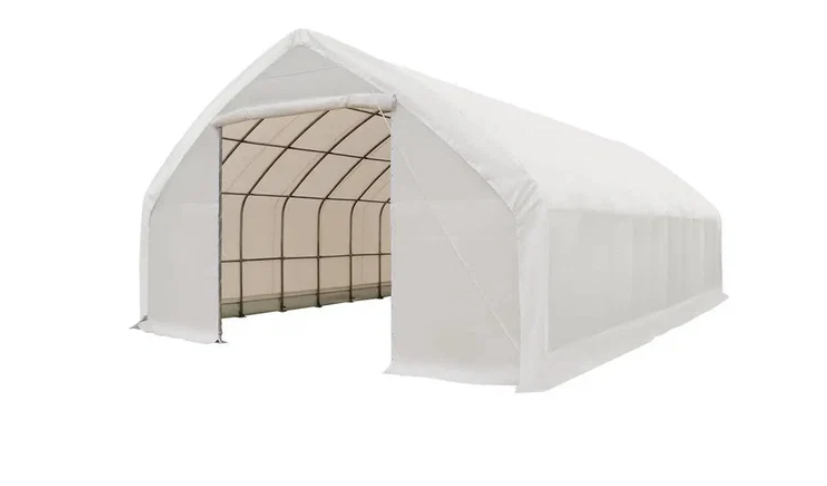
A straight wall design carries full height right up to the point where the roof begins. Pallets go hard against the wall, shelving sits flat, and a machine can be parked with its mirrors close to the fabric rather than a couple of metres clear of it.
The difference is not subtle over a floor of this size. A storage shelter fifteen metres long gains most of a usable aisle down each side simply by standing its walls upright, which is why the format has spread quickly through farm and contractor yards.
Thirty by fifty feet is a layout question before it is a size
A storage shelter of roughly nine metres by fifteen metres sounds generous until machinery is drawn onto it. A tractor carrying a front loader, a sprayer with folded booms, and a header front on a trailer all use the length rather than the width, so the long axis runs with the traffic.
Parking nose to tail down one side and keeping the other clear for access is the arrangement most operators settle on. Upright walls are what make that work, because the clear side stays genuinely clear instead of narrowing towards the ground on both flanks.
Fire retardant fabric matters where the fire risk is real
Across much of rural Australia a building of this kind stands in a landscape that burns. Fire retardant fabric does not make a structure fireproof, but it will not sustain a flame on its own once the source is taken away, which is the difference between a spark and a total loss.
Embers carried ahead of a front are the usual ignition source rather than direct flame. A grower in the Riverina keeps the ground around his building mown and bare for several metres, because the fabric specification only helps when there is nothing burning against it.
Simple practices that keep a storage shelter doing its job
- Keep the perimeter mown and clear of fuel
- Check anchors after the first heavy blow
- Store fuel and chemicals in a separate building
- Leave a clear exit at both ends
Where a straight wall span wins and where it does not
- Strength: usable floor from wall to wall
- Strength: erected in days, not building seasons
- Limit: fabric is not an insulated permanent shed
- Limit: needs anchoring suited to the ground
Compared with a steel shed on the same footprint, a fabric storage shelter gives up insulation and lockable security, and returns covered space at a fraction of the cost without a lengthy build. For machinery that mainly needs to be out of the weather, that exchange is straightforward.
Covered space is being judged by usable area rather than footprint
Buyers across Australian agriculture have started comparing buildings on the floor they can actually stack rather than the dimensions written on a quote. Wall shape has moved from a styling detail to a purchasing criterion, and suppliers have answered with more vertical sided designs.
That shift shows in the fabric buildings TMG Industrial supplies to Australian farms and contractors, where usable width is treated as the specification that counts.





